Early Modern · 1500 - 1800
Clothing Around the World circa 1500
Four selected comparisons near 1500: a portrait, a court garment analysis, a rank badge, and a surviving tunic. Follow what each kind of evidence can tell us.
By Dan Schnau · Last updated
Clothing near 1500 can be compared through very different evidence: Italian portraits show worn arrangements, Ottoman textile analysis identifies dyes, Ming insignia express official rank, and Andean tunics preserve their construction.1,2,3,4 This is a selection of four cases, not a complete map of world dress or four equivalent everyday outfits.
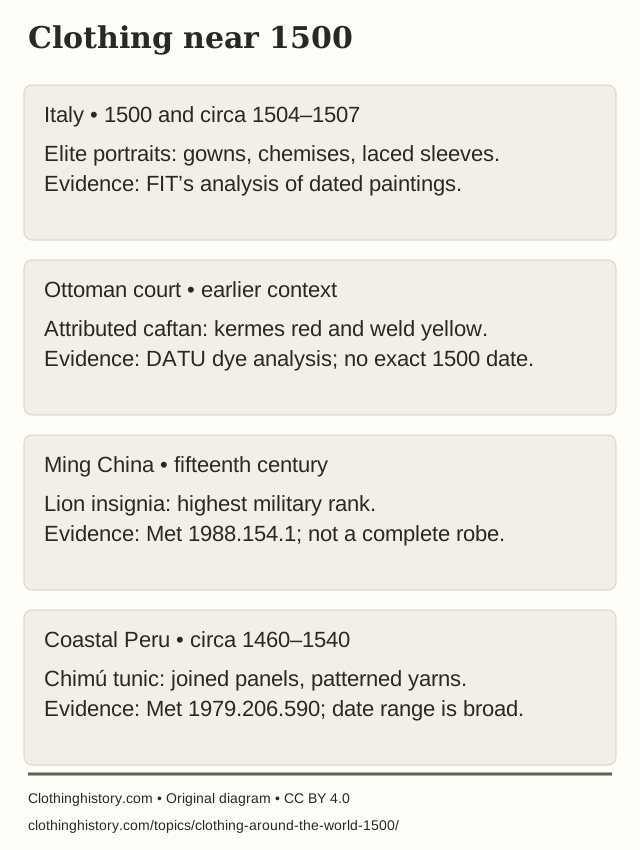
Download the printable PNG comparison. Suggested credit: “Clothing around 1500, Clothinghistory.com, CC BY 4.0,” with a link to this page. Print this page for the full source list.
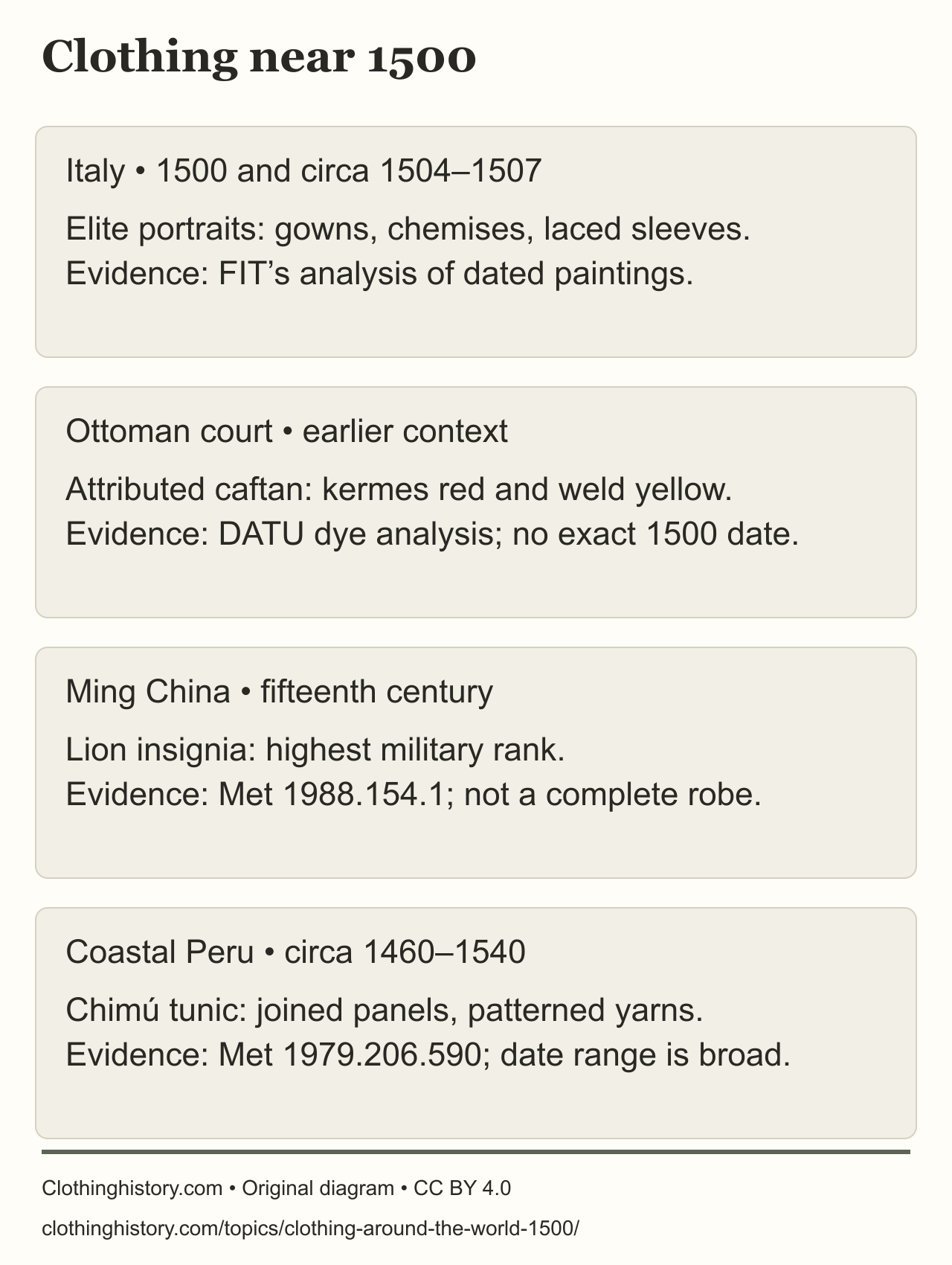
Read the dates before comparing
The preferred focus is approximately 1475–1525. Some objects have broader dates; one example below provides earlier fifteenth-century context. Those limits matter. A textile dated 1460–1540 cannot be assigned to the year 1500, and a badge dated only to the fifteenth century does not demonstrate an exact turn-of-century outfit.3,4
| Setting | Evidence and date | What is being compared |
|---|---|---|
| Italy | Painted portraits, 1500 and ca. 1504–1507.1 | Elite women's worn layers and sleeve attachments. |
| Ottoman court | Caftan attributed to Mehmed the Conqueror; earlier context, not an object dated exactly to 1500.2 | Laboratory identification of red and yellow dyestuffs. |
| Ming China | Surviving lion rank badge, fifteenth century.3 | Official insignia; the badge is not a complete robe. |
| Coastal Peru | Late Chimú tunic, ca. 1460–1540.4 | A surviving garment's structure and patterned yarns. |
Italy through portraits
FIT's Fashion History Timeline discusses Bernardino Zaganelli's Portrait of a Lady, dated 1500, and Raphael's portrait of Maddalena Doni, dated about 1504–1507. Its account identifies gowns worn above the natural waist and sleeves attached with lacing, with the white chemise visible at openings. Jewelry and carefully dressed hair belong to these elite portrayals too.1
Here the source is an image of a wearer. It helps explain the relationship between layers, but it does not preserve a dress's hidden seams or establish the wardrobe of an agricultural worker. The useful comparison is the arrangement the painter represented, with the sitter's status kept in view.
Continue with early modern European clothing and the illustrated kirtle explanation for an earlier layering comparison.
Ottoman court dress through dye analysis
DATU's conservation account reports analysis of a Topkapı Palace caftan attributed to Mehmed the Conqueror, inventory 13/6. It identifies Ararat kermes as a red dyestuff and weld as a yellow one, and says that the analysis supports the art-historical dating.2
This is earlier court context for the comparison, not a caftan independently dated to precisely 1500. The evidence is particularly useful for a question portraits cannot settle on their own: what produced a textile's color? It does not provide a basis for drawing an entire wardrobe for every Ottoman subject.
Explore Ottoman clothing for a broader history and early modern Middle Eastern clothing for regional comparisons.
Ming China through a badge of rank
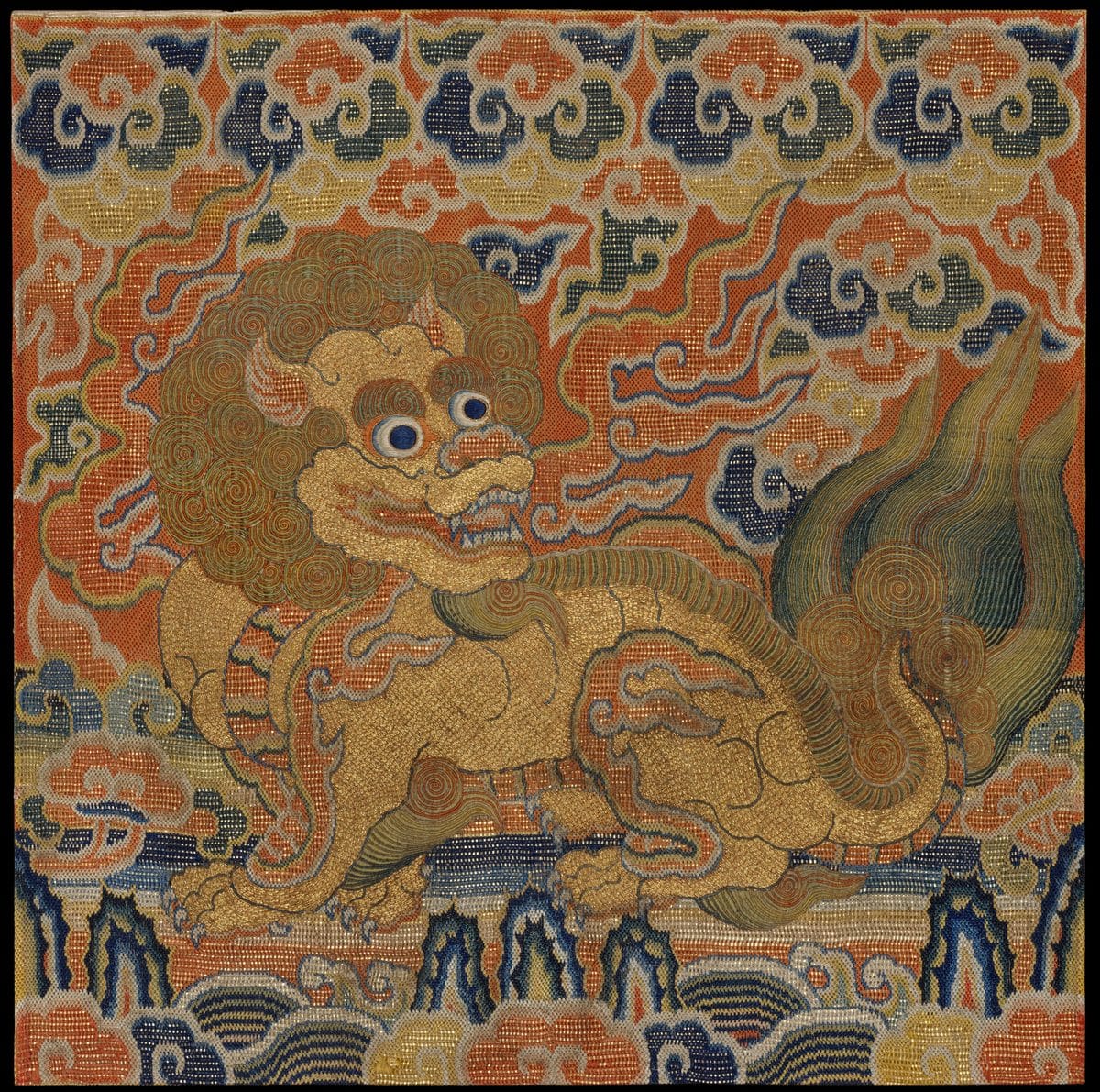
The Met dates this badge to the fifteenth century. Its account explains that officials' audience robes bore rank insignia: birds for civil officials and quadrupeds for military officials. The lion on this example signifies the highest military rank.3
The surviving piece is silk and metallic-thread embroidery on silk gauze, not an intact official's outfit.3 Its date is broader than the preferred comparison window and may be earlier. It supplies Ming context without being forced into an exact 1500 date. For the changing system and its later differences, see Chinese rank badges.
Coastal Peru through a surviving tunic
The Met's Tunic with Crescent Headdress Figures is classified as Chimú and dated about 1460–1540. It consists of two panels joined down the middle with an opening left for the neck. Colored camelid-hair yarn covers a brown cotton ground, and its lower edge carries fringe.4
This example lets us compare actual garment construction with the worn arrangements represented in Italy. The figures woven into the tunic also have their own dress and headgear; those motifs are a different layer of evidence from the tunic that carries them. The museum discusses them as markers of authority and possible identities rather than identifying one known owner.4
This is a coastal Chimú example, not a substitute for every Andean tradition. Compare Inca clothing and medieval clothing in the Americas to explore that wider setting.
What the comparison shows
Ask the same questions of each case: Is there a surviving garment? Is a wearer represented? How precise is the date? Does the evidence describe an official or court context, or ordinary work? Which material details have actually been identified?
The answers vary. Keeping that variation visible is more informative than arranging four speculative figures in matching poses. The selection does not cover South Asia or Sub-Saharan Africa; follow the South Asia and Sub-Saharan Africa guides for their histories, and use the timeline to compare changes across periods.
Classroom activity
Teach this comparison with Investigating Clothing Around 1500, a complete 50-minute lesson for grades 9–10 with source cards, student worksheets, teacher answers, and a rubric.
Sources
- 1500–1509 — Fashion History Timeline, Fashion Institute of Technology (Italian portraits, dates, and women's dress).
- Topkapı Palace Museum dye analysis — DATU, Turkish Cultural Foundation (caftan 13/6 and dyestuffs).
- Rank Badge with Lion — Metropolitan Museum of Art, 1988.154.1 (date, materials, and rank).
Return to text (6 references)
Reference 1 Reference 2 Reference 3 Reference 4 Reference 5 Reference 6 - Tunic with Crescent Headdress Figures — Joanne Pillsbury and Christine Giuntini, Metropolitan Museum of Art, 1979.206.590 (date, construction, and motifs).
Return to text (6 references)
Reference 1 Reference 2 Reference 3 Reference 4 Reference 5 Reference 6