The kirtle was the fitted dress worn by European women over the chemise in the later Middle Ages. Lourdes Font of the Fashion Institute of Technology describes it as "the côte-hardie (English kirtle, Italian cotta)," tightly fitted through the bodice with a full skirt, and in the 1430s names it as kirtle in England, côte-hardie in Burgundy and France, and cotta or gamurra in Italy.1,2
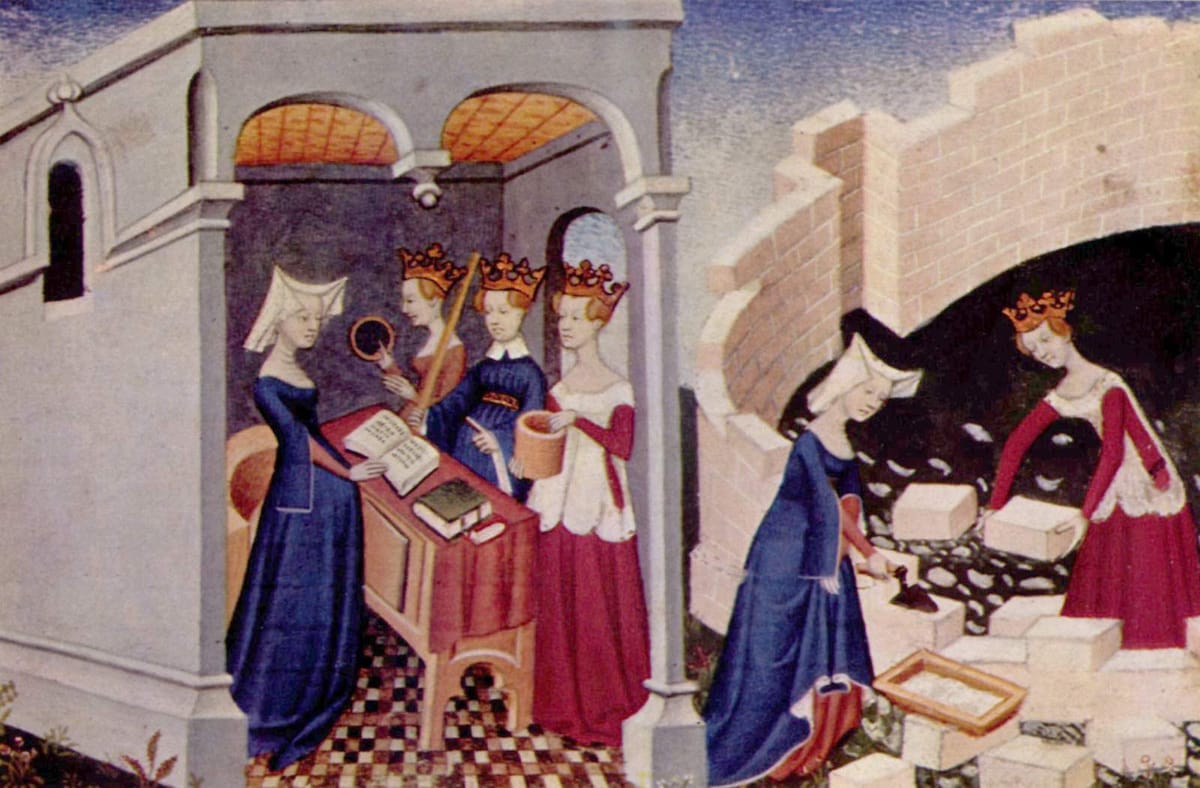
Building the City of Ladies, miniature from Christine de Pizan's Le Livre de la Cité des Dames, Master of the Cité des Dames, Paris, about 1400–1410. Bibliothèque nationale de France, MS fr. 607, fol. 2. Wikimedia Commons, Public Domain.

How It Was Worn
In the decade 1400–1409 the côte-hardie could lace at the front, at one or both sides, or at the center back.1 Its sleeves were usually fitted and laced at the wrist.1 In the miniature above, Font identifies the queen as wearing an ermine-trimmed sideless surcote over a côte-hardie of the kind Isabeau de Bavière wore at court ceremonies.1
Materials and Decoration
Wool was the usual fabric, in a wide range of qualities, with silk reserved for the very rich and silk-wool blends as a cheaper option.1 The dress was lined in linen "to prolong the life of the garment and achieve a smooth, close fit."2
The Term Today
By the 1580s the English word had shifted. Sarah Bochicchio describes a woman's layers as a smock and stockings, then a bodice and "a kirtle (or skirt)," its shape determined by the farthingale beneath it, and quotes Philip Stubbes: "yet they must have kirtles—for so they call them—of silk, velvet, grograin, taffeta."3
On This Site
- Medieval European clothing and the layering of chemise, kirtle, and surcote
- Early modern European clothing and the kirtle of the 1580s
Sources
- 1400–1409 — Lourdes Font, Fashion History Timeline, Fashion Institute of Technology, 2019, updated 2025 (names, fit, lacing, sleeves, materials, and the Cité des Dames miniature).
- 1430–1439 — Lourdes Font, Fashion History Timeline, Fashion Institute of Technology, 2021, updated 2025 (regional names and linen lining).
- 1580–1589 — Sarah Bochicchio, Fashion History Timeline, Fashion Institute of Technology, 2019, updated 2020 (the kirtle as skirt, the farthingale, and the Stubbes quotation).Reference 1