Inquiry: What can surviving clothing and accounts of portraits tell us about dress around 1500, and which conclusions would need more evidence?
Use your browser’s print command for the student packet, or choose “Save as PDF” in the print dialog. The buttons select other print options. Read the cards online and answer on paper or in your classroom document.
Teacher guide
Investigating Clothing Around 1500
Grades 9–10 · 50 minutes · Preparation about 10 minutes. Materials: paper and pencils; a projector is optional. Print one three-card set per pair and the two response sheets per student. For 30 students, prepare 15 card sets and 30 response sets. All readings needed for the task are below.
The student printout includes five activity pages and a shared references page. Share the references with the card sets.
Inquiry: What can surviving clothing and accounts of portraits tell us about dress around 1500, and which conclusions would need more evidence?
Students will distinguish observation from interpretation, qualify comparisons using dates and source types, cite two cards, and identify a question needing further evidence. The analysis approach draws on Library of Congress guidance.4 The evidence task supports CCSS RH.9-10.1, including attention to date and origin.5
Read the answer guide first. Introduce Italy, China, and coastal Peru as selected settings. Explain that an artifact is an object made or used by people; a portrait represents a person; an inference is a reasoned interpretation; and circa means approximately. In these cards, an insignia communicates rank and a tunic is a garment with a neck opening.2,3
Teaching sequence
- 0–5 minutes
- Show card B. Ask students to separate a visible detail from information that needs its label. Students record a detail and a question.
- 5–10 minutes
- Model card A. Identify its modern author and the older paintings discussed. Ask what the account supports and what remains unknown.
- 10–25 minutes
- Pairs examine B and C and complete the organizer. Swap reader and recorder roles. Ask where each fact comes from.
- 25–33 minutes
- Discuss the dates and compare the objects. Pairs revise the overgeneralized statement on response sheet 2.
- 33–45 minutes
- Students independently write their argument using two cards. Refer to the rubric; offer sentence starters.
- 45–50 minutes
- Students complete the exit ticket. Collect the response sheets and discuss one misunderstanding.
Discussion prompts: “Where did that fact come from?” “Does the date allow that conclusion?” “What additional evidence would help?” Accept different interpretations when students connect them to evidence.
Adapt the lesson
Reading support: read A aloud and use B and C for independent work. Offer the sentence starters on response sheet 2. Accept six sentences or an oral argument addressing the same rubric. Image descriptions accompany both objects; color identification is unnecessary.
Advanced: follow one museum link, identify information absent from the card, and explain whether it changes the argument. For a second period, check a claim in the parent comparison article against its source and revise the response.
35-minute option: hook and model, 8 minutes; pair analysis and comparison, 12; argument, 12; exit ticket, 3. Discuss specific evidence without asking students to dress up as a cultural group.
Source cards
Investigating Clothing Around 1500 · Card A
An account of Italian portraits
Place: Italy
Historical date: 1500 and approximately 1504–1507
Evidence: Modern scholarly account of historical paintings
Fashion historian Justine De Young discusses two Italian portraits: Zaganelli’s Portrait of a Lady, dated 1500, and Raphael’s Maddalena Doni, dated about 1504–1507. She describes gowns with sleeves tied to the bodice and a white chemise, an undergarment, showing through openings. The account also draws attention to jewelry and dressed hair. These painted arrangements provide evidence for the dress represented by the artists. Here you are reading a modern explanation of the paintings, rather than inspecting either painting yourself. Think about which questions this kind of account can answer.1
Original classroom paraphrase of Justine De Young, FIT Fashion History Timeline, published 2019, updated 2020. Historical dates refer to the paintings. Read the account.
Consider: What does this source support? Which facts come from its modern explanation? What would you need another source to establish?
Words to use
Artifact: an object made or used by people. Portrait: a representation of a person. Inference: an interpretation supported by evidence. Circa: approximately. Insignia: a sign of rank in card B. Tunic: the garment with a neck opening in card C.2,3
The History of Clothing · clothinghistory.com/lessons/clothing-around-1500/ · Original activity text CC BY 4.0; image credits above.
Investigating Clothing Around 1500 · Card B
Rank Badge with Lion
Place: China, Ming dynasty
Historical date: Fifteenth century
Evidence: Photograph of a surviving badge with modern museum context
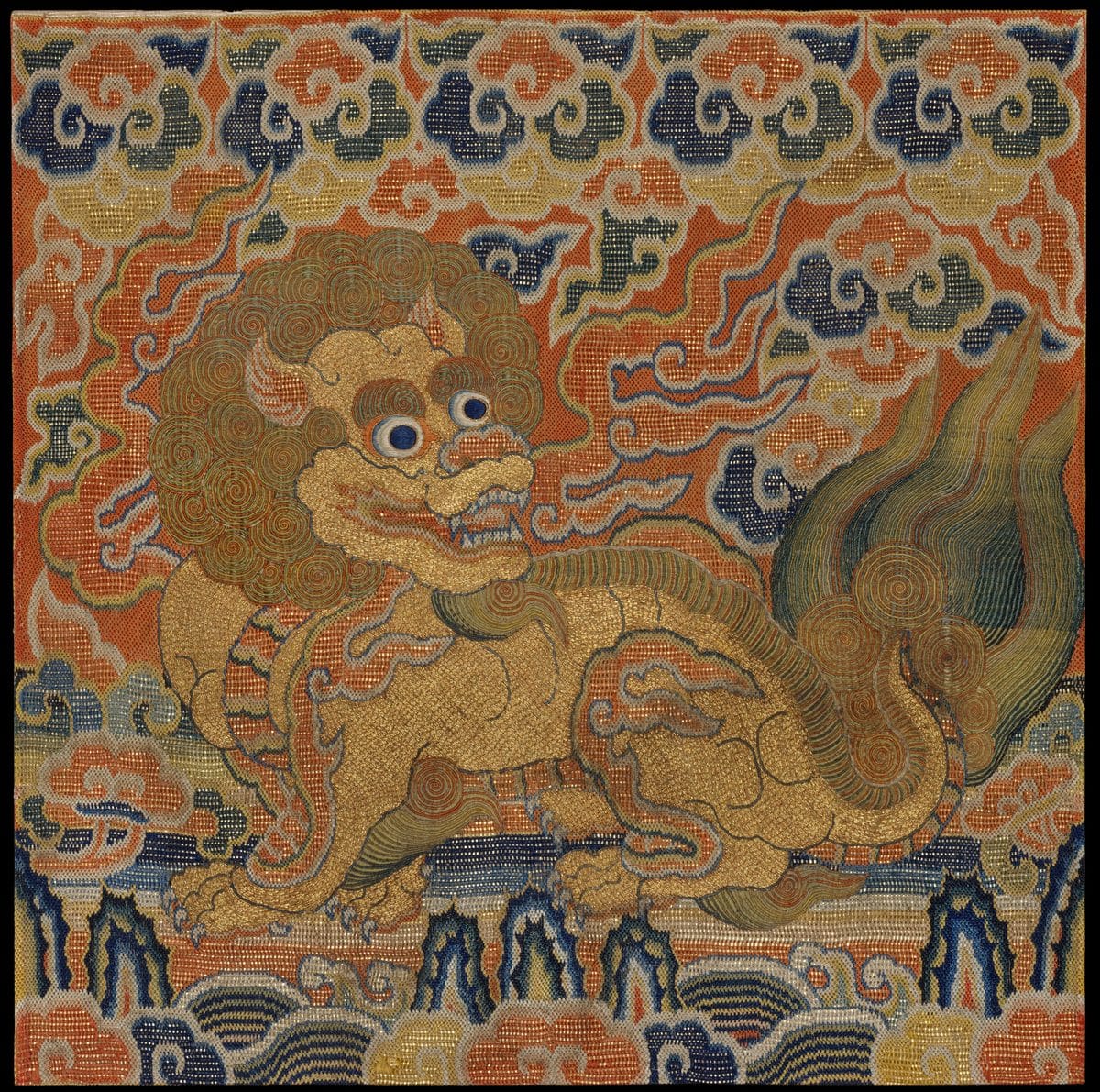
The Met identifies this textile as silk and metallic-thread embroidery on silk gauze. Its catalog explains that badges on officials’ audience robes communicated rank. The lion on this example indicated the highest military rank. The surviving badge is only one part of an outfit. Its catalog date covers a century; it does not give a precise year of use.2
Consider: What does this source support? Which facts come from its modern explanation? What would you need another source to establish?
The History of Clothing · clothinghistory.com/lessons/clothing-around-1500/ · Original activity text CC BY 4.0; image credits above.
Investigating Clothing Around 1500 · Card C
Tunic with Crescent Headdress Figures
Place: Peru, Chimú
Historical date: Approximately 1460–1540
Evidence: Photograph of a surviving garment with modern museum context
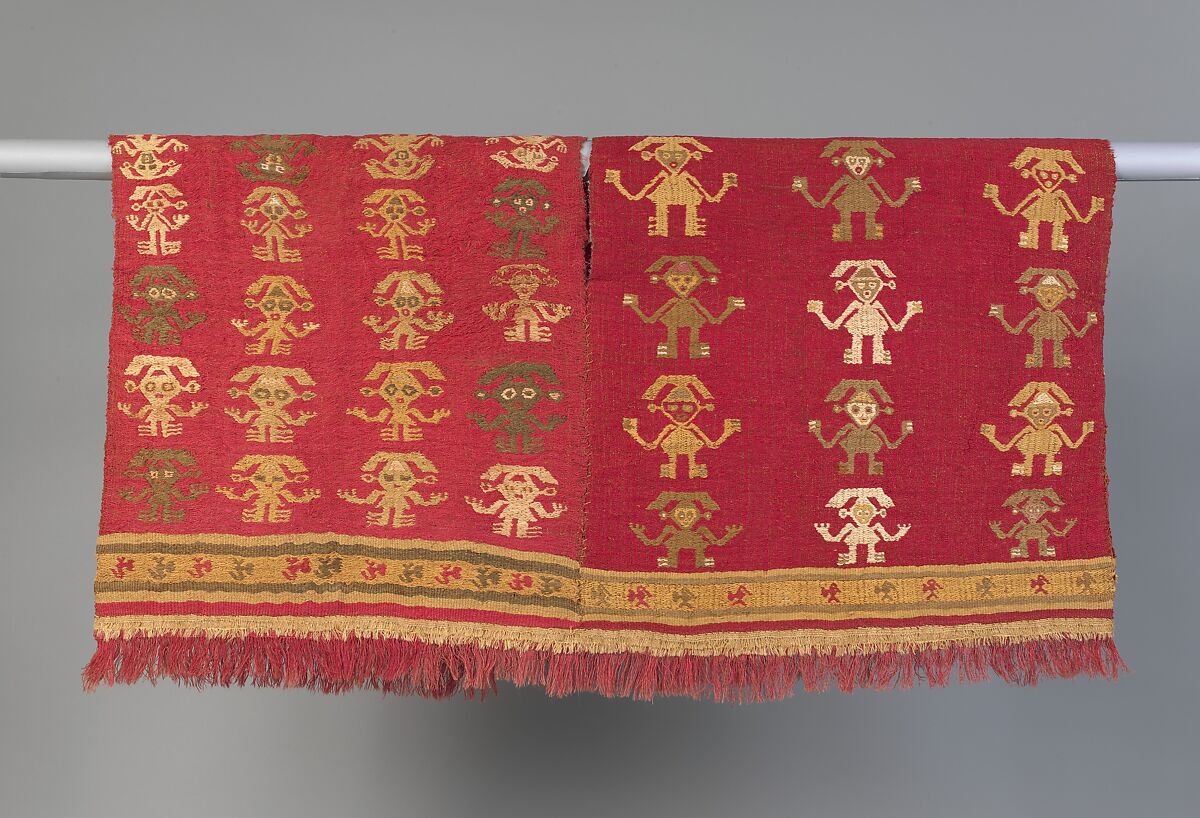
The museum describes two woven panels joined at the center, leaving a neck opening. Camelid-hair yarns cover a cotton ground. Repeating figures decorate the garment. The tunic itself and the figures represented on it are different kinds of evidence: a design is not another surviving outfit. The record gives a date range rather than one year and does not identify a particular wearer.3
Consider: What does this source support? Which facts come from its modern explanation? What would you need another source to establish?
The History of Clothing · clothinghistory.com/lessons/clothing-around-1500/ · Original activity text CC BY 4.0; image credits above.
Response sheet 1
Name _________________________ Date ______________
1. Identify the evidence. Record place, historical date, and kind of evidence for A, B, and C. For A, also name the modern author and older works discussed.
Card A:
Card B:
Card C:
2. Observe and interpret. For each object, identify two visible details, one fact from the catalog context, one supported inference, and one remaining question. Label where each statement comes from.
Card B — visible details / catalog fact / inference / question:
Card C — visible details / catalog fact / inference / question:
The History of Clothing · clothinghistory.com/lessons/clothing-around-1500/ · Original activity text CC BY 4.0
Response sheet 2
Name _________________________ Date ______________
3. Read the dates. Can all three cards establish what someone wore in exactly 1500? Explain using at least two dates or ranges.
4. Compare usefulness. Which card best helps investigate garment construction? Which explains an official insignia? Explain your choices.
5. Repair a claim. Revise: “These examples show what everyone around the world wore in 1500.”
6. Make an argument. What can surviving clothing and accounts of portraits tell us about dress around 1500, and which conclusions would need more evidence? Write 100–150 words with two specific details from at least two cards. Explain their relevance and a limit. Cite card letters.
Try: “Card __ supports… because…” “The image shows…” “The catalog explains…” “This suggests…, but cannot establish…”
7. Exit ticket. Give one supported conclusion, one unanswered question, and a kind of evidence that could help answer it.
The History of Clothing · clothinghistory.com/lessons/clothing-around-1500/ · Original activity text CC BY 4.0
Teacher answer guide and rubric
Suggested answers
Accept equivalent wording and defensible alternatives. Card letters identify evidence within the packet; numbered references lead to full sources. These notes also connect to the parent article’s Italy, Ming China, and coastal Peru sections.
- Identification: A: Italy; 1500 and ca. 1504–1507; De Young’s modern account of portraits by Zaganelli and Raphael. B: Ming China; fifteenth century; badge photograph plus catalog. C: Chimú, Peru; ca. 1460–1540; tunic photograph plus catalog.1,2,3
- Observation: accept visible shapes, patterns, and borders. Separate those observations from material identification or social meaning supplied by the record. A possible inference should explain its evidence; a claim naming an owner without evidence is insufficient.2,3
- Dates: no. B covers a century; C spans decades. Neither proves use in the exact year 1500. A describes paintings with their own dates.1,2,3
- Usefulness: C and its catalog support a construction question; B and its catalog explain official insignia. A supports discussion of represented layers.1,2,3
- Revision: “These selected examples provide evidence about particular settings near this period; they cannot describe everyone’s clothing.” Explain that dates, social coverage, and evidence types differ.
- Argument: assess the claim, evidence, explanation, and limit using the rubric below. Different conclusions can earn full credit when adequately supported.
- Exit: for example, a question about clothing worn for ordinary work could lead to dated occupational accounts or depictions from the same setting. The proposed source needs a clear connection to the question.
Common errors to discuss
A museum’s modern explanation is not itself the ancient object. A photograph alone cannot establish a fiber identification or symbolic meaning. A catalog range does not identify a single year. These examples cannot represent every social group.
Example argument
The cards offer different ways to investigate clothing, but the answers depend on the evidence supplied. Card A describes sleeves tied to a gown’s bodice in portraits. Card C describes a tunic assembled from two joined panels. One account helps explain represented layers; the other helps investigate construction. Comparing these source types helps us choose evidence suited to a question. Yet these cards cannot show a universal wardrobe for 1500: their dates and settings differ, and an account of a painting answers different questions from an object record. I would seek more dated evidence about particular wearers before making claims about everyday clothing.
Worked score: 8/8. Claim 2; evidence 2 (A’s represented layers and C’s construction); explanation 2 (matches evidence to question); limits 2 (dates and coverage). The factual examples derive from A and C.1,3
Weaker response: “Everyone wore fancy clothing in 1500 because these examples are decorated.” Revision: identify two cards, explain what their details establish, and limit the conclusion to the represented examples. Decoration alone does not establish universal use. This response earns 0/8 as written: no bounded claim, specific attributed details, supported connection, or explained limit.
Assessment rubric
Score each criterion 0–2, for a total of eight. Use the organizer and exit ticket to see where students need practice.
Claim
2: Direct answer with an appropriately limited conclusion. 1: Relevant but vague or partly overgeneralized. 0: Missing or unsupported conclusion.
Evidence
2: Two accurate details from at least two identified cards. 1: One usable detail or unclear attribution. 0: No usable evidence.
Explanation
2: Explains how details support the claim. 1: Connection only partly explained. 0: No connection to the claim.
Limits
2: Explains a relevant limit and its effect. 1: Names a limit without explaining it. 0: Treats examples as exact or universal.
A planning indicator is six points with two for evidence. Teachers may choose their own grading policy.
After teaching
Note preparation time, completion, unclear prompts, print issues, and which rubric criteria need support. Revise the activity based on the class’s needs.
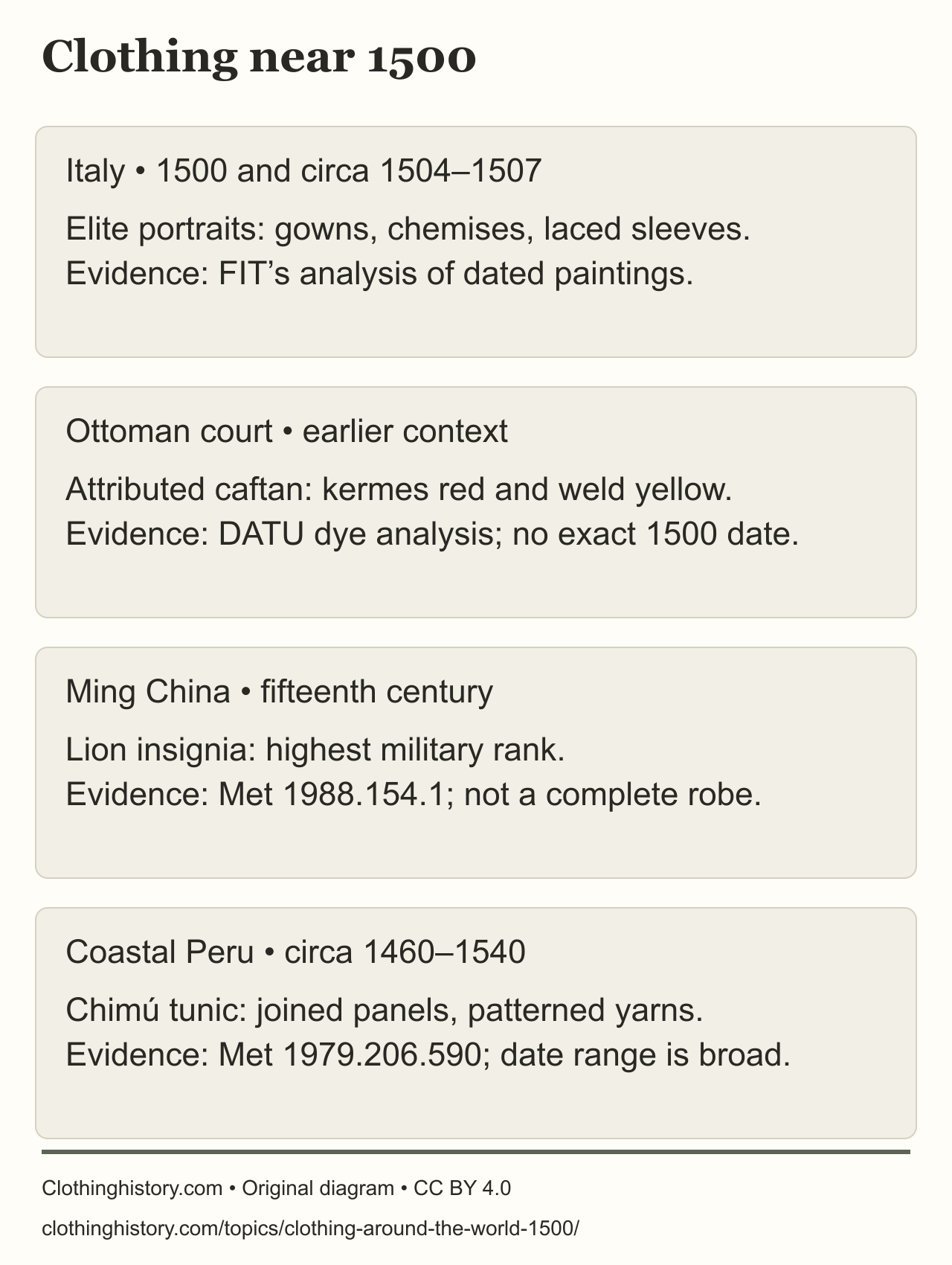
For a recap, see the four-case comparison graphic with its qualifications in the full article. Continue with Chinese rank badges.
Sources
- 1500–1509 — Justine De Young, FIT Fashion History Timeline, 2019, updated 2020. Italian womenswear discussion and figures 4–5.
- Rank Badge with Lion — Metropolitan Museum of Art, 1988.154.1. Date, material, rank interpretation, and public-domain image.
Return to text (7 references)
Reference 1 Reference 2 Reference 3 Reference 4 Reference 5 Reference 6 Reference 7 - Tunic with Crescent Headdress Figures — Metropolitan Museum of Art, 1979.206.590. Joanne Pillsbury and Christine Giuntini, 2018. Date, construction, and public-domain image.
Return to text (8 references)
Reference 1 Reference 2 Reference 3 Reference 4 Reference 5 Reference 6 Reference 7 Reference 8 - Using the Reflect Column to Develop Critical Thinking — Library of Congress, Anne Savage, 2012. Observation and inference teaching approach.Reference 1
- History and Social Studies Grades 9–10 — Common Core State Standards Initiative. RH.9-10.1: source evidence, date, and origin.Reference 1
Original activity text © 2026 The History of Clothing, CC BY 4.0. Credit this lesson and its page address when sharing. Museum images retain the public-domain status and credits on their cards. Scholarly and catalog explanations are paraphrased with attribution; their original text has its own rights.