Early Modern · East Asia · 1500 - 1800
Chinese Rank Badges: Reading Ming and Qing Official Clothing
A guide to the square insignia on Chinese officials' clothing, using dated museum objects to explain materials, placement, and changing rank symbols.
By Dan Schnau · Last updated
Chinese rank badges, also called mandarin squares, were textile insignia attached to officials' robes.1,2 Birds indicated civil ranks and animals indicated military ranks. The system continued across the Ming and Qing dynasties, but the meaning of a particular animal could change: the Metropolitan Museum identifies a tiger with third-rank military office in the Ming and fourth-rank office in the Qing.1
This guide concentrates on insignia rather than every garment worn at court. For the surrounding dress history, see early modern East Asian clothing and nineteenth-century East Asian clothing.
What Was a Mandarin Square?
The Australian Museum describes mandarin squares as woven or embroidered plaques used on Chinese official robes from the early Ming through the end of the Qing. The textile announced an office or rank through an emblem. It was therefore more specific than a general preference for an auspicious bird or animal in decorative cloth.2
A nineteenth-century tiger badge in the V&A makes the placement particularly clear. The museum identifies it as one of a pair for the front and back of a navy-blue surcoat worn during ceremonial and court functions. The surviving separate square is only part of the original dressed appearance.3
Birds and Animals: Why the Dynasty Matters
| Museum example | Date and interpretation |
|---|---|
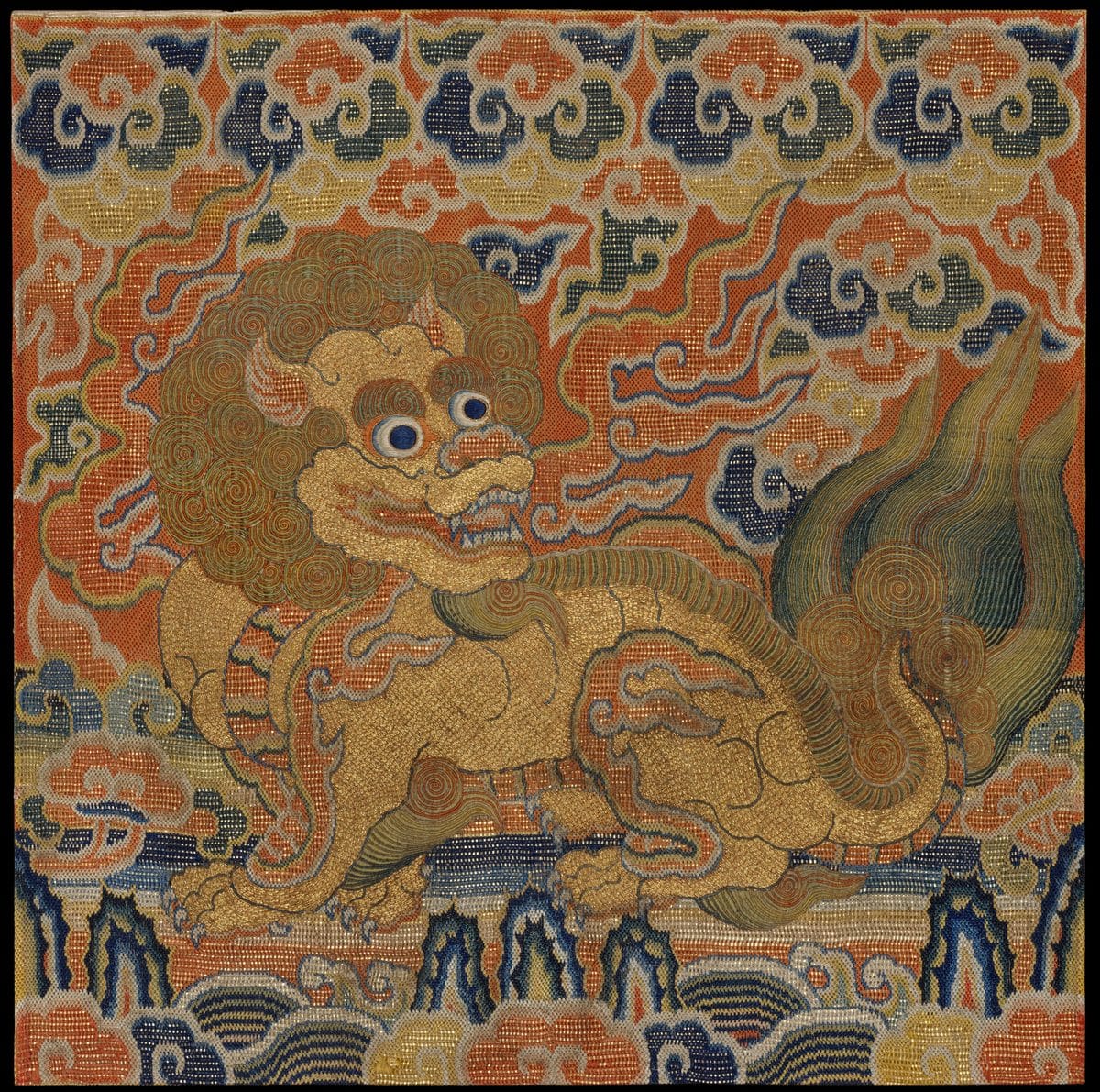
| Lion badge, Met 1988.154.1 | Fifteenth-century Ming example; the museum associates its lion with the highest military rank.4 |
| Tiger badge, Met 36.65.11 | Eighteenth-century Qing example; the museum explains the tiger's change from Ming rank three to Qing rank four.1 |
| Lion pair, V&A T.196&A-1934 | Nineteenth-century badges for a second-rank military official.5 |
| Tiger badge, V&A T.243-1912 | Nineteenth-century badge for a fourth-rank military official.3 |
The comparison is more useful than an undated animal chart. A lion on one museum's Ming badge and a lion on a later Qing pair need not designate the same rank. Record the dynasty and object date before applying an identification.4,5
How Were Badges Made?
The Ming lion badge above combines silk with metallic-thread embroidery on silk gauze. It is a surviving textile, rather than a modern reconstruction from a portrait. Its materials offer a different kind of evidence from painted depictions of officials wearing similar insignia.4
The V&A's nineteenth-century lion pair also uses silk gauze, embroidered with silk and metal threads, chiefly in cross-stitch. The catalogue describes a silver-patterned background and a wave motif below the lion. A rank emblem occupied a designed textile field, rather than appearing alone like a modern printed label.5
The V&A tiger example has a different construction: its record describes a kesi tapestry-woven background with embroidery in seed stitches. It shows a tiger standing on a rock above water, with clouds and bats in the surrounding design. Identifying the animal is consequently only the first step in describing the object.3
Did Officials' Wives Wear Rank Badges?
Yes. The Australian Museum records Qing requirements for officials' wives to wear their husbands' rank insignia from 1652. It describes a later distinction in which the bird on the wife's badge faced the opposite way, so that the birds faced one another when the couple sat together ceremonially. This concerns the representation of a household's status, rather than evidence that the wife held the same government appointment.2
How to Read a Museum Example
Start with the catalogue's dynasty, date, creature, and assigned rank. Then look at technique and placement: a badge might belong to a pair, and its surrounding motifs can be as carefully worked as the central emblem. Finally, compare it with another dated record. The lion and tiger examples here demonstrate both continuity in the system and changes in its specific meanings.1,3,4,5
For a different Korean clothing tradition, explore hanbok history. For another Chinese garment with a changing form and name, continue to qipao history.
Sources
- Rank badge with tiger, 36.65.11 — Metropolitan Museum of Art (eighteenth century; comparison of Ming and Qing rank meanings).
- Mandarin Square — Stan Florek, Australian Museum (textile insignia and officials' wives).
- Rank badge, T.243-1912 — Victoria and Albert Museum (tiger, technique, rank, and placement).
- Rank Badge with Lion, 1988.154.1 — Metropolitan Museum of Art (fifteenth-century Ming example).
- Pair of rank badges, T.196&A-1934 — Victoria and Albert Museum (nineteenth-century lion pair).