Ottoman clothing was the dress of the empire ruled from Istanbul, and for most of its history it was built from layers: wide trousers, a shirt, an inner robe, and one or more kaftans, topped for men by a turban. At court these layers were cut from heavy silks woven with gold and silver. Between 1826 and 1829, Sultan Mahmud II replaced the turban with the fez for his army and then for civil officials, and men adopted a black frock coat called the stambouline.1,2,5
This page follows that story from the early modern court to the nineteenth-century reforms. It explains what survives, who wore what, and why the fez is not as old as it looks.
What Survives, and How We Know
The richest evidence for Ottoman dress is the palace itself. The Topkapı Palace Museum in Istanbul holds clothing ranging from outer gowns to socks, and Sumiyo Okumura counts more than 1,500 varieties of garments there.2 A 2012 report, citing a book by Ahmet Ertuğ, put the collection at around 2,500 garments, stored in thousands of boxes and bundles of fabric.4 The two figures count in different ways, but both describe an unusually large royal wardrobe.
Part of that wardrobe survived because of palace rules. According to the same report, the women of the palace were not allowed to take their palace clothing with them when they left.4 Garments therefore stayed in the institution rather than being passed on and worn out.
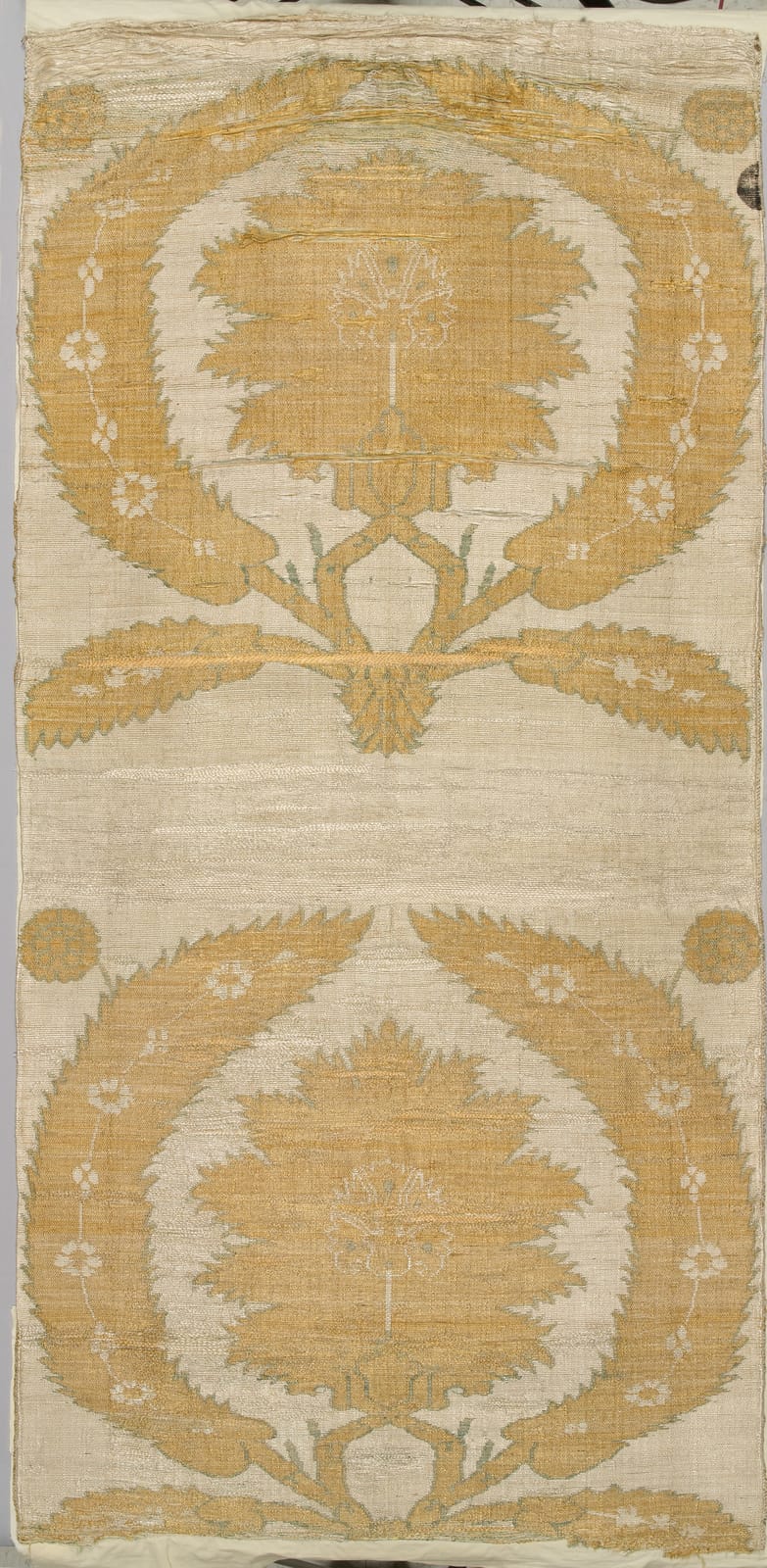
Museums outside Turkey add complete garments and fragments. The Metropolitan Museum of Art holds fragments of a seraser kaftan dated to the second half of the seventeenth or early eighteenth century.9 The Cleveland Museum of Art holds brocaded silk velvets woven in Bursa and in Istanbul or Bursa, one of which was probably used as upholstery for a palace divan.7,8 Painted portraits, albums of costume watercolors, and palace registers fill in how these pieces were combined on the body.2,5,11
This evidence has a strong bias. It records the sultan, his household, and wealthy officials far better than farmers, porters, or provincial villagers. A museum kaftan shows the top of the clothing system, not its average.
Early Modern Court Dress: Layers and Kaftans
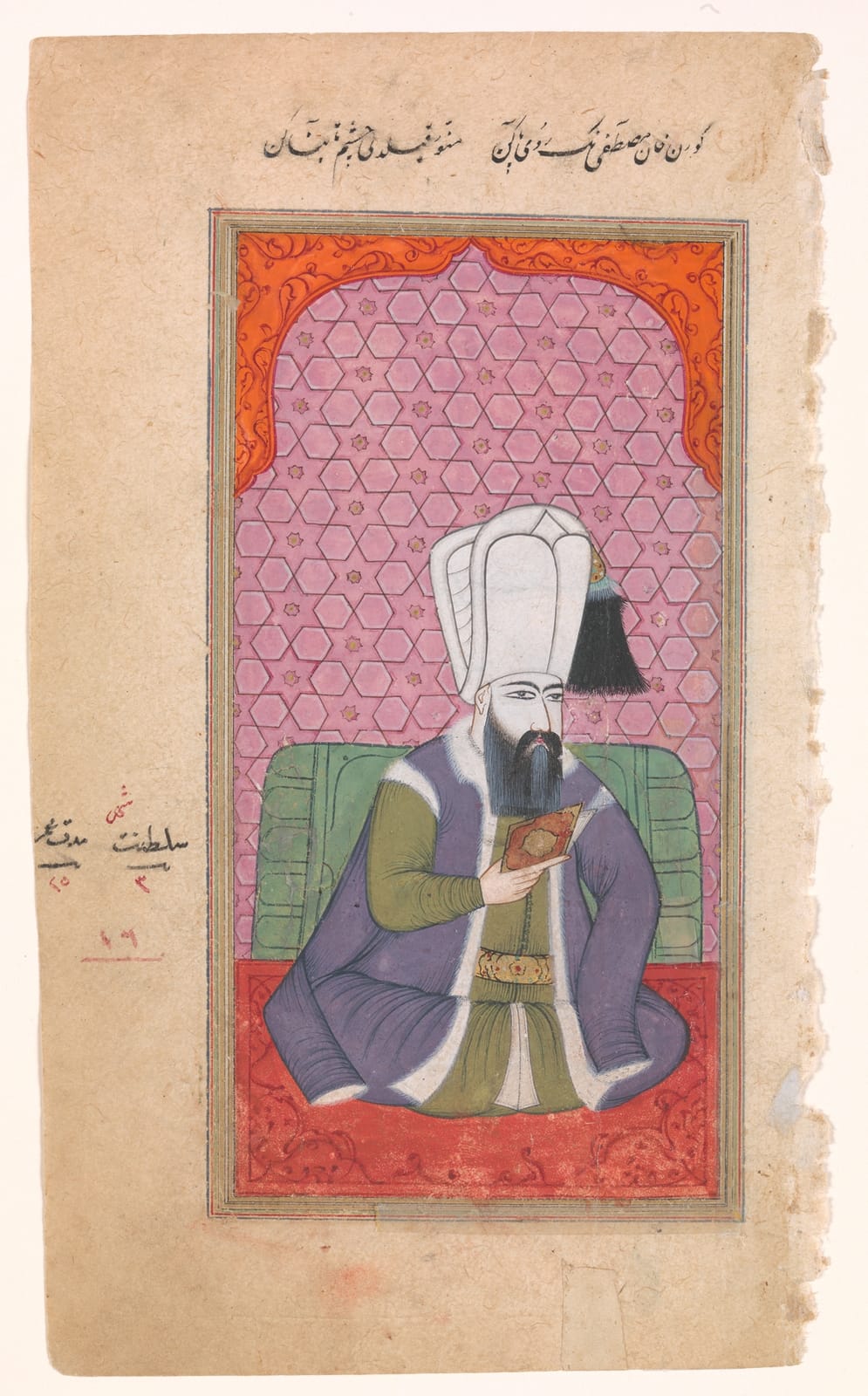
Okumura describes the sultans' daily dress as a short or long kaftan worn over şalvar (trousers) and a shirt or inner robe.2 "Kaftan" was a general term for an outer garment worn over the şalvar, and its length could cover the hips, reach below the knees, or extend to the ankles.2 Kaftan sleeves were sewn to the body without a curved armhole, and the sleeves of inner robes buttoned from elbow to wrist.2
Official occasions called for more layers. A long-sleeved inner robe went under a short-sleeved kaftan of heavier silk, and over both went the kapaniçe, a long fur-lined outer robe with jeweled buttons.2 Okumura notes a treasury register from 1680 that lists bands of jeweled frogging for these fastenings.2 Other outer garments included the ferace, worn by both men and women, and the kaba and cübbe, long gowns with a diagonal front opening.2
Headwear marked identity and status. Early forms included the üsküf, worn by sultans and by the Janissaries, and the sultans wrapped a turban around it when they attended council meetings.2 Later royal headgear included the mücevveze, a cylindrical form wrapped in muslin that appeared under Mehmed II, and the selimi, named after Selim I.2 Before 1829, elaborate codes dictated the style of turban that each class wore.1 A trained eye could read rank from a man's head.
Women's Dress
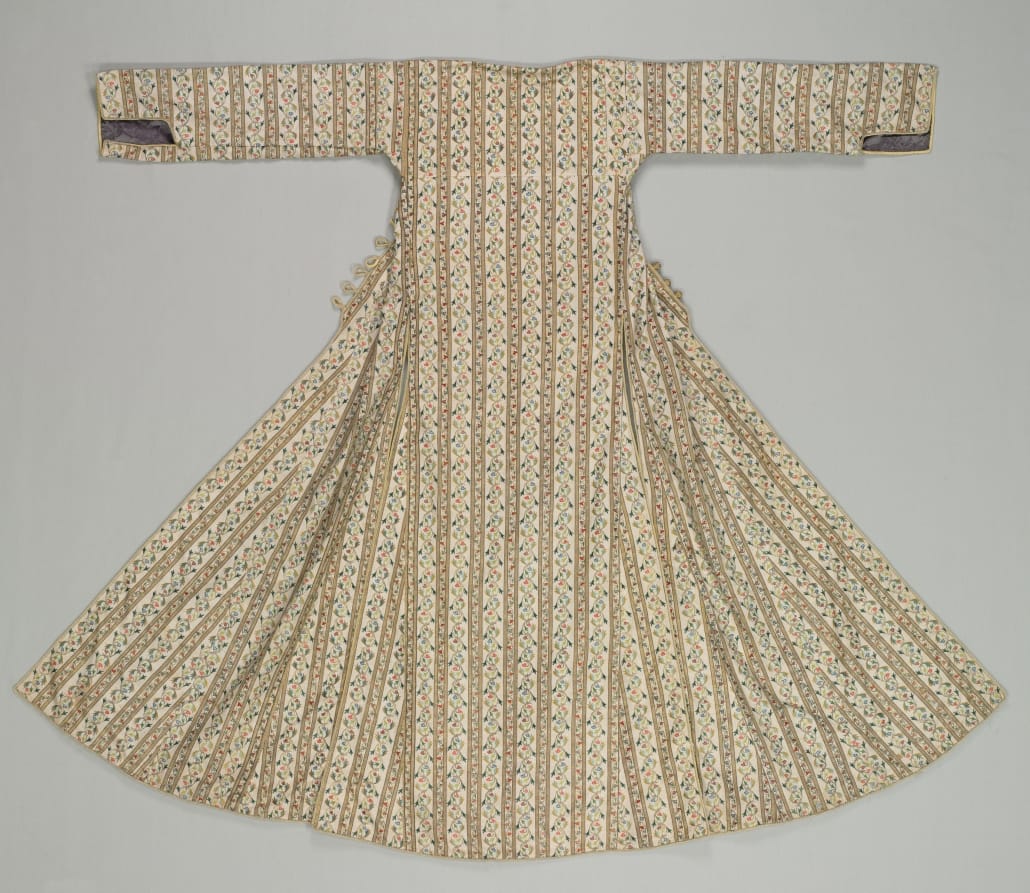
Women's clothing used a similar layered structure, and nineteenth-century garments such as the striped silk robe with chain-stitch embroidery above survive in museum collections.10 Okumura describes very wide, loose şalvar tied at the waist, then a long-sleeved, cream-colored shirt of bürümcük, a raw silk crepe.3 Over the shirt came the inner kaftan, or iç entari, usually a solid color with a U-shaped neckline and long sleeves.3 An outer kaftan with short sleeves and a deep U-shaped neckline went on top, and winter versions were lined with fur.3
Outdoors, women wore the ferace. In the fifteenth century both men and women wore it, but the women's version was slightly more fitted.3 Okumura also names the peçe, worn widely among Turkish women, which appears in many sixteenth-century miniatures.3 Women of the sultan's family wore a diadem called the kaşbastı as an indication of rank, and by the middle of the sixteenth century a flat felt hat with a white scarf wrapped over it had become common headgear.3
Women's dress changed on its own timetable. Okumura dates noticeable Western influence after the seventeenth century, with significant change during the reign of Ahmed III (1703–1730).3 After the 1850s, palace women increasingly ordered Western fabrics and accessories from Europe, and after 1875 traditional costume, in her words, "fell under the dominance of western influence."3
Fabrics, Workshops, and Color
Court dress depended on luxury silk. Okumura lists kemha (brocade), kadife (velvet), çatma (brocaded velvet), seraser (silk with gold and silver threads), and satin, along with lighter silks such as taffeta and a gauze-like fabric called vala.2 Wool broadcloth, mohair, cashmere, and cottons also appear in the palace wardrobe.2 Not all of this cloth was Ottoman. Some came from Italian weaving centers and from Iran, India, and China.2
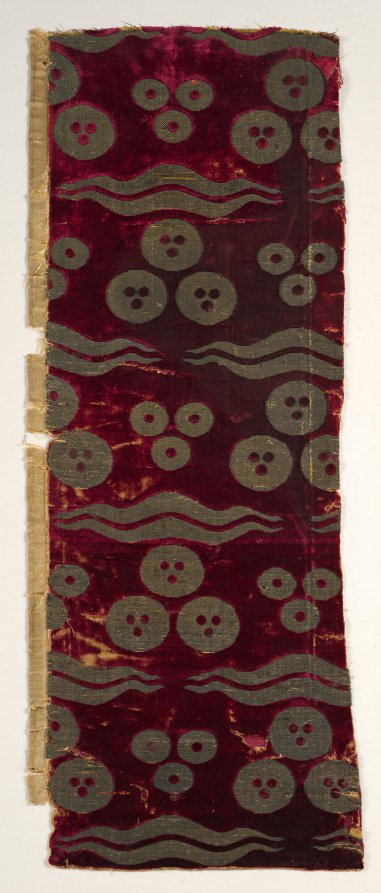
Bursa was a key center of production. The Cleveland Museum of Art describes Bursa as the silk capital and major commercial center of the Ottoman Empire, and its late-fifteenth-century velvet above was woven in an imperial workshop there.8 The museum notes that its crimson silk pile is almost twice as dense as later monochrome velvets.8 The pattern of three balls and paired wavy bands is known as chintamani, a name the museum derives from a Sanskrit word for a Buddhist motif.8
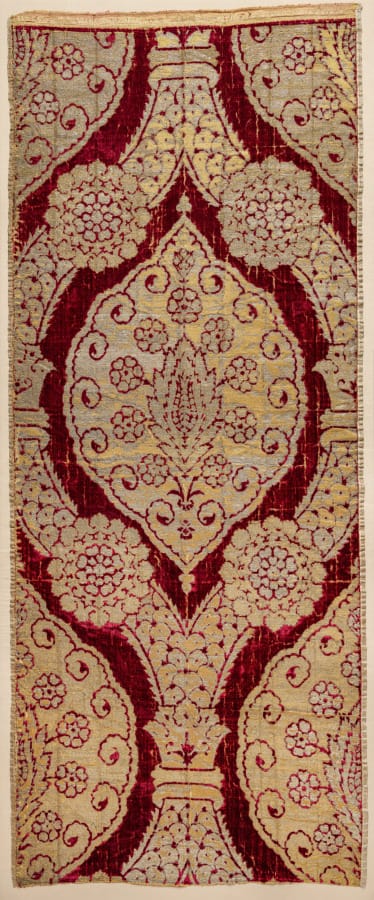
Pattern scale was part of the message. Cleveland describes a late-sixteenth-century velvet as similar to fabrics worn by sultans on ceremonial occasions at Topkapı Palace, and it says such bold patterns symbolized the power and wealth of the empire.7 The design pairs large medallions and lattices, readable from across a room, with small flowers and crowns that could be admired only up close.7
The sources consulted for this page say little about specific dyestuffs, so this page does not name them. What the objects show directly is a palette led by crimson, gold, and silver, the colors of the most expensive cloth.7,8
Dress Laws: Rank, Religion, and Reform
The Ottoman state regulated clothing long before the fez. The 1829 reform is described by the Fashion Institute of Technology as a dramatic change to existing Ottoman sumptuary legislation, and it abolished the turban codes that had told each class what to wear.1 Women's dress was also policed. Okumura records a palace judgment of 1725–1726 warning women about their clothing, and further judgments in 1807 and 1811 that restricted the colors, collars, and headgear women could wear in public.3
Mahmud II changed the direction of these laws. After the destruction of the Janissaries in 1826, an event known as the "Auspicious Incident," he introduced the fez and wore it with European-style military uniform.1 In 1829 he extended the change to civil officials of every rank, and the law applied to Muslims and non-Muslims alike.1 A Qatar National Library album of court costume watercolors from around 1840 summarizes the same decree: it forbade the old-fashioned costumes except for clerics, the headdress became the fez, and men wore the black frock coat known as the stambouline.5 The album also records that Mahmud believed the new costume led to equality for all his citizens.5
The Pera Museum in Istanbul dates the reform to 1828 in its description of a posthumous portrait that shows Mahmud II in a frock coat, trousers, mantle, and fez.6 The different dates reflect a reform that unfolded in stages rather than on a single day.
The sultans' own wardrobes changed too. Okumura writes that half of Mahmud II's garments were traditional and half Western, and that the sultans started to wear the fez instead of turbans.2 Later sultans adjusted its shape. FIT records the mejidiye named for Abdülmejid, the aziziye for Abdülaziz, and a nearly cylindrical fez favored by Abdülhamid II.1
Elite and Ordinary Wearers After the Reform
The fez was adopted most enthusiastically by the new bureaucratic and professional classes.1 Its adoption among ordinary men was slower and less obedient. FIT reports that Muslim artisans wore the fez wrapped in turban-like cloth or rejected it outright.1 By the end of the century the lower classes had adopted the fez, but some still wrapped it in cloth, a style that FIT, citing the historian Donald Quataert, says may have been a form of resistance.1
The new hat also created an industry. Mahmud II and Mehmed Ali of Egypt set up fez factories in Istanbul and Cairo in the late 1820s to supply their new armies, and this pushed Tunisian guild producers into crisis.1 An emblem of Ottoman identity was soon a factory product.
The reform did not lead in a straight line to European dress. In 1877, Abdülhamid II banned the Western brimmed hat.1 The fez itself was outlawed by the Hat Law of November 1925, which stayed on the books until 2014.1
Myths Corrected
Myth: the fez was an ancient Ottoman tradition. It was a recent import. FIT describes it as a red felt skullcap of Moroccan origin that naval officers brought to the sultan's attention from the western Mediterranean, and it was previously largely unknown in Istanbul.1 Its spread in the 1820s was a deliberate policy, which FIT calls "an instrument of social engineering."1
Myth: the Ottomans resisted change in dress until the empire fell. The evidence points the other way. Turban codes were replaced by state decree in 1829, palace women were ordering European fabrics after the 1850s, and the sultans themselves wore Western-style uniforms.1,2,3 The empire changed its clothing repeatedly, sometimes toward Europe and sometimes, as in 1877, away from it.1
For the wider regional picture, see 19th-century Middle Eastern clothing and the earlier court silks in early modern Middle Eastern clothing and Ottoman textile arts.
Quick Answers
What did people wear in the Ottoman Empire?
Men and women both wore layers: wide şalvar trousers, a shirt, an inner robe, and one or more kaftans. Men added a turban until the fez replaced it for officials in 1829, and women wore the ferace outdoors.1,2,3
What is a stambouline coat?
The stambouline was the black frock coat that Ottoman men wore with the fez after Mahmud II's 1829 decree banned the old-fashioned costumes for everyone except clerics.5
When did the Ottomans start wearing the fez?
Mahmud II introduced the fez in 1826, wearing it with European-style military uniform, and extended it to civil officials of every rank in 1829. The Hat Law of 1925 outlawed it.1
Why did Ottoman sultans keep so many clothes?
Garments stayed inside the palace, partly because palace women could not take their palace clothing with them when they left. A 2012 report put the Topkapı collection at around 2,500 garments.4
Sources
- The Fez and the Ottoman Path to Modernity — Emerson Hurley, Fashion History Timeline, Fashion Institute of Technology (SUNY), 2023 (1826 and 1829 reforms, turban codes, Moroccan origin, factories, artisans, 1877 hat ban, 1925 Hat Law).
- Garments of the Ottoman Sultans — Sumiyo Okumura, Turkish Cultural Foundation (Topkapı holdings, kaftan and kapaniçe, headgear, fabrics, Mahmud II's wardrobe).
- Women's Garments — Sumiyo Okumura, Turkish Cultural Foundation (women's layers, bürümcük, peçe, palace judgments of 1725–26, 1807, and 1811, Western influence).
- Topkapı Palace garment collection to be restored — Hürriyet Daily News, 5 September 2012 (around 2,500 garments, storage, palace clothing rule).
- Watercolor drawings of Ottoman costumes — Qatar National Library Digital Repository, album of 91 drawings, about 1840 (1829 decree, clerics exception, fez, stambouline).
- Sultan Mahmud II — Athanasios Karantzolas, Pera Museum, Istanbul, via Google Arts & Culture (1828 dress reform, frock coat, trousers, mantle, and fez).
- Brocaded velvet with medallions in ogival lattice, 2001.3 — Cleveland Museum of Art (ceremonial fabrics at Topkapı, pattern scale).
- Brocaded velvet with chintamani design, 1943.313 — Cleveland Museum of Art (Bursa imperial workshop, pile density, chintamani).
- Kaftan, 2003.416a–e — The Metropolitan Museum of Art, collection API record (date, seraser, credit line).
- Woman's robe, 1916.1466 — Cleveland Museum of Art (nineteenth-century striped and embroidered silk robe).
- Portrait of Sultan Mustafa I, 457787 — The Metropolitan Museum of Art, collection API record (date, medium, credit line).