Early Modern · East Asia · 1500 - 1800
Hanbok History: Korean Jackets, Skirts, Trousers, and Ceremonial Dress
A guide to Korean clothing through garment construction, Joseon dress, wedding and birthday ensembles, and the changing meaning of hanbok.
By Dan Schnau · Last updated
Hanbok means Korean clothing. The V&A explains that the term came into use in the late nineteenth century to distinguish local dress from Western-style clothing. The garments and traditions are older than that name: they changed over time rather than forming one unaltered national costume.1
This page follows the components and uses of hanbok. For broader comparisons, see medieval East Asian clothing and early modern East Asian clothing.
What Are the Main Parts of Hanbok?
| Garment or accessory | Role in the ensembles described by the National Folk Museum |
|---|---|
| Jeogori | An upper garment worn by men and women, with strings at the front.2,3 |
| Chima | A skirt widening toward the bottom and forming folds.2 |
| Baji | Trousers, adjusted at the lower leg with ties called daenim.3 |
| Po | An outer robe; the museum lists dopo, jungchimak, and durumagi among its forms.3 |
| Norigae | An ornament attached at a jacket's strings or a skirt's waist.2 |
The jacket's front strings are called goreum.2 The National Folk Museum also describes separate pouches, or joomeoni, among women's accessories. Details such as these are useful reminders that an ensemble includes its fastenings and carried objects, not only its overall silhouette.2
How Did the Clothing Change?
The V&A traces earlier combinations of upper and lower garments through the Three Kingdoms and Goryeo periods, discussing exchanges with neighboring societies. Its account describes Tang influences and later Mongol influence on Goryeo court clothing. These contacts formed part of a changing Korean dress history.1
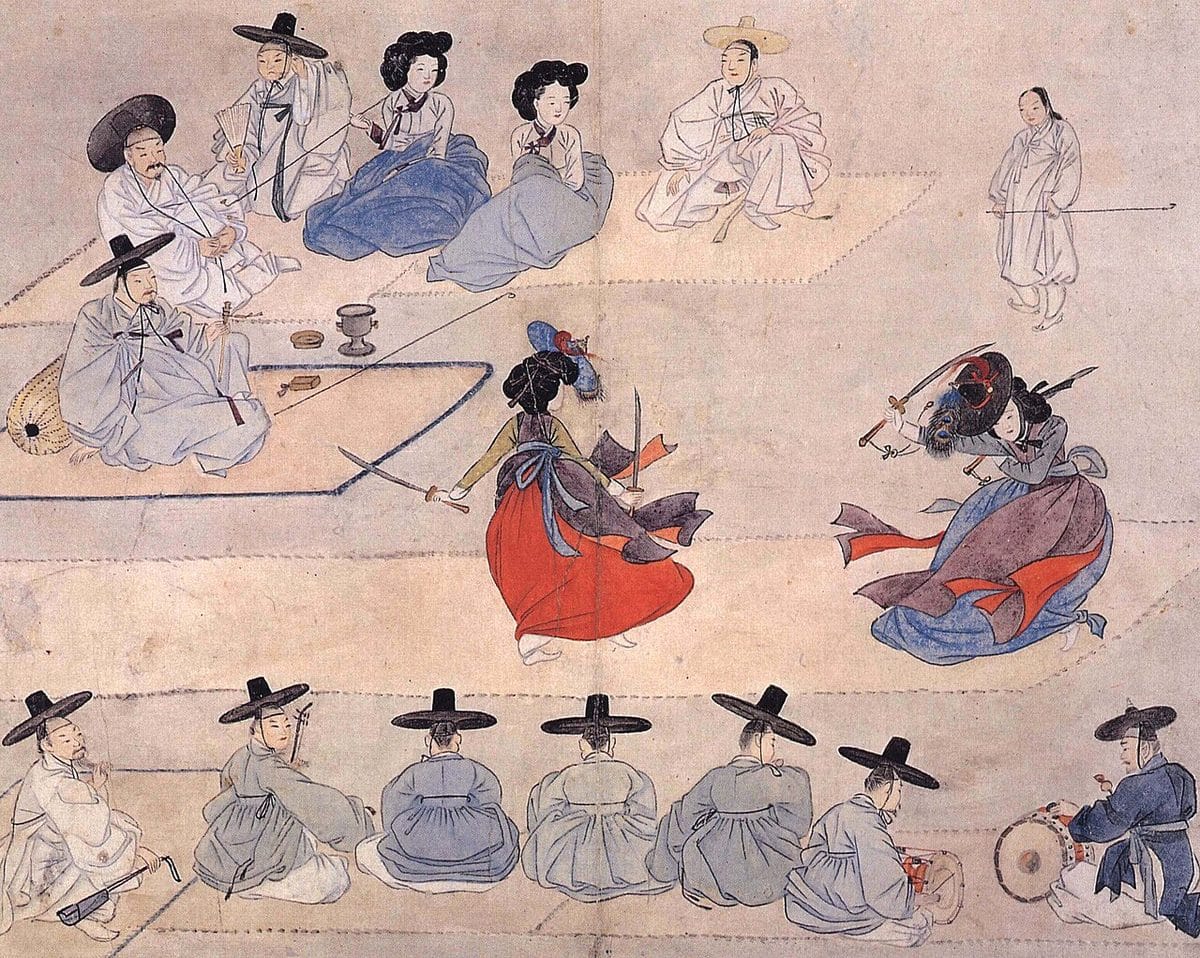
The museum distinguishes the strongly differentiated men's and women's silhouettes of Joseon dress from less fixed earlier divisions. It also records changes in women's jacket length. The short jacket and full skirt familiar from many later images should therefore not be projected unchanged back onto every earlier period.1

Materials, Rank, and the Evidence
Silk, hemp, ramie, and cotton appear in the V&A's account of hanbok materials. The museum also emphasizes flat cutting and construction, with the garment wrapped and tied on the wearer. Fabric, color, and arrangement all matter when comparing surviving ensembles.1
The Asian Art Museum's Couture Korea exhibition discussed restrictions on garments, materials, colors, and accessories within Joseon society. Its display included modern reproductions made with historical objects and paintings as references. That distinction is worth checking in any exhibition photograph: a carefully researched reproduction is evidence of an interpretation, not an excavated or inherited original garment.4
Wedding Hanbok
The National Folk Museum describes wedding outfits that allowed commoners to use elaborate ceremonial clothing associated with the palace. Its account identifies the groom's danlyeong robe and samo hat, and the bride's hwalot or wonsam, with ceremonial headwear such as a jokduri.5
The same resource explains pyebaek, a family ceremony that may follow a Western-style wedding. The couple change into ceremonial clothing and bow to older relatives. The example shows why a wedding's different stages may involve more than one outfit, rather than a simple choice between “traditional” and “modern.”5
Children's Clothing and the First Birthday
A separate museum resource describes the baby's collarless baenaetjeogori and the clothing worn for the first birthday, or dol.6 Its examples include a saekdong jeogori and ggachi durumagi with a cap or head covering. Children's ceremonial dress therefore needs its own account, rather than being treated as an adult ensemble in miniature.6
Is Hanbok Only Historical Clothing?
No. Alongside ceremonial uses, the V&A documents designers reworking hanbok for contemporary wear. Its collection includes a 2013 ensemble by Kim Young Jin. These designs belong to the continuing history of the clothing, while museums preserve and interpret earlier garments and images.1
For other evolving East Asian garment traditions, explore kimono history and qipao history. For official insignia rather than the broader ensemble, see Chinese rank badges.
Sources
- Hanbok – traditional Korean dress — Jenny Kim, Victoria and Albert Museum, updated 2024 (name, historical changes, construction, textiles, and contemporary design).
- Women's hanbok — National Folk Museum of Korea, Korean Culture Box.
- Men's hanbok — National Folk Museum of Korea, Korean Culture Box.
- Asian Art Museum Unveils Couture Korea — Asian Art Museum of San Francisco, 2017 (Joseon dress and the exhibition's reproductions).Reference 1
- Wedding hanbok — National Folk Museum of Korea, Korean Culture Box.
- Children's hanbok — National Folk Museum of Korea, Korean Culture Box.