The qipao, also called the cheongsam, is a Chinese women's dress with a stand-up collar, a side closure, and side slits. Its modern form was developed in Shanghai in the 1920s.7,8 The name is older: "qipao" originally referred to the long gowns worn by Manchu women under the Qing dynasty (1644–1911).1 The Hong Kong Museum of History describes the 1930s as the dress's heyday, followed by a decline on the Chinese mainland after 1949, continued wear in Hong Kong, and a revival from the mid-1990s.1
Qipao history is therefore two histories at once: the story of a garment and the story of a name. Where the dress came from is still argued over, and this page sets out the main positions alongside the surviving garments.
Banner Gown: Where the Name Comes From
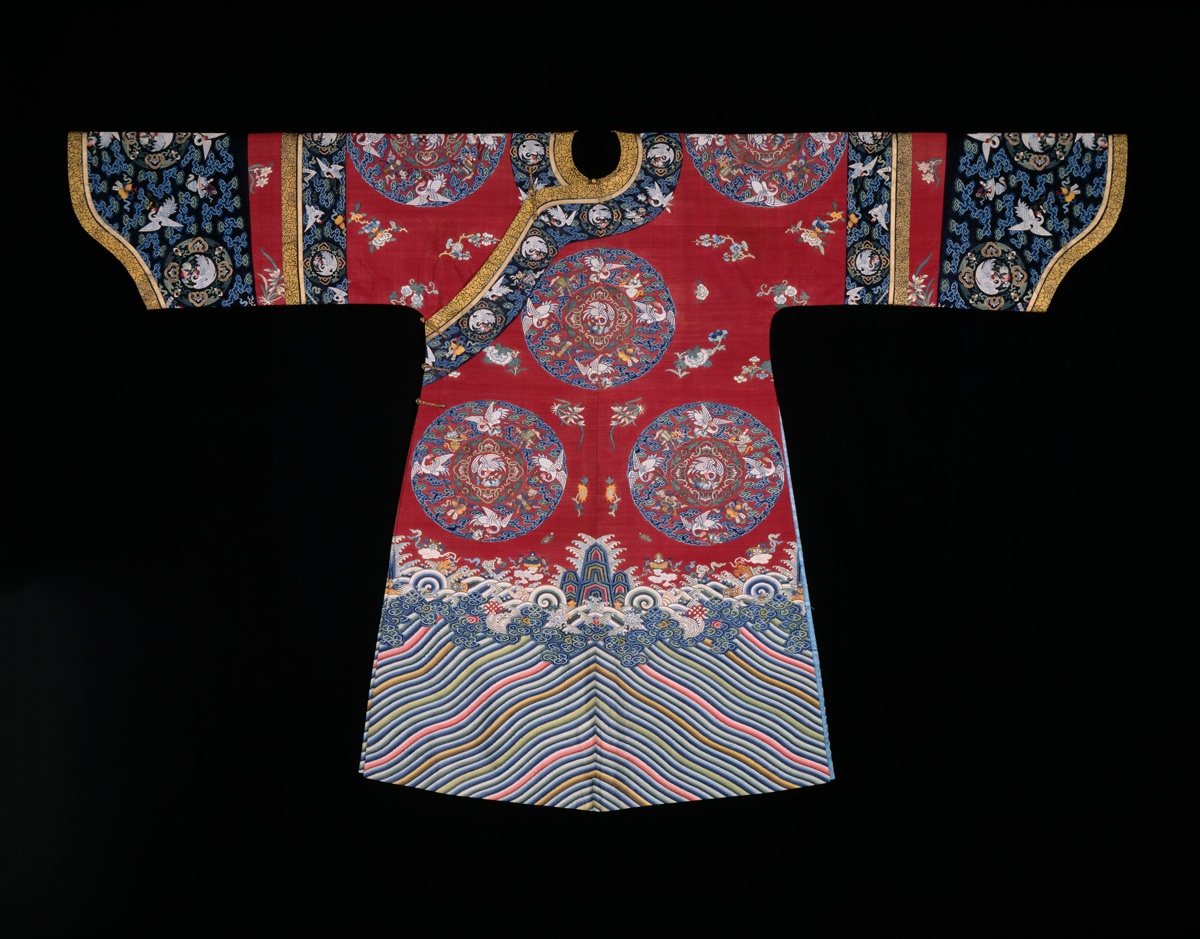
The name points to the Manchu banners: the New Zealand Fashion Museum glosses qipao as "banner gown" and connects it to the Banner System, which it describes as a structure for organizing all Manchu families into administrative divisions in China in the seventeenth century.2 The Victoria and Albert Museum (V&A) likewise describes the modern dress as retaining the basic form of the dress of the "Banner people," the Manchus.10 A Hong Kong museum display translates qipao literally as "Manchu robe" and notes that in Hong Kong the dress was generally called the cheongsam, meaning "long dress."3
According to the Hong Kong Museum of History, Manchu gowns originally had a tighter fit that suited a nomadic and hunting life. After the mid-Qing period, the gown became ankle length, with a loose, straight cut and wide sleeves, and embellishments and details were especially important in Qing dress.1 The Art Institute of Chicago's long pao above is a Qing woman's formal domestic robe of silk in slit tapestry weave.17
Manchu women were not the only source. A 2013 study by Lushan Sun and Melody LeHew states that elements of both Manchu and Han ethnic dress contributed to the original qipao style during the Qing dynasty.5
Disputed Origins: Three Theories and a Debate
Writing for The China Project in 2020, Catherine Zauhar states plainly that "No one actually knows for sure where the qipao comes from," and sets out three theories.4
- The Manchu theory. The Manchus wore long, loose robes called changpao, with slits down the sides that were convenient for riding and archery. Zauhar writes that Han scholars and officials were ordered to wear them, and that their legacy is visible in the qipao.4
- The ancient theory. Zauhar reports that the historian Yuan Jieying, author of China Qipao, argues that the dress's framework was established in the Western Zhou dynasty (1046–771 BC), because it resembles a straight skirt of that time.4 Sun and LeHew, citing a 2009 article by Liu, note a claim that the qipao can be traced as early as the Shang dynasty in the form of a long robe, while calling the Qing dynasty its "most commonly known origin."5
- The modern theory. On this view, the qipao is a new creation of the Republic of China, blending Western ideas with Chinese dress.4
Historians add a further twist. In a 2019 University of Kansas honors thesis, Adrienne Cox summarizes the historian Antonia Finnane as downplaying direct Manchu influence and treating the qipao as a modification of the long robe worn by elite and educated Chinese men, adopted by women much as Western women adopted trousers. Cox herself disagrees, arguing that this view overlooks Manchu influence on Qing men's dress.6 A Bard Graduate Center course on the dress refers to the qipao's "ambivalent relationship" to the Manchu gown.7
The Hong Kong Museum of History takes a middle position: the early form of the 1920s "traced its origins back to the gown of the Manchu women of the Qing dynasty but also incorporated contemporary fashion elements."1 A catalog record at the Smithsonian's National Museum of American History credits Western designers, stating that the loose dress was "modified by Western designers in the 1920's" to fit more closely.16 The evidence does not settle the question, but it does correct one common myth: the close-fitting qipao is not an unchanged ancient costume. For the Qing background, see nineteenth-century East Asian clothing under the Qing and early modern Chinese dress after the Manchu conquest.
Shanghai in the 1920s: A New Dress for New Women
After the 1911 Revolution, according to the Hong Kong Museum of History, schooling became widely available to Chinese women. Students adopted a plainer "new civilised outfit" of blouse and skirt, which became the predominant style of the 1910s and 1920s.1
In the 1920s an early form of the qipao appeared beside it. It was cut wide and straight like the Manchu gown, but its skirt was shortened to the calf to show the ankles, its sleeves reached the elbow or wrist, and its cuffs, collar, and front flap were edged with simple bindings.1 The V&A dates the dress's popularity to the mid- to late 1920s, "when women in China began to play a greater role in public life," and describes the early modern qipao as "relatively loose and comfortable, a symbol of simplicity and frugality."9 The National Museum of Singapore's 2012 exhibition presented the 1920s qipao as the dress of the educated elite: loose, with wide sleeves, and simple overall.11
Yu. A. Seliverstova places the first development of the modern version in Shanghai in the 1920s, partly under the influence of Beijing styles, and credits high-class courtesans and celebrities with making the redesigned, tight-fitting dress popular.8 Cox reports that Finnane links the qipao's rise as a symbol of modern Nationalist women to Soong Ching-ling, wife of Sun Yat-sen, who changed her wardrobe during a journey in 1923.6
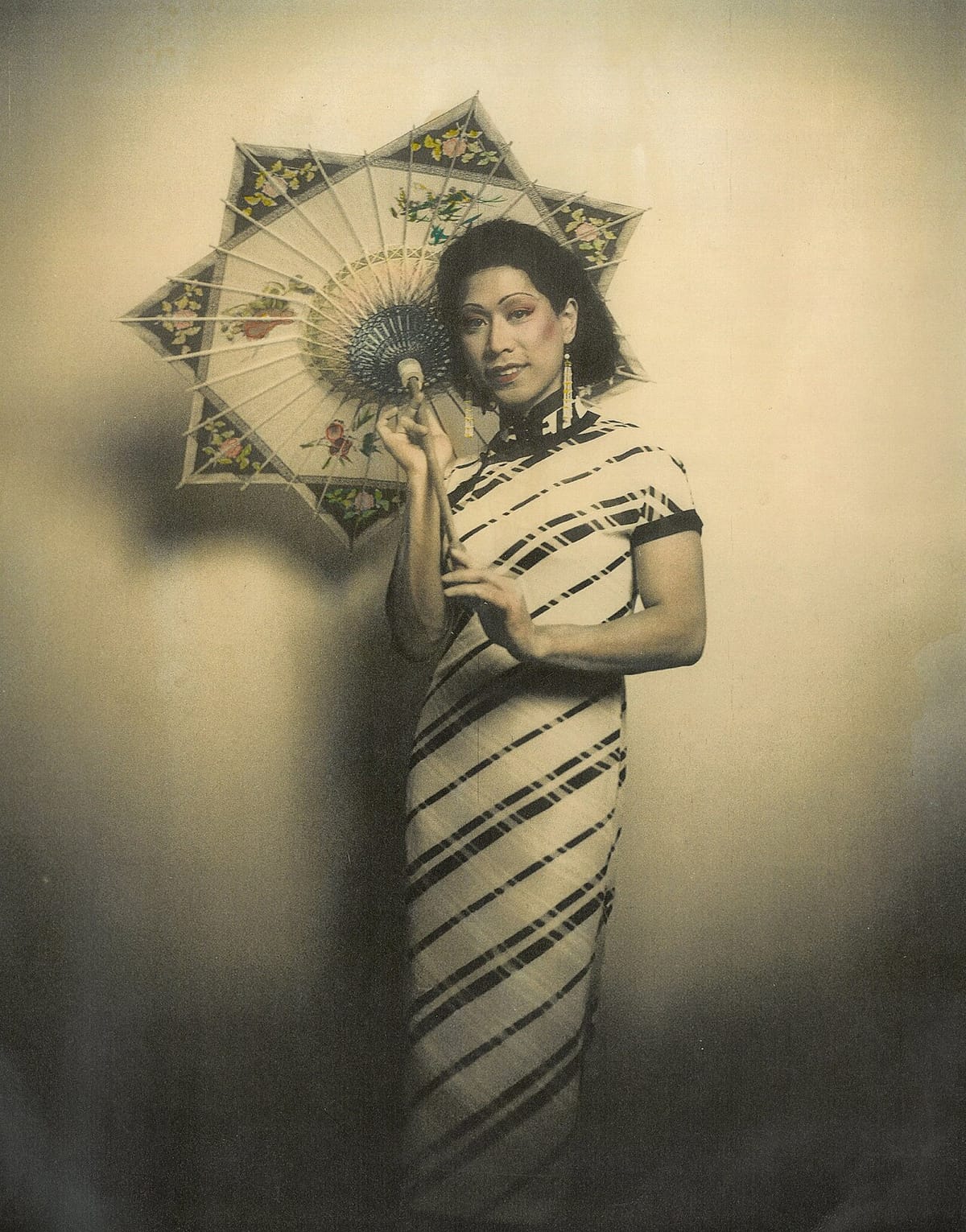

The state soon gave the dress official standing. When the Republican government issued its "Attire Regulations" in 1929, it recognized the qipao as ceremonial dress, and the Ministry of Education made it one of the few school uniform styles girls could wear.1 The V&A summarizes the dress's meaning in this period: the qipao was seen as the woman's dress of "new" China, and its changes in ornament and tailoring marked the "overthrowing" of the feudal past.10
The 1930s and 1940s: Slimmer, Longer, Then Fitted
The Hong Kong Museum of History calls the 1930s the qipao's heyday, when women of all ages and from all walks of life wore it daily. Influenced by Western admiration of slenderness, the skirt was extended to the ankles and the dress became longer and slimmer, with higher slits to allow movement. Fashionable women often wore it with high heels.1 Shanghai was the center of China's fashion and entertainment industries, and calendar posters and film stars such as Hudie and Ruan Lingyu set trends that other women followed.1
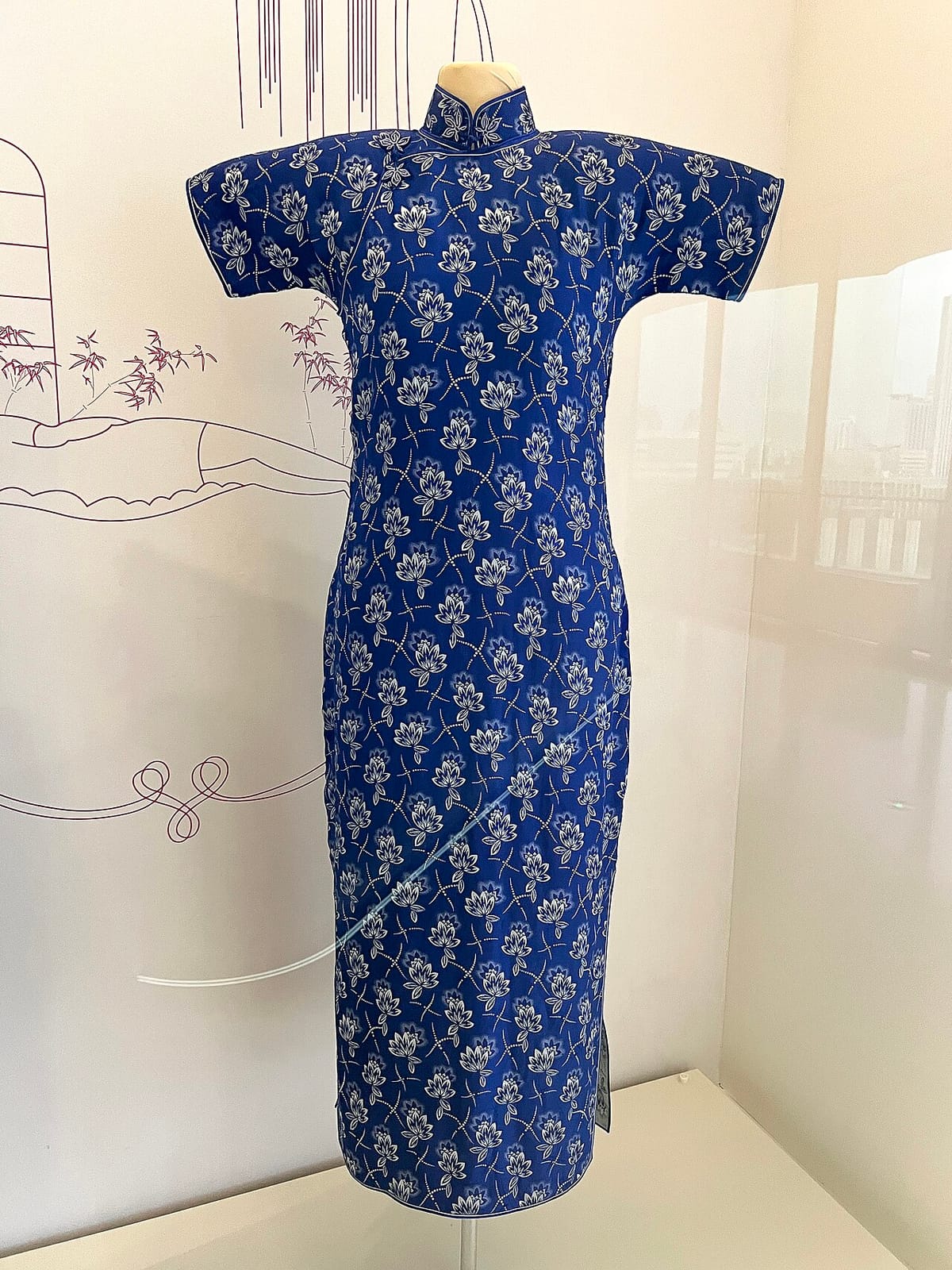

Fabrics changed with the cut. In its section on the cheongsam in Singapore from the 1920s to the 1940s, the National Museum of Singapore describes narrower, shorter sleeves and imported fabrics such as silk crepe, georgette, and chiffon, with geometric, floral, and Art Deco motifs. It notes that Art Deco prints were extremely popular in Shanghai in the 1930s, and that in one 1930s example the sleeves and body were cut from a single piece of fabric.11 A Shanghai qipao of about 1930 at the V&A is made of synthetic velvet and crepe with a devoré (burn-out) pattern and an Art Deco lace detail. The V&A notes that Shanghai's tailors and dressmakers brought Western features such as darts and lace into the qipao's construction.10
By the 1940s, according to the V&A, Western tailoring had made the dress "much more form-fitting."9 Sun and LeHew list the features that changed during the Republican era: fit, materials, sleeve shape, collar height, button style, hemline, and accessories. They quote Finnane's description of the qipao as "a stage for debates about sex, gender roles, aesthetics, the economy, and the nation."5
After 1949: Decline on the Mainland, Tailors in Hong Kong
After the founding of the People's Republic of China in 1949, very few women on the mainland wore the qipao. The Hong Kong Museum of History says this was especially true from the 1960s, when cheap manufactured clothing undercut the tailor-made dress, although leaders' wives and public figures still wore it as ceremonial dress on diplomatic occasions.1 The Bard Graduate Center course description goes further, stating that the style was banned in mainland China from the 1950s to the 1970s.7
The V&A records that after 1949 many Shanghai tailors, fearing reprisals for "being bourgeois," fled to Hong Kong, where qipao making continued for many years.10 There the dress remained common attire, serving as a uniform for students and waitresses, as a wedding dress, and as national costume for Hong Kong representatives in world beauty pageants.1 A Hong Kong museum display describes it as highly fashionable between the 1930s and 1970s.3
Surviving Hong Kong garments show both continuity and change. A sleeveless gold lace qipao at the V&A was made by a Shanghai tailor on Nathan Road from Italian or French fabric and worn at a wedding banquet in 1969; it fastens with hidden press studs and a plastic zip.13 A velvet cheongsam of about 1965 combines synthetic panne velvet, a psychedelic print, and bust darts, which the V&A identifies as a feature of Western tailoring.14 The Hong Kong Museum of History dates the qipao's retirement as women's daily dress to the late 1960s.12
Beyond China: Singapore, the United States, and New Zealand
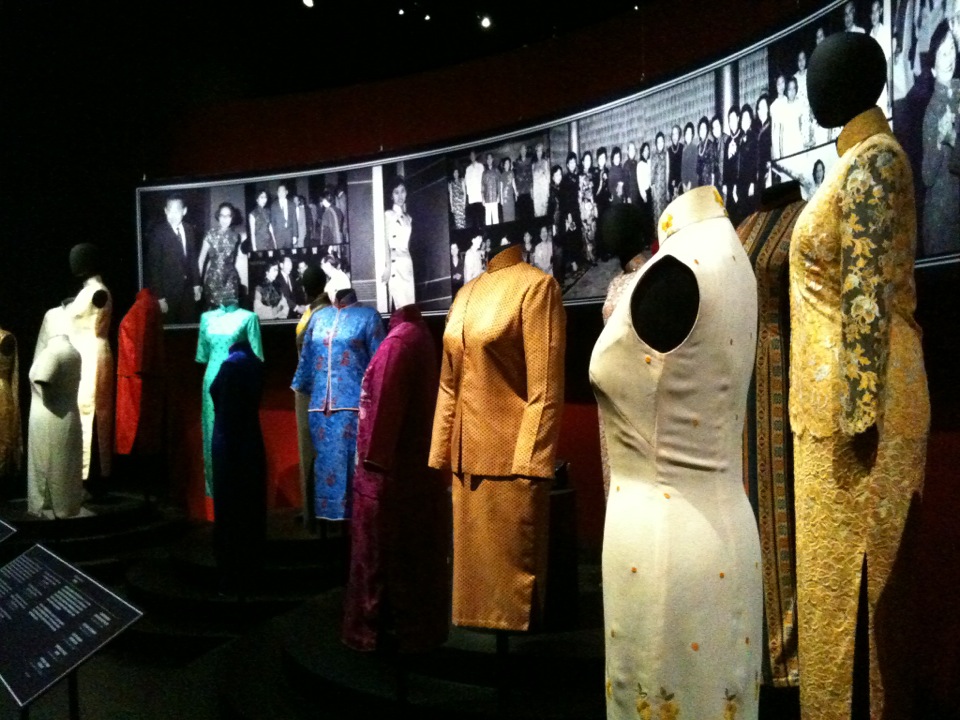

The dress traveled with Chinese communities. The National Museum of Singapore traces its introduction to Singapore in the 1920s, where it was popular with teachers, wives of wealthy businessmen, young girls, and Peranakans. Its "golden period" there, in the 1950s and 1960s, made it everyday wear for working women, with nipped-in waists and darts at bust and waist.11
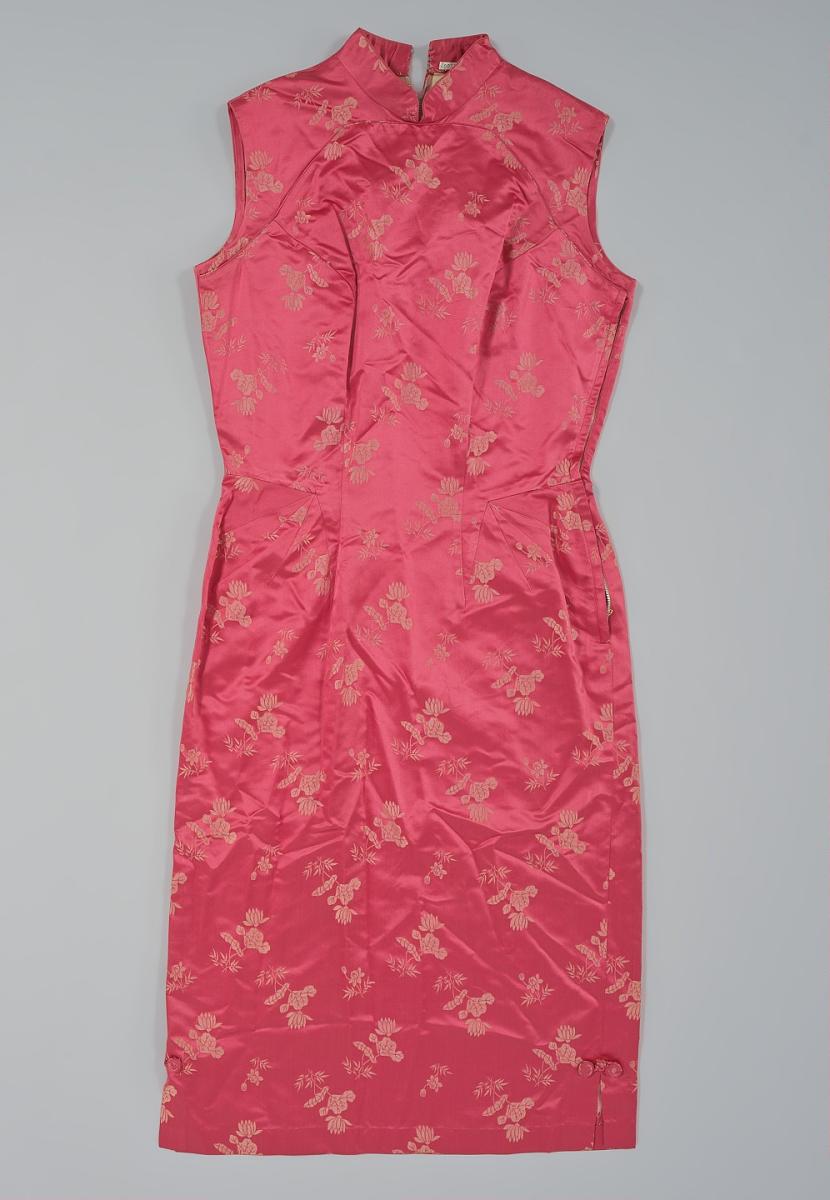
Hong Kong-made dresses also entered American collections. The qipao above, now at the National Museum of African American History and Culture, carries a woven label reading "MADE IN HONG KONG / BRITISH CROWN COLONY." It is fitted throughout with darts and princess seams and closes with metal zippers.15 The National Museum of American History holds a cheongsam of about 1930 worn in Manhattan's Chinatown by Virginia Lee, who posed in a similar dress for a United States World War II poster and for a "Miss China" contest in New York. Its record states that the close-fitting form became broadly popular in the United States as evening wear in the late 1950s and 1960s.16 In New Zealand, the designer Sharon Ng made a qipao in 2004 decorated with a print of Bill Hammond's art, part of a body of work merging her New Zealand and Chinese cultures.2
Revivals and New Meanings
The Hong Kong Museum of History says the qipao faded from public consciousness during the 1970s and 1980s and rose in popularity again in the mid-1990s, especially in the run-up to Hong Kong's 1997 handover to China.1 Zauhar dates its return earlier, to the 1980s, as pageant wear, wedding dresses, and film costume.4 The Bard Graduate Center course describes a revival since the 1990s, both as ceremonial dress and as daily wear, in China and among overseas Chinese.7
The museum's 2010 exhibition showed how far the dress had traveled. It ranged from Qing women's long gowns to the qipao worn by hostesses at the 2008 Beijing Olympics ceremonies and by Gwen Kao, wife of the Nobel laureate Charles Kao, at the 2009 Nobel Prize ceremony.1 The museum concludes that the qipao has become a symbol for Chinese women and, for many of them, the obvious choice of dress "on special occasions where one's Chinese identity is to be emphasised."1 For the wider twentieth-century setting, including the Zhongshan suit, see modern East Asian clothing and the search for national dress.
Quick Answers
When Was the Qipao Invented?
The modern qipao developed in Shanghai in the 1920s, and it reached its heyday in the 1930s.1,8 Some writers trace its roots much further back, to Qing Manchu robes or even to the Zhou and Shang dynasties, so its "invention" depends on how the garment is defined.4,5
What Is the Difference Between Qipao and Cheongsam?
They are two names for the same dress. Qipao is the Mandarin name, linked to the Manchu "banner" people; cheongsam is the Cantonese name, generally used in Hong Kong and meaning "long dress."2,3,9,10
Is the Qipao Manchu or Han Chinese?
Both, according to different sources. Museums connect it to the long gowns of Manchu women, while Sun and LeHew credit both Manchu and Han dress, and Finnane, as summarized by Cox, emphasizes Chinese men's long robes.1,5,6
Was the Qipao Banned in China?
Accounts differ. The Bard Graduate Center describes it as banned on the mainland from the 1950s to the 1970s; the Hong Kong Museum of History describes a sharp decline after 1949, with the dress still worn on diplomatic occasions.7,1
Sources
- "Qipao" of different eras on display at Museum of History — Hong Kong Museum of History, press release, Government of the Hong Kong Special Administrative Region, 22 June 2010 (Manchu gowns, the 1920s prototype, the 1929 Attire Regulations, the 1930s heyday, post-1949 decline, Hong Kong uses, and the 1990s revival).
- NG qipao banner gown with Bill Hammond print, 2004 — New Zealand Fashion Museum (qipao as "banner gown," the Banner System, and Sharon Ng's design).
- "Hong Kong Cheongsam Story" Exhibition — Hong Kong Museum of History and Hong Kong Arts Centre, Leisure and Cultural Services Department (qipao as "Manchu robe," cheongsam as "long dress," fashionable 1930s–1970s).
- A brief history of the qipao: China's sexiest dress — Catherine Zauhar, The China Project, 20 May 2020 (three origin theories, Yuan Jieying, and the 1980s revival).
- 70 Years of Fashion in the Chinese Dress: Exploring Sociocultural Influences on Chinese Qipao's Hemline Height and Waistline Fit in 1920s–1980s — Lushan Sun and Melody LeHew, International Textile and Apparel Association Annual Conference Proceedings 70, 2013 (Manchu and Han elements, the Shang dynasty claim, changing features, and the Finnane quotation; retrieved via the Wayback Machine).
- The Qipao: Defining Modern Women in the First Half of the 20th Century — Adrienne Cox, departmental honors thesis, University of Kansas, 2019 (summary of Antonia Finnane's view and Soong Ching-ling in 1923; retrieved via the Wayback Machine).
- Qipao/Cheongsam: A Cultural History of Modern Chinese Fashion — Bard Graduate Center, course description (definition, 1920s Shanghai, the Manchu gown, the mainland ban, and the revival since the 1990s).
- Evolution in Style of Shanghai Women in the 1920s and 1930s — Yu. A. Seliverstova, RUDN Journal of World History, 2012 (abstract: the modern qipao in 1920s Shanghai, Beijing influence, courtesans and celebrities).
- Qipao, FE.44-1997 — Victoria and Albert Museum, late 1930s (popularity in the mid- to late 1920s; loose early form; form-fitting by the 1940s).
- Qipao, FE.8-2009 — Victoria and Albert Museum, Shanghai, ca. 1930 (the "Banner people," synthetic devoré velvet, Western tailoring, and tailors moving to Hong Kong after 1949).
- Be 'In the Mood for Cheongsam' at the National Museum of Singapore — Chung May Khuen, Desirene Ho, and others, National Museum of Singapore, Roots.gov.sg (1920s loose style, imported fabrics, Art Deco prints, and the cheongsam in Singapore).
- The Evergreen Classic: Transformation of the Qipao — Hong Kong Museum of History, past exhibition, 2010 (retirement as daily dress in the late 1960s).
- Qipao, FE.114-1996 — Victoria and Albert Museum, Hong Kong, 1969 (wedding banquet dress by a Shanghai tailor on Nathan Road).
- Qipao, FE.47-1995 — Victoria and Albert Museum, Hong Kong, ca. 1965 (synthetic panne velvet and Western darts).
- Red floral sleeveless qipao, 2007.3.685 — Smithsonian National Museum of African American History and Culture (Hong Kong label and fitted construction; text retrieved through the Smithsonian Open Access API).
- Circa 1930 Women's Gown (cheong sam), 1992.0620.16 — Smithsonian National Museum of American History (Virginia Lee, Western modification in the 1920s, and American evening wear; text retrieved through the Smithsonian Open Access API).
- Woman's Long Pao (Formal Domestic Robe), 1943.571 — Art Institute of Chicago (the Qing woman's robe illustrated).