Hanbok is the term for Korean dress, an umbrella term that "encompasses thousands of years of Korean clothing" rather than a single design.1 It consists of a top piece and a bottom piece: a jeogori jacket worn by women with a chima skirt and by men with baji trousers.1 The word was introduced in the late nineteenth century by Koreans to distinguish their everyday dress from Western-style clothing.1
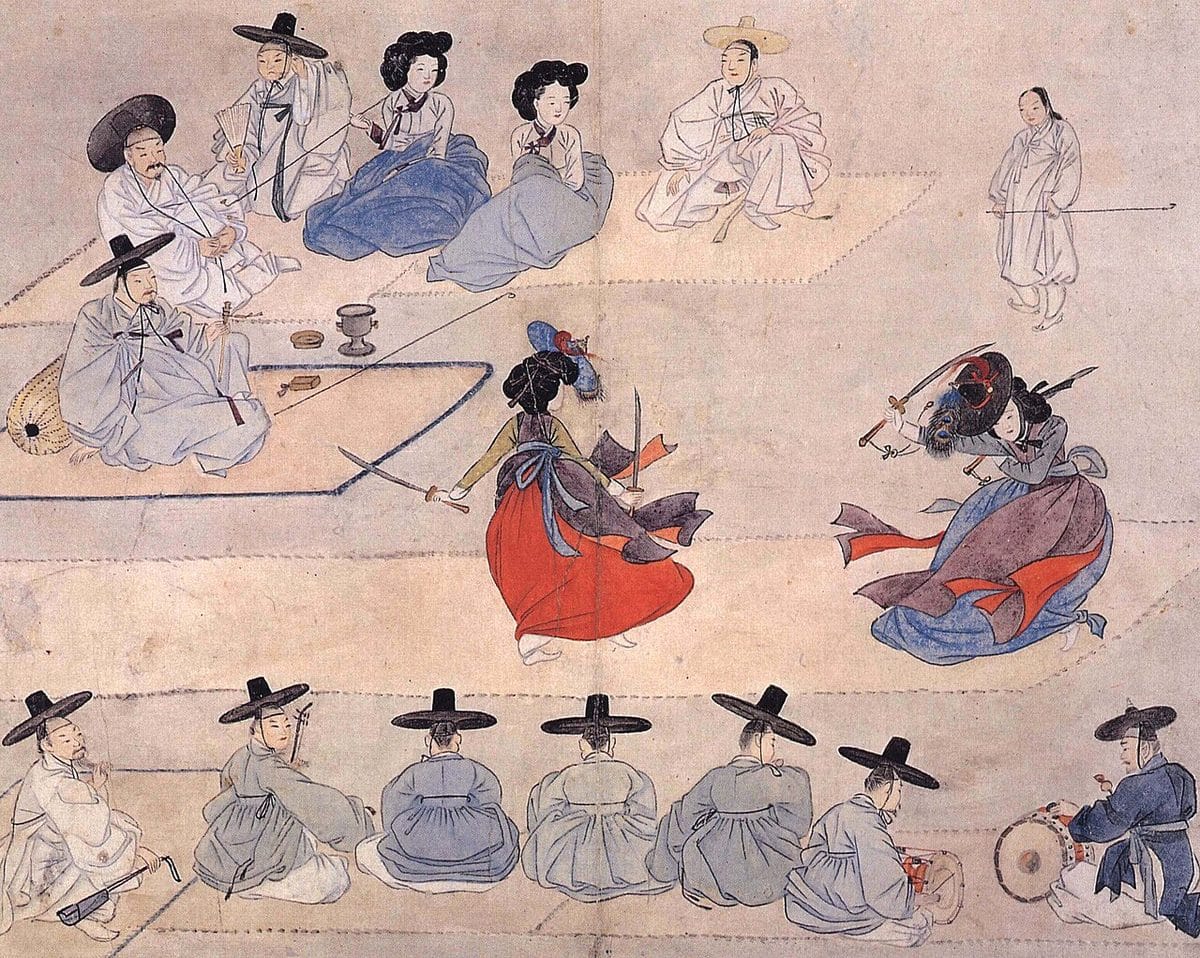
Shin Yun-bok, Sword Dance (Ssanggeom daemu), from the album Hyewon pungsokdo, late Joseon dynasty, ink and color on paper. Kansong Art Museum, Seoul. Wikimedia Commons, Public Domain.

Origins and History
In the Three Kingdoms period (57 BC–668 AD) the jeogori wrapped closed at the front, the chima was long and spacious, and long outer coats called durumagi appeared.1 Under Goryeo (918–1392) Mongolian influence affected court officials' uniforms, and under Joseon (1392–1910) hanbok evolved into the version "we are most familiar with today," with distinct men's and women's silhouettes and rank-based dress.1
Materials and Decoration
Hanbok is cut and sewn flat, and its tops are tied with a one-looped bow called a goreum.1 Ramie and hemp were used widely by commoners before cotton was produced in Korea, while silk was woven for the royal household.2 Palace members wore vibrant colors such as red, blue, green, and black, while commoners favored white, which symbolized purity and resilience.1
The Term Today
The South Korean government designated October 21 as Hanbok Day and recognized hanbok saengwal as a National Intangible Cultural Heritage, and the word entered the Oxford English Dictionary in 2021.1 Designers including Lee Young-hee have reinterpreted hanbok for modern audiences.1,3
On This Site
- Ancient East Asian clothing
- Medieval East Asian clothing
- Early modern East Asian clothing
- 19th century East Asian clothing
- Modern East Asian clothing
Sources
- Hanbok: traditional Korean dress — Jenny Kim, Victoria and Albert Museum, updated 17 April 2024 (umbrella term, origin of the word, garments by period, flat cutting, goreum, colors, Hanbok Day, and the Oxford English Dictionary).
Return to text (9 references)
Reference 1 Reference 2 Reference 3 Reference 4 Reference 5 Reference 6 Reference 7 Reference 8 Reference 9 - Traditional womenswear (hanbok) — Victoria and Albert Museum, FE.55:1 to 4-1991, Korea, 1980 (ramie and hemp for commoners, silk for the royal household).Reference 1
- Jacket (jeogori) — Victoria and Albert Museum, FE.541:1-1992, Lee Young Hee studio, Seoul, 1992 (formal hanbok outfit made at the designer's Seoul studio).Reference 1