The kimono developed from the kosode, a straight-seamed garment worn beneath aristocratic robes in medieval Japan that gradually became outerwear. By the sixteenth century, the garment was a principal form of dress across classes and for both sexes. Its familiar identification as “kimono,” and its role as a symbol of Japanese tradition alongside Western clothing, took shape much later, around the nineteenth century.1,2,3
Kimono history is therefore a history of changing use and meaning as well as changing clothes. A relatively consistent wrapped form could express differences in wealth, age, taste, and occasion through its fabric, sleeves, decoration, and accessories.1,2
From Medieval Undergarment to Outer Dress
The Costume Museum in Kyoto identifies the kosode as underwear in the Heian era, then describes its gradual emergence as an outer garment during the Kamakura and Muromachi eras. Its account also traces a movement from relatively plain clothing toward multicolored, patterned garments. This was a long development, rather than an invention at a single court or on a particular date.3
The name needs care. Kosode is commonly translated as “small sleeves,” but the distinguishing smallness concerns the opening through which the hand passes, rather than simply the overall length of the hanging sleeve. JSTOR Daily explicitly describes smaller armholes, while the Costume Museum identifies the narrow cuff, or sode-guchi, among the garment's characteristics. Calling every kosode a short-sleeved kimono can therefore give the wrong visual impression.2,3
The broader setting is covered in medieval East Asian clothing. For the garment itself, the important transition was that something worn beneath elite layers became increasingly visible as dress in its own right, with an expanding surface for decoration.1,3
When Did Kosode Become Kimono?
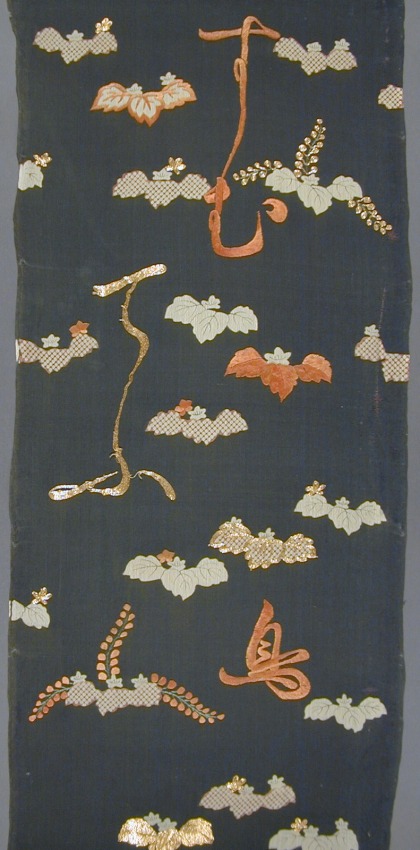

Kimono means “the thing to wear.” The V&A dates adoption of the term to the mid-nineteenth century; JSTOR Daily places the naming transition in the Meiji period, beginning in 1868. These accounts put the shift around the same broad historical turning point, but do not establish one exact year when everyone abandoned kosode for kimono.1,2
It is useful to distinguish the age of the garment from the age of its modern cultural identity. An Edo-period kosode can be described as a kimono for a present-day reader without implying that its original wearer used the same terminology. Equally, the nineteenth-century naming shift does not mean the underlying garment was newly invented then.1,2
During the Edo period, fabric, color, technique, and motif communicated social distinctions through a broadly shared garment form. Design books, known as hinagata bon, helped clients, shops, and makers navigate these choices. JSTOR Daily identifies a surviving example dated 1666, showing how textile fashion circulated through published designs.2
Surviving garments give an uneven picture of that fashion. Poorer wearers used clothing until it wore out, while wealthier households could preserve expensive pieces and commission replacements. The elaborate silk kosode in museum collections therefore show particular parts of the clothing world especially well; they cannot stand for every person's wardrobe.2
Construction: Straight Seams and an Adjustable Wrap
The kimono's basic construction uses straight seams rather than a closely shaped, fitted outline. It wraps left side over right and is secured with an obi sash. Excess length can be drawn up beneath the obi, while the collar can be adjusted, including being drawn back to expose the nape in women's dress.1
That structure provides flexibility, but does not mean proportions never changed. The Costume Museum describes earlier kosode with broad bodies and relatively short reaches from the back seam to the cuff, followed by changes in cloth width and garment form between the Momoyama and Edo eras. Continuity of the general shape coexisted with changes in how it sat on the body.3
Seasonal construction mattered too. The V&A distinguishes unlined summer kimono from winter garments with multiple linings. A garment's suitability therefore depended on more than its visible pattern: the cloth and layers were part of how it worked as clothing.1
Sleeves, Obi, and Social Formality
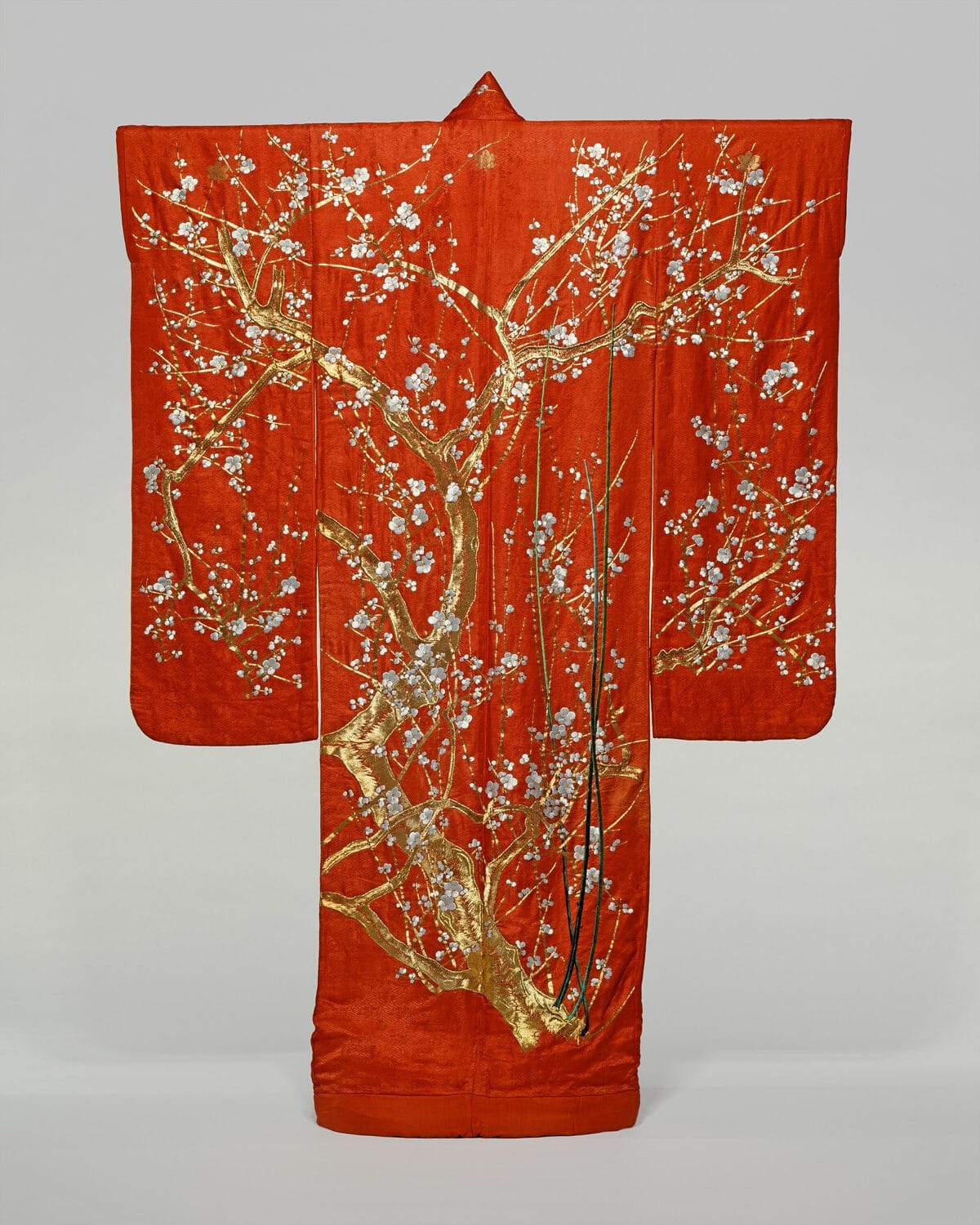
Sleeve length could distinguish uses within the wider garment family. The Art Institute of Chicago describes furisode as a long-sleeved garment worn by children and unmarried women on special occasions. Its red silk example above probably served as an uchikake, or outer coat: a reminder that a museum garment's place within an ensemble matters as much as its silhouette.4
The obi also changed the visual balance of dress. According to the V&A, women's obi became much wider and more exuberant in the eighteenth century, using rich brocades or elaborate embroidery. Its nineteenth-century embroidered velvet example belonged to the type used by a woman of the samurai class to secure the kimono beneath an uchikake; the outer uchikake itself was worn without an obi.5
Formality cannot be read from sleeve length alone. The V&A emphasizes the combined significance of color, decoration, obi, and accessories. JSTOR Daily likewise describes fabric quality and design as communicating rank, age, gender, and refinement, sometimes within sumptuary restrictions. An expensive silk garment and an informal cotton one could share a wrapped structure while serving very different social purposes.1,2,6
Motifs: Season, Good Fortune, and Literary Taste
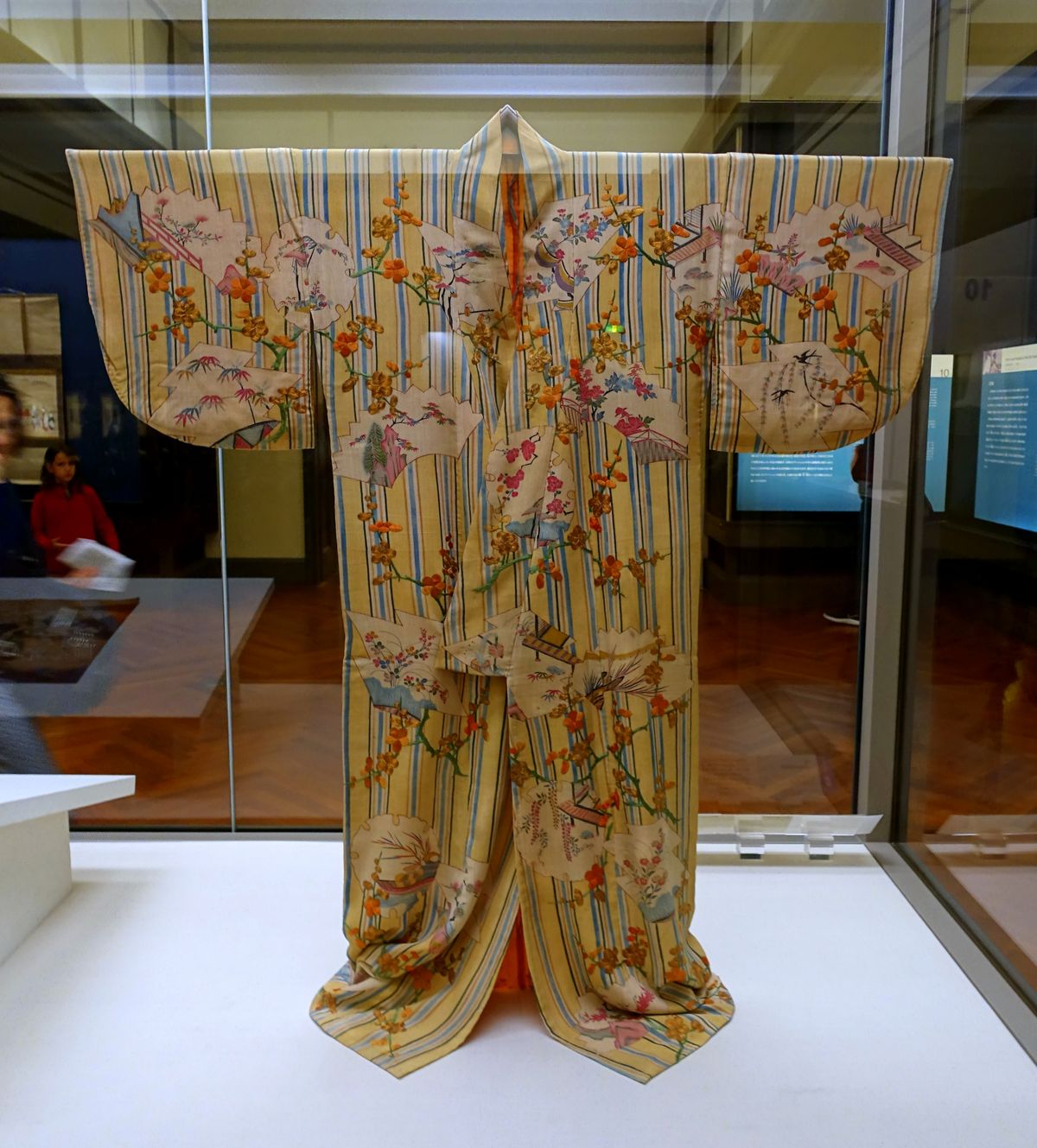

Decoration carried much of the meaning that a changing cut might carry in other fashions. The V&A identifies cherry blossom, chrysanthemums, and maple leaves as seasonal imagery. Cranes convey longevity and good fortune; pine, bamboo, and plum, the Three Friends of Winter, express longevity, perseverance, and renewal. Plum blossom on winter dress can suggest the approaching spring.1
Motifs could also ask the viewer to recognize a poem or story. Rather than portraying people directly, a design might use objects that suggest their presence: dropped fans, for example, could allude to interrupted lovers. JSTOR Daily discusses literary references and written characters as signs of a wearer's cultivated knowledge.1,2
These associations make more sense in context than as a universal codebook. The sources connect design choices to season, occasion, social position, and refinement. Reading a garment means considering those factors together, rather than assigning a single fixed meaning to every flower or color.1,2 For the regional setting of Edo textile fashion, see early modern East Asian clothing.
Modernization Did Not End Kimono Fashion
In the Meiji period, Western clothing became associated with official modernization, especially for men in government and military settings. JSTOR Daily describes kimono, particularly women's dress, acquiring a stronger role as a visible link to Japanese cultural continuity amid those changes.2 The wider reforms are discussed in nineteenth-century East Asian clothing.
Kimono design also registered modern life. The V&A records cars, trains, aircraft, and skyscrapers on early twentieth-century garments, particularly those for boys, followed by increasingly nationalistic and militaristic imagery in the 1930s. Modern subjects appeared within the established clothing form, rather than only in Western-style clothes.1
The Metropolitan Museum of Art's exhibition Kimono Style describes another important change: modernization widened women's access to silk kimono. Around the 1920s, affordable ready-to-wear meisen kimono became popular, sold through department stores using Western-style marketing. Modernization could expand the kimono market as well as encourage Western dress. The Met also traces influence in the other direction: Western couturiers studied Japanese woodblock prints, and designers including Madeleine Vionnet and Cristóbal Balenciaga drew inspiration from the kimono's loose silhouette and rectilinear cut.7
The postwar transition was uneven. Textile Research Centre researcher Naoko Kikuchi describes daily Western dress spreading with urban life from the mid-1950s, while some people continued wearing kimono daily into the 1970s. Her study includes affordable, home-washable wool kimono and silk-and-synthetic examples alongside special-occasion clothing. Modern kimono were not exclusively ceremonial silk garments.8
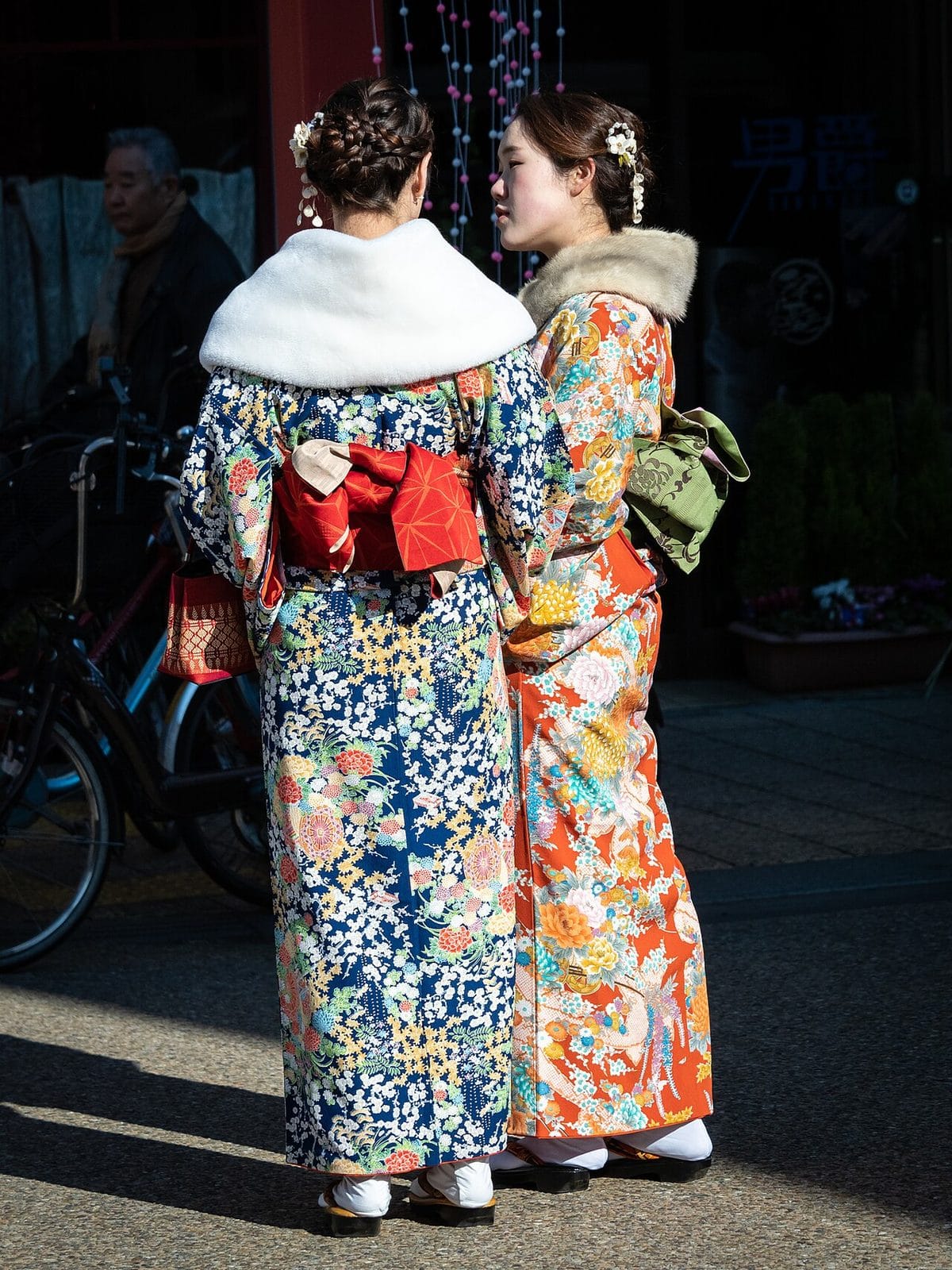

Kikuchi also documents the importance of coming-of-age ceremonies and wedding attendance, and the development of rental and dressing assistance for wearers who needed help assembling the outfit. The shift toward special occasions changed how garments were acquired and worn as well as how often they appeared.8 See modern East Asian clothing for the wider fashion context.
Quick Answers
What Is the Difference Between Kimono and Yukata?
Yukata are informal cotton summer kimono, associated with bathing as well as casual wear. The V&A translates the name as “bathing clothes” and describes nineteenth-century examples as usually stencil resist-dyed in indigo blue, worn by both men and women. A yukata belongs within this clothing tradition, but should not be confused with a formal silk ensemble.6,1
Does Kosode Mean Short Sleeves?
The conventional translation is “small sleeves,” but the name refers to the small opening at the hand. It does not mean that every kosode had sleeves ending high on the arm.2,3
Were Kimono Always Made of Silk?
No. The V&A notes that most people wore silk only on special occasions and documents cotton yukata. Postwar collections also include wool and synthetic-fiber kimono.1,6,8
Is Kimono an Unchanged Ancient Costume?
No. Its history includes the kosode's move from underwear to outerwear, changes in proportions and obi, nineteenth-century naming and identity, and modern materials and imagery. The continuity lies in a recognizable garment tradition that kept responding to its wearers' lives.1,2,3,5,8
Sources
- Kimono — Victoria and Albert Museum, updated 17 April 2024 (construction, naming, social meaning, motifs, and twentieth-century imagery).
- The Surprising History of the Kimono — Cynthia Green, JSTOR Daily, 2017, updated 2025 (kosode terminology, Edo design books, social distinctions, and Meiji cultural identity).
- Woman of the upper class in kosode of Keicho period — The Costume Museum, Kyoto (medieval undergarment-to-outerwear transition, narrow cuffs, and changing construction).
- Furisode, collection record 150739 — Art Institute of Chicago, collection API (long sleeves, wearers, special occasions, and the red silk garment illustrated).
- Obi — Victoria and Albert Museum, FE.23-1973 (eighteenth-century widening and the relationship between obi, kimono, and uchikake).
- Kimono (yukata) — Victoria and Albert Museum, T.189-1934, 1850–1880 (cotton, stencil resist dyeing, indigo, bathing, and informal summer wear).
- Kimono Style: The John C. Weber Collection — The Metropolitan Museum of Art, 2022 exhibition (modern silk access, ready-to-wear meisen, department stores, and exchanges with Western fashion; text retrieved through Jina Reader).
- Japanese kimonos from the late 1950s to the 1970s — Naoko Kikuchi, Textile Research Centre, Leiden, 19 August 2021 (postwar daily wear, materials, ceremonies, rental, and dressing assistance).