The Chola dynasty ruled the Tamil south from roughly 848 to 1279 CE, at its height controlling the Coromandel coast, Sri Lanka, and trade routes reaching across the Bay of Bengal. Chola dynasty clothing was almost entirely unstitched — lengths of cotton or silk wrapped, pleated, and tucked rather than cut and sewn. Tailoring arrived in South Asia with the Central Asian courts of the north, and in the Chola south it made almost no impression at all.
What makes Chola empire clothing unusual to study is the gap between how much we can see and how little survives.
What Survives, and What Does Not
Not a single scrap of Chola cloth remains. Cotton and silk do not last centuries in a monsoon climate, and the Tamil country has yielded no textile finds comparable to the dry-tomb survivals of Egypt or Peru. Everything known about Chola dynasty fashion is therefore reconstructed from images and documents:
- Stone sculpture, above all at the Brihadisvara Temple at Thanjavur, consecrated around 1010 CE under Rajaraja I
- Bronze icons cast by the lost-wax method — the celebrated Chola bronzes of Shiva, Parvati, and the Tamil saints
- Temple frescoes in the Brihadisvara ambulatory passage
- Inscriptions — many thousands, carved on temple walls and copper plates, recording donations, taxes, and temple administration in unusual detail
- Tamil literature, both devotional and courtly
This evidence has a built-in bias. Nearly all of it depicts gods, kings, and wealthy donors, rendered according to religious and courtly convention. It tells us a great deal about elite and divine dress and very little about what a farmer in the Kaveri delta wore.
Men's Dress
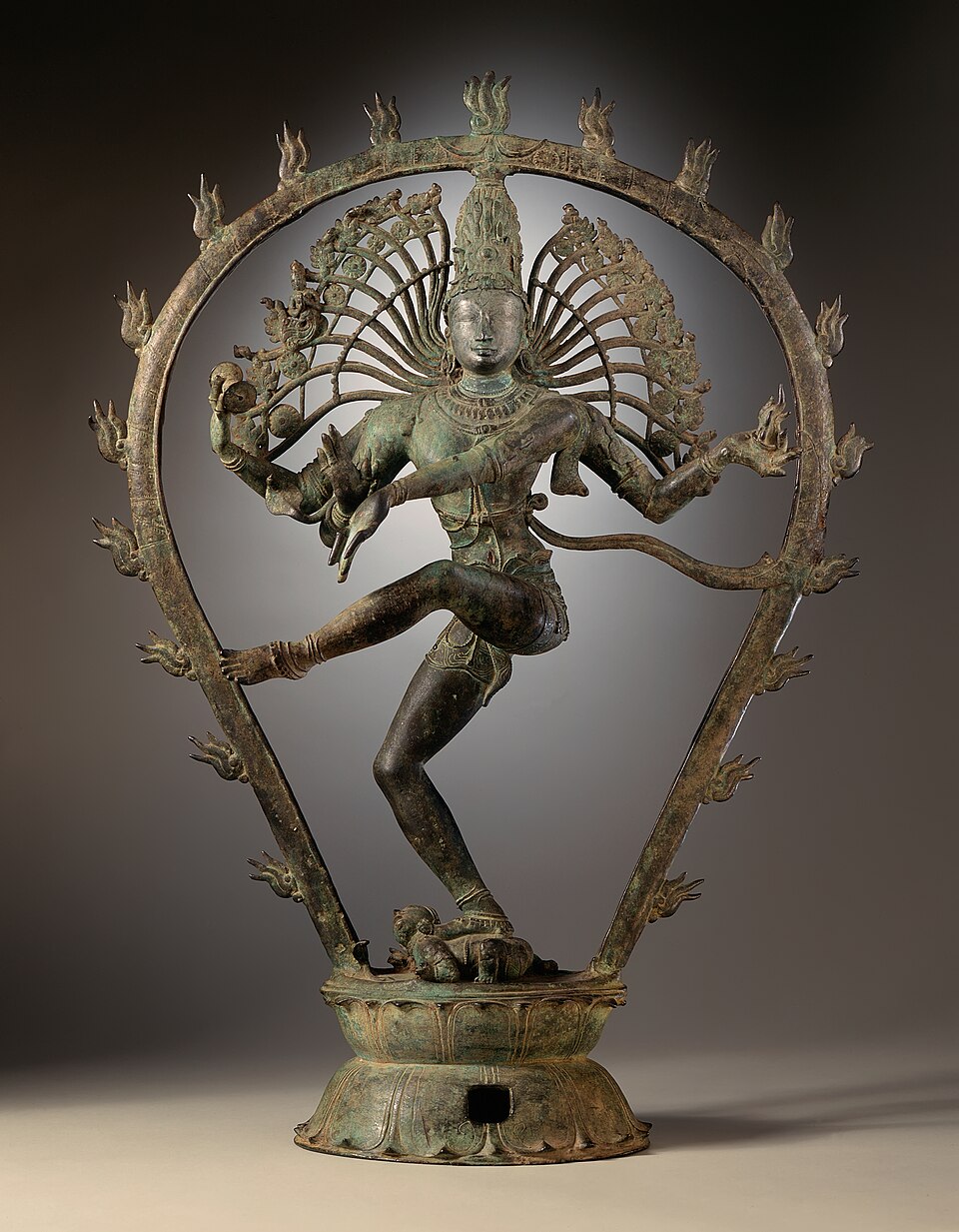 Chola bronze casting rendered ornament in fine detail while treating cloth as a nearly transparent surface.
The standard male garment was a single length of cloth wrapped at the waist and falling to the knee or ankle — the veshti of Tamil usage. For labor, travel, or warfare it was worn as a kachcham, with the cloth drawn back between the legs and tucked at the waist behind, converting a drape into something closer to trousers without a stitch being sewn. The same garment appears across South Asia as the dhoti.
Above the waist, men are usually shown bare-chested. An angavastram — an unstitched shoulder cloth draped across the torso or over one shoulder — served for formality, warmth, and modesty, and remains in ceremonial use in Tamil Nadu today. Officials and courtiers wear wound head cloths and turbans in sculpture; kings wear the conical makuta crown.
Women's Dress
Women wore a lower garment of comparable construction, wrapped and pleated at the waist, sometimes with the loose end drawn up across the body. The upper body was covered by a kachchu or kurpasam, a breast band of cloth tied across the chest.
It is worth being precise here, because it is widely misstated: the sari as a modern ensemble — a long drape worn with a fitted stitched blouse and an underskirt — is not a Chola garment. That combination took shape in the nineteenth century. Chola-period women's dress was a drape plus a band, and the two pieces were not tailored.
The Problem of Invisible Cloth
Anyone looking at Chola bronzes for the first time notices that the figures barely appear to be dressed. Cloth is indicated by incised lines for pleats, hems, and sashes laid over an unbroken body contour, so that thighs and abdomen read through the fabric as though it were not there.
There are two explanations, and both are probably right. South Indian weavers genuinely did produce cotton of extraordinary fineness, and a superfine muslin drape over an oiled body is close to translucent. But Chola sculptors were also working within a religious idiom in which the divine body is the subject and cloth must not obscure it. The convention is a statement about the figure, not a documentary record of the garment. Read literally — as it sometimes is — it produces the false impression that Chola dress was minimal.
Ornament Was the Real Display
Where cloth is understated in Chola art, ornament is exhaustively detailed, and it carried most of the visual signalling that clothing carries in tailored traditions. Recurring elements include makara kundala earrings shaped as sea-creature heads, the channavira chest chain crossing diagonally over both shoulders, the udarabandha band across the midriff, the katisutra or mekhala hip girdle worn over the drape, keyura armlets above the elbow, bangles, and heavy anklets.
The inscriptional record here is remarkable. Rajaraja I's endowments at Thanjavur itemize donated jewels and temple ornaments by weight, material, and gemstone, producing one of the most detailed inventories of precious objects anywhere in medieval India. Cloth is recorded in the same inscriptions, but by quantity and purpose rather than by appearance — a reminder that the Cholas documented what they taxed and donated, not what they wore.
Fiber, Dye, and the Coromandel Tradition
Cotton was the everyday fiber, grown and spun locally and woven on pit looms. Silk was reserved for elite and ritual use, including the garments in which temple deities were dressed.
The dye tradition of the Coromandel coast is the Chola south's most consequential textile legacy. Its foundation was mordant dyeing — treating cloth with a metallic fixative such as alum or iron before immersion in the dye bath, so that color bonds permanently to cotton fiber rather than washing out. The critical red came from chay root, and blue from indigo; turmeric and safflower gave yellows and pinks that faded quickly. Mastery of mordants is what allowed South Indian dyers to produce brilliant, genuinely washfast cottons at a time when most of the world could dye wool and silk well but cotton badly. Centuries later this same expertise made Coromandel painted and printed cottons among the most sought-after commodities in world trade.
Weavers, Looms, and the Temple Economy
Chola inscriptions name weaving communities — the Kaikkolar, later known as Sengunthar, and the Saliyar among them — as organized groups with recognized standing, temple obligations, and internal governance.
Their economic position rested on the temple. A major South Indian temple was not only a religious institution but a landholder, employer, and consumer on a large scale, and it required cloth continuously: deities were bathed and dressed daily, festivals demanded fresh garments, and priests, dancers, and musicians all had to be clothed. Inscriptions record endowments established specifically to fund garments for a deity in perpetuity. Weavers accordingly settled in temple towns, and the state taxed their looms directly through a levy assessed per loom.
Cloth also functioned as honor. The parivattam, a cloth tied about the head, was conferred by temple or ruler as a formal mark of distinction — a use in which the value lay in who bestowed the cloth rather than in the cloth itself. Conversely, the right to wear particular garments and ornaments was tied to rank, and disputes over such rights appear in the South Indian record for centuries afterward.
Textiles and the Maritime Empire
The Cholas were an unusually outward-facing South Asian power. Rajendra I launched a naval expedition against the Srivijaya empire in Southeast Asia around 1025, and Chola embassies reached Song China in 1015, 1033, and 1077. Merchant guilds operating under Chola protection — the Ayyavole Five Hundred and the Manigramam among them — ran the trade that moved through Coromandel ports.
Cotton cloth was a staple of that commerce, exchanged across the Bay of Bengal for spices, aromatics, camphor, and Chinese goods. South Indian textiles were entering Southeast Asian markets during the Chola period, beginning a pattern of demand that would still be shaping the region's dress five centuries later.
What the Chola Legacy Actually Is
Kanchipuram silk saris are frequently marketed as a Chola inheritance, and the claim needs qualifying. Kanchipuram was indeed a major city under the Cholas and a weaving center of long standing. But the Kanchipuram silk sari industry as it exists today — its techniques, its characteristic contrast borders, its weaver communities — took its modern shape much later, and the weaver migrations usually invoked in its origin story are dated to the Vijayanagara period in the sixteenth century. What connects the two is continuity of place and craft, not an unbroken product line.
The firmer legacy is elsewhere: in the draped, unstitched garment that outlasted every tailored fashion introduced to the subcontinent, and in the mordant-dyeing expertise of the Coromandel coast, which eventually reached further into the world than the Chola navy ever did.