The sari is a long, unstitched length of cloth that a woman wraps and pleats around her waist and then drapes over one shoulder, sometimes covering her head.12,14 This draped South Asian garment is worn in many sizes and wrapping styles, usually with a blouse, the choli, and the textile historian Jasleen Dhamija calls it "the most typical form of South Asian women's dress."1 Its roots lie in the draped, unstitched clothing of ancient South Asia.1 The ensemble most people picture today, however, is much younger: the familiar pleated drape with a blouse and petticoat took shape in nineteenth-century Bengal.13,14
The history of the sari is therefore a history of a wrapped South Asian garment that kept its basic principle while its length, drape, fabric, and underlayers changed around it.
Ancient Draped Dress: Antariya and Uttariya
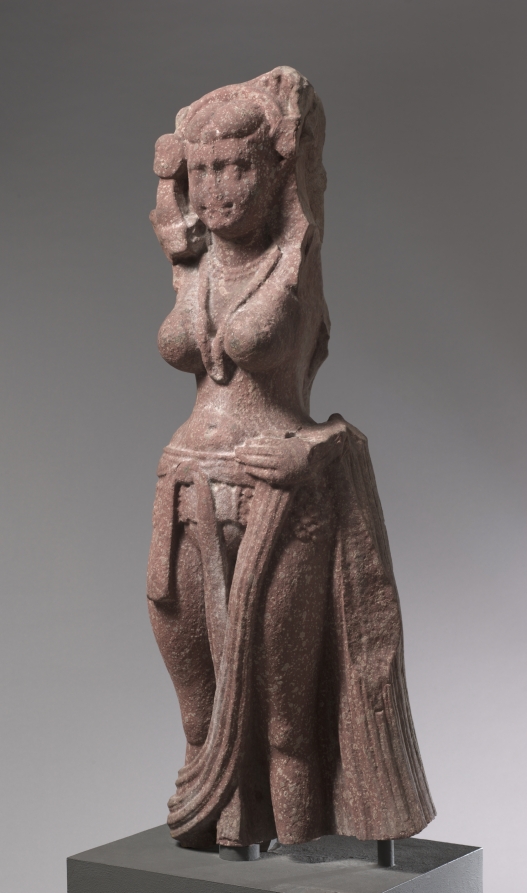
No ancient sari survives as cloth, so the early story is reconstructed from sculpture and words. Dhamija considers wrapped and draped garments to be the oldest form of attire in South Asia.1 By post-Vedic times, she writes, draped garments had developed into a costume with names of its own: the antariya, the lower garment, held in place by a sash or a girdle of jewelry, and the uttariya, the upper wrapper, draped in many folds.1 She also records a breast cloth of the same period, the pratidi, and embroidered wrap skirts called pesas.1
Sculpture shows how these drapes looked. A Mathura relief of the second century CE in the Victoria and Albert Museum appears at first to show a naked woman, but a ridge across the stomach and a falling sash reveal a skirt of transparent fabric, perhaps a fine muslin, which the museum identifies as an antariya.4 The Cleveland Museum of Art holds a Mathura nature divinity of about 75 CE in the same red sandstone.5 Later stone sculptures, Dhamija notes, show the lower wrap pleated and passed between the legs to be tucked in at the back, with variations named "elephant's trunk" and "fish tail."1
The name itself is old. The Sanskrit word śāṭī, which appears in the Mahabharata, is defined in the Monier-Williams dictionary as "a strip of cloth, a kind of skirt or petticoat."2 Banglapedia derives the modern word from this Sanskrit term, and the Art Institute of Chicago translates the Hindi sari as "strip [length] of cloth."3,12 What these ancient sources do not show is a single body-length wrap worn as it is today. Banglapedia describes the sari's evolution from the two-piece antariya and uttariya into a one-piece drape, and points to a sculpture in the Mathura Museum, the Kambojika, as showing a sari draped almost in the modern style.3 Dhamija adds a more speculative idea: the pleated, shoulder-draped Greek chiton, worn by Greek women at the Mauryan court, "may have been an ancestor of the sari."1 For the wider ancient setting, see our survey of ancient South Asian clothing from the Indus Valley to the Mauryas.
Draped and Stitched: The Blouse Before the Colonial Era
Upper-body coverings have a long history of their own. In the Gupta-era murals at Ajanta, according to Dhamija, women wear a range of blouses known by names similar to choli, the word for blouse today.1 She also corrects a common assumption: some European scholars believed that Muslims introduced tailoring to South Asia, but early literature already has words for the needle, the thimble, scissors, and a sewing bag.1
Dhamija traces a notable Islamic influence on South Asian clothing from the eleventh century onward, including a highly evolved style of stitched costume,1 a story told in our surveys of medieval South Asian clothing under the Delhi Sultanate and Mughal-era and regional dress in early modern South Asia. The draped principle also carried religious meaning: Dhamija notes that among Hindus and Jains, stitched garments have to be removed for religious ceremonies or for entering a temple.1 For the wrapped lower garments and breast bands of the Tamil south, see our page on Chola dynasty clothing and its draped garments.
Regional Drapes: One Cloth, Many Ways to Wear It
The sari varies in length as much as in drape. Dhamija gives lengths of 137 to 312 inches (3.5 to 8 meters) among the women of central India and the western coast, where tribal women wear shorter saris and urban, more affluent women wear longer ones.1 Banglapedia gives a range of 5 to 7 yards across India, with a standard urban length of 6 yards and a half-yard piece woven at the end for the blouse.3
Some of the regional drapes that Dhamija describes include:
- In central India and on the western coast, the front pleats pass between the legs and tuck in at the back to form unstitched pantaloons, a style associated with women's chastity.1
- In urban Gujarat, women wear a fourteen-and-a-half-foot sari with a cross border worn in the front.1
- In Karnataka and Tamil Nadu, women wear the sari in a variety of styles that depend on climate and cultural tradition, while women in Kerala wear sarongs instead of saris.1
In Bengal, Banglapedia records an older style worn without a blouse or petticoat: the cloth was knotted at the waist, folded into an apron, wrapped around the back, and thrown over the left shoulder, where its end could cover the head as a sign of propriety before elders or at religious ceremonies.3 The end of the sari that is finally draped over the shoulder is the pallu, and on Banarasi saris a hunting scene can appear in the pallu alone.6
Men wear an analogous garment, the dhoti, a wrap for the lower body that is usually tucked to form an unstitched pantaloon.1
Weaves and Fibers: Banarasi, Kanjivaram, and Jamdani
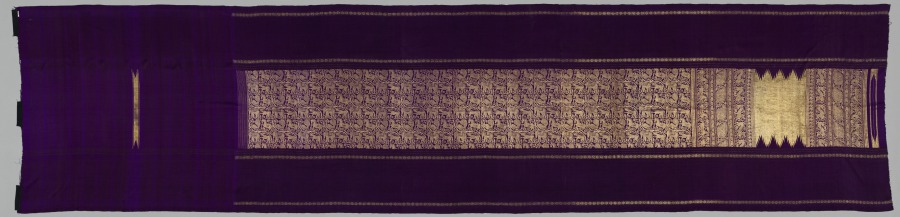
A sari's fabric signaled wealth and occasion as clearly as its drape signaled region. Banglapedia notes that silk and brocade saris, fine muslin, and jamdani continue to hold sway for ceremonial occasions in Bengal.3 The Art Institute of Chicago notes that the brilliant red of one late nineteenth-century sari in its collection is associated with wedding attire.12
Banaras (Varanasi). Suchitra Balasubrahmanyan, of the School of Design at Ambedkar University, Delhi, describes Banarasi brocades, made most often in silk with extra patterning threads of silver and gold, as expensive fabrics mainly used by the wealthy elite.6 Their early history is uncertain. She finds no mention of silk fabrics being produced in Banaras until the nineteenth century, although legends suggest the earlier arrival of weavers from Gujarat. What is known is that high-quality silk and zari brocades were produced in Banaras for display at the Great Exhibition in London in 1851.6 Silk yarn was never local to the town and came from Bengal, Central Asia, and China, and local zari was supplemented with supplies from Paris.6 A nineteenth-century Benares sari in Cleveland, of silk and gold brocade, measures 466.5 centimeters long.7
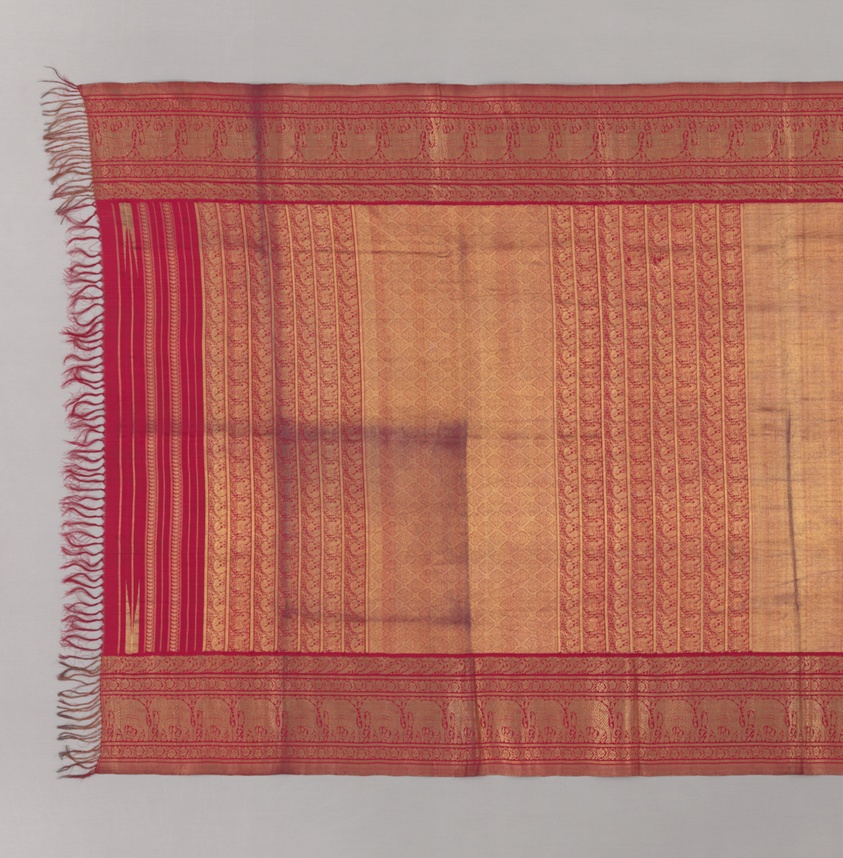
Kanchipuram. The Kanjivaram silk sari is often presented as timeless, but the historian Vijaya Ramaswamy describes silk weaving as "a latecomer" to the Kanchipuram region, which was known for cotton, and says that the British encouragement of sericulture led some weavers there to take up silk.8 Her view is that "before the late 19th century, the Kanjivaram silk sari did not exist."8 The Art Institute of Chicago dates the Kanjivaram sari shown above to the late nineteenth century.9
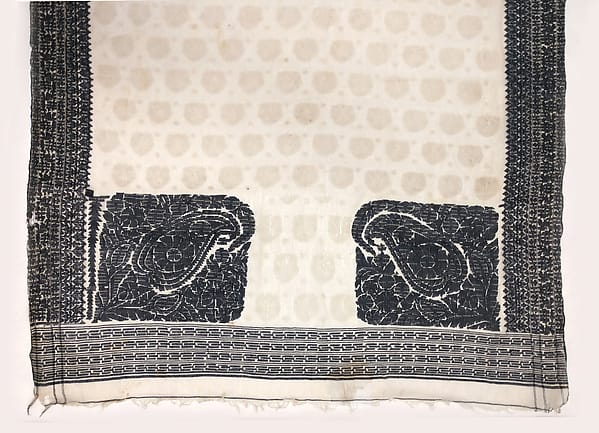
Dhaka. Jamdani is a sheer, patterned cotton fabric woven on handlooms around Dhaka, and its motifs are created directly on the loom with a discontinuous weft technique.10 UNESCO, which inscribed jamdani weaving on its Representative List of the Intangible Cultural Heritage of Humanity in 2013, calls the sari the principal dress of Bengali women at home and abroad and describes the jamdani sari as "a symbol of identity, dignity and self-recognition."10 The Met catalogues the Dacca piece above as muslin with an in-weave design.11
The Blouse and Petticoat: A Nineteenth-Century Ensemble
Under colonial rule, Dhamija writes, women began wearing blouses that imitated the necklines, collars, and puffed sleeves of Western fashion.1 Banglapedia traces the blouse's evolution from a bodice-like shape tied at the back with strings to a long-sleeved blouse buttoned in front.3
The best-known story of this change comes from Bengal. According to a 2022 account in The Daily Star, affluent women of nineteenth-century Bengal wore semi-transparent saris without undergarments inside the zenana, the secluded women's quarters of the household. Jnanadanandini Devi, the wife of Satyendranath Tagore, met Parsi and European women in Bombay and blended the Parsi style with her own. Her drape brought the end of the sari over the left shoulder, freeing the right arm, and added front pleats and brooches, and she adopted a blouse and petticoat under Parsi influence.13 The style became known as the Thakurbari sari, and she taught it to other women through advertisements in the Bamabodhini Patrika.13 The Border&Fall documentation project credits the nivi drape, which it calls "the most widely recognized style worn across the globe," to Gyanodanandini Tagore (another spelling of her name), who it says increased the sari's length in the 1860s.14
The new drape did not win everyone at once. Banglapedia notes that the pleated, or kuchi, style was at first considered non-traditional and was disapproved of, and that it possibly gained social acceptance by the nineteenth century, as drawings and photographs of the period show.3 Our survey of the sari and dress in 19th-century South Asia covers these regional changes in more detail.
Swadeshi and Khadi: The Sari as Politics
Cloth became a political weapon in the struggle against British rule. Divia Patel of the V&A describes the swadeshi movement of the 1890s as a response to growing discontent with colonial rule, with economic issues at its heart: cheaper, finer machine-made thread and fabric from England was disrupting India's own production of handmade fabric. The movement called for a boycott of foreign goods and led to mass protests and bonfires of foreign clothing.15 Gandhi later asked the nation to spin, weave, and wear khadi, hand-woven cloth made from hand-spun thread.15
Saris figured directly in this campaign. In an "Appeal to the Women of India" dated August 11, 1921, Gandhi wrote that he had set fire to "the huge pile containing costly saris and other dresses" in Bombay on July 31.16 He praised women who "have now adopted the white and spotless but heavy khadi sari," and he told them that "only hand-spun and hand-woven can be regarded as Indian manufactures."16 Our survey of modern South Asian clothing, khadi, and independence follows the politics of cloth after 1947.
The Modern Sari
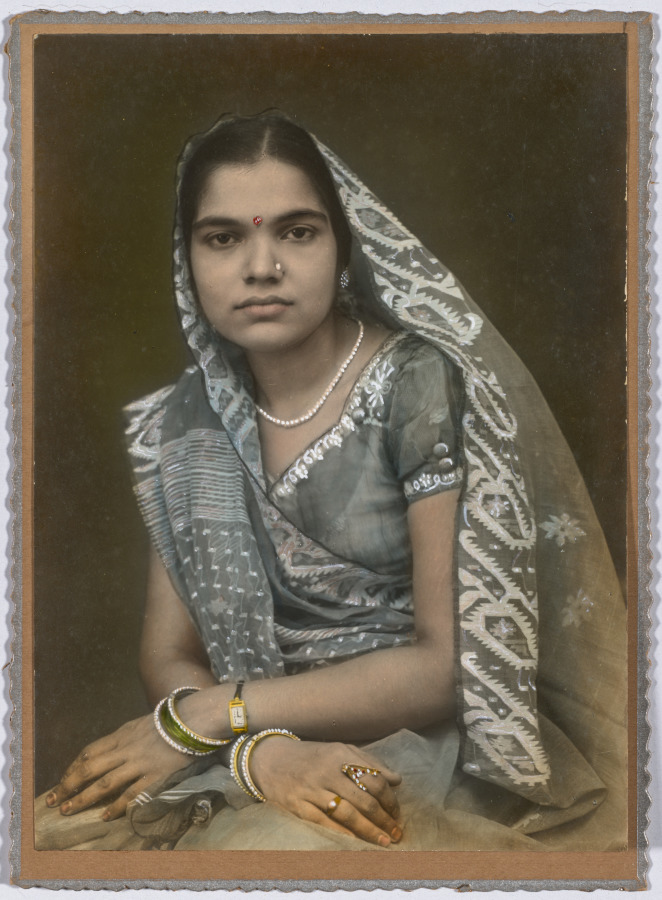
The twentieth century changed the sari again. Studio portraits recorded how it was worn; the Cleveland Museum of Art notes that hand-coloring a portrait photograph cost extra and gave it the status of a luxury item, akin to painted portraiture.17 Banglapedia records that, in Bengal, the handloom cotton saris of village women were replaced in noticeable quantities by colorful machine-made prints, and that fine mulmul cottons gave way to voiles and fine synthetics.3 Georgettes, chiffons, lace, and satin added variety, but Banglapedia concludes that the way of wearing the sari "stabilised in its present form in the 20th century."3 Banarasi weaving changed as well: after independence, the government of India set up Weavers Service Centres, including one in Banaras, and in the following decades Banarasi designs show experiments with motifs and asymmetrical layouts.6
Today the sari faces a different challenge. The Border&Fall project describes it as a garment "often seen as staid, traditional and increasingly worn only on formal occasions, particularly in urban India," and its films document drapes from fifteen Indian states to change that perception.14 Its definition has also widened: traditionally a single piece of unstitched fabric with variable densities in its parts, the sari now includes textiles woven by mill or by hand, often with one density.14
Quick Answers
Where did the sari originate?
The sari grew out of the draped, unstitched dress of ancient South Asia. Post-Vedic dress already had a lower wrapper, the antariya, and an upper wrapper, the uttariya, and Banglapedia describes the sari's evolution from these two pieces into a one-piece drape.1,3
What is the draped South Asian garment worn by women called?
It is the sari, also spelled saree: a long piece of unstitched cloth wrapped around the waist and draped over the shoulder, usually worn with a fitted blouse called a choli.1,12,14 Dhamija calls it the most typical form of South Asian women's dress.1
What does the word sari mean?
The Art Institute of Chicago translates the Hindi word as "strip [length] of cloth."12 It is related to the Sanskrit śāṭī, defined as "a strip of cloth, a kind of skirt or petticoat."2,3
When did women start wearing a blouse with the sari?
Blouse-like garments appear much earlier, but the modern blouse and petticoat spread in the nineteenth century. In Bengal, Jnanadanandini Devi adopted them under Parsi influence, and the nivi drape is credited to her; Border&Fall says she increased the sari's length in the 1860s.1,13,14
Is the Kanjivaram silk sari an ancient tradition?
Not as a silk sari. The historian Vijaya Ramaswamy argues that the Kanjivaram silk sari did not exist before the late nineteenth century, although the Kanchipuram region had a much older cotton-weaving tradition.8
Sources
- Asia, South: History of Dress — Jasleen Dhamija, Encyclopedia of Clothing and Fashion, via Encyclopedia.com (the sari and choli; antariya, uttariya, pratidi and pesas; tailoring vocabulary; Ajanta blouses; regional drapes and lengths; colonial-era blouses).
- Śāṭī — Monier Monier-Williams, A Sanskrit-English Dictionary, Cologne Digital Sanskrit Dictionaries, University of Cologne.
- Sari — Shawal Khan, Banglapedia: National Encyclopedia of Bangladesh, Asiatic Society of Bangladesh (etymology; two-piece to one-piece drape; lengths; Bengali drapes; blouse; twentieth-century fabrics).
- Shalabhanjika — Victoria and Albert Museum, IM.73-1927 (Mathura, 2nd century; transparent skirt, or antariya).
- Nature Divinity (Yakshi) — Cleveland Museum of Art, 1968.104.
- Woven Embroidery: The Brocades of Banaras — Suchitra Balasubrahmanyan, Sahapedia.
- Sari — Cleveland Museum of Art, 1981.218 (Benares, 19th century, silk and gold brocade).
- Kanchipuram Handlooms: In Conversation with Prof Vijaya Ramaswamy — Sahapedia.
- Kanjivaram Sari — Art Institute of Chicago, 2025.146.
- Traditional art of Jamdani weaving — UNESCO Intangible Cultural Heritage, inscribed 2013 (retrieved through the Wayback Machine).
- Sari-length textile — The Metropolitan Museum of Art, 2019.452.4 (record read through the Met collection API).
- Woman's Sari — Art Institute of Chicago, 1944.128 (meaning of the word, wrapping, choli and underskirt, red and wedding attire).
- How Jnanadanandini Devi taught Bengali working women to wear the Sari — Aashnai Syeda, The Daily Star, 2022.
- No. 83 Nivi Drape - West Bengal, India — Border&Fall, The Sari Series: An Anthology of Drape, Google Arts & Culture, 2017.
- The Spinning Wheel of Democracy — Divia Patel, V&A Blog, Victoria and Albert Museum, 2015.
- Appeal to the Women of India, August 11, 1921 — M. K. Gandhi, Mani Bhavan Gandhi Sangrahalaya, Mumbai.
- Untitled (Portrait of a Woman in Gray Sari and Veil) — Cleveland Museum of Art, 2017.11.