Mughal clothing is the dress of the court and nobility of the Mughal Empire, whose court (1526–1858) was, at its height, the leading cultural center of the Indian subcontinent.1 Its core was a stitched outfit for men: the jama, a long robe with a fitted bodice and a skirt, tied on one side, worn over trousers and belted with a patka sash, with a turban on the head.1,2 Women of the court wore a front-opening robe, the peshwaz, over trousers with a large head-cover.8 The style grew out of a change that was underway before the Mughals arrived, which historians describe, crudely, as a shift from draped to stitched clothing.1
How We Know What the Mughals Wore
Three kinds of evidence survive, and each one shows a different part of the picture.
The first is painting. Mughal artists painted cloth with great care. Some of the earliest surviving individual portraits from the Mughal workshop date to about 1575, under Akbar.5 Paintings show ensembles, colors, and how people wore their clothes, but they are idealized. Artists made images of women of the court from idealized forms, and portraits of specific women are relatively rare, because the women of the household lived in seclusion.1
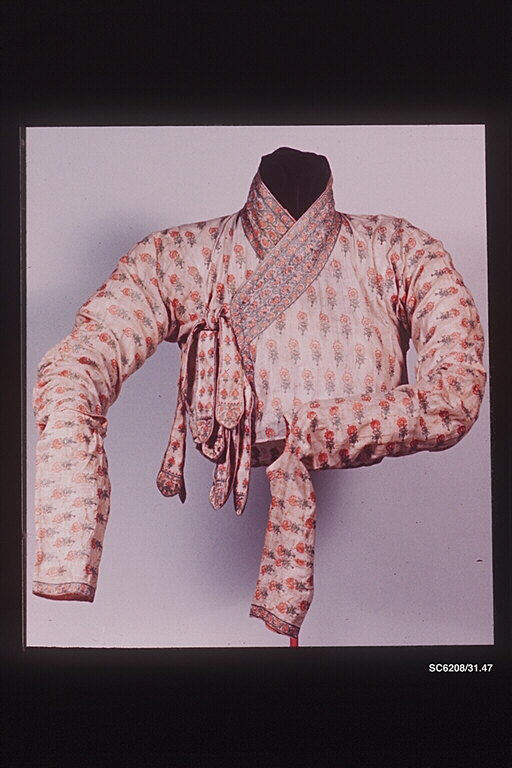
The second is cloth. Garments from the period are rare. Most surviving Indian dress dates from about 1800, and older survivors are mostly flat lengths of cloth rather than clothing.1 The Metropolitan Museum of Art holds the upper part of a jama from about 1628–58, embroidered cotton and silk.1,4 It survived because the bodice and skirt of the jama of that period were made separately and stitched together, so the parts could come apart.1
The third is writing. The most detailed text is the Ain-i Akbari, the account of Akbar's government written by Abu'l Fazl. Its chapter on the imperial wardrobe lists the garments the emperor wore, how much cloth each needed, and what the tailoring cost.3 Memoirs, chronicles, and inventory records add more detail; Sylvia Houghteling's study of Mughal textiles draws on paintings, poetry, chronicle histories, and royal inventories together.13
Reign by Reign: Babur to the Eighteenth Century
Babur (from 1526). The founder of the dynasty came from Central Asia, and his dress was Central Asian. He kept wearing the heavy leather postin and the long chapan coat. He also wrote with contempt that in Hindustan "peasants and people of low standing go about naked," meaning that they wore a loincloth.2
Akbar (r. 1556–1605). Under Akbar, Mughal rule was placed on a surer footing and enlarged.1 Akbar adopted a white cotton jama, translucent, with a tight bodice and a skirt that reached just past the knees.2 The cut was probably an adaptation of the jamas that Rajputs wore in late Sultanate times.1 Akbar also took a personal interest in cloth. Abu'l Fazl writes that the emperor learned the whole trade in theory and practice, and that the imperial workshops and the towns of Lahore, Agra, Fatehpur, Ahmedabad, and Gujarat made "master-pieces of workmanship."3
Jahangir (r. 1605–1627). An allegorical painting of Jahangir holding court shows him in a long robe of extremely fine, sheer cloth over loose striped trousers.1 Because Muslims were not to wear pure silk against the skin, the fabrics were probably the finest cotton or a cotton and silk mixture.1 In his memoirs, Jahangir described a new sleeveless, thigh-length jacket in an Iranian style that he adapted for the court.1
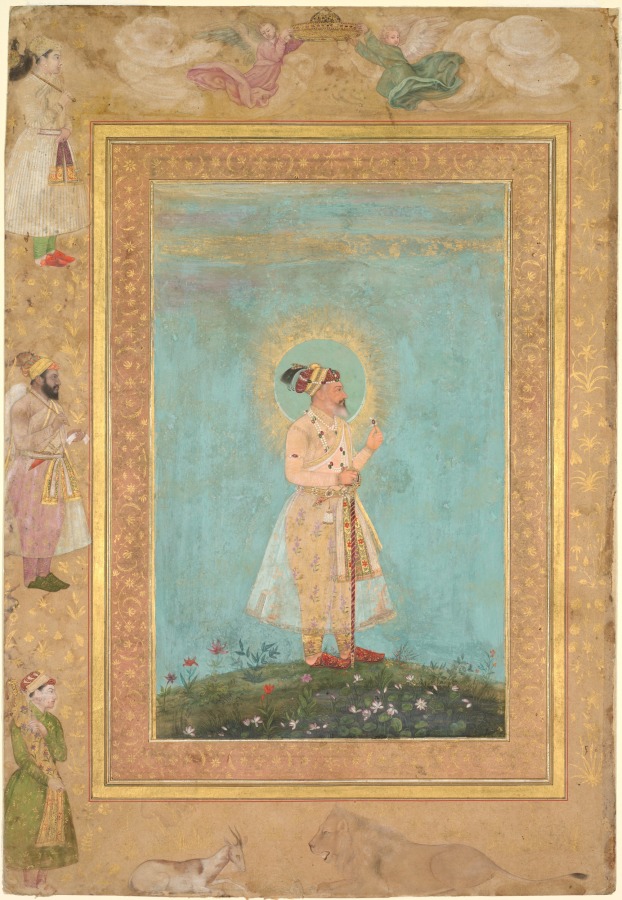
Shah Jahan (r. 1627–1658). Over the seventeenth century, the jama became more voluminous, with many pleats and folds, and the top and bottom parts were made separately and joined.1 A portrait of Shah Jahan from about 1650 shows his robe as costly translucent muslin.6 Shah Jahan and Aurangzeb also wore beards as a sign of piety, where Akbar and Jahangir had worn drooping whiskers.1
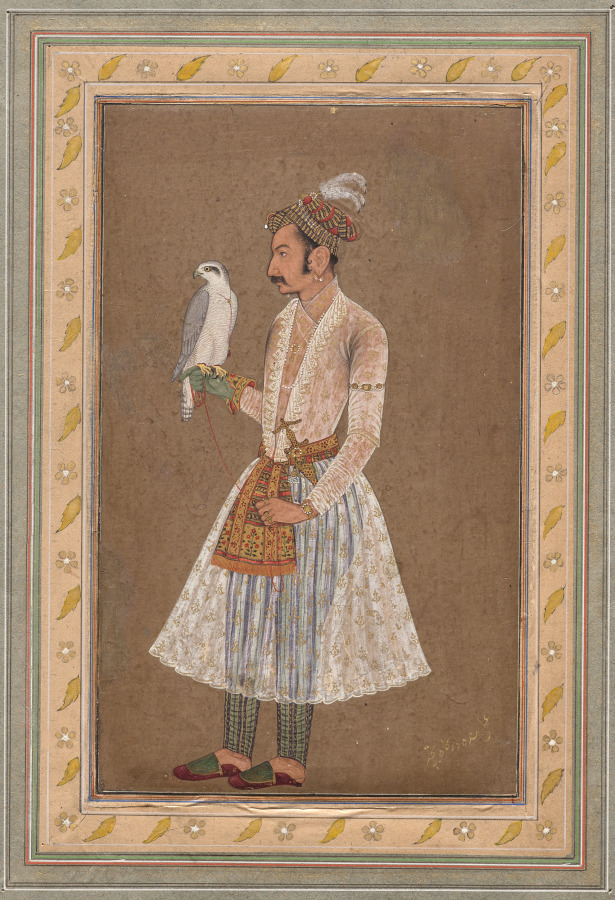
The eighteenth century. As central Mughal power weakened, the jama kept changing. By the eighteenth century, the length of the coat had dropped from the knee to the ankle.1 The emperor Muhammad Shah (r. 1719–1748), known as "Rangila," "the Colorful," appears in a posthumous portrait in a chartreuse green jama with a jeweled belt.12
Men's Dress: Jama, Paijama, Patka, and Turban
A Mughal man of rank wore four main things. The jama was the outer robe. Under it went trousers, which in portraits can be striped, as in a painting of Jahangir.1 At the waist he tied a patka. These sashes were about eleven feet long and half a yard wide; they held the panels of the jama in place or served as belts.2 A late seventeenth-century example at the Metropolitan Museum of Art, in embroidered cotton and silk, measures about 308 by 56 centimeters.7 A man who was kamar band, "waist bound up," was ready for action and service, and a dagger could be lodged securely in the sash.1 The patka was usually plain in the middle, which went around the waist, and richly decorated at the ends, and its designs changed from geometric to more floral by the middle of the seventeenth century.2

The turban completed the outfit. Turbans of chequered cloth, made all over India, appear in Mughal paintings, including an allegorical painting of Jahangir.1 The Ain-i Akbari lists chirahs, turban cloths, among the wardrobe goods.3 Emperors decorated their turbans with plumed aigrettes and strings of stones.1
The ties of the jama carried meaning. A robe fastened on the left was customary for Hindus at court, and one fastened on the right was customary for Muslims, and the ties became decorative features in their own right.1 The Ain-i Akbari shows that this was not a fixed rule from the start. It says the takauchiyah, a coat of the Indian form, had formerly been tied on the left, and Akbar ordered it to be tied on the right and made with a round skirt.3
Women's Dress: Peshwaz, Paijama, and Head-Cover
The Ain-i Akbari describes the peshwaz as a coat of the same form as the takauchiyah, "open in front."3 In the court dress of later Mughal and Deccan women, the peshwaz was often made of fine muslin and worn over patterned paijama trousers and a bodice. A large head-cover or shawl completed the outfit.8 In general, the dress of elite women was a variation of men's dress, often with a length of fine fabric over the head or draped about the arms and shoulders.1
Women also wore Indic dress alongside these forms. A late seventeenth-century Rajput painting from Bikaner shows several styles in one scene, among them a companion in a long, delicate jama over a short-sleeved choli, or bodice, and loose trousers, and an attendant in a choli with either a sari or a skirt and a separate head-cover.1 One name for that large veil is odhni; a later set from Lahore, of about 1855, pairs a kurta and choli with one.9
Elite and Commoner
Almost all of the evidence describes the court. The emperor stood at the top of a visible hierarchy. What set him apart was the craftsmanship and material of his clothes, and his jewelry, more than their form or color, and nobles dressed as befitted their rank.1 Akbar also regulated dress directly. He ordered that people of certain ranks should wear certain articles, "in order to regulate the demand."3
Outside the court, the draped and wrapped garments of India stayed in use. Babur's remark about peasants describes a loincloth, not nakedness.2 Even the emperors used Indic dress in some settings. One painting shows Jahangir at the jharokha window bare-chested, in pearls, earrings, a turban, and a lungi.2
Nobles beyond the Mughal heartland adopted court dress. Jagat Singh, a prince from a small hill kingdom who grew up at Jahangir's court, was painted in Mughal style, probably in 1619.10 The exchange went in both directions. Akbar and Jahangir wore bandhani, tie-dyed cotton, which the scholar Steven Cohen linked to their marriage alliances with Rajput families.2
Fabrics: Muslin, Silk, and Kashmir Shawls
Cotton had a special place in Mughal dress. Houghteling calls it "a fabric of compromise": the jama covered the body, while its sheer cloth showed the king's inner state.2 Muslin came from many centers. A painting of the celebrations after the victory over Baz Bahadur of Malwa shows Akbar in a very fine cloth of the kind that Chanderi, in Malwa, was famous for, and in the 1630s the governor of Malwa sent "several thousand bales" of it to Shah Jahan. After Bengal came under Mughal rule, an office called the malmal khas supervised Bengal muslins and silks for the courts at Delhi and Agra.2
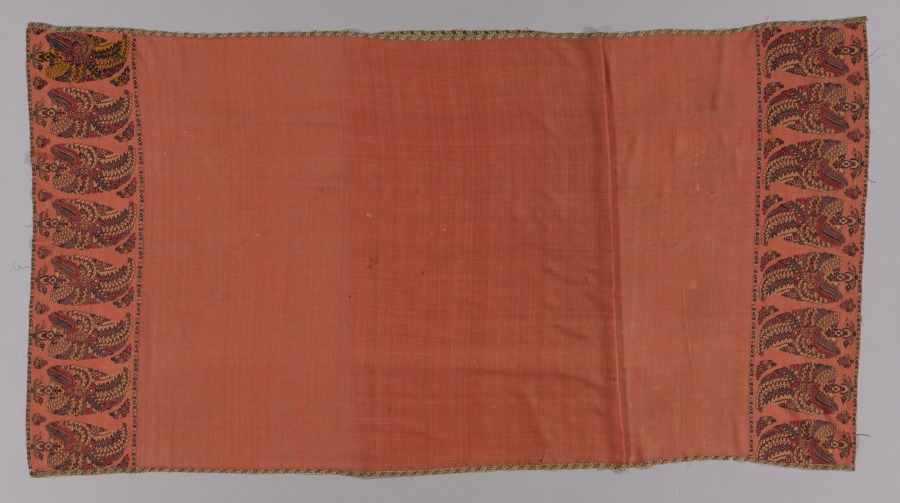
Wool from Kashmir was the other great luxury. Abu'l Fazl writes that Akbar preferred woolen stuffs, "especially shawls," and that the emperor encouraged shawl making in Kashmir. Lahore had more than a thousand workshops, where a shawl of mixed silk and wool, the mayan, was chiefly woven.3 He also records a change in how shawls were worn. People formerly folded them in four, but now threw them over the shoulder without folds, and Akbar began to wear them double.3 Kashmir also paid part of its tribute in fine woolen shawls.2
The wardrobe was organized with great care. Garments in the imperial store were ranked by date of entry, color, price, and weight, and Abu'l Fazl gives a ranked list of colors that begins with the natural color of the tus shawl.3 Every season the workshops made one thousand complete suits for the imperial wardrobe.3 The same chapter lists gold brocades from Gujarat, Lahore, Yazd, Kashan, and Europe.3
Robes of Honor and Akbar's New Names
Cloth was a political tool. Robes of honor, the khil'at or khilat, carried the emperor's touch and were central to ceremonies of investiture and gift exchange. A full set might include as many as seven items: a turban, a jama, a qaba, a close-fitting coat, trousers, a shirt, and a sash.1 An early portrait from Akbar's court shows a courtier holding a maroon and gold scarf that may have been a gift from the emperor.5 Articles in Akbar's wardrobe were also taken out and given away as presents.3
Akbar even renamed clothes. Abu'l Fazl reports that the emperor "invented new and pleasing terms." He called the jama sarbgati, "covering the whole body"; the drawers yarpirahan, "the companion of the coat"; the patka katzeb; and the shawl parmnarm.3 The renaming sits beside Akbar's adoption of the cotton jama, which was part of an effort to join Mughal Islamic traditions with Indic culture.2
Myths About Mughal Dress
Myth: The jama was a Persian garment imported whole. The Mughals did bring Central Asian dress, and Babur kept his chapan.2 But the Mughal jama was probably an adaptation of jamas that Rajputs wore before the Mughal conquest.1 Mughal court dress was a combination, not a transplant.
Myth: Indian court dress did not change. Outsiders often saw Indian dress as timeless.1 The evidence shows steady change: the jama grew fuller in the seventeenth century and longer in the eighteenth, and patka designs moved from geometric to floral.1,2 Kashmir shawl design also evolved, from plain fields with isolated plants at the ends to dense cone-shaped motifs.11 The name "paisley" for those motifs came later, from imitations woven in Paisley, Scotland.11
For the wider picture of the region in this period, see early modern South Asian clothing.
Quick Answers
What did Mughal emperors wear?
Mughal emperors wore a jama, a long robe tied at the side, over trousers, with a patka sash at the waist, a jeweled turban, and many jewels. The emperor stood apart through the fine material and craftsmanship of his clothes rather than a different cut.1,6
What is a jama in Mughal history?
The jama is a long robe with a fitted bodice and a skirt, tied on one side. It became a standard part of Mughal court dress, and Akbar renamed it sarbgati, "covering the whole body."1,3
What did Mughal women wear?
Women of the court wore the peshwaz, a front-opening robe, often of muslin, over paijama trousers and a bodice, with a large head-cover or shawl.8 Women also wore Indic dress such as the choli with a skirt or sari.1
What was a khilat robe of honor?
A khilat was a set of garments given by the emperor in ceremonies of investiture or gift exchange. It could include up to seven items, such as a turban, a jama, a coat, trousers, and a sash.1
Sources
- Fashion and Empire in Early Modern South Asia, c. 1500–1800 — Jagjeet Lally, author's manuscript, UCL Discovery, University College London, 2021 (Mughal court 1526–1858; draped to stitched; jama form, ties, and changes; kamar band; robes of honor; women's dress; Met 31.47).
- The Emperor's New Clothes: Fashion, Politics, and Identity in Mughal South Asia — Simran Agarwal, The Public Domain Review, 2025, drawing on Sylvia Houghteling (Babur's dress; Akbar's cotton jama; patka size and design; bandhani; Chanderi muslin; malmal khas; Kashmir tribute).
- The Ain i Akbari, vol. 1, Ains 31–32: The Wardrobe; On Shawls, Stuffs, &c. — Abu'l Fazl 'Allami, trans. H. Blochmann, Calcutta, 1873, via Persian Literature in Translation, Packard Humanities Institute.
- Fragment of a Robe (Jama) — The Metropolitan Museum of Art, 31.47 (India, c. 1628–58, cotton and silk, embroidered).
- A Mughal courtier — Cleveland Museum of Art, 2013.294 (c. 1575; among the earliest surviving Mughal portraits; scarf that may have been an imperial gift).
- Shah Jahan holding a spinel and a long Deccan sword — Cleveland Museum of Art, 2013.328 (c. 1650; "costly translucent muslin robe").
- Sash (Patka) — The Metropolitan Museum of Art, 47.118a, b (India, late 17th century).
- Peshwaz — Victoria and Albert Museum (Mughal empire or Deccan, late 18th or early 19th century; muslin; worn over paijama with a bodice and a large head-cover or shawl).
- Kurta from Pakistan — TRC Needles, Textile Research Centre, Leiden (kurta, choli and odhni, "veil," Lahore, c. 1855).
- Portrait of Raja Jagat Singh of Nurpur — Cleveland Museum of Art, 2013.324 (court of Jahangir, probably 1619).
- Apricot Long Shawl — Cleveland Museum of Art, 2008.215 (Kashmir, 1785–1800; development of shawl design; the term paisley).
- Posthumous portrait of the Mughal emperor Muhammad Shah — Cleveland Museum of Art, 2013.347 (reigned 1719–1748; "Rangila"; chartreuse green jama).
- The Art of Cloth in Mughal India — Sylvia Houghteling, Princeton University Press, 2022.