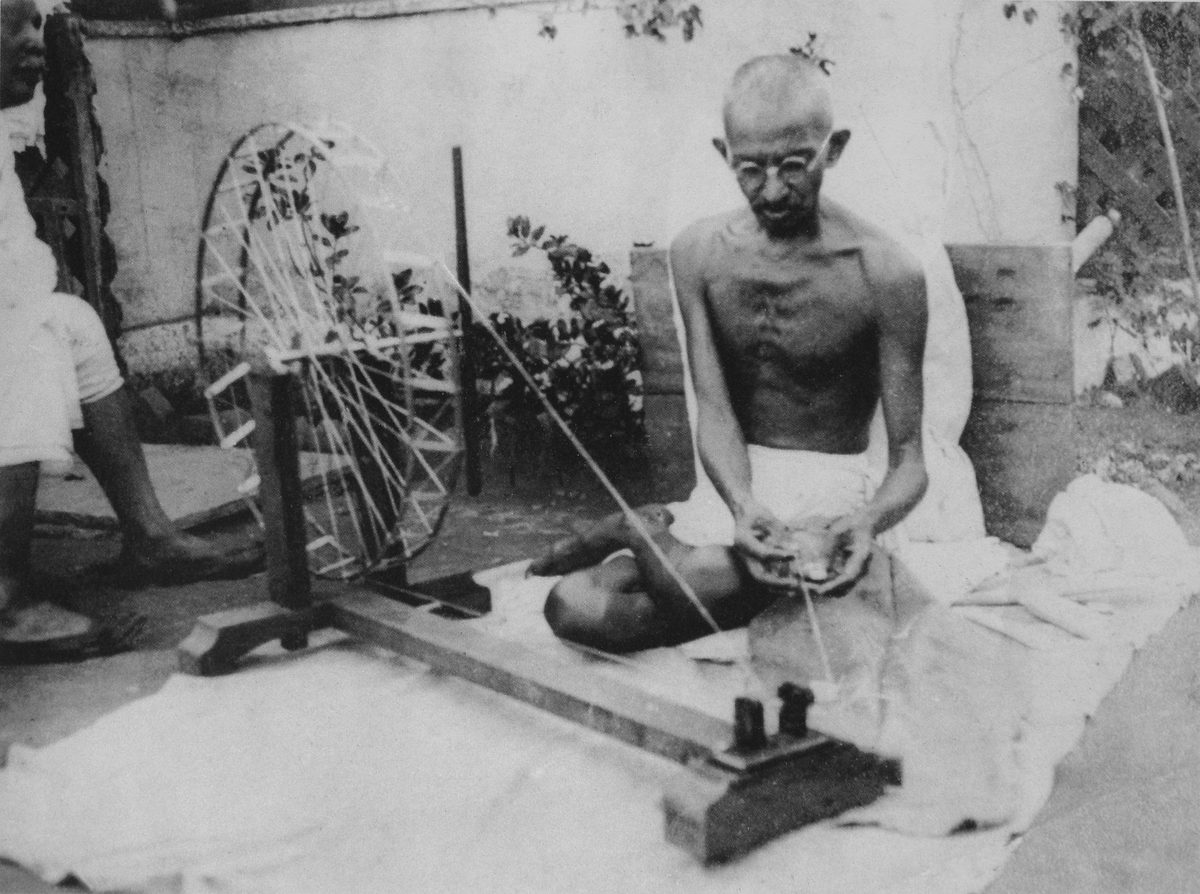
The dhoti is an unstitched length of cloth that men in South Asia wrap around the lower body. The textile historian Jasleen Dhamija calls it "an analogous wrapped garment for the lower torso and legs" to the sari, "widely worn by men," and writes that "it is usually wrapped and tucked to form a kind of unstitched pantaloon."1

Origins and History
Dhamija places the dhoti within a long tradition of draped dress. "Draped and wrapped garments are the most common form of clothing for both men and women in South Asia," she writes.1 In post-Vedic times, "Antariya was the lower garment, while the upper was uttariya."1
How It Was Worn
In the colonial era, Dhamija writes, "The Bengali babu wore his dhoti with a shirt, a coat, and an umbrella."1 In the urban areas of Gujarat "men wear a dhoti with a shirt," and in Bangladesh "Hindu men wear a dhoti (unstitched pantaloon), a vest, and a shoulder cloth."1
Materials and Decoration
Two nineteenth-century dhotis at the Victoria and Albert Museum, both transferred from the India Museum in 1879, are long lengths of white cotton with woven silk borders. One from Varanasi, of about 1855, has "side borders of red and green silk in striped and floral design" and measures 480 by 111 centimeters.2 One from Dhaka, of about 1872, has "narrow side borders in white, red and green silk" and measures 448 by 117 centimeters.3
On This Site
- Ancient South Asian clothing
- Medieval South Asian clothing
- Early Modern South Asian clothing
- 19th Century South Asian clothing
- Modern South Asian clothing
- Chola dynasty clothing and textiles
- History of the sari
Sources
- Asia, South: History of Dress — Jasleen Dhamija, Encyclopedia of Clothing and Fashion, via Encyclopedia.com (the dhoti as an unstitched pantaloon; draped garments; antariya and uttariya; the Bengali babu; Gujarat and Bangladesh).
- Dhoti — Victoria and Albert Museum, 8800(IS) (Varanasi, ca. 1855; white cotton with silk borders; dimensions; transferred from the India Museum in 1879; record read through the V&A collections API).Reference 1
- Dhoti — Victoria and Albert Museum, 8672(IS) (Dhaka, ca. 1872; white cotton with silk borders; dimensions; transferred from the India Museum in 1879; record read through the V&A collections API).Reference 1