Ancient · Europe · 3000 BCE - 500 CE
Ancient Greek Clothing: Chiton, Peplos, Himation, and Chlamys
A guide to ancient Greek garments, their construction and color, and the limits of learning about dress from sculpture and vase painting.
By Dan Schnau · Last updated
Ancient Greek clothing included the chiton, a tunic, the peplos, a garment with a folded upper edge, and the himation, a large mantle. Men also wore a shorter cloak called the chlamys. These names describe garment families with variations in fabric, fastening, and arrangement; they were not one uniform outfit worn throughout Greek history.1,2
This guide focuses on the garments discussed in museum accounts of Archaic and Classical dress. For the surrounding regional history, see ancient European clothing.
The Main Garments Compared
| Garment | Construction and use |
|---|---|
| Chiton | Cloth joined to form a tunic, with openings for the head and arms; shoulder fastenings could extend along the upper arms.2 |
| Peplos | A large cloth folded down at the top to form an overfold, then fastened at the shoulders.3 |
| Himation | A rectangular mantle arranged around the body; its draping could vary considerably.2 |
| Chlamys | A short cloak associated with men, including riding dress.1 |
How Was a Peplos Worn?
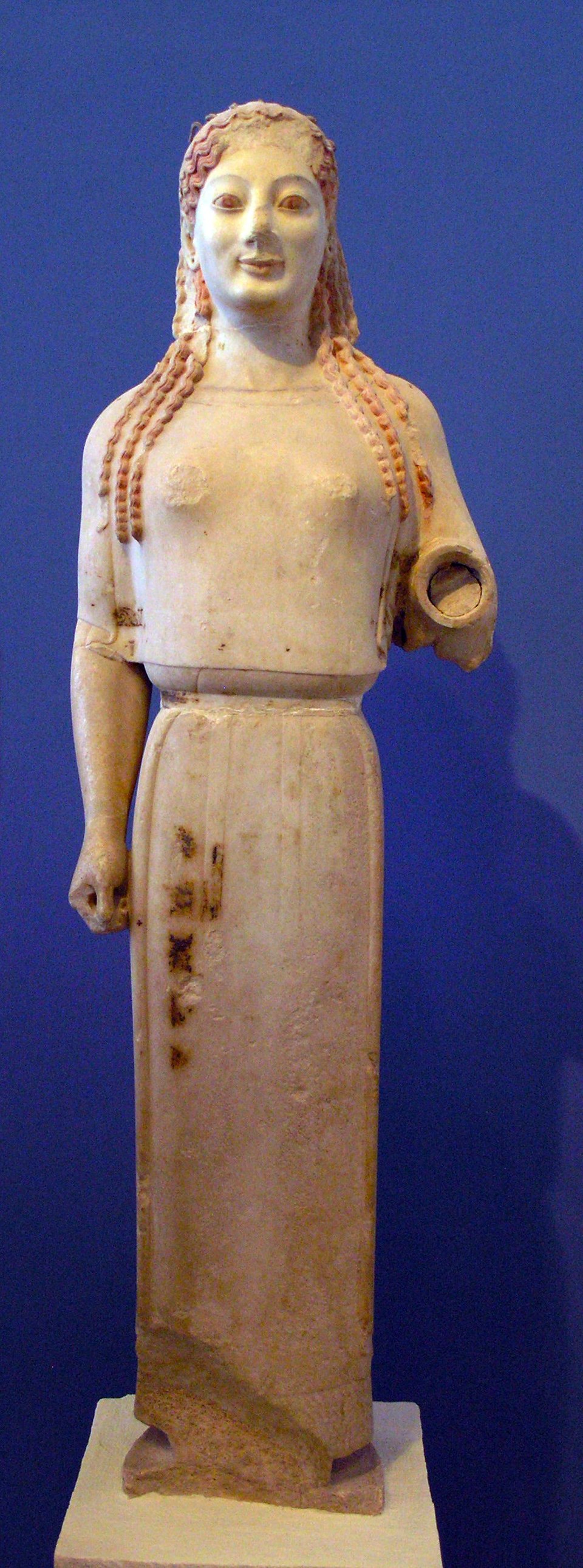
A peplos was usually made of relatively heavy wool. The upper portion folded outward and downward, creating the distinctive overfold called an apoptygma.3 Shoulder pins held the garment in place. Some arrangements left one side open, while others closed the side with sewing or additional fastenings. This makes “a sheet simply wrapped around the body” an incomplete description.3
The National Archaeological Museum in Athens illustrates the garment through a statue dated to about 440 BCE. Its sculpted folds respond to the figure's movement. The museum also connects the peplos with Athena and the ceremonial presentation of a woven garment at the Panathenaea festival. A garment could therefore carry religious meaning as well as clothe its wearer.4
What Made the Chiton Different?
The chiton's structure depended on joining cloth rather than creating the peplos's characteristic deep overfold. Harold Koda describes a common construction using two rectangles sewn at the sides, with their upper edges joined at selected points for the shoulders. Other versions used pins or buttons. These arrangements help explain why images can show either open shoulders or a series of fastenings along the upper arms.2
Lighter linen was used for chitons, while heavier wool was typical of the peplos. Belting could draw up extra length to create a pouch of cloth, called a kolpos, above the waist.1 The visible silhouette consequently depended on how a garment was arranged as well as how much material it contained.1
Cloaks, Movement, and Men's Dress
Men wore tunics and mantles too. The chlamys was a shorter cloak, while a himation offered a larger expanse of cloth to arrange around the body. Sandals, slippers, shoes, and boots also appear in the evidence; footwear was not limited to the open sandals familiar from modern costume illustrations.1
A himation was rectangular, whereas the Roman toga had a different shape and social history. Calling every ancient Mediterranean wrap a toga obscures those differences. Koda also cautions that the garment names used by scholars simplify a much more varied visual record.2
Were Ancient Greek Clothes White?
Paint traces on sculpture complicate the familiar image of white Greek clothing. Cambridge's painted reconstruction of the Peplos Kore draws on surviving pigment and earlier records of its appearance. The museum explicitly describes the reconstruction as an interpretation: traces establish that color existed, but a modern painted cast cannot recover every original detail with certainty.5

What Can Images Tell Us?
Statues, figurines, and painted pottery provide evidence of garment arrangement, but they also express artistic choices. The University of Colorado's account notes that representations of women were often created by men and shaped by their expectations. Its discussion also distinguishes later draped garments from the fitted clothing shown in Bronze Age imagery. “Ancient Greek clothing” should therefore be read with attention to period, setting, and the kind of person represented.3
For a comparison of another court's tunics and riding clothes, continue to ancient Persian clothing.
Sources
- Ancient Greek Dress — Department of Greek and Roman Art, Metropolitan Museum of Art, 2003.
- The Chiton, Peplos, and Himation in Modern Dress — Harold Koda, Metropolitan Museum of Art, 2003 (construction and terminology).
- Women's Dress in Archaic Greece: The Peplos, Chiton, and Himation — Stephanie Ann Smith and Debby Sneed, University of Colorado Boulder, 2018.
- A peplos for Athena — Chrysanthi Tsouli, National Archaeological Museum, Athens, 2017.Reference 1
- Peplos Kore restored — Museum of Classical Archaeology, University of Cambridge (painted reconstruction and its limits).Reference 1