The peplos was a women's garment of ancient Greece: a large rectangle of heavy fabric, usually wool, folded over along the upper edge and fastened at the shoulders with a pin or brooch.1 Stephanie Ann Smith and Debby Sneed of the University of Colorado Boulder call it "the earliest known item of Archaic Greek women's clothing," and note that it is also known as the Doric chiton.2
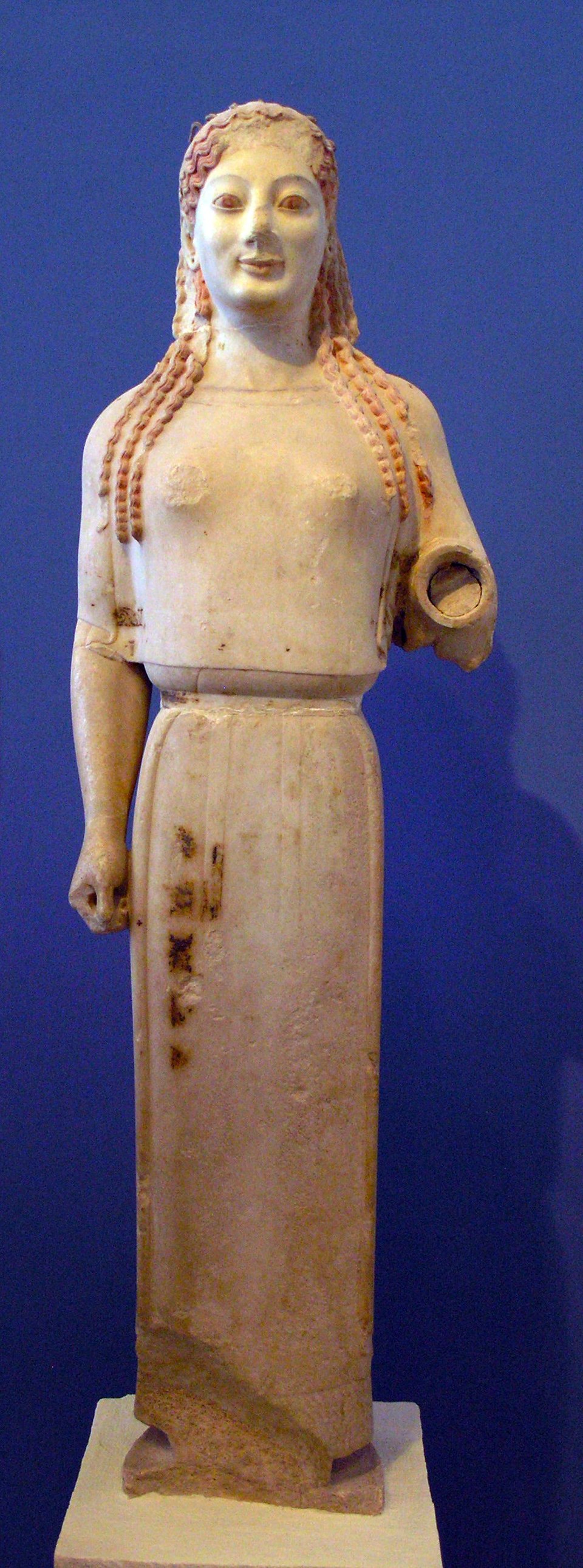
The Peplos Kore, about 530 BCE, Acropolis Museum, Athens. Photo: Marsyas. Wikimedia Commons, CC BY-SA 2.5.

How It Was Worn
The overfold, called the apoptygma, reached to the waist.1 Openings for the arms were left at each side, and the open side of the garment was either left that way or pinned or sewn to form a seam.1 Smith and Sneed distinguish an open peplos, left open to show one leg, from a closed peplos sewn along both edges.2 The garment was floor-length and usually long enough to be pulled over the belt, creating a pouch known as a kolpos.1
Materials and Decoration
Smith and Sneed write that "Peploi were often brightly colored and patterned."2 The Met describes the fabric as heavy, usually wool.1
Meaning and Status
The Art Institute of Chicago retells a story from Herodotus in which Athens ordered the peplos replaced by the chiton after women stabbed a battle survivor with their pins, and notes that historians are generally skeptical about it.3 Smith and Sneed write that the chiton lost favor to the peplos in the fifth century BCE.2
On This Site
Sources
- Ancient Greek Dress — Department of Greek and Roman Art, Heilbrunn Timeline of Art History, The Metropolitan Museum of Art, October 2003 (construction, apoptygma, kolpos, and materials; text retrieved through the Wayback Machine).
- Women's Dress in Archaic Greece: The Peplos, Chiton, and Himation — Stephanie Ann Smith and Debby Sneed, Department of Classics, University of Colorado Boulder, 18 June 2018 (earliest Archaic women's garment, Doric chiton, open and closed forms, color, and the fifth-century shift).
- Ancient Greek Dress: The Classic Look — Jeff Nigro, Art Institute of Chicago, 1 February 2022 (the Herodotus story and the peplos in art; text retrieved through the Wayback Machine).Reference 1