Ancient · Middle East & North Africa · 3000 BCE - 500 CE
Ancient Persian Clothing: Achaemenid Court and Riding Dress
A sourced guide to Achaemenid clothing, with distinctions between ceremonial and riding outfits and a close look at the limits of the surviving evidence.
By Dan Schnau · Last updated
Ancient Persian clothing in the Achaemenid period included both flowing court garments and a riding outfit with a sleeved upper garment, trousers, and a cloak. These were alternatives within the empire's clothing traditions, rather than a dependable way to identify every wearer's ethnicity. Scholarly descriptions distinguish their function and appearance while acknowledging overlapping use.1,2
This guide focuses on Achaemenid evidence. For neighboring traditions, start with Mesopotamian clothing or the ancient Middle Eastern survey.
Court Dress and Riding Dress Compared
Wolfgang Messerschmidt's chapter on Achaemenid clothes distinguishes the riding outfit from the Persepolitan court robe, which he calls a kypassis.2 The riding ensemble includes a tiara, a sleeved shirt, close-fitting legwear, and a cloak. His summary notes that the king could also wear riding dress, although official art at the royal residences presents him in the court robe and a crenellated crown.2
| Evidence or garment | What it helps explain |
|---|---|
| Draped, pleated court clothing | Ceremonial appearance rather than a single ethnic uniform.1 |
| Trousered riding outfit | Another established form of clothing, also available to royal wearers.2 |
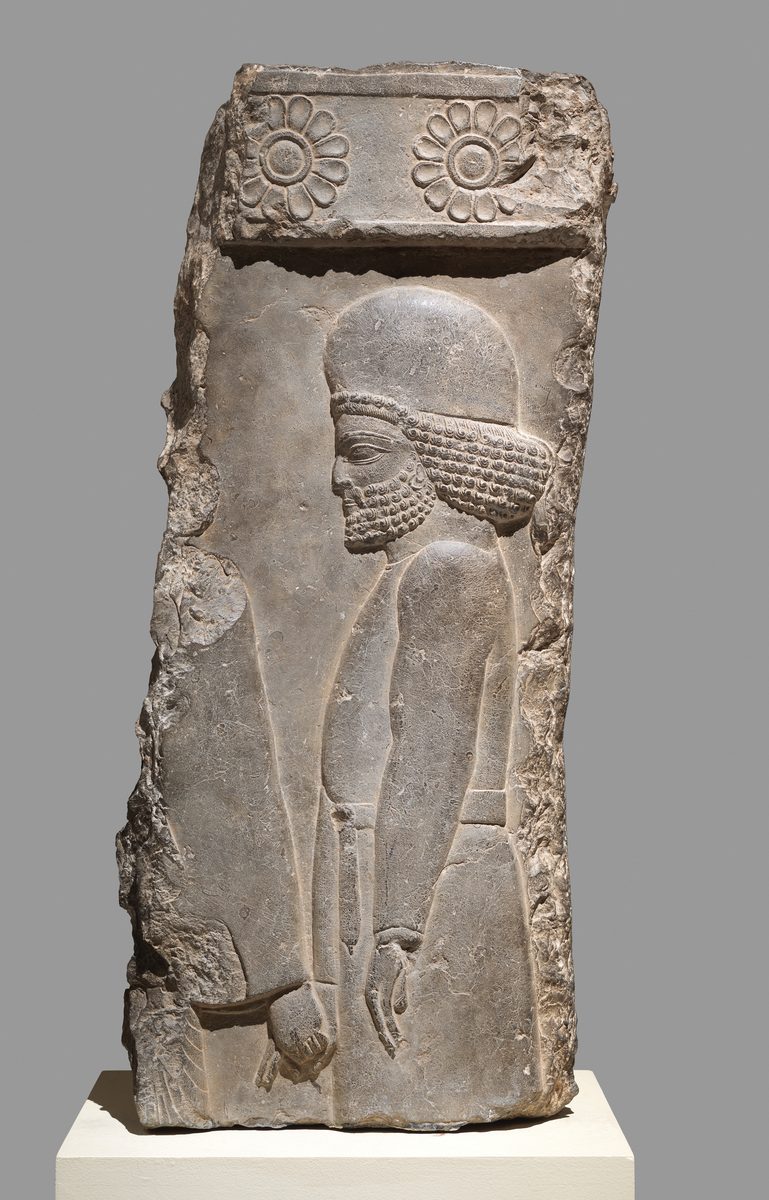
| Rounded cap and belted tunic | Features used in the Met's interpretation of a particular Persepolis figure.3 |
| Royal crown in residence art | The king's formal presentation within the setting of the court.2 |
What the Persepolis Reliefs Show
UNESCO dates the beginning of Darius's great terrace at Persepolis to about 518 BCE. Successive rulers expanded the palace complex. Its carved scenes include guards, dignitaries, and tribute bearers, placing clothing within a carefully arranged representation of monarchy and empire.4
One relief in the Metropolitan Museum, dated to about 405–359 BCE, shows a bearded figure in a belted tunic and rounded cap. The museum identifies him as Median and places him in a procession bringing provisions for a royal feast. That interpretation belongs to this object's setting and catalogue; it should be distinguished from the broader question of whether an outfit could be worn by people of several backgrounds.3,1
Was “Median Dress” Only Worn by Medes?
No. Alireza Shapur Shahbazi cautions against using dress alone to identify nationality. He prefers the descriptive categories court dress and cavalry costume. A trousered figure should not automatically be identified as a Mede from clothing alone.1
The long-sleeved overgarment often called a candys also presents a problem: Shahbazi notes continuing debate about the term and its identification.1
What Did Achaemenid Women Wear?
Evidence is less complete for women. The introductory Iranica discussion explains that texts and monuments from early Iranian history disproportionately concern men, rulers, and elite settings. Artistic conventions can also obscure whether an image records clothing in ordinary contemporary use.5
Shahbazi gathers depictions of women in pleated clothing and voluminous garments compared with an Ionic chiton. He cautions that textiles from distant Pazyryk may reinterpret Achaemenid influences, rather than preserving clothing identical to that worn at the Persian court.1
How to Read a Reconstruction
A reconstruction brings several kinds of evidence together, but they answer different questions. A relief preserves a represented outline; a literary passage supplies a description; an excavated fragment may identify a textile. Iranica warns that these sources are uneven and difficult to reconcile. The distinction matters most when a reconstruction seems to offer a complete outfit for a social group poorly represented in the surviving material.5
For a comparison of rectangular mantles and tunics, see ancient Greek clothing. For much later court traditions, continue to Ottoman clothing.
Sources
- Clothing ii. In the Median and Achaemenid periods — Alireza Shapur Shahbazi, Encyclopaedia Iranica (court and cavalry styles, terminology, women's dress, and interpretive limits).
Return to text (6 references)
Reference 1 Reference 2 Reference 3 Reference 4 Reference 5 Reference 6 - Clothes and Insignia — Wolfgang Messerschmidt, in A Companion to the Achaemenid Persian Empire, 2021, chapter 74 (public chapter summary).
- Relief: figure in a procession, 39.133 — Metropolitan Museum of Art.
- Persepolis — UNESCO World Heritage Centre (site chronology and royal imagery).Reference 1
- Clothing i. General remarks — Encyclopaedia Iranica (source survival and the interpretation of representations).