The toga was the wrapped woolen outer garment of ancient Rome, worn over a tunic and draped around the body without pins or sewing. Its probable ancestor was the tebenna, a semicircular mantle worn by the Etruscans, a people of the Italian peninsula. From the time of the Roman Republic (509 to 27 BCE), the plain toga was the symbol of Roman citizenship, and only free male citizens were supposed to wear it. It survived as an elite ceremonial garment into the fifth century CE.1,3,4
Romans themselves treated the garment as a badge of identity. In the Aeneid, Virgil has Jupiter call the Romans "masters of the earth, the race that wears the toga."3
Etruscan Roots and the Earliest Toga
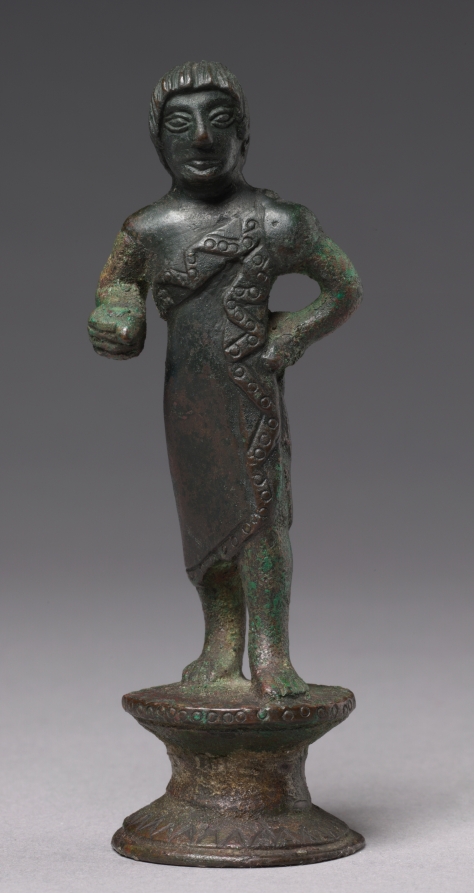
The Cleveland Museum of Art describes the cloak on this small bronze as likely an embroidered tebenna, "an Etruscan forerunner to the Roman toga praetexta."5 Phyllis Tortora, writing in the Encyclopedia of Clothing and Fashion, notes that several Roman kings were Etruscan and that many elements of Etruscan culture passed to the Romans; the toga may have been one of them.1 Smith's Dictionary of Greek and Roman Antiquities (1875) agrees that the Romans seem to have received the garment from the Etruscans, and records the ancient claim that the toga praetexta in particular was derived from them.2
Very little actual cloth survives. Ursula Rothe's book The Toga and Roman Identity, as summarized in a review in the Bryn Mawr Classical Review, discusses "the only materially surviving tebenna/toga from the ancient world," a fragmentary wool mantle with a border of a different color, dated to 700 BCE.4 Almost everything else we know comes from sculpture, painting, coins, and Roman writers.
The early toga was smaller and simpler than the later one. According to Gellius, as cited by Smith, it was at first worn alone, without a tunic.2 Tortora describes its earliest form as a semicircle of white wool.1 Rothe also discusses archaic habits that survived later, such as wearing the toga without a tunic.4
The Toga as Citizen Dress
The toga was a legal and social marker as much as a piece of clothing. Barbara McManus states that only male citizens were allowed to wear it.3 Smith notes that its use was forbidden to exiles and to foreigners, and the Fashion, Costume, and Culture encyclopedia adds slaves to that list.2,8
Citizens were expected to wear the toga for public life. Tortora describes it as required dress for official activities, worn to audiences with the emperor and to the games.1 Smith lists the law courts, the theater and the games when the emperor was present, and clients when they received the sportula.2 It was a civilian garment: in war it was laid aside, so that togatus (a man in a toga) was the opposite of miles (a soldier).2
The ceremony of taking up the adult toga marked a boy's entry into public life. McManus places it between the ages of 14 and 16, usually at the festival of the Liberalia on March 17, when a boy laid aside his bordered toga and put on the toga virilis.3 Smith describes friends escorting the young man in a solemn procession to the Forum and the Capitol.2
Types of Toga
The basic shape stayed the same, but color and trim showed who the wearer was:3
- Toga virilis, also called the toga pura: the plain toga of adult male citizens, in the natural off-white color of undyed wool.3,2
- Toga praetexta: an off-white toga with a broad purple border. Sources disagree about who could wear it. McManus limits adult use to curule magistrates (curule aedile and above).3 Smith lists magistrates of Rome and of the colonies and municipalities, priests, and people performing sacred rites.2 Tortora gives the border as about two or three inches wide.1
- Toga candida: a toga artificially whitened for men standing for office. Smith says the brightness came from rubbing it with chalk, and Tortora notes that the English word "candidate" comes from it.3,2,1
- Toga pulla: a toga of dark wool worn in mourning. Smith adds that artisans and others of the lower orders sometimes wore it too.3,2
- Toga picta: a purple toga embroidered with gold thread, worn by a victorious general in his triumph. Under the emperors, Smith says, consuls wore it, and so did praetors when they celebrated the games.3,2
- Trabea: a toga ornamented with purple horizontal stripes. Smith reports three kinds described by Servius, and connects the trabea with early kings, augurs, consuls at certain ceremonies, and the equestrian order.2
Children also wore the praetexta. Smith states that children of both sexes wore it with the bulla, and that girls wore it until marriage.2 Tortora says girls gave it up around puberty.1 McManus notes that in theory all freeborn citizen boys could wear it, but because of its expense it generally indicated an upper-class wearer.3
A toga that was not kept clean had its own meaning. Smith explains that a dirty toga was called sordida, and accused persons wore one, with disordered hair, as Cicero did.2
How the Toga Was Worn
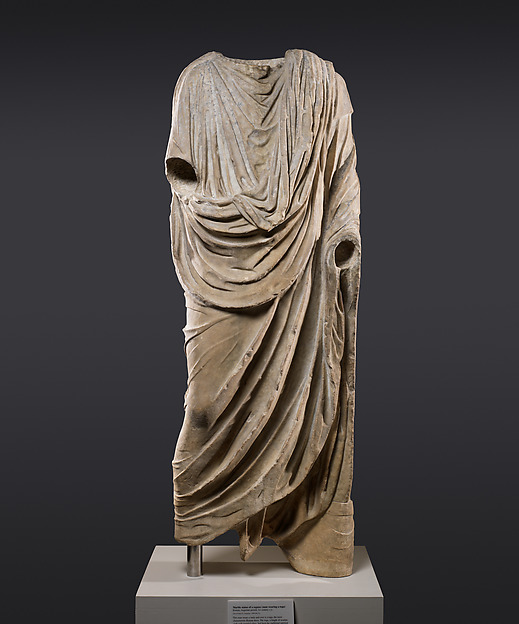
The toga was a large woolen cloth cut with both straight and rounded edges.3 McManus describes the sequence: the cloth was folded lengthwise, draped over the left side of the body and the left shoulder, brought under the right arm, and back up over the left arm and shoulder. Its own weight and the pressure of the wearer's left arm held it in place.3
Two parts of the later toga had their own names.1 The sinus was the large overfold hanging across the front of the body. The umbo was a bunch of cloth pulled up from beneath the sinus and draped over it.3 Tortora explains that the sinus could at first hold objects such as a scroll; when it became too loose, the umbo served as the pocket.1 The back of the toga could be drawn up over the head for religious ceremonies.3
Size is harder to fix. Smith, writing in 1875, judged the exact form "much disputed" and thought the later toga must have been less than a semicircle to produce so many folds.2 The Fashion, Costume, and Culture encyclopedia gives a size of "about eighteen feet long by about eleven feet wide" for the enlarged toga.8 Tortora notes that a poor man might wear a shorter toga to save money, while a man who wanted to impress might wear a larger one.1
The garment was difficult to manage. McManus calls togas "costly, heavy, and cumbersome," and notes that prominent Romans had slaves trained to put them on.3 Smith also describes a ritual drape, the cinctus Gabinus, in which part of the toga was tied around the body as a belt while another part covered the head; persons offering sacrifices wore it, and its name points to an Etruscan origin.2
Augustus and the Toga
By the late first century BCE, according to the Metropolitan Museum of Art, the toga was declining in popularity.7 The emperor Augustus pushed back. Suetonius writes that Augustus "desired also to revive the ancient fashion of dress." On seeing a crowd in dark cloaks at an assembly, he quoted Virgil's line about the toga-clad Romans and "directed the aediles never again to allow anyone to appear in the Forum or its neighbourhood except in the toga and without a cloak."6
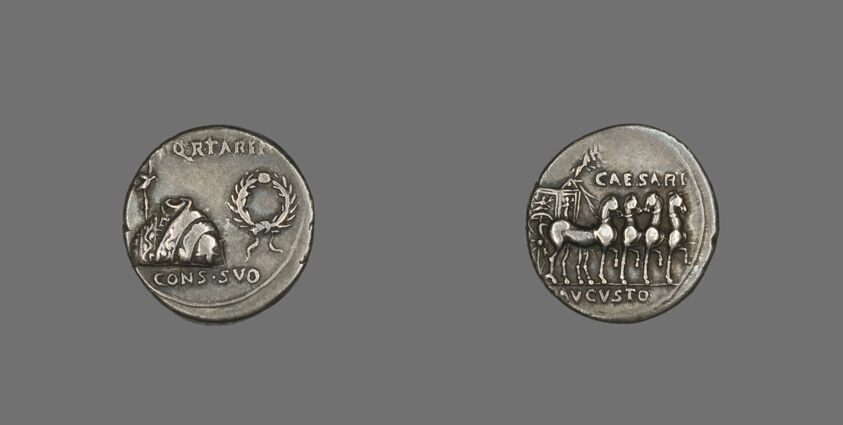
The Met calls the result "a sort of unofficial state dress that all citizens were required to wear in the forum."7 Rothe treats Augustus's toga policy as revolutionary, reviving the garment in both style and significance, and in her words it allowed "every man to understand the new world order."4 The coin above, issued about 18 BCE with the inscription CAESARI AVGVSTO, shows a toga, tunic and wreath that the Art Institute of Chicago describes as symbols of the Roman empire.9
Augustus's own habits were more modest. Suetonius says his togas were "neither close nor full," and that he wore house clothes made by his sister, wife, daughter, or granddaughters.6
Women and the Toga
The toga was not always a male garment. McManus, Tortora, and Smith all state that women had worn it in early Rome.3,1,2 By the late Republic, all women married according to Roman law were entitled to wear the stola, a long sleeveless tunic worn over another tunic, and respectable women added a palla, a rectangular cloak, when they went outside.10
A darker tradition attached the toga to women who lost their respectability. Smith states that after matrons took up the stola, the toga was worn only by prostitutes and by women divorced for adultery.2 McManus says the lowest-class prostitutes were compelled to wear a plain toga of coarse wool, and that there is "some evidence" that convicted adulteresses might have been forced to wear it.3 Rothe is more skeptical. According to the review, she treats this toga as "more of a literary image of improper gendered behaviour," less likely to have been an actual habit of dress, and never a punishment imposed by law.4 The evidence does not settle how often such women wore togas in daily life.
Decline in Late Antiquity
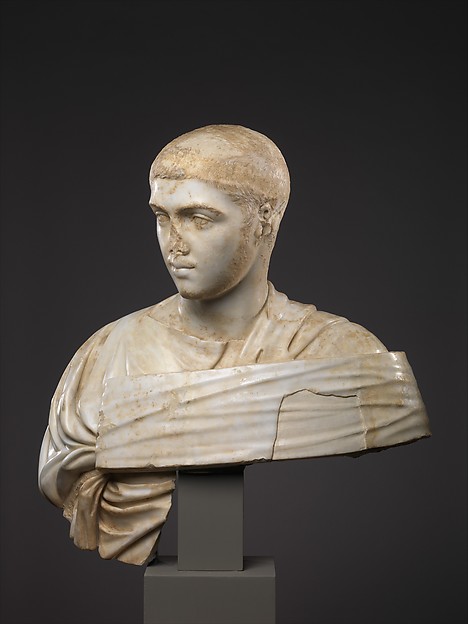
The toga kept changing shape after Augustus. Tortora describes a version from about 118 to 119 CE that dropped the umbo for a twisted band, and by the third century a "toga with the folded bands."1 The Met describes the bust of Severus Alexander (reigned 222 to 235 CE) as wearing a toga contabulata, with a large overfold across the chest, a type distinctive of later Roman portraits in formal civic dress.11
Everyday use faded. The Fashion, Costume, and Culture encyclopedia dates the toga's abandonment as a common garment to sometime after about 200 CE, though it was still worn for ceremonies.8 Tortora writes that men in the later empire preferred the pallium, a rectangular wrap descended from the Greek himation.1 Rothe, as the review summarizes her, adds that Christians preferred the pallium and that the Celtic paenula cape became general streetwear, while the toga became an elite ceremonial dress in use until the fifth century CE.4
Law still required it on some occasions. A law of January 12, 382 CE, issued to the prefect of the city of Rome, told senators inside the city to put aside military dress for the colobium and the paenula, but to appear in the toga when the senate met or when their case was heard before a judge.12 The wider shift toward sleeved tunics and trousers is covered in the late antiquity section of our survey of ancient European clothing, from Greek chitons to Roman togas.
Myths About the Roman Toga
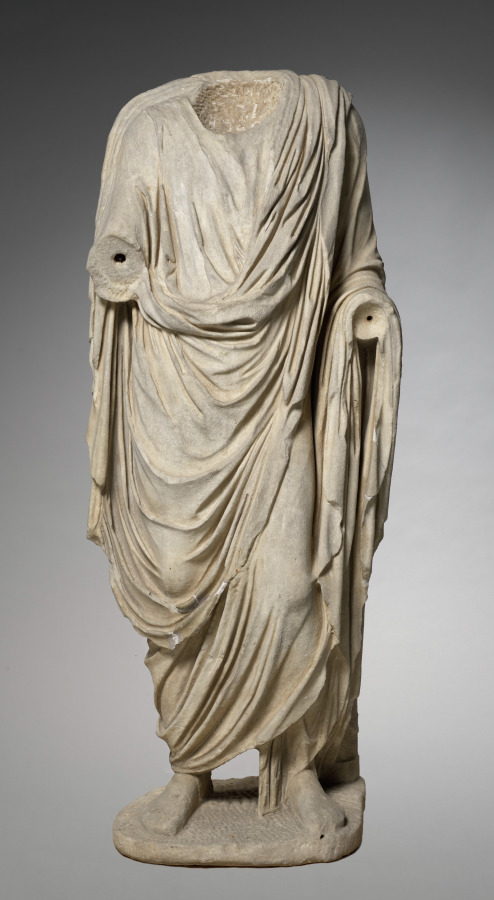
"Everyone in Rome wore a toga every day." The toga was for male citizens, not for women in general, slaves, or foreigners.3,8 The basic item of male dress was the tunic, and working men and slaves often hitched theirs up for freer movement.3 Citizens did not always wear the toga either: by the beginning of the Empire, Augustus had to require it in the Forum.3,6 Statues can also mislead. The Cleveland Museum of Art notes that this toga-clad body was displayed from 1929 until 1973 with a portrait head that did not originally belong to it.13
"The toga was only a symbol, rarely worn." This is the opposite error. Rothe argues against the scholarly view of the toga as "a symbol rather than a garment," and uses pictorial evidence to show it was worn in everyday life, including by sub-elite citizens whose togas may have been darker and less voluminous, and often dirty, shabby, and patched.4
"Togas were always white." The plain toga was the off-white of undyed wool, but mourners wore dark togas, magistrates and children wore purple borders, and triumphing generals wore purple with gold.3,2
Quick Answers
Who Could Wear a Toga in Ancient Rome?
Male Roman citizens. Foreigners, exiles, and slaves were barred from it. Freeborn children could wear the bordered toga praetexta, and women had worn the toga in early Rome before adopting the stola.2,3,8,1
What Is the Difference Between the Toga Praetexta and the Toga Virilis?
The toga praetexta had a broad purple border and was worn by freeborn children and certain magistrates and priests. The toga virilis, or toga pura, was the plain undyed toga a boy put on at about 14 to 16 to mark adulthood.3,2
How Big Was a Roman Toga?
It varied with period and with the wearer's wealth. The early toga was small; one reference work gives about eighteen by eleven feet for the later, larger version.1,8
When Did Romans Stop Wearing the Toga?
It faded from common use after about 200 CE and survived as elite ceremonial dress into the fifth century CE.8,4
Sources
- Toga — Phyllis Tortora, in Valerie Steele (ed.), Encyclopedia of Clothing and Fashion, Charles Scribner's Sons, 2005 (Encyclopedia.com).
- Toga — Philip Smith, in William Smith (ed.), A Dictionary of Greek and Roman Antiquities, John Murray, 1875 (LacusCurtius, University of Chicago).
- Roman Clothing, Part I — Barbara F. McManus, The College of New Rochelle (VRoma Project), 2003.
- Review of U. Rothe, The Toga and Roman Identity — Ria Berg, Bryn Mawr Classical Review 2020.09.12, 2020.
- Statuette of a Youth — Cleveland Museum of Art, 1929.441.
- Suetonius, Life of Augustus — trans. J. C. Rolfe, LacusCurtius (University of Chicago) (chapters 40 and 73).
- Marble statue of a togatus (man wearing a toga) — The Metropolitan Museum of Art, 04.15 (label text retrieved through the Wayback Machine).
- Toga — Fashion, Costume, and Culture: Clothing, Headwear, Body Decorations, and Footwear through the Ages, UXL (Encyclopedia.com).
- Coin Depicting a Toga, Tunic and Wreath, collection record 9993 — Art Institute of Chicago, collection API.
- Roman Clothing, Part II: Women — Barbara F. McManus, The College of New Rochelle (VRoma Project), 2003.
- Marble portrait bust of Severus Alexander — The Metropolitan Museum of Art, 2011.87 (label text retrieved through the Wayback Machine).
- Codex Theodosianus, Book 14 — Latin text, The Latin Library (CTh 14.10.1, January 12, 382).
- Togatus Figure — Cleveland Museum of Art, 1929.439.