The chiton was a tunic worn by both women and men in ancient Greece.1 The Metropolitan Museum of Art describes it as a very long and wide rectangle of fabric sewn up at the sides, pinned or sewn at the shoulders, and usually girded at the waist.1 It was made of a much lighter material than the peplos, usually imported linen.1 Men wore a chiton similar to the one worn by women, but knee-length or shorter.1
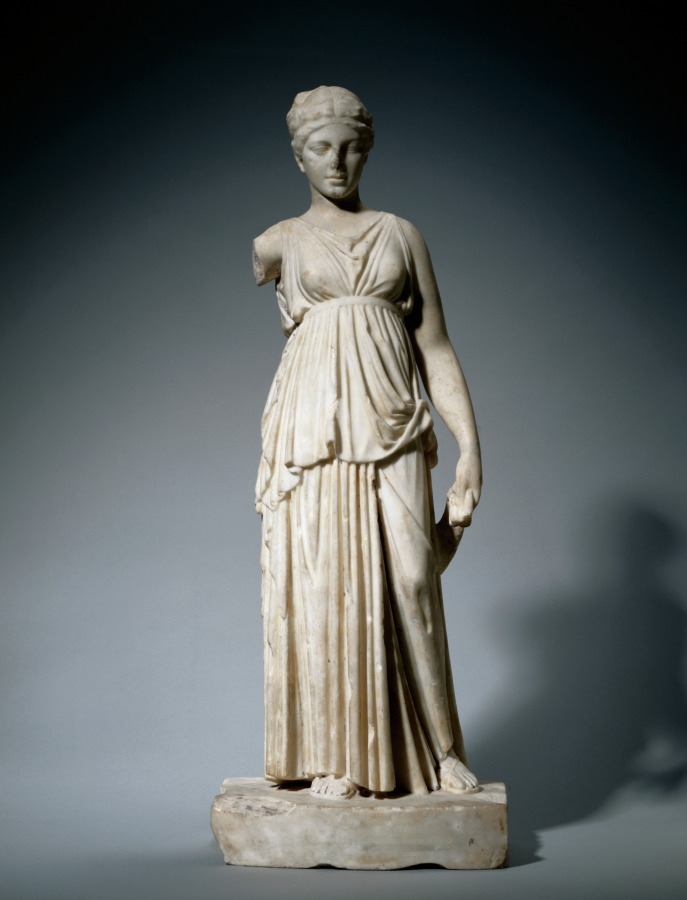
Dancer, marble statuette of a woman wearing a chiton, Greece, Alexandria(?), c. 50 BCE, Cleveland Museum of Art, 1965.24. Cleveland Museum of Art, CC0.
Origins and History
Stephanie Ann Smith and Debby Sneed write that the chiton, also known as the Ionic chiton, "is usually understood as a later modification of the peplos," and had appeared by the middle of the sixth century BCE.2 The Art Institute of Chicago writes that a long chiton was originally worn by men and was adopted by women in the fifth century BCE, while men's chitons became shorter.3
How It Was Worn
The chiton was often wide enough to allow for sleeves, fastened along the upper arms with pins or buttons.1 The Cleveland dancer wears a chiton folded at the top to create a large overhang, pinned at the shoulders, and belted high.4
Materials and Decoration
The Art Institute states that the chiton was often made of silk for women, and that by the fourth century BCE chitons had borders and patterns that the philosopher Plato and others condemned as decadence.3
On This Site
Sources
- Ancient Greek Dress — Department of Greek and Roman Art, Heilbrunn Timeline of Art History, The Metropolitan Museum of Art, October 2003 (construction, linen, men's and women's lengths, and sleeves; text retrieved through the Wayback Machine).
- Women's Dress in Archaic Greece: The Peplos, Chiton, and Himation — Stephanie Ann Smith and Debby Sneed, Department of Classics, University of Colorado Boulder, 18 June 2018 (Ionic chiton, relationship to the peplos, and sixth-century appearance).Reference 1
- Ancient Greek Dress: The Classic Look — Jeff Nigro, Art Institute of Chicago, 1 February 2022 (adoption by women, silk, and fourth-century decoration; text retrieved through the Wayback Machine).
- Dancer (1965.24) — Cleveland Museum of Art, collection record via the museum's open access API (the marble statuette illustrated and how its chiton is folded, pinned, and belted).Reference 1