The himation was the cloak of ancient Greece, worn by both women and men.1 The Metropolitan Museum of Art describes it as essentially a rectangular piece of heavy fabric, either woolen or linen, draped diagonally over one shoulder or symmetrically over both shoulders, like a stole.1
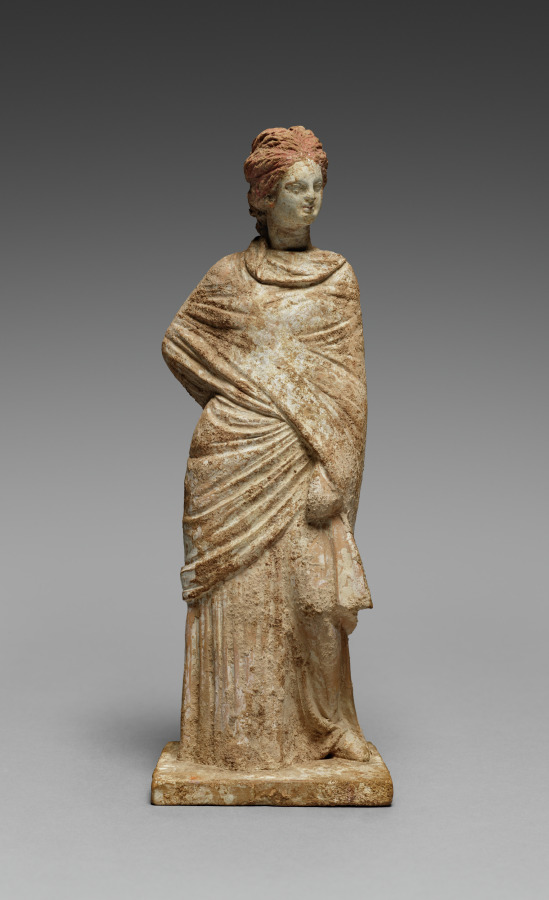
Female figurine wearing a himation over a chiton, molded and painted terracotta, Tanagra, Boeotia, Greece, 330–200 BCE, Cleveland Museum of Art, 1926.522. Cleveland Museum of Art, CC0.
How It Was Worn
The Art Institute of Chicago writes that the himation was typically draped diagonally over one shoulder and wrapped around the body, and that although it was commonly worn over a chiton, men sometimes wore it on its own.2 Stephanie Ann Smith and Debby Sneed of the University of Colorado Boulder describe it worn over both shoulders, or as a "transverse himation," draped diagonally across the torso over one shoulder.3 The Cleveland figurine shows a young woman wearing a himation over a dress called a chiton.4
Origins and History
Smith and Sneed list the himation among the three major garment categories of the Archaic period, which they date from the eighth century to 480 BCE, and note that it survived the changes in clothing style during the Archaic period.3 The Art Institute distinguishes it from the chlamys, a short cloak clasped at the right shoulder and worn exclusively by men.2
Materials and Decoration
The Met gives the fabric as heavy wool or linen.1 The Cleveland figurine was originally brightly painted and keeps traces of color, including red hair.4
On This Site
Sources
- Ancient Greek Dress — Department of Greek and Roman Art, Heilbrunn Timeline of Art History, The Metropolitan Museum of Art, October 2003 (cloak definition, materials, and draping; text retrieved through the Wayback Machine).
- Ancient Greek Dress: The Classic Look — Jeff Nigro, Art Institute of Chicago, 1 February 2022 (diagonal draping, wear over a chiton, and the chlamys; text retrieved through the Wayback Machine).
- Women's Dress in Archaic Greece: The Peplos, Chiton, and Himation — Stephanie Ann Smith and Debby Sneed, Department of Classics, University of Colorado Boulder, 18 June 2018 (transverse himation, Archaic dating, and survival of the garment).
- Female Figurine (1926.522) — Cleveland Museum of Art, collection record via the museum's open access API (the Tanagra figurine illustrated, its himation over a chiton, and its traces of paint).