19th Century · Europe · 1800 - 1900
What Working Women Wore in Victorian London
Clothing for work, clothing for display, and clothing as a choice: three ways to read the evidence for working women in London around 1860–1890.
By Dan Schnau · Last updated
Working women in Victorian London did not share a single uniform. Household advice distinguished clothing for dirty work from clothing for receiving callers, while a servant's own account could attach pride and independence to a plain working dress. Street selling posed another set of circumstances, including long exposure to bad weather.1,2,3 This guide concentrates on evidence around 1860–1890, with the dates and limits of each account kept visible.
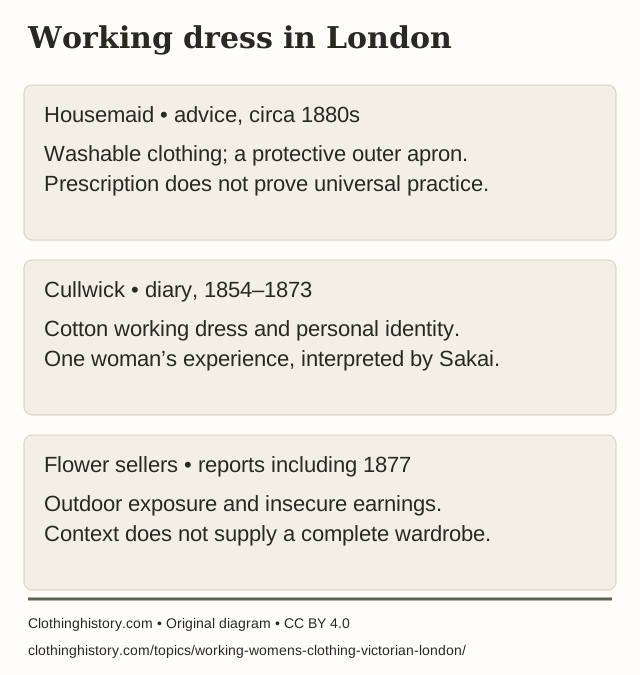
A housemaid's work and changes of dress
The household manual Cassell's Household Guide recommended washable clothing for a housemaid's morning tasks. For cleaning it advised a broad holland apron over a white apron: removing the outer layer would allow her to answer the door more presentably. For winter afternoons it suggested dark or black French twill; for summer, light cotton. It also recommended a white crochet cap.1
This is a prescription from an employer-facing manual, not a survey proving that every servant owned those clothes. Its value is the relationship it draws between a task, a protective layer, and the appearance expected when moving into public-facing duties.
The transcription's edition is approximately dated to the 1880s. It describes time for making or repairing a housemaid's own clothes after other work, and applies its dress advice to parlourmaids too. Those instructions expose the labor behind maintaining the appearance the manual demanded.1
Hannah Cullwick and the meaning of working dress
Historian Taeko Sakai's study of Hannah Cullwick draws on a diary kept between 1854 and 1873. Cullwick was a domestic servant whose relationship with Arthur Munby eventually gave her access to a different social position. Sakai argues that her continued attachment to humble cotton working dress expressed independence, professional pride, and a working-class identity.2
Cullwick is especially useful because she interrupts the assumption that plain clothes must mean a frustrated wish to dress like an employer. But she cannot represent all servants. Sakai explicitly identifies the unusual circumstances of her relationship and life.2 The responsible comparison is between a particular woman's perspective and the expectations imposed on servants, rather than between a universal “poor” wardrobe and a universal “rich” one.
Street selling and outdoor work
LSE's account of London's flower sellers discusses Adolphe Smith's Street Life in London, published in 1877, alongside other nineteenth-century investigations. It describes women and girls earning precarious incomes and working outdoors in difficult weather.3 This helps establish a working context; it does not supply a complete inventory of their clothes.
A photograph or illustration can invite questions about outer coverings, footwear, the handling of goods, and what is visible beneath an apron. It cannot by itself establish hidden underwear, exact fiber content, original color, or how many changes of clothes its subject owned. Those questions need another kind of evidence. LSE's account also reproduces moral judgments made by contemporary commentators; those judgments should be read as the commentators' views, not adopted as descriptions of the women themselves.3
Compare the evidence
| Context | What the source establishes | What it does not establish |
|---|---|---|
| Housemaid and parlourmaid | Recommended washable dress, protective aprons, and changes for public-facing tasks.1 | How consistently households followed the advice. |
| Cullwick's domestic service | One woman's attachment to cotton working dress and the meaning she gave it.2 | A standard wardrobe shared by all domestic workers. |
| Flower selling | The insecurity and outdoor exposure described in investigations.3 | A complete outfit, textile identification, or clothing budget. |
Why a later servant's dress needs a date
London Museum holds a checked cotton servant's dress with a linen-lined bodice. Its record gives a production date of 1907–1910, while the description dates it to 1910–1915.4 Both are later than this article's main period. It is a useful comparison for studying a surviving garment, but it cannot serve as direct proof of a London woman's outfit in 1870.
Keeping those dates attached to the object prevents a familiar museum image from silently filling an earlier gap. The same care applies to a fashion plate: a stylish gown does not become evidence for a particular occupation merely because it belongs to the right decade.
For broader changes in silhouette, production, and fashion, see nineteenth-century European clothing. Compare the different setting of American frontier clothing without assuming that working clothes were identical across the Atlantic.
Quick Answers
Did every maid wear a black dress?
Cassell's advice itself distinguished washable morning clothing, dark winter afternoon dress, and light summer cotton. It was also advice, not a count of what servants actually wore.1
Could working dress express pride?
Sakai interprets Cullwick's attachment to her working clothes in precisely that way, while emphasizing her individual circumstances.2
Can we reconstruct a typical working woman's wardrobe?
These sources support particular garments, recommendations, and experiences. Combining them into one supposedly typical outfit would erase differences between work, season, household, and personal choice.
Sources
- Servants of the House — Cassell's Household Guide, new and revised edition, approximately 1880s; primary text transcribed by Lee Jackson's Dictionary of Victorian London, especially “The Housemaid” and “The Parlourmaid.”
Return to text (6 references)
Reference 1 Reference 2 Reference 3 Reference 4 Reference 5 Reference 6 - A Domestic Servant's Ideas of Dress, Gender and Career in Victorian England — Taeko Sakai, Journal of Home Economics of Japan 69(3), 2018, pp. 160–168; English abstract (Cullwick's diary and dress).
Return to text (6 references)
Reference 1 Reference 2 Reference 3 Reference 4 Reference 5 Reference 6 - A woman's work: London's flower sellers — Mhairi Gowans, LSE History, 2024 (street selling and contemporary commentators).
- Dress, servant dress, 88.99/3 — London Museum (materials and differing dates within the object record).Reference 1