19th Century · Europe · 1800 - 1900
History of Corsets: Stays, Silhouettes, and Common Myths
A history of stays and corsets through museum garments, construction methods, changing fashions, and the difference between everyday support and tight-lacing.
By Dan Schnau · Last updated
Corsets and stays shaped the torso beneath, and sometimes as part of, fashionable clothing. Their construction and silhouette changed across the eighteenth and nineteenth centuries. A stiffened pair of eighteenth-century stays was not identical to a Victorian corset, and neither should be understood only through the most extreme tight-lacing stories.1,2,3
This guide follows selected surviving garments and museum interpretations. For the dresses worn over them, see early modern European clothing and nineteenth-century European clothing.
Stays and Corsets: What Is the Difference?
Museum terminology overlaps. FIT's Exposed exhibition labels an eighteenth-century garment “corset (stays),” while explaining how some decorative understructures also appeared as part of visible dress. It contrasts those uses with more private nineteenth-century underwear. A name alone does not establish how much of a garment was shown.1
The Metropolitan Museum's account of eighteenth-century silhouette describes conical stays that worked with wide skirts. Panniers expanded the skirt at the sides, creating a contrast with the torso. The fashionable appearance was produced by the relationship between these structures, rather than by the waist alone.4
What Were Stays Made From?
A French example in the Met, dated to the late 1760s, combines silk, linen, leather, wood, and baleen. The catalogue describes strips of baleen enclosed between the facing fabric and lining. Their arrangement supported the shape, including the curved upper edge. Both fully boned and partly boned constructions existed.5
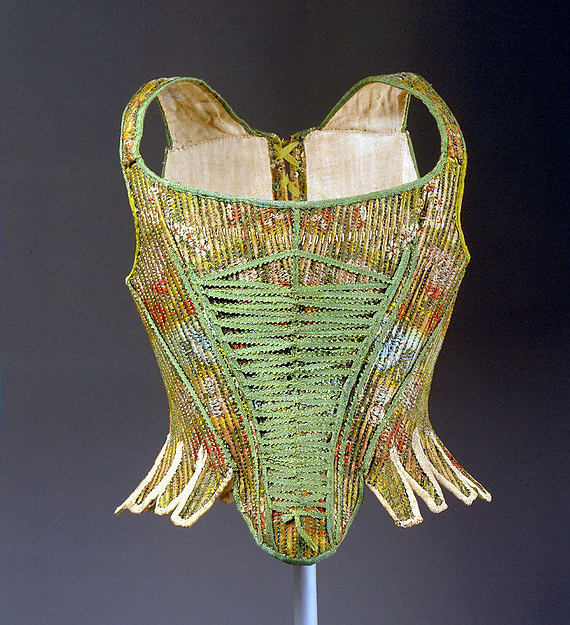
The V&A distinguishes boning from the busk, a stiffening element placed down the center front.2 It also explains that so-called whalebone was baleen, a flexible keratinous material, rather than a whale's skeletal bone. Reading the materials list helps clarify the construction more accurately than imagining a garment made from rigid bones throughout.2
Did High-Waisted Dresses End Corsetry?
No. FIT's exhibition discusses a short corset appropriate to the high-waisted gowns of the early nineteenth century. Its example from about 1815 emphasizes the bust through shaped cups and a front busk. The garment's purpose and outline differed from the earlier conical stays, but support had not simply vanished.1
This is a reason to compare dated garments. The changing height and line of an outer dress can alter what an undergarment needs to do, so a history built around one supposedly eternal corset shape misses part of the evidence.1,4
Victorian Manufacture and Access
The V&A describes how sewing machines helped corset manufacturers expand their ranges and sell to less wealthy buyers. Its account also follows developments such as metal eyelets and differing approaches to stiffening. These changes affected the garment's production as well as its appearance.2
The Museum at FIT's The Body exhibition places that expansion within a social history: nineteenth-century technology made corsets available across a broader demographic, while expectations of wearing them spread beyond elite women. Its interpretation connects the garment with changing ideals of the body and the pressures of fashionable dress.6
Was Every Corset Tight-Laced?
Tight-lacing and wearing a corset are not interchangeable. LancasterHistory's discussion treats tight-lacing as a particular practice and challenges common claims about tiny universal waists. It also cautions that rejecting exaggerated stories does not establish that corsets had no adverse effects. The useful distinction is between an evidenced practice and a sweeping claim about every wearer.3
Did women have ribs removed for corsets?
LancasterHistory finds no historical evidence for that story and cites fashion historian Valerie Steele's rejection of it. It should not be repeated as an established Victorian custom.3
From Underwear to Visible Fashion
Corset references continued after the nineteenth century. FIT's Exposed exhibition discusses Jean Paul Gaultier's body-conscious designs inspired by girdles and corsets, including a dress from about 1987. The example belongs to a later history of underwear appearing as outerwear, rather than demonstrating that its wearer used the same garment as an eighteenth-century court dresser.1
Continue with the history of denim for another garment tradition whose materials and social meanings changed over time.
Sources
- Exposed: A History of Lingerie — Museum at FIT, 2014 (stays, about 1815 corset, and Gaultier).
- Corsets, crinolines and bustles: fashionable Victorian underwear — Victoria and Albert Museum (construction and manufacture).
- Make No (Whale)Bones About It: Debunking those Corsetry Myths — Stephanie Celiberti, LancasterHistory, 2019 (tight-lacing, qualifications, and rib-removal myth).
- Eighteenth-Century Silhouette and Support — Jessica Glasscock, Metropolitan Museum of Art, 2004.
- Corset, C.I.50.8.2 — Metropolitan Museum of Art (French, late 1760s; materials and boning).Reference 1
- 18th and 19th Centuries — The Body: Fashion and Physique, Museum at FIT, 2017–2018.Reference 1