American frontier clothing was mostly plain and practical: fur trappers wore fringed buckskin and coats cut from wool blankets, pioneer families crossed the plains in handmade dresses of calico, gingham, and wool, miners wore ordinary work clothes and, from 1873, copper-riveted denim pants, and cowboys borrowed their hats, boots, and leather chaps from Mexican vaqueros.1,2,4,5,7,8,11,12 The "Western look" familiar today, with its big hats and fringed jackets, was polished and spread by Wild West shows and later by films.14,20 This page goes deeper than the cowboy paragraph in the 19th-century Americas survey, group by group.
Fur Trade and Mountain Men
Fur trappers, or mountain men, were hired for terms of one, two, or three years in the West.1 They trapped beaver because beaver felt hats were hugely popular in Europe and the United States in the 1820s and 1830s; the hats were made from the soft, waterproof underfur of the animal.1 Trappers sold their pelts at an annual rendezvous, where St. Louis merchants exchanged goods for furs, and they went about in buckskin clothing.1 The fashion that supported them did not last: by 1840 silk had replaced beaver as the preferred material for hats.1
An eyewitness visual record of how they dressed comes from Alfred Jacob Miller, a painter then based in New Orleans, who traveled with a supply caravan from Westport (today Kansas City) to the Green River rendezvous in present-day Wyoming, sketching constantly along the way.3 His drawing Trappers, Auguste and Louis, a study for a later watercolor, shows two buckskin-clad men (the catalogue of his work doubts they are really Auguste and Louis, two hunters hired for the 1837 journey); the catalogue describes a heavily fringed buckskin coat, leggings of brain-tanned buckskin cut tight from knee to ankle, and moccasins with decorated vamps, and notes that trappers also wore buckskin pantaloons cut with the narrow buttoned front fall of the era's trousers.2 Headwear was improvised as felt hats wore out, but the style easiest to document is a round-crowned, broad-brimmed wool felt hat.2
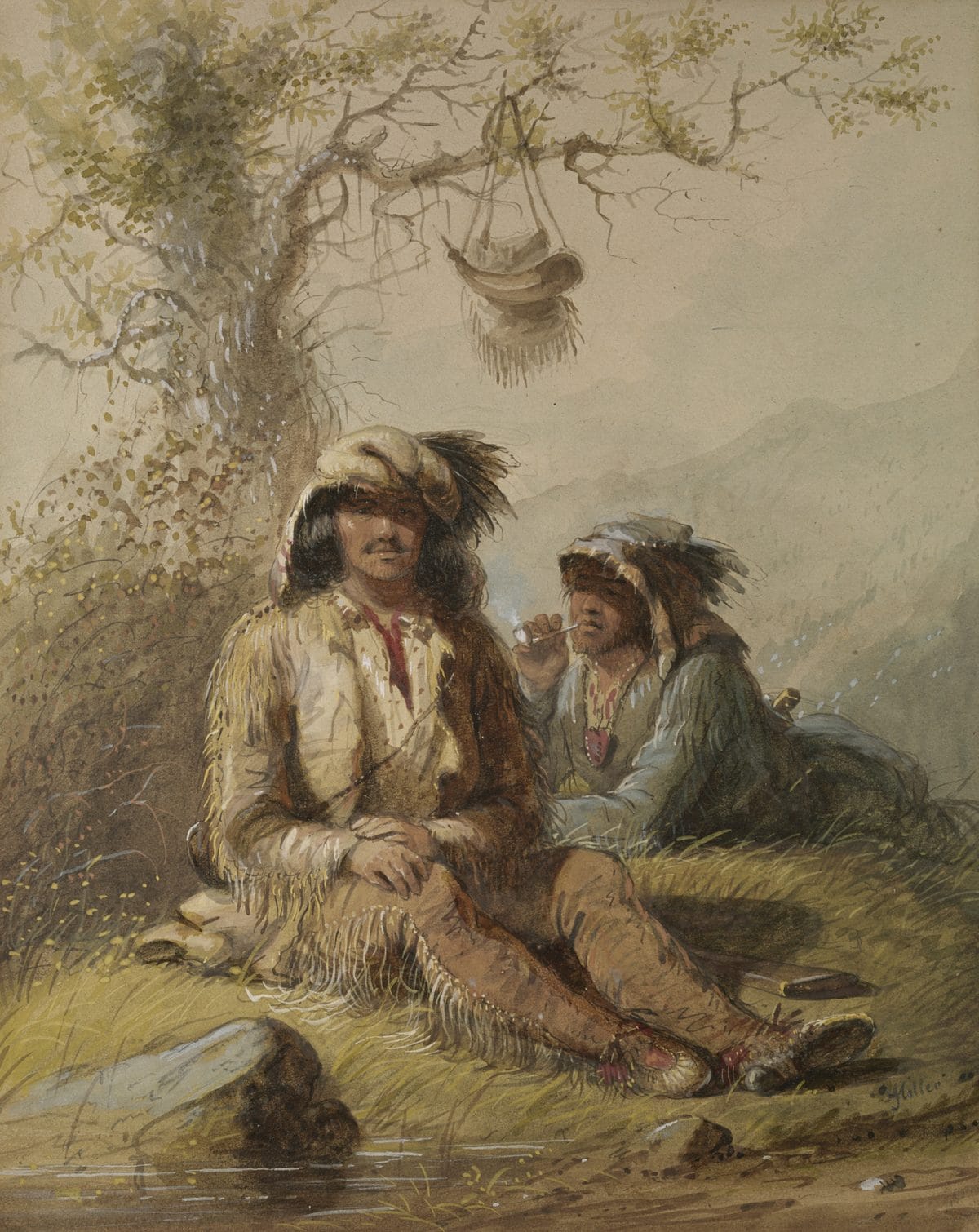

Wool was as important as leather. The point blanket, first woven by French makers in the 17th century and later popularized by the Hudson's Bay Company, was bought by Indigenous and settler communities alike for bedding and clothing.4 Métis and French settlers cut blankets into the capote, a wrap-style coat that was especially popular with trappers because its wrap style made it easy to move and hunt in; it was in such demand that in 1706 the Hudson's Bay Company hired a tailor to make blankets into these coats.4 A frontier trapper in a fringed buckskin shirt, a blanket coat, and moccasins was dressed in a mix of European cloth and Native American cut and technique.
The Overland Trail and Pioneer Women
From the 1830s to the 1860s, between 250,000 and 500,000 people traveled to Oregon and California on the overland trails.5 Like most Americans of the time, they had small wardrobes of largely handmade clothing, and because there would be little chance to sew on the trail, women had to make everything the family needed before they left.5 Settlers bought raw wool and cotton and grew flax, and women spun and wove their own cloth. A popular fabric was linsey-woolsey, a mix of linen and wool that was cheaper than pure wool but still warm and strong.5 Women dyed it with local bark for browns and yellows, or with imported indigo and woad for blue and madder for red, and they bought calico or gingham for special occasions.5
Families tried to bring two or three changes of clothing for each person. Historian John Mack Faragher's summary of a woman's trail wardrobe is two or three dresses, usually of dark gingham, calico, or heavy wool, with one or two linen petticoats, aprons, shoulder kerchiefs, a warm shawl, and perhaps a coat.5 Dresses were simply tailored, and women also wore the sunbonnet, often of colorful calico stretched over wire or wooden frames.5 Men wore loose, full shirts, often open at the neck, loose trousers held up with suspenders or a leather belt, heavy boots, and hats of straw or felted wool.5 Children under six or seven of both sexes wore a loose linen dress.5
Long skirts were badly suited to the trail: they dragged on the ground, tore often, and made cooking over an open fire hazardous. A few women in the 1850s made the trip in bloomers, but most kept their usual dresses, partly because bloomers were linked to female radicals and partly because a woman with two or three dresses was unlikely to make a new outfit for the trail alone.5
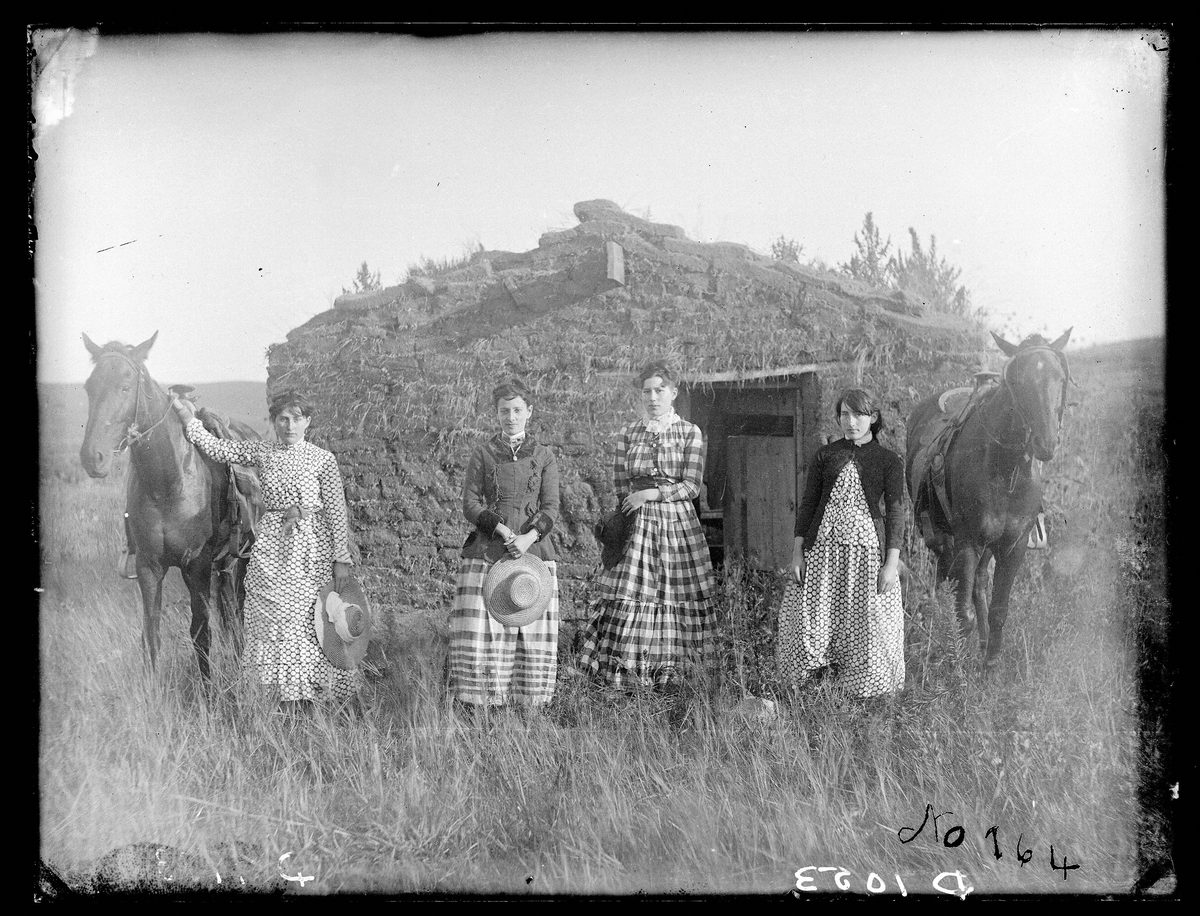

Once settled, homesteaders gradually gained access to store-bought goods. In the late 19th century mail-order shopping opened new possibilities for Americans on farms and in small villages, and catalogs offered rural customers ready-made goods like those in city shops and department stores; by 1900 Sears, Roebuck & Company was one of the greatest merchandisers in the world.6
Miners and the Gold Rush
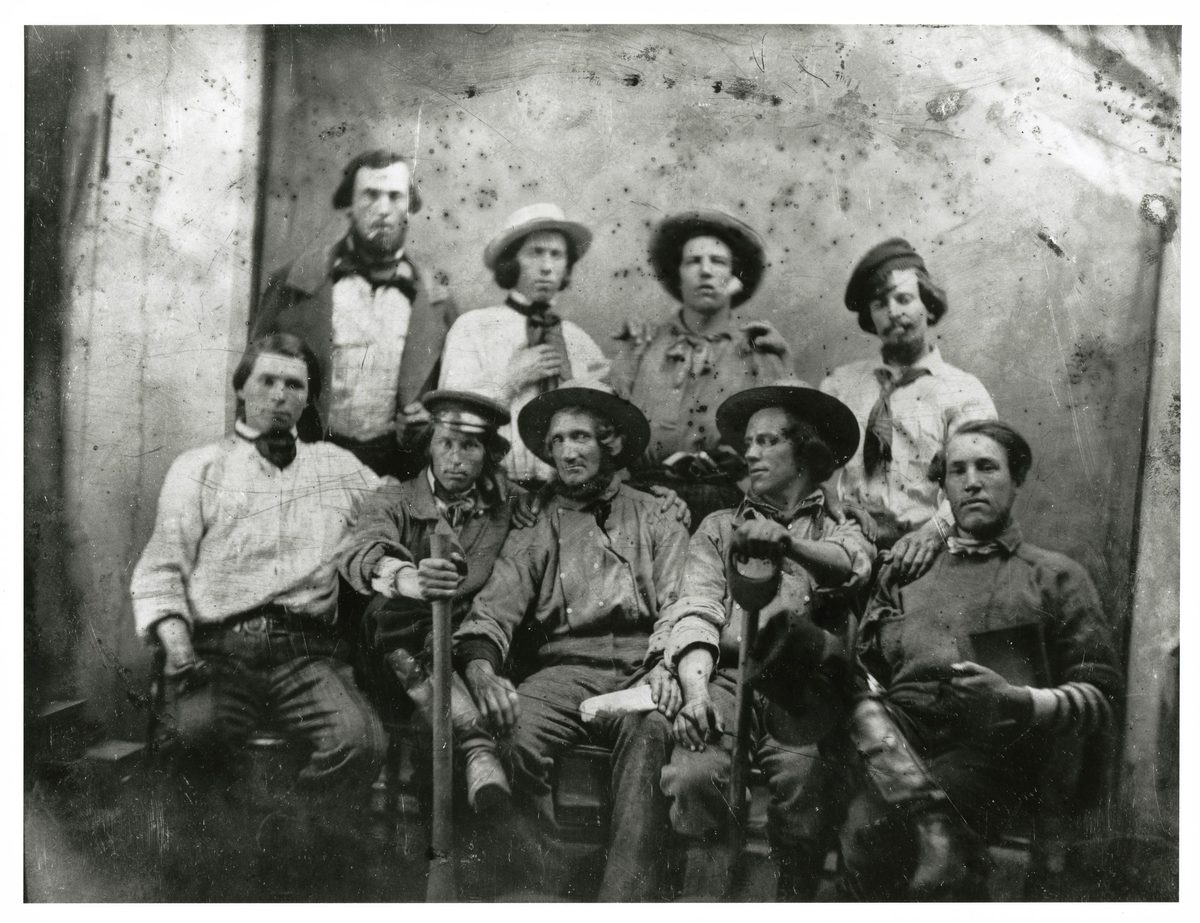
The California Gold Rush brought merchants west along with miners. Levi Strauss arrived in San Francisco in March 1853 and opened a haberdashery and textile store whose stock included everything the mineworkers and pioneers needed, from toothbrushes and suspenders to buttons and suits.8 The miners themselves, as surviving daguerreotypes show, dressed much like other working men of the period: loose shirts, neckerchiefs, sturdy trousers, boots, and whatever hat or cap they owned.

The garment that came out of this world was invented not in a mining camp but in a tailor's shop in Reno, Nevada. Jacob Davis, a tailor who bought off-white cotton duck cloth from Levi Strauss & Co., was asked in late 1870 by a woman customer to make a pair of strong, cheap pants for her large husband, who wore through his trousers quickly.7 Davis had copper rivets in his shop for attaching straps to horse blankets, and he used them to fasten the pockets. Within eighteen months he had made and sold two hundred pairs, at first in duck and soon afterward in denim as well.7 He wrote to Strauss proposing a joint patent, and the patent for an "Improvement in Fastening Pocket-Openings" was granted on May 20, 1873.7,9 At first the pants were sewn by women working at home, until demand forced the company to build a factory in San Francisco with Davis as supervisor.7
The riveted trousers were called waist overalls; the term "blue jeans" only came into wide use in the 1960s.8 By the end of 1873 the company had sold 5,875 pairs of denim trousers and coats, and for decades jeans were work clothing for lumberjacks, gold prospectors, and other laborers.8 For how they became everyday fashion in the 20th century, see Modern Americas clothing.
The Cowboy Outfit and Its Vaquero Roots
The American cowboy took most of his gear from the Mexican vaquero: the cowboy hat, the lasso, and pointed boots all trace back to vaquero practice.12 Cowboy chaps descended from the vaqueros' chaparreras, and early chaps, which hugged the legs, were called "shotgun" chaps.11 Later varieties included wide-legged batwings and "woolies" made of Angora goat hair or sheep's wool; all were leather leggings worn over the pants as protection from rocks, branches, and horns.10
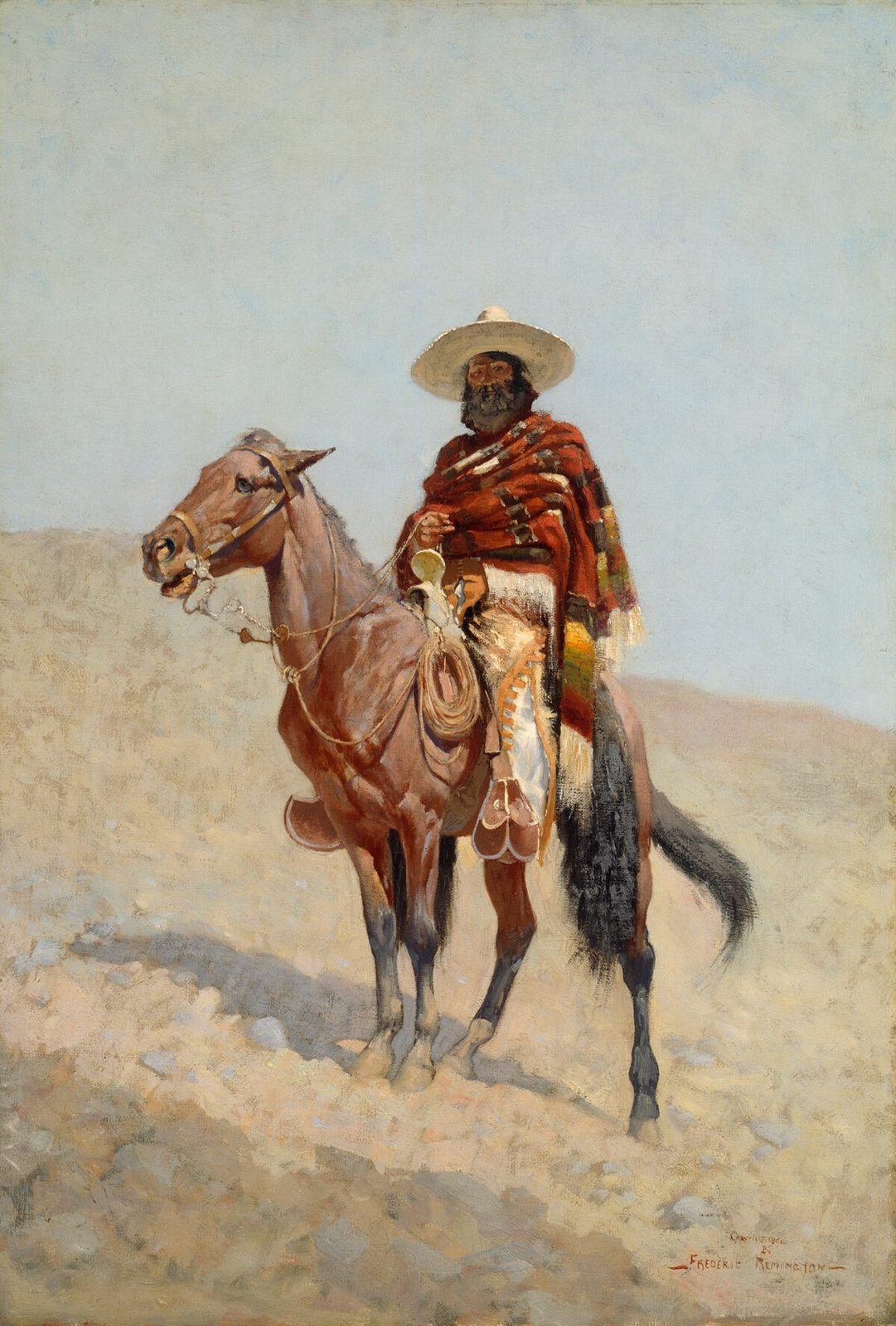
The rest of the working outfit was chosen for long days in the saddle. Shirts were long-sleeved, of cotton in summer and wool in winter, and because shirts and pants often lacked pockets, cowboys wore vests, often of wool, to carry tobacco and money.10 Pants were often canvas or wool, usually brown, black, or tan.10 The bandanna, a square of silk or cotton folded into a triangle and tied loosely at the neck, could be pulled over the nose and mouth against dust or used as a bandage.10 Boots had narrow toes to fit the stirrup and high heels to keep the foot from sliding forward; in the 1880s a pair might cost $10 to $25, when a cowboy earned about $30 a month.10 Spurs had a blunt spiked wheel, the rowel, that turned as the rider touched the horse.10 Long oilskin coats, called dusters or slickers, were split up the back for riding.10
The hat that defined the look was John B. Stetson's "Boss of the Plains," introduced in 1865. By later standards it was plain, with a flat, round brim and a smooth, rounded crown, and it was made of fur felt from beaver, rabbit, and other small animals to stand up to the weather.13 The original had a 4-inch rounded crown and a brim up to 3¾ inches wide, and wearers personalized it with dents and curved brims, such as the pinched peak later called a campaign or Russell crease.14
Native American Dress and Exchange on the Frontier
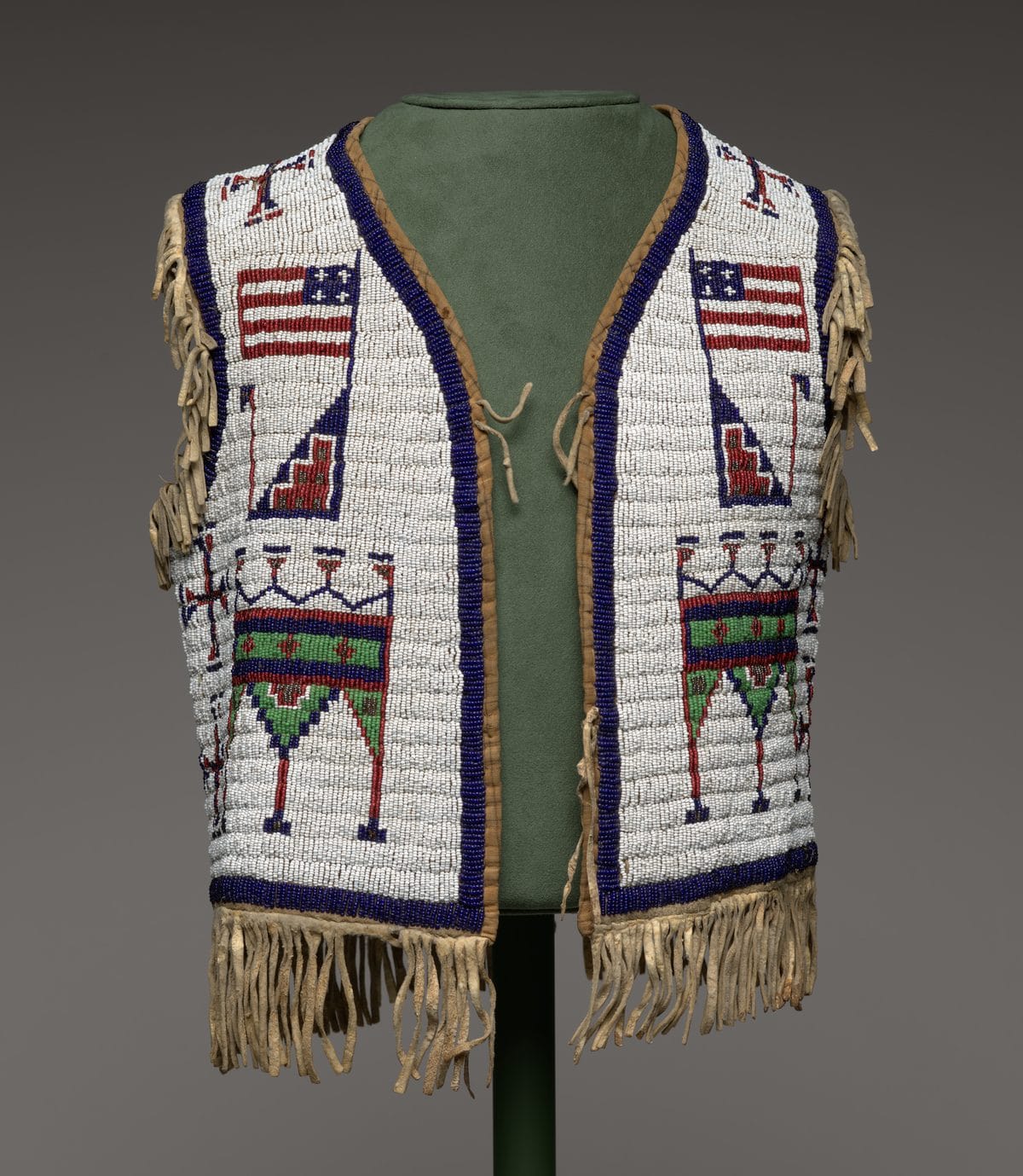
Frontier dress was never one-directional. By 1700 European Americans were making their presence felt on the Great Plains, and Plains peoples creatively adopted European materials and garment types into their wardrobes.16 Before contact, Plains peoples decorated clothing and other items with porcupine quills and mineral pigment designs; afterward, glass beads made in Europe arrived through trade.17 Beads also carried social weight: on a Cheyenne girl's dress, the heavy beadwork added prestige and honor.17 The survey page covers Lakota beaded dresses and leader shirts in more detail.
Cloth and ribbon moved the same way. The Osage, who began trading with the French after Europeans entered their territory in the early 1600s, obtained wool cloth in red, black, navy, and white, and silk ribbon.18 After the French Revolution of 1789, silk fell out of favor in Europe and the French silk industry turned to America as a market for its unwanted ribbons.18 Osage women cut and folded ribbon into designs and sewed them by hand onto wool to make ribbonwork, an art learned from female relatives.18 The same blankets that trappers wore as capotes were also bought by Indigenous communities for clothing.4
This exchange took place under growing pressure. By 1870 most Plains people had been forced onto reservations, and wars, forced assimilation, and the near-extermination of the buffalo by the U.S. government, ranchers, and railroads undermined Plains culture.16,17 The vest above, made after that date, joins a Euro-American garment form and patriotic flag imagery to Lakota beadwork.16
Buffalo Bill's Wild West and the Invention of the "Western Look"
In 1883 William F. Cody founded "Buffalo Bill's Wild West," a traveling show that dramatized the history of the frontier, toured the United States and Europe, and promoted a romanticized image of the American West.19 Showmen like Cody presented themselves as scouts dressed in buckskins, "sure and quick with wit and weapons."20 Advertisements promised war-painted Arapaho, Cheyenne, and Sioux performers, who were usually cast as attackers who were defeated, reinforcing the idea that the West had been won by force.20
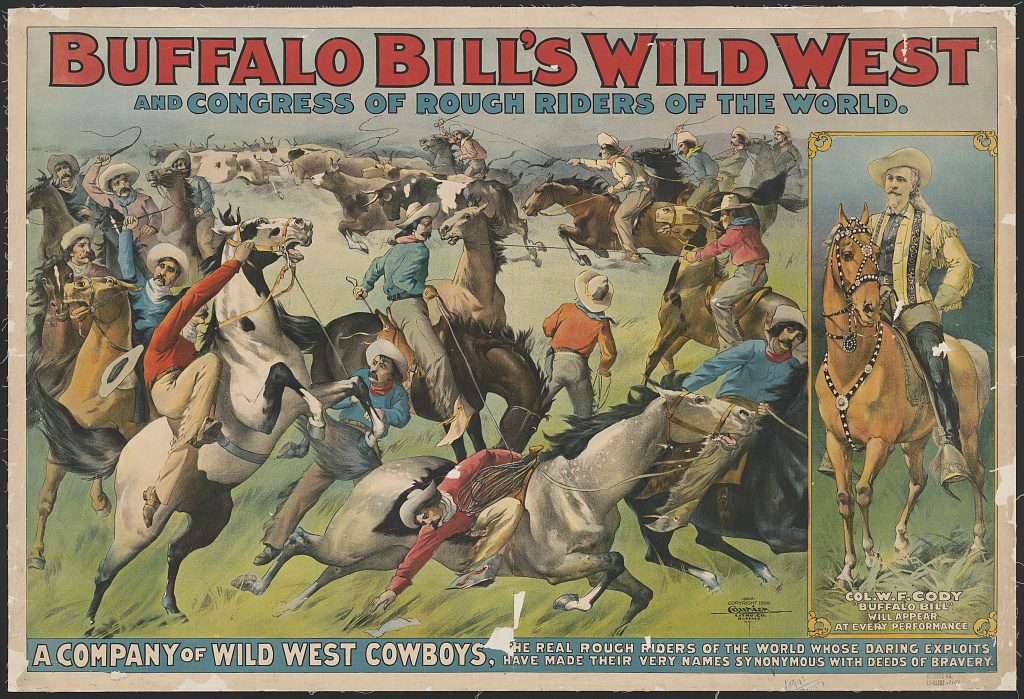
The shows also made the cowboy a hero. Before Cody presented the cowboy Buck Taylor, there was no popular cowboy hero, and in the early 1900s cowboys gradually displaced scouts and Native Americans as the shows' main attraction.20 Performers trained in Wild West shows, such as Tom Mix of the Miller brothers' 101 show, carried their cowboy-entertainer skills into silent Westerns.20 The shows moved western life "from the realm of history into mythology and popular culture."20 In the 1930s, wealthy Easterners vacationing on dude ranches brought jeans home as souvenirs, and Western film stars such as John Wayne and Gary Cooper were often filmed in them, which helped turn work clothing into fashion.8
Common Myths and Quick Answers
Did cowboys wear ten-gallon hats?
Not under that name. The term "ten-gallon hat" is first recorded around 1925–30 and is said to come from the Spanish galón, a braid, rows of which were wrapped above the brim, not from how much water it could hold.15 The original Boss of the Plains had a modest 4-inch crown, and the best-selling hat of the late 19th century, in the West as well as the East, was reportedly the derby.14
Were jeans blue from the start?
No. Jacob Davis's first riveted pants were made of off-white cotton duck, and he switched to denim soon afterward.7 Cowboys did not live in jeans either: their pants were often canvas or wool, usually brown, black, or tan, although denim work pants were worn.10
Did pioneers wear buckskin?
Mostly not. Buckskin was the dress of trappers and mountain men.1 Pioneer families wore handmade clothing of linsey-woolsey, wool, calico, and gingham, sewn before they set out.5
Did cowboys invent their own look?
Very little of it. The hat, boots, chaps, and lasso came from Mexican vaqueros, and the polished "Western" image of fringe, big hats, and heroic cowboys was spread by Wild West shows and films.11,12,14,20
Sources
- Mountain Men and Trappers — Gateway Arch National Park, National Park Service.
- Trappers, Auguste and Louis — Fur Traders and Rendezvous: The Alfred Jacob Miller Online Catalogue, Ricketts Art Foundation, Buffalo Bill Center of the West and Museum of the Mountain Man.
- Alfred Jacob Miller: Adventure Artist — Fur Traders and Rendezvous: The Alfred Jacob Miller Online Catalogue, Ricketts Art Foundation, Buffalo Bill Center of the West and Museum of the Mountain Man.
- Hudson's Bay Point Blanket — Regan Shrumm, The Canadian Encyclopedia, 2018.
- The Overland Trails — American Eras, Gale (via Encyclopedia.com).
- Sears, Roebuck & Co. Mail-Order Catalog, "Ladies' Misses and Girls' Clothing, Fall & Winter, 1907-1908" — The Henry Ford.
- Jacob Davis: His Life and Contributions — Levi Strauss & Co. Archives.
- Levi Strauss: A Bavarian-American Success Story — Tanja Roppelt, Haus der Bayerischen Geschichte (House of Bavarian History).
- Levi's History — Levi Strauss & Co.
- Cowboy Clothing and Equipment — Nebraska Studies, Nebraska Public Media.
- The Cowboy Goes East: Howdy, Hungary! — National Cowboy & Western Heritage Museum, 2022.
- How the Spanish vaquero gave way to the American cowboy — Melodie Edwards, Wyoming Public Radio, 2022.
- History of the Cowboy Hat — National Cowboy & Western Heritage Museum.
- Stetson Invented the Cowboy Hat, Westerners Gave It Wings — David Lauterborn, Wild West magazine (HistoryNet), 2024.
- Ten-gallon hat — Dictionary.com.
- Boy's Vest, c. 1880 — The Cleveland Museum of Art.
- The Plains: Hudson Museum Virtual Tour Video Transcript — Hudson Museum, University of Maine.
- Ribbon Appliqué Wearing Blanket — Denver Art Museum.
- William "Buffalo Bill" Frederick Cody — Hall of Great Westerners, National Cowboy & Western Heritage Museum.
- Wild West Shows — S. Matthew DeSpain, Encyclopedia of the Great Plains, University of Nebraska–Lincoln.