Tang dynasty clothing is the dress of China under the Tang (618–907), when the capital, Chang'an, was linked by the Silk Road to the markets of Central Asia and the Middle East. Elite women wore a short top or jacket, a long skirt, and a shawl, while men and women of the ruling class also adopted a steppe riding outfit of tight-sleeved robe, trousers, belt, and boots.1,2,3,4,19 The historian BuYun Chen argues that the period had a true fashion system: styles, body ideals, and silk patterns changed over the dynasty, driven, in her account, by a textile industry fed by imperial expansion and by what she calls "aesthetic play."4
This page covers the evidence, women's and men's dress, the fashion for foreign clothes, rules on color, silk, and the change after the An Lushan rebellion. For the wider setting, see medieval East Asian clothing.
How We Know What the Tang Wore
The picture of Tang dress is assembled from several kinds of evidence. In her 2019 book Empire of Style, BuYun Chen draws on Tang poetry and essays on art, documents found at Turfan and Dunhuang, and excavated tomb murals, figurines, and textiles, as well as official histories and legal texts.4 Her chapter on women's style relies mainly on murals and figurines from Tang tombs.4
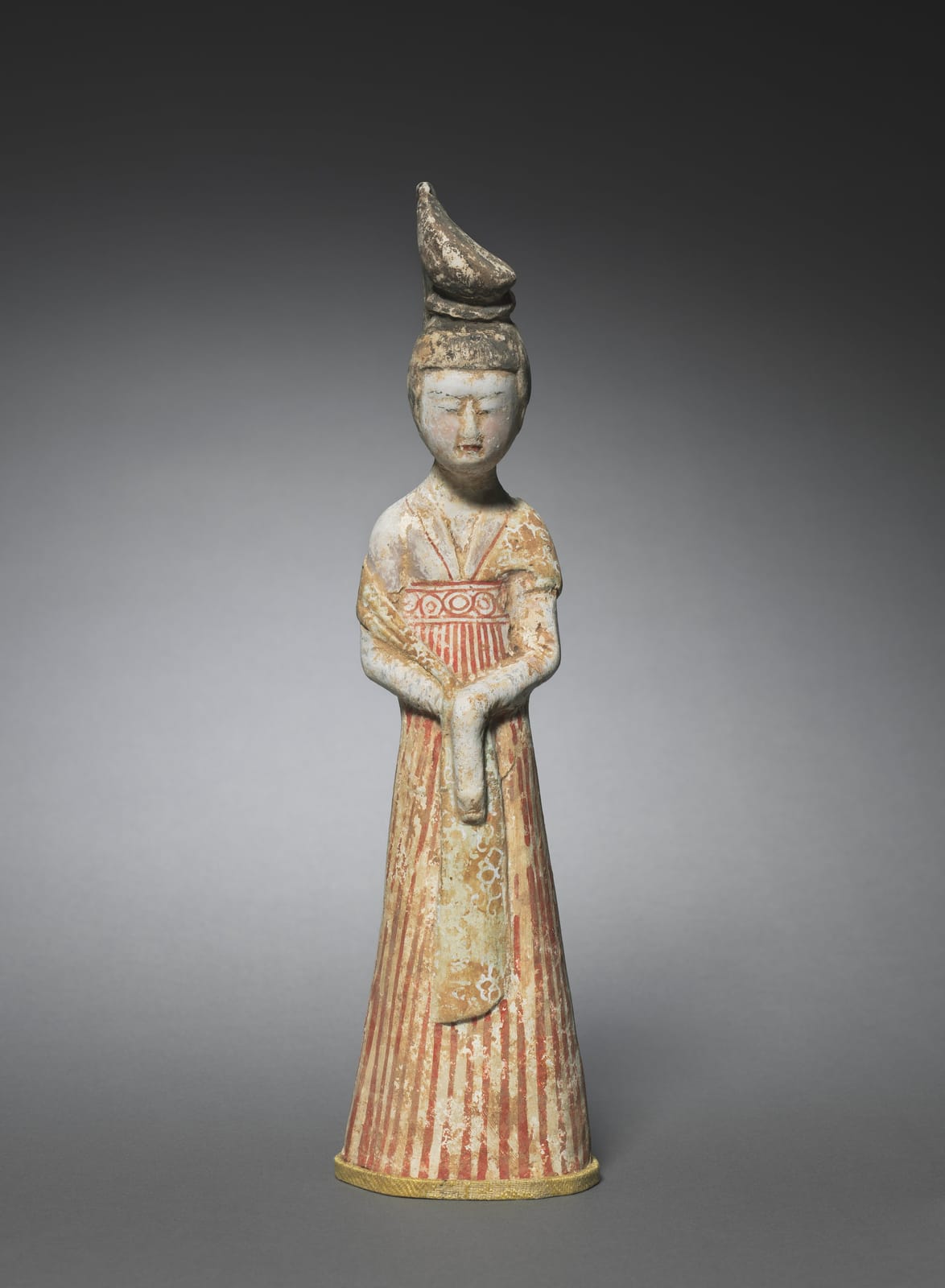
Tomb figurines are a major source. The Cleveland Museum of Art notes that such earthenware figures were placed in tombs to accompany the dead into the afterlife, alongside officials, musicians, dancers, hunters, foreign travelers, and guardians.5,6 Painted surfaces matter here: the Cleveland court lady above still shows a red-striped skirt, a waistband with double red circles, and a stole with white rosettes.6
Textiles survive at a few sites. At Astana, a burial ground near Turfan on the northern Silk Road, the explorer Aurel Stein excavated silks that had been preserved by the dry desert heat.7 Paintings in the late Tang Cave 156 of the Mogao caves at Dunhuang record performers' costumes that reflect real dress with influences from the Western Regions.8 In 1987 a forgotten underground chamber at the Famen Temple pagoda near Xi'an yielded more than 700 silk textiles, including damasks, gauzes, brocades, and embroideries.9 In Japan, the Shōsōin treasure house in Nara has stored an eighth-century textile collection since that century, including textiles from the daily life of Emperor Shōmu (reigned 724–749).10 Silks preserved there show how Tang patterns spread across East Asia.11
Women's Dress: Short Jacket, Long Skirt, and Shawl
The basic outfit of a Tang woman paired a short jacket (ru) with a skirt (qun), the combination known as ruqun.26,2 Chen lists the staples of a Tang woman's wardrobe as an unlined short robe or top (shan) or a short jacket (ru), a skirt (qun), and a shawl (pibo). Each ensemble began with the short robe, cut from a single piece of silk.2
The Cleveland figure shows how these pieces looked together around 700–750. Her V-neck blouse is tucked into a floor-length skirt with a high, empire waistband, her clasped hands are hidden by long, narrow sleeves, and a long stole drawn from the bodice falls between her wrists.6 A Sui dynasty figurine of a woman playing a lute on horseback already wears a high-waisted long skirt with a narrow-sleeved top.12
These garments changed less in cut than in surface. According to the historian Jonathan Skaff's summary of Chen's argument, the basic pieces changed relatively little in sleeve width, hemline, and waistline, while the colors, patterns, and weaves of the silk changed constantly. In the seventh century women's clothes had a trimmer fit and flat colors. By the eighth century they had fuller, more billowing cuts, first with stripes and then with floral patterns.4
The Asian Art Museum of San Francisco makes the same point with an early Tang dancer: fashion changed remarkably quickly during the dynasty's first century, and her elongated sleeves reflect court fashions of that time.13
Men's Dress: Riding Robe, Futou, and Rank Colors
The traditional dress of the Han Chinese was generally a full-length garment with wide sleeves. In the first half of the Tang (618–755), however, the ruling class widely wore a riding dress of tight-sleeved robe, trousers, belt, and boots, which had its origins in the clothing of steppe peoples. The historian K. Nomoto argues that the Tang court used this riding dress as a common badge of status and office that both Han Chinese and foreigners in Tang service could accept, and that luxury silks with hybrid designs raised it from a steppe garment to aristocratic wear.3
On their heads, men wore the futou, a headwrap of black cloth. Early futou were simple cloths wrapped around the head. Over the Tang they took on the look of a fitted, structured cap, and officials added two long wings of stiffened ribbon.14 A description of the older wrap, quoted by Liu Fusheng, explains that in the Tang style all four ribbons hung down after being tied.15
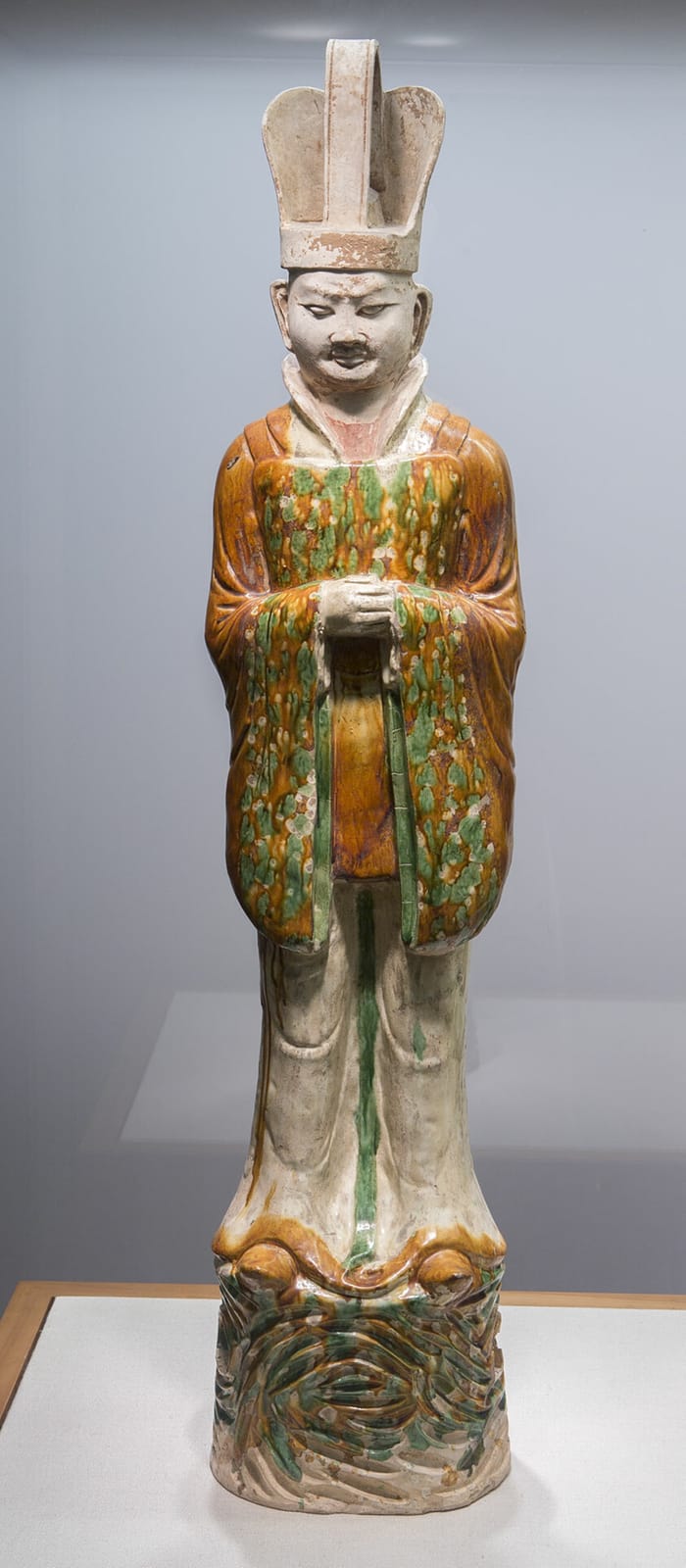
Court officials appear among Tang tomb figures, alongside musicians, dancers, hunters, and guardians.6 The Chicago official above is glazed in the three-color sancai technique.16
Official dress used color to mark rank. A chapter by Liu Fusheng in A Social History of Middle-Period China (Cambridge University Press) explains that the early Song followed the Tang system, in which officials of the third rank and above wore purple, those of the fifth rank and above vermilion, those of the seventh rank and above green, and those of the ninth rank and above black.15 Lu Yuchang's study of Chinese color culture finds that dark yellow was forbidden as the emperor's color from the early Tang to the late Yuan, and that purple remained the color of emperors and top officials.21
Rules did not freeze fashion. Chen argues that the power of premodern states to enforce a fixed hierarchy of dress has been exaggerated, and reads repeated attempts to renew sumptuary rules as evidence that they failed. In 771, for example, Emperor Daizong issued an edict forbidding the weaving of opulent and novel patterns of silk, partly out of concern that fancy weaving drew farming families away from the plain silk owed as tax.4
Hufu, Riding Dress, and Veils: Women in Foreign Fashion
Tang men and women were fascinated by things foreign. The Asian Art Museum notes that they often dressed in foreign fashions and welcomed foreign dance and music at court.13 The clearest example is the hufu, or foreign dress. A 2020 thesis by Gabrielle Berman describes it as male foreign clothing that typically included a long patterned robe, a leather belt, long trousers, and boots. Paintings and pottery figurines show elite women and their attendants wearing it.17 Berman connects the style to foreign influence along the Silk Road, including Sasanian Persia, and to polo, which she calls a Persian import.17
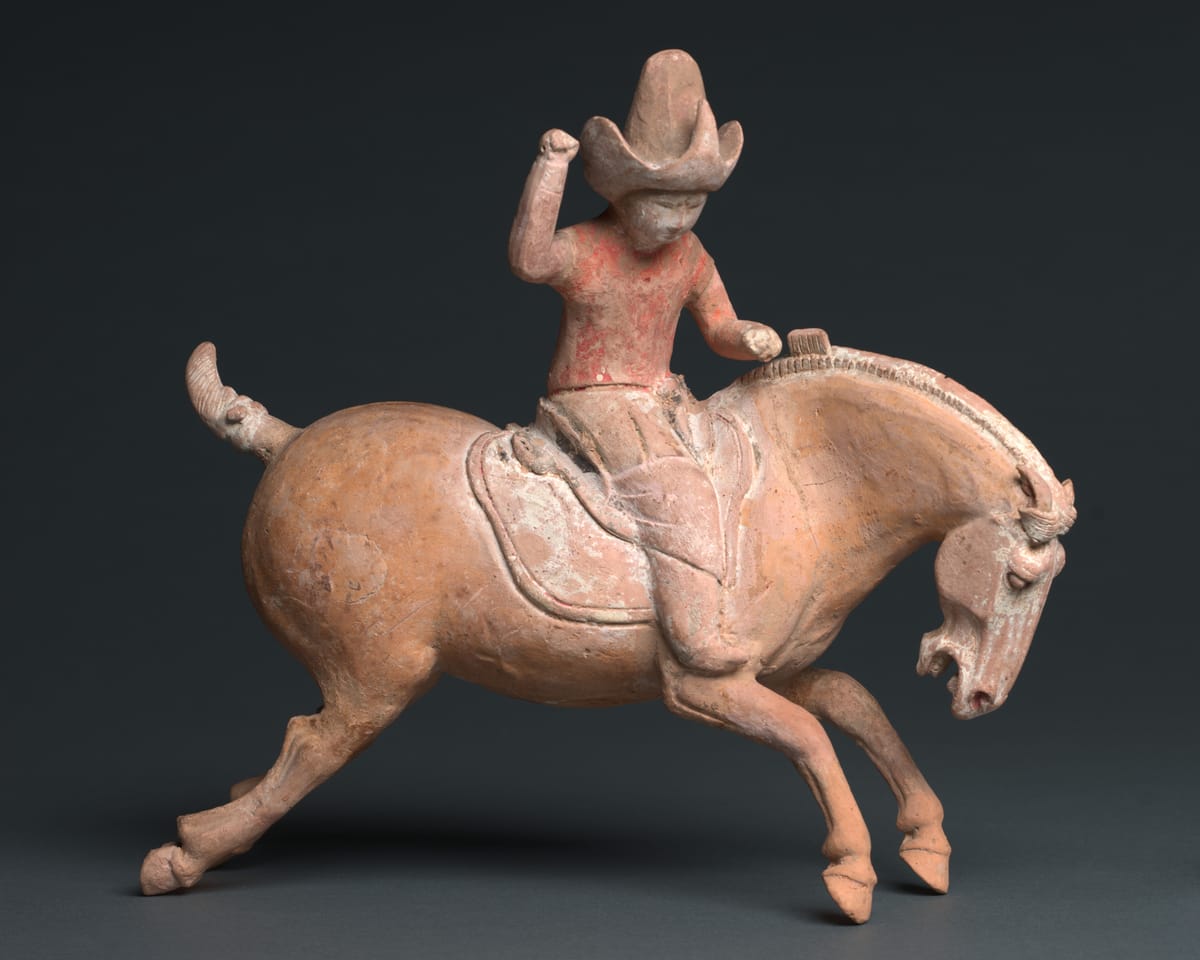
The Cleveland polo player above is a woman dressed in a man's riding habit.18 The Art Gallery of New South Wales states that it was normal for women to dress as men for riding at this time.19 Chen, as summarized by Skaff, describes elite women's habit of cross-dressing in male "barbarian dress" of caftan, belt, boots, and headwear as a fashion across the seventh and eighth centuries.4
Riding shaped how women covered their heads, and the change can be dated through the official Old Tang History (Jiu Tang shu). Bosen Zhang summarizes its account: in the early Tang, women riders at court followed the older Qi and Sui custom of wearing the mili, a covering for the head and body worn by women going out. After the Yonghui era they took up the curtained hat, or weimao, with a silk mesh falling from the brim to the neck, and after Wu Zetian's reign the mili died away.12,19
The next step came in the Kaiyuan era (713–742). The Art Gallery of New South Wales dates polo figures like its own to that era and quotes the same history: "At the beginning of the Kai-yuan period, the palace ladies who rode behind the imperial carriage all wore Central Asian ('hu') hats, exposing their painted faces, without a veil." Officials' families followed, the veiled hat went out of fashion, and some women rode in men's dress and boots.19 Zhang notes that a three-color glazed figurine of a female rider from the tomb of Princess Yongtai shows a court lady with bright makeup dressed in Hu clothing.12
The Walters Art Museum notes that figures of women on horseback became common in Tang tombs and that court women took part in equestrian sports, including a version of polo. Its own pair of riders wear riding trousers and a short jacket.20 Zhang adds that the riders shown in these figures range from noblewomen to maids.12
Silk, Taxes, and the Silk Road
Silk was money as well as clothing. The Tang state collected taxes partly in cloth, woven from silk or hemp depending on the region, and shipped tax cloth to the frontiers to pay for administration.4 Most of it was plain. Of 14,678 silks listed in a Dunhuang inventory of 745 for the Doulu Army, the vast majority were plain weaves or silk floss, and only 540 bolts, or 3.67 percent, were plain weaves dyed red or green.4
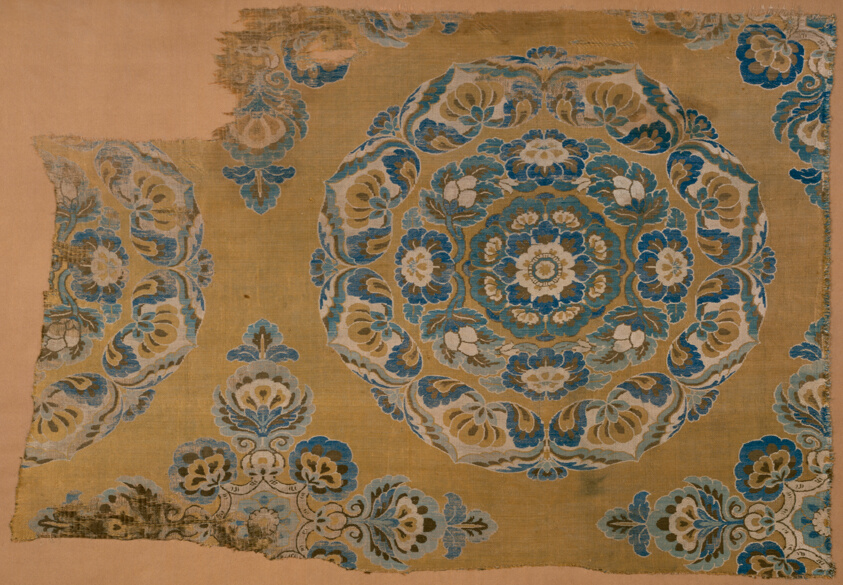
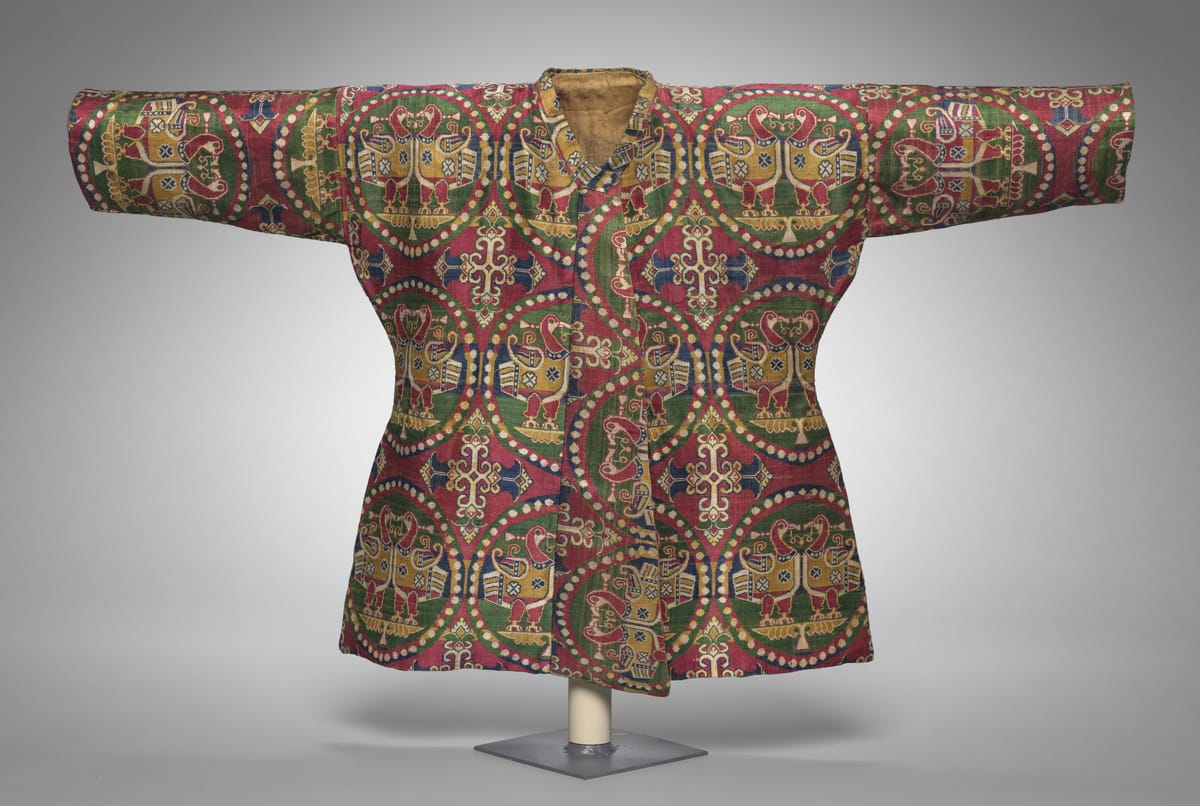
Luxury silks carried designs that moved along the trade routes. The Art Institute of Chicago describes the floral medallion on the fragment above as built from half-palmette tendrils that Chinese weavers adopted from foreign sources and refined.11 A child's coat at the Cleveland Museum of Art, from the 700s, has an outer silk with paired ducks in pearl roundels, a hallmark of Sogdian silks, and a lining of Chinese twill damask.22
After An Lushan: A Changed Fashion World
Chen places the peak of the Tang fashion system in the reign of Xuanzong (712–756), when display and spectacle defined life in Chang'an. The An Lushan rebellion (755–762) broke out near the end of his rule and, in the eyes of the literati, discredited his court's extravagance.4 The first-half dates that Nomoto uses for the spread of the riding dress, 618–755, end at the same break.3
Fashion did not end, but it moved. After the rebellion, silk production shifted to the south, where new loom technology and a growing market economy produced more sophisticated designs.4 The poet Bai Juyi's "Adornment of the Times" attacked women's hairstyles and makeup in the "barbarian" style as signs of social and political decline after the rebellion. Chen concludes that such criticism shows how much fashion still mattered.4 The story continues with the Song dynasty in medieval East Asian clothing.
Myths About Tang Dynasty Clothing
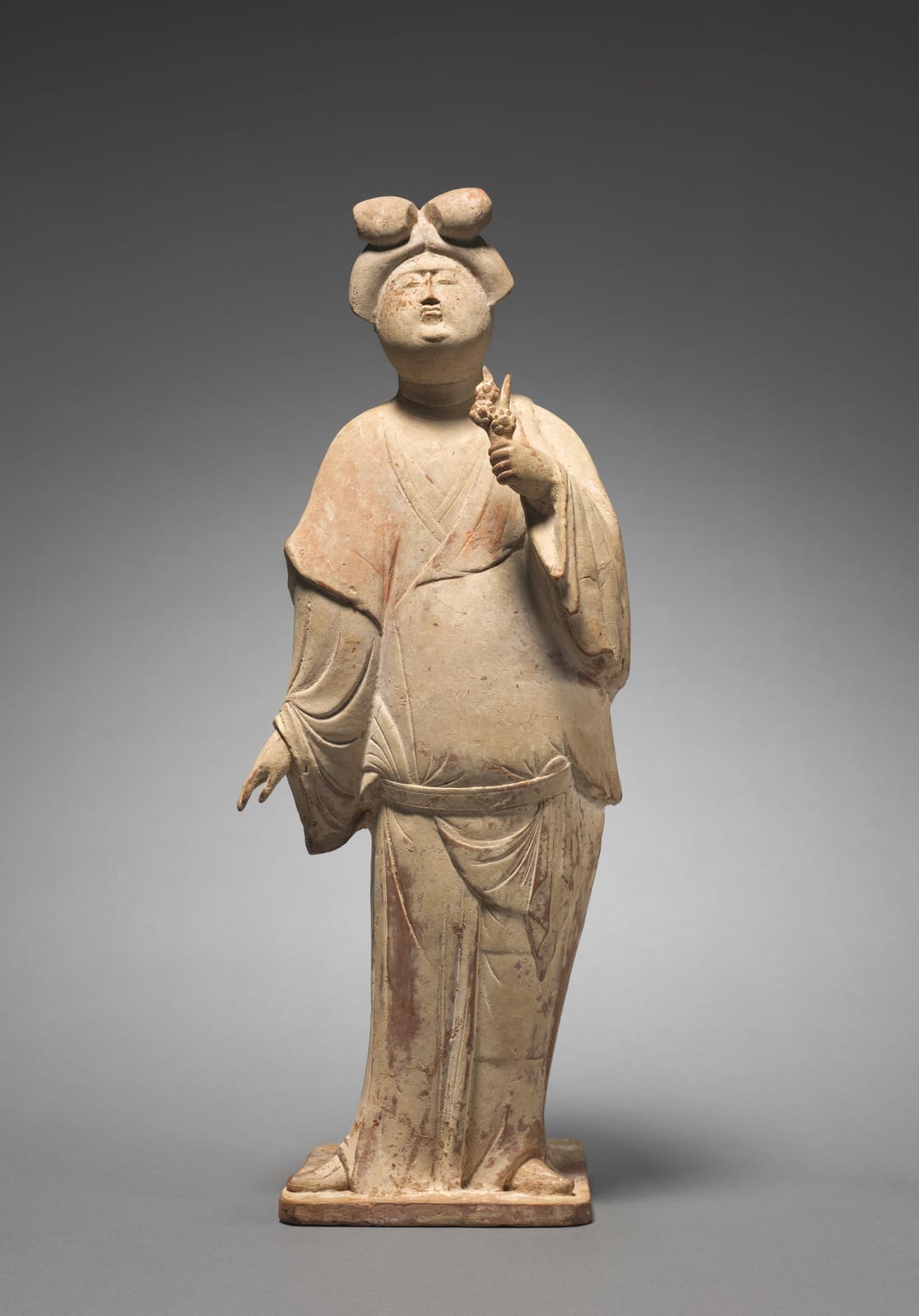
Myth: all Tang women were plump. The full-figured "Tang beauty" belongs to a particular phase. Chen shows a slender ideal in the seventh century, replaced by a voluptuous one by the early eighth century.4 The Asian Art Museum notes that its slender early Tang dancer would have looked out of place among the plump women of style of the 700s.13 The Art Institute of Chicago describes its plump mid-eighth-century equestrienne as reflecting early-to-mid-eighth-century ideals of beauty, and the Cleveland Museum of Art calls its plump lady with plum blossoms a common type in mid-eighth-century tombs.23,24
Myth: Tang clothing was one fixed costume. Hanfu, a term that literally means "Han (Chinese) clothing," is today the name of a revival movement, and that movement is recent: Sixth Tone dates its start on the mainland to 2003, when Wang Letian wore traditional clothing in public, and notes that enthusiasts recreate garments from descriptions in literary texts.25 The evidence above shows that Tang dress changed through the dynasty and borrowed freely from the steppe and Central Asia.4,3
Quick Answers
What Did Women Wear in the Tang Dynasty?
Elite women wore a short top or jacket, a long, high-waisted skirt, and a shawl, often made of silk.2,6 Many also rode and played polo in men's riding dress.18,19
What Is a Tang Ruqun?
It is the jacket-and-skirt ensemble: ru means a short jacket and qun a skirt, and it was commonly worn with a pibo shawl.2,26
What Did Men Wear in the Tang Dynasty?
Elite men widely wore a riding outfit of tight-sleeved robe, trousers, belt, and boots, with a black futou on the head. Officials' robe colors marked their rank.3,14,15
Were Tang Women Allowed to Wear Men's Clothes?
Yes. Figurines and paintings show elite women in men's foreign dress, and the Old Tang History records women riding in men's clothes and boots in the Kaiyuan era.17,19
Sources
- Empire of Style: Silk and Fashion in Tang China — BuYun Chen, University of Washington Press, 2019; book abstract, Swarthmore College Works (Chang'an, the Silk Road, and the Tang fashion system).Reference 1
- Seated Court Lady — The Silk Road, Department of History, University of New Mexico (quotes Chen, Empire of Style, on shan, ru, qun, and pibo).
- Dressing as horsemen: the universalisation of steppe dress in the first half of Tang dynasty China (618-755) — K. Nomoto, DPhil thesis, University of Oxford, 2022 (abstract; retrieved via the Wayback Machine).
- Review of Empire of Style: Silk and Fashion in Tang China by BuYun Chen — Jonathan Karam Skaff, Journal of Chinese Studies no. 71 (2020), pp. 199–204, Institute of Chinese Studies, The Chinese University of Hong Kong (Chen's sources, changing body ideals and silk patterns, sumptuary rules and the 771 edict, tax silk and the 745 Doulu Army inventory, the An Lushan rebellion, and Bai Juyi).
Return to text (14 references)
Reference 1 Reference 2 Reference 3 Reference 4 Reference 5 Reference 6 Reference 7 Reference 8 Reference 9 Reference 10 Reference 11 Reference 12 Reference 13 Reference 14 - Court Lady with Tall Headdress: Tomb Figurine, 1983.24 — Cleveland Museum of Art (tomb figurines accompanied the dead into the afterlife).Reference 1
- Court Lady with High Chignon, 1983.25 — Cleveland Museum of Art (V-neck blouse, empire-waisted skirt, stole, painted patterns; the range of tomb figures).
- Textile fragments from Astana, LOAN:STEIN.99 — Victoria and Albert Museum, Stein collection (Astana near Turfan, preserved by the dry desert).Reference 1
- A Study on the Costumes of the Performers in the Later Tang Cave 156 at the Mogao Grottoes — Li Bo, Dunhuang Research, 2011 (abstract, via the Digital Library of Buddhist Studies, National Taiwan University).Reference 1
- Visiting the Silk Road (II) — Shelley Anderson, Textile Research Centre Leiden, 2015 (Famen Temple silks found in 1987).Reference 1
- The Shoso-in Textiles of the Era of Emperor Shomu — Atsuhiko Ogata, Imperial Household Agency, Textile Society of America Symposium Proceedings, 2012 (abstract).Reference 1
- Fragment (Dress Fabric), 1998.3 — Art Institute of Chicago (half-palmette medallion; Shōsōin silks and the spread of Tang patterns).
- On the Change of the Female Status in the Tang Dynasty from the Horse-riding Tomb Figurine — Bosen Zhang, Proceedings of the 2018 International Workshop on Education Reform and Social Sciences, Atlantis Press, 2019 (the Sui rider, mili, curtained hats, Hu hats, and the Princess Yongtai figurine).
- Dancer, approx. 618–700 — Asian Art Museum of San Francisco, education resource (foreign fashions, quickly changing fashion, the slender dancer and the plump women of the 700s).
- Was a Classic Chinese Hat an Early Form of Social Distancing? — Claire Voon, Atlas Obscura, 2020 (futou history).
- Apparel and Accessories — Liu Fusheng, in A Social History of Middle-Period China, Cambridge University Press (excerpt: the Tang system of rank colors and the Tang-style headwrap).
- Civil Official (Wenguan), 1970.1068 — Art Institute of Chicago.Reference 1
- Tang Elite Women and Hufu Clothing: Persian Garments and the Artistic Rendering of Power — Gabrielle Berman, thesis, University of Wisconsin–Milwaukee, 2020 (abstract).
- Polo Player, 1964.181 — Cleveland Museum of Art (a woman in a man's riding habit).
- Polo Player, EC29.1962 — Art Gallery of New South Wales (women dressing as men for riding; the Jiu Tang shu passage on Hu hats and the weimao, translated in I. L. Legeza, 1972; retrieved via the Wayback Machine).
Return to text (6 references)
Reference 1 Reference 2 Reference 3 Reference 4 Reference 5 Reference 6 - One of a Pair of Women on Horseback, 49.2329 — Walters Art Museum (women riders and polo; riding trousers and short jacket).Reference 1
- The Culture of Colors of China (I): About the Semantic and Historical Change of Emperor's Color: Yellow and Purple — Lu Yuchang, KIBI International University (abstract; retrieved via the Wayback Machine).Reference 1
- Child's Coat with Ducks in Pearl Medallions, 1996.2.1 — Cleveland Museum of Art (Sogdian silk with a Chinese damask lining).Reference 1
- Equestrienne, 1970.1073 — Art Institute of Chicago (early-to-mid-eighth-century ideals of feminine beauty).Reference 1
- Woman Holding Plum Blossoms, 1987.13 — Cleveland Museum of Art (plump lady, a common type in mid-eighth-century tombs).Reference 1
- The Forgotten Drivers of China's 'Hanfu' Movement — Fan Chen, Sixth Tone, 27 November 2024 (meaning of hanfu, Wang Letian in 2003, recreating garments from texts).Reference 1
- An Attempt to Analyze the Implicitness of the Aesthetic Features of Chinese Art: Taking the Aesthetic Features of Women's Clothing in the Flourishing Period of Tang Dynasty as an Example — Zhaofang Xv, Proceedings of the International Conference on Education, Language, Art and Intercultural Communication (ICELAIC 2014), Atlantis Press, 2014 (the Tang women's Ruqun dress: a short jacket or blouse, a long high-waisted skirt, and a scarf).