A kosode is a Japanese robe with small wrist openings that, according to JAANUS, became the principal outer robe of Japan in the sixteenth century and evolved into the modern kimono.2 The Costume Museum in Kyoto describes it as underwear in the Heian era that "turned into an outer-garment gradually" between the Kamakura and Muromachi eras.1

Origins and History
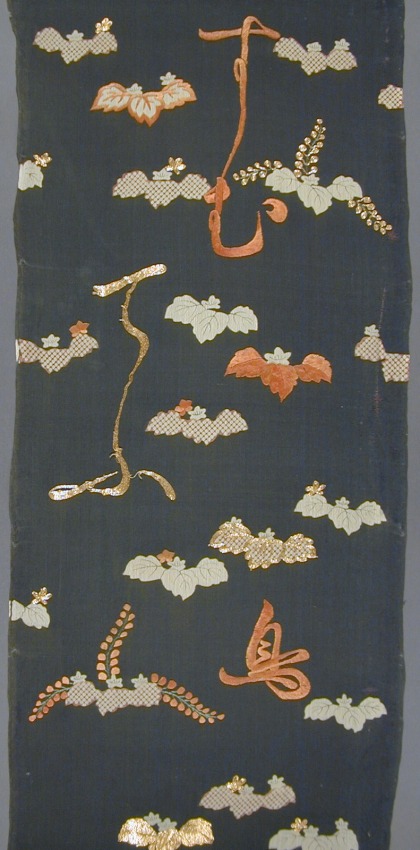
The Costume Museum traces a change from clothes of "mono-color and without patterns" to "multi-color with patterns," and states that the form of the kosode was established between the Momoyama and Edo eras.1 JSTOR Daily states that in the Edo period (1603-1868) it was a unisex outer garment, and that only from the Meiji period (1868-1912) onward was it called kimono.3
How It Was Worn
The name means "small sleeves," but it refers to the wrist opening.2 The Victoria and Albert Museum explains that robes with small openings at the wrist are kosode, while robes with a wide opening along the entire width of the sleeve are osode.4 JAANUS describes two main pieces joined at the center back, rectangular sleeves, two narrower front panels, and a diagonal collar piece.2
Meaning and Status
JSTOR Daily states that in the Edo period every Japanese person wore kosode, so style, motif, fabric, technique, and color announced the wearer and were often subject to sumptuary regulations.3
On This Site
- Medieval East Asian clothing
- Early modern East Asian clothing
- Nineteenth-century East Asian clothing
- Modern East Asian clothing
- Kimono history: from kosode to modern Japanese dress
Sources
- Woman of the upper class in kosode of Keicho period — The Costume Museum, Kyoto (Heian undergarment, gradual change to outer garment, patterns, and Momoyama-Edo form).
- Kosode — Japanese Architecture and Art Net Users System (JAANUS), 2001 (definition, sixteenth-century outer robe, and construction).
- The Surprising History of the Kimono — Cynthia Green, JSTOR Daily, 2017, updated 2025 (Edo unisex outer garment, Meiji naming, and social messages in kosode).
- Robe and belt (kariginu), FE.157&A-1983 — Victoria and Albert Museum (kosode and osode distinguished by the wrist opening).Reference 1