Heian period clothing is the dress of Japan between 794, when the capital moved to Heiankyō (now Kyoto), and 1185, when warrior government began in Kamakura.1 At court it meant wide-sleeved silk robes worn in many layers: a noblewoman's formal dress combined a jacket called the karaginu and a trailing skirt called the mo with layered robes beneath, and a nobleman's formal dress was the sokutai.2,3,4 Ordinary people wore simpler clothes, mostly of hemp.5
The period is best known for color. Court women chose the colors of their layers to match the season, following combinations listed in charts called kasane no irome.6 For the wider regional picture, see medieval East Asian clothing.
How We Know: Scrolls, Diaries, and Few Surviving Clothes
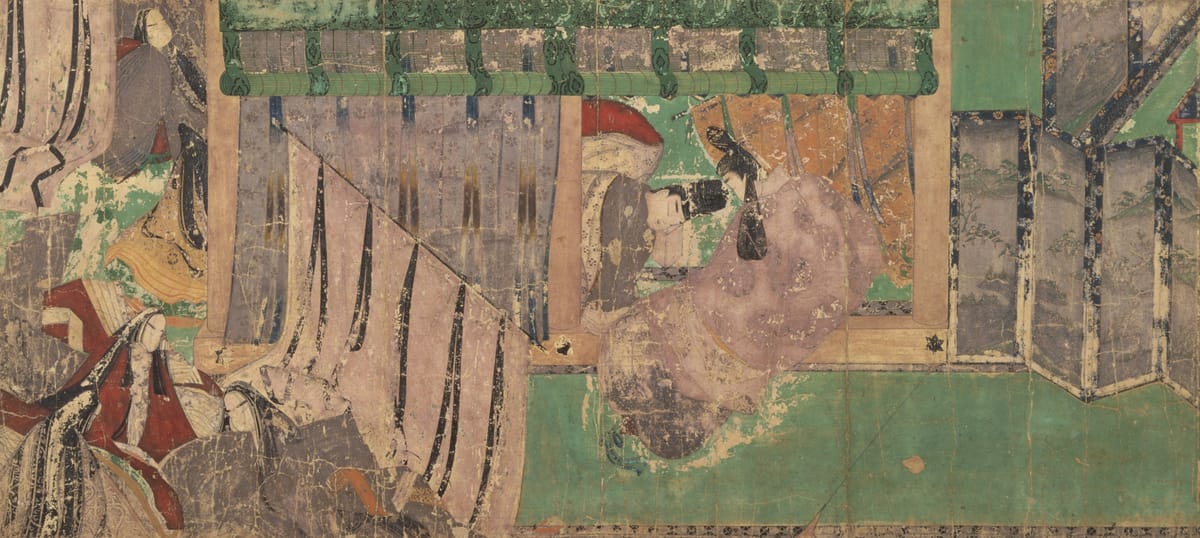

Surviving garments are few. The Japanese encyclopedia Nipponica names the kosode found in the coffin of Fujiwara no Motohira in the Konjikidō of Chūson-ji as the oldest surviving kosode, and the Costume Museum in Kyoto points to robes kept at Tsurugaoka Hachiman Shrine in Kamakura that are linked to Hōjō Masako (1157–1225).5,2,15 Most of what we know comes from pictures and writing.
The most important pictures are the illustrated handscrolls of The Tale of Genji. The Tokugawa Art Museum calls them the oldest surviving illustrated version of the novel, dates them to the twelfth century, and lists them as a National Treasure.7 They were made about a hundred years after Murasaki Shikibu finished her story; one volume is in the Gotoh Museum in Tokyo and three in the Tokugawa Art Museum.8 Because they are fragile, they are usually shown for only about one week each November.8
Court women also wrote about clothes. Murasaki Shikibu's diary, which covers 1007 to 1010 in a 1920 translation by Annie Shepley Omori and Kochi Doi, records what each lady wore at court ceremonies, down to the colors of her robes and the decoration of her train.9 Sei Shōnagon's Pillow Book, of which Arthur Waley translated about a quarter in 1928, notes clothes in passing: an "aster" mantle, worn-out hunting-cloaks on footmen, women's long hair.10
Modern reconstructions draw on texts and pictures together. The Costume Museum bases its dressed figures on sources such as the Masasuke Shōzoku Shō, a costume manual compiled in the Insei period late in the Heian era, and the twelfth-century Kokawa-dera engi scroll.2,15
From Tang Models to Heian Court Dress
Heian dress began as Chinese-style official dress. The women's court uniform set out in the Yōrō clothing code, and the ninth-century components listed in the Engishiki, followed a Tang pattern.3 From the middle of the Heian period on, this dress was reshaped: narrow sleeves became wide, garments grew longer and were cut with straight seams, and robes were worn layered one over another.3 Men's dress went the same way. Nipponica describes a move away from directly imported Chinese clothing toward forms suited to Japan's climate and way of life, with longer garments and straight cutting.4
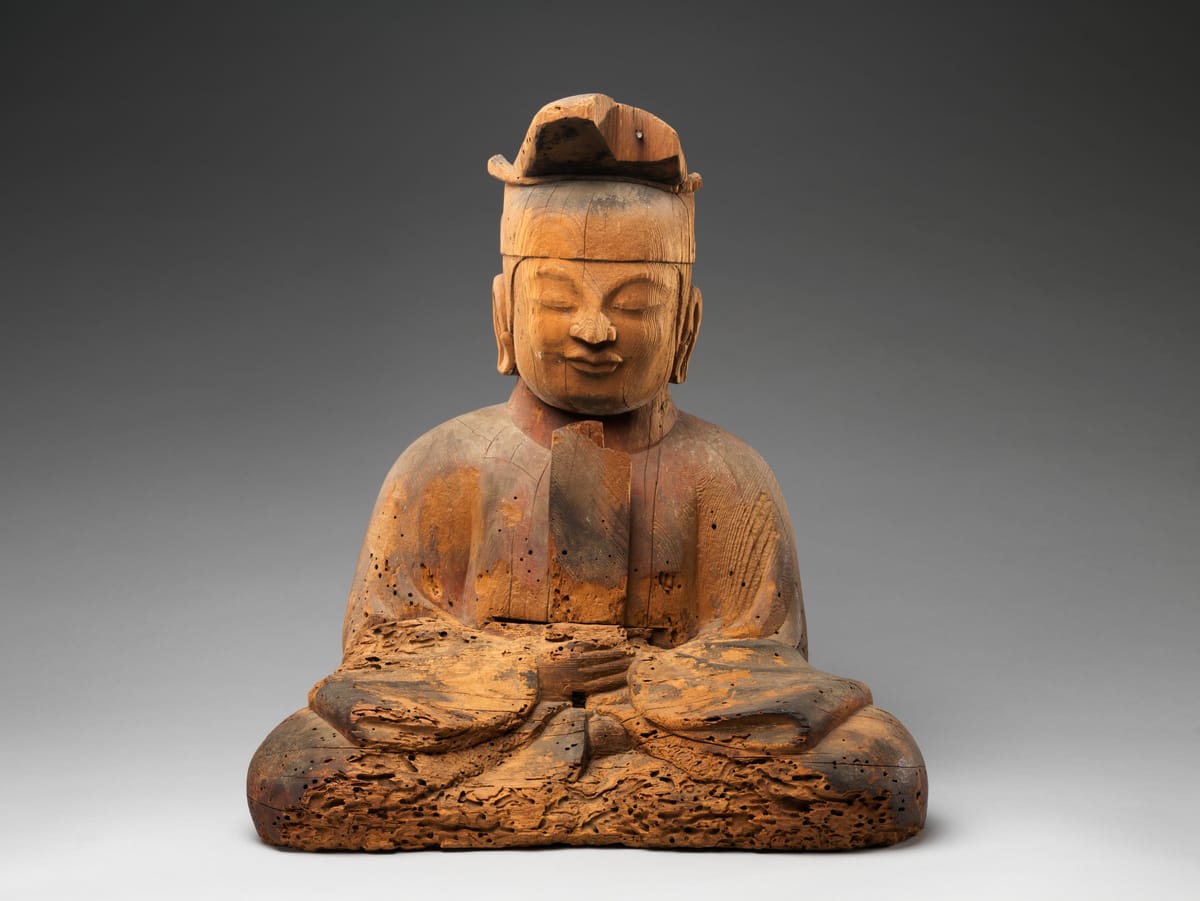
In 894 a planned embassy to Tang China under Sugawara no Michizane was cancelled, and he recommended that no more be sent.11 The Metropolitan Museum describes the court's decision to end official relations with China as part of a time of "internal cultural concentration."1 But the sources describe dress changing gradually across the period, not all at once after 894.3,4 The tenth-century Shinto sculpture above, for example, already wears a robe with broad sleeves.12
Women's Court Dress: Karaginu, Mo, and Layered Uchiki
The basic dress of a Heian court lady was a robe called the uchiki, worn over an unlined robe called the hitoe, with a red divided skirt (hakama) and, beneath everything, a white kosode.2 The uchiki was sometimes worn in layers.2 For full court dress, two pieces were added: the karaginu, a short jacket worn over the layered robes, and the mo, a skirt tied at the back of the waist and trailing behind.3,2 Both came from older Chinese-style garments. The karaginu grew from a short sleeveless jacket that was enlarged and given sleeves, and the mo had once been a long wrap skirt that, once robes were layered, could only be tied at the back.3
By the end of the period, five layered robes had become standard, and these were called itsutsuginu, "five robes."3,6 The 1920 translation of Murasaki Shikibu's diary describes the uchigi (the same robe) as a long, flowing robe lined in another color, worn over two or more silk robes of different colors, with a long white silk train painted or embroidered at the back.9
Dress also showed rank. Only women allowed the "forbidden colors" could wear colors such as deep purple and crimson and double-woven patterned silks; women of middle rank and above wore twill and plain silk, and those below wore plain silk only.3 Murasaki Shikibu notes that ladies permitted the "honourable colours" (purple and scarlet, in the translators' note) wore brocade karaginu, while older ladies without that right chose quieter robes.9
Long hair appears throughout the sources. Waley's Sei Shōnagon admires a girl whose very beautiful hair spreads down her back, and the Costume Museum's figure of a court lady wears her hair straight and long.10,2 Murasaki Shikibu's diary records that on the last night of the year "we dyed our teeth [black]," with the word "black" supplied by the translators.9
Kasane no Irome: Dressing in Seasonal Colors
The Japanese government magazine Highlighting Japan explains that the Heian nobility drew up rules for the color combinations of layered silk robes, worn by both women and men at court, based on the colors of the changing seasons. Charts of these combinations, called kasane no irome, list more than 100 patterns.6 Each layer showed only slightly at the collar, sleeve edges, and hem.6
One example is kobai no nioi, the gradation of red plum: a red layer followed by four lightening shades of pink, suitable for special occasions in early spring. Safflower and other natural dyes produced the gradations.6 Layering could also change a color: a white outer silk over a red lining gave the pale red of cherry blossoms.6
The Pillow Book shows the same habit of naming colors after plants. Waley's footnote explains that its "aster" mantle was light purple lined with clear blue.10 Seasonal changes followed the calendar.3 The Masasuke Shōzoku Shō, quoted by the Costume Museum, has court ladies wearing two unlined robes together from the sixth month and changing their dress on the seventh day of the seventh month.2
Men's Court Dress: Sokutai, Ikan, Nōshi, and Kariginu
A nobleman's formal dress was the sokutai. Under the old code, ceremonial dress had been the raifuku, but in the Heian period the raifuku was used only at enthronements, and the regular court uniform took its place at ceremonies under the name sokutai.4 The full outfit included a cap, an outer robe (ho), several inner robes with a long trailing back panel, white trousers, a leather belt set with stones, a flat baton, and a fan.4 Because it was worn by day it was also called "daytime dress."2,4
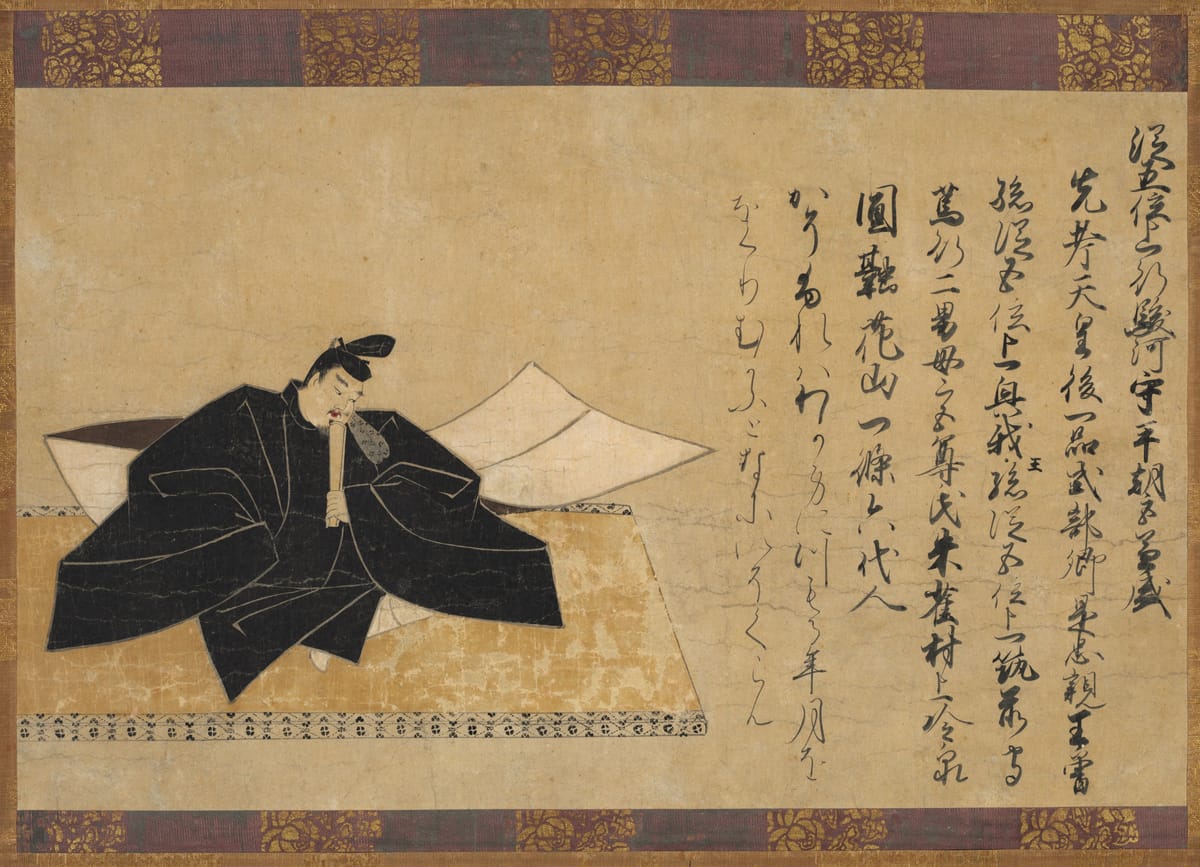
The color of the outer robe followed rank. By the tenth century, deep purple for the third rank and above had turned to black, the fourth rank also wore black, and the sixth rank and below wore green, which from the twelfth century was in practice a pale indigo (hanada).4 The Cleveland painting above, made in the thirteenth century, shows Taira no Kanemori, one of the Thirty-Six Poetic Immortals of classical Japanese literature, in a black court robe.13
The ikan was a lighter court dress: the outer robe worn with full trousers called sashinuki, without the stone belt.2 It was classed as tonoi shōzoku, a term the Costume Museum translates as "dress for home" and Nipponica groups with simplified night-duty dress, but it was soon worn in the palace itself.2,4 The nōshi had the same cut as the court robe but was not tied to the colors of rank, and the emperor, the crown prince, princes, and senior nobles wore it as everyday dress.14 Late in the period, nobles who received imperial permission could attend court in it.14 Young men wore deep colors and older men pale ones.14
The kariginu began as private dress worn for hunting and had open sides; later it became formal dress for officials below the sixth rank.2
Commoners' Clothing and the Road to Kamakura
Ordinary people dressed very differently. Nipponica says that commoners wore a short garment without sleeves or a kosode with short tube sleeves as outerwear, the men with short trousers and the women with an apron-like wrap called the shibira.5 Their kosode were mainly hemp, with short sleeves and a hem that left the shins bare, sometimes decorated with simple tie-dyed or rubbed patterns.5 The Costume Museum's figure of a common woman after the mid-Heian period wears a kosode and shibira, with short hair tied at the back.15 The hitatare, later the samurai's everyday dress, began as one of the commoners' garments of the Heian period.15
The same garment, the kosode, existed among nobles only as a hidden undergarment of white plain silk or twill.5 This split matters for later history. As the court nobility declined in the Kamakura period (1185–1333), noble dress grew simpler, women began to wear the kosode with only a hakama or a robe over it, and the kosode slowly became outerwear, the long story told in kimono history.16,3,5
Court dress itself did not vanish in 1185. The Costume Museum says the full karaginu ensemble became dress for special ceremonies only, while the formal dress of a woman of the upper warrior class in the early Kamakura period was a white kosode with a narrow sash and court-style hitoe and uchiki layered over it.15 Warriors from the shogun down to the fifth rank wore the sokutai at major ceremonies.4
Myths About Heian Period Clothing
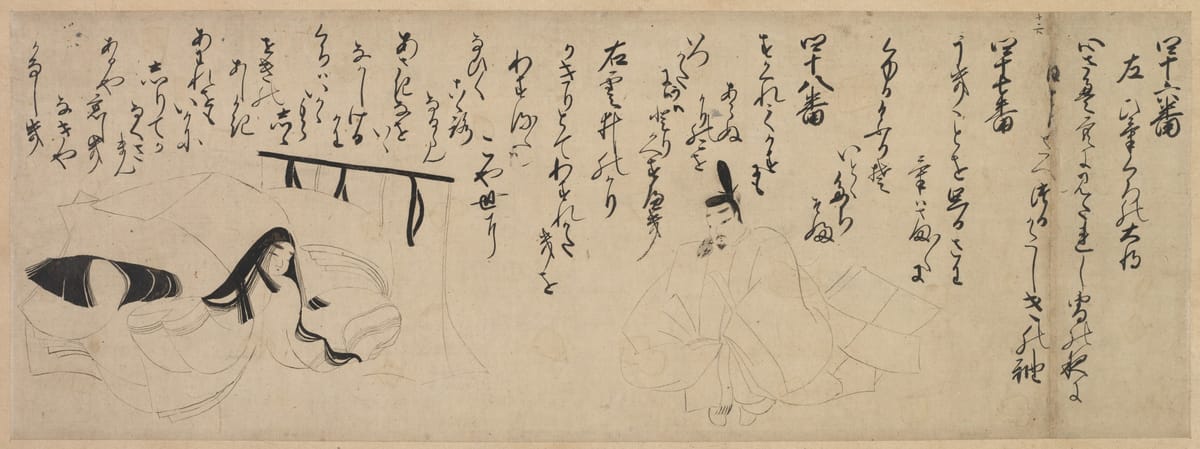
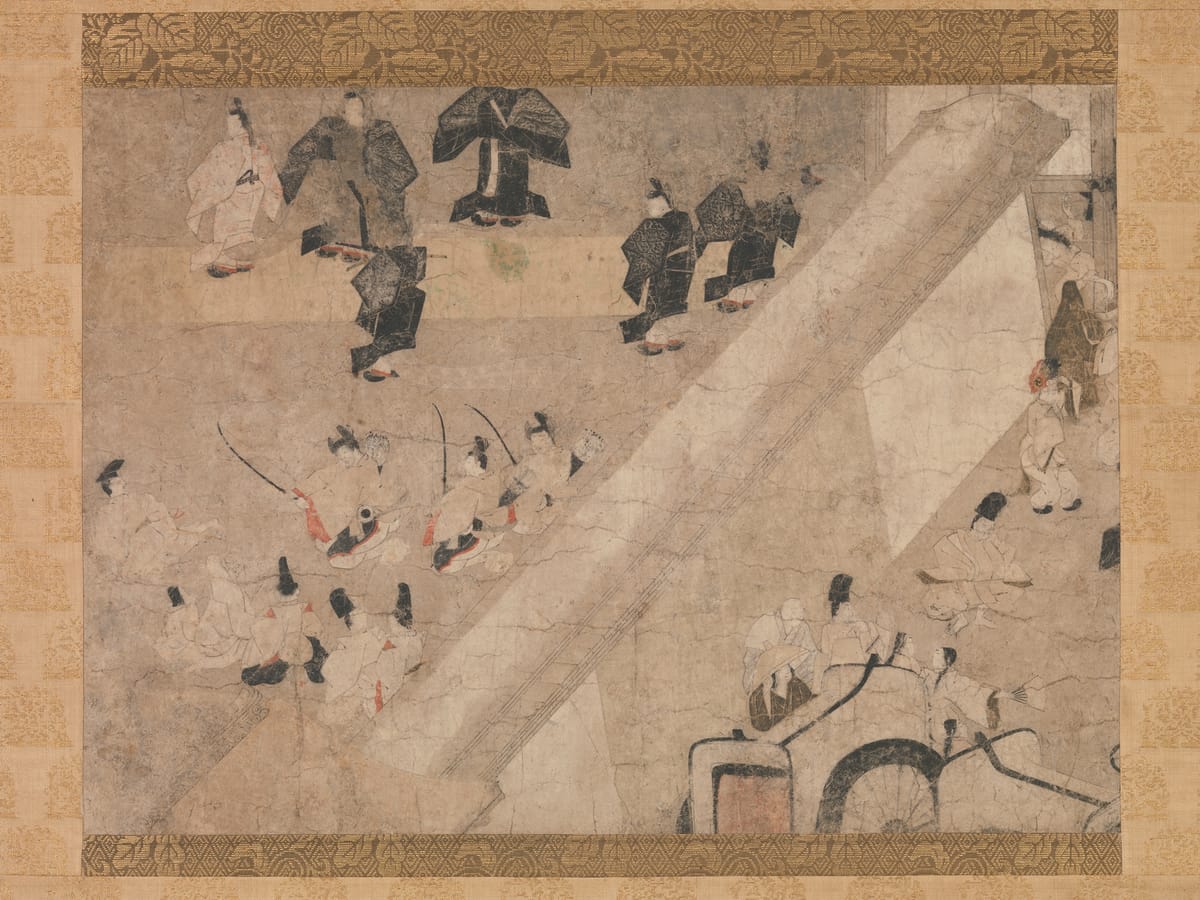
Myth: the junihitoe always had exactly twelve layers. The name refers to twelve layered robes,3 and even a Japanese government fact sheet states that formal dress had twelve.16 Takada Shizuo, writing in Nipponica, says the number of robes was not limited to twelve and could be more or fewer. The Eiga monogatari (Tale of Flowering Fortunes) mentions an extreme case of twenty, and from the late Heian period five were considered proper.3 Highlighting Japan likewise says that the set first had twelve or more layers and that five became standard around the end of the period.6 Later images, like the fifteenth-century drawing above, still show ladies in heavy layered robes.17
Myth: Heian women called their formal dress junihitoe. The formal names were nyōbō shōzoku (dress of a court lady) or mo karaginu. According to Nipponica, "junihitoe" was a popular name for many robes layered over a hitoe, and it was probably applied by mistake to the full karaginu and mo ensemble only in the early modern period.3
Myth: Japanese dress changed overnight in 894. The cancellation of the embassy to China is a real date, but the reshaping of court dress happened over generations.11,3,4
Quick Answers
What Did People Wear in the Heian Period?
Nobles wore layered silk robes with wide sleeves: women the uchiki, karaginu, and mo, and men the sokutai, ikan, or nōshi. Commoners mostly wore hemp kosode with short trousers or a wrap.2,3,4,5
What Is a Junihitoe?
It is the popular name for the formal dress of a Heian court lady: layered robes over a hitoe, with a karaginu jacket and a mo skirt. Five layered robes became standard by the end of the period.3,6
How Many Layers Did Heian Court Ladies Wear?
It varied. Twelve was not a fixed number; one source records twenty, and five became standard late in the period.3
What Is Kasane no Irome?
It is the Heian system of color combinations for layered robes, chosen to suit the season. Charts list more than 100 combinations.6
Sources
- Heian Period (794–1185) — Department of Asian Art, Heilbrunn Timeline of Art History, The Metropolitan Museum of Art, 2002 (text retrieved through Jina Reader).
- Courtier in regular court dress, ikan, Court lady in itsutsu-ginu kouchiki, Courtier in everyday wear, kariginu, Court lady in everyday wear for winter and Court lady's everyday wear for summer, Insei period — The Costume Museum, Kyoto.
Return to text (13 references)
Reference 1 Reference 2 Reference 3 Reference 4 Reference 5 Reference 6 Reference 7 Reference 8 Reference 9 Reference 10 Reference 11 Reference 12 Reference 13 - Jūnihitoe (十二単) — Takada Shizuo, Nihon Daihyakka Zensho (Nipponica), Shogakukan, via Kotobank (in Japanese).
- Sokutai (束帯) — Takada Shizuo, Nihon Daihyakka Zensho (Nipponica), Shogakukan, via Kotobank (in Japanese).
Return to text (11 references)
Reference 1 Reference 2 Reference 3 Reference 4 Reference 5 Reference 6 Reference 7 Reference 8 Reference 9 Reference 10 Reference 11 - Kosode (小袖) — Yamanobe Tomoyuki, Nihon Daihyakka Zensho (Nipponica), Shogakukan, via Kotobank (in Japanese).
Return to text (7 references)
Reference 1 Reference 2 Reference 3 Reference 4 Reference 5 Reference 6 Reference 7 - Kimono Combinations: The Seasons in Layers of Silk — Highlighting Japan, Government of Japan, October 2020 (text retrieved through Jina Reader).
Return to text (9 references)
Reference 1 Reference 2 Reference 3 Reference 4 Reference 5 Reference 6 Reference 7 Reference 8 Reference 9 - Genji monogatari emaki — Tokugawa Art Museum, Nagoya, collection highlights.Reference 1
- The Genji monogatari emaki — Japanese Studies blog, The Ohio State University Libraries.
- Diaries of Court Ladies of Old Japan — trans. Annie Shepley Omori and Kochi Doi, Houghton Mifflin, 1920 (Project Gutenberg; The Diary of Murasaki Shikibu, with translators' notes 33–35).
- The Pillow-Book of Sei Shōnagon — trans. Arthur Waley, George Allen & Unwin, 1928 (Project Gutenberg).
- Sugawara no Michizane (845–903) — course notes, HIST 341K, The University of Texas at Austin.
- Male and Female Shinto Deities — The Metropolitan Museum of Art, 2015.300.256a, b, collection API.Reference 1
- Taira no Kanemori of the Thirty-Six Poetic Immortals — Cleveland Museum of Art, 1951.397.Reference 1
- Nōshi (直衣) — Takada Shizuo, Nihon Daihyakka Zensho (Nipponica), Shogakukan, via Kotobank (in Japanese).
- Commoner in everyday wear, hitatare, Commoner in everyday wear: kosode and shibiradatsumono and Woman of the upper warrior class in formal costume — The Costume Museum, Kyoto.
- Japanese Dress in Former Times — Fashion fact sheet, Web Japan, Ministry of Foreign Affairs of Japan (text retrieved through Jina Reader).
- Section of an Illustrated Tale of Genji Poetry Contest — Cleveland Museum of Art, 1989.119.Reference 1