19th Century · Sub-Saharan Africa · 1800 - 1900
Kuba Raffia Cloth and the Art of Dressing for Ceremony
A Kuba dance skirt could measure several meters around the body. Follow the work from palm leaf to loom, then see which parts of the pattern a dancer actually showed.
By Dan Schnau · Last updated
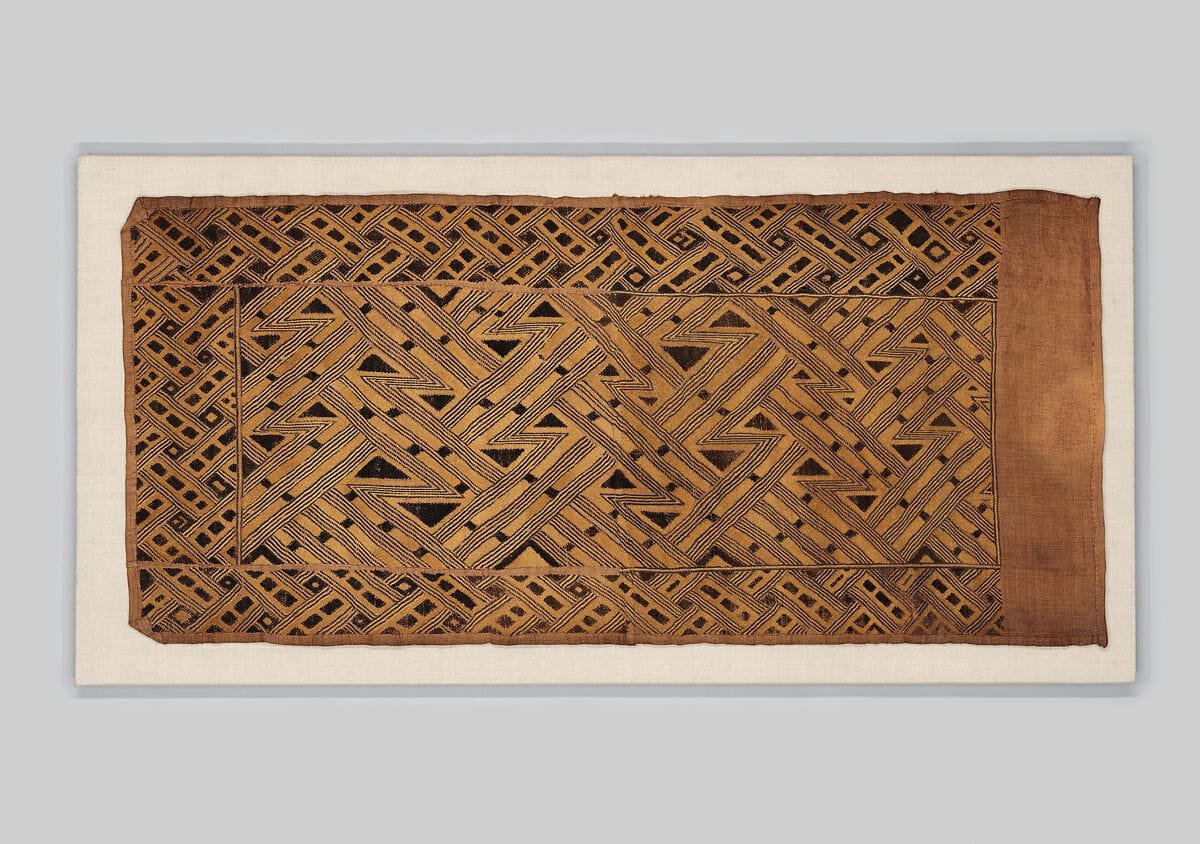
At a Kuba court dance in the Sankuru River region of today's Democratic Republic of the Congo, an elite woman might wear two skirts. A belt secured the shorter one over a gold-colored underskirt. As she moved, the viewer saw bands of pattern on her hips against the plainer cloth below. The dark and light strands in the overskirt pictured here came from a palm. Its soft, raised surface is embroidery.1
From palm leaf to embroidered cloth
The starting material was the frond. In the account accompanying a Shoowa woman's skirt at the Toledo Museum of Art, young men split the palm leaves and women prepared the fibers. Men wove the ground cloth. On an inclined loom, crossing two sets of strands over and under one another produced a plain weave. It took a second group of operations to turn that ground into a patterned garment.2,3
Look at the wide middle band of the dance skirt above. A woman embroidered the woven ground with short lengths of dyed and undyed raffia. Trimming the projecting ends created a dense pile. The threads stand up from the surface, so the eye follows both changes of color and changes of texture. This finish accounts for the name Kasai velvet sometimes given to Kuba pile cloth.1,4
Appliqué produced another kind of pattern. On the mid-twentieth-century Shoowa skirt in Toledo, the maker laid patches of different tones over the base and sewed them down with black stitches. The dark outline both holds each patch in place and defines its shape. The skirt measures about 3.3 meters along its long side. At that scale the maker could vary the shapes from one part of the garment to the next.2
What happens to the pattern when the skirt is wrapped?

Start at the left of the Cleveland overskirt. The dark interlocking diamonds stand out at a glance. Near the opposite end a similar figure is worked in a shade close to the ground. Between the two are sections with much smaller, widely spaced marks. Spread flat, the whole piece measures 4.13 meters long and only 64 centimeters across. Most photographs need to reduce it to a narrow strip to fit it on a screen.5
Now imagine feeding that length around a waist. The surface you saw a moment ago disappears under the next turn. For the long ceremonial skirts of royal Bushoong women, the Princeton University Art Museum describes a spiral arrangement that leaves the lower edges of successive layers showing. Some Kuba wrappers also had pom-poms or cowries along the edges. Gathering the cloth brought these details together and let them move with the wearer. A photograph of the entire flat skirt reveals work that even a spectator standing beside the dancer could only partly see.4,6
Men wore long wrappers too. A mapel, or man's ceremonial skirt, from the Sankuru River region measures 3.76 meters by 74 centimeters. The Met dates it to the middle or later nineteenth century and identifies cotton as well as raffia and dye. Compare its length with the first overskirt pictured here, just over 1.2 meters long. A collection label that identifies an object as a man's skirt, a woman's overskirt, or panels from a garment tells us something its rectangular outline alone cannot settle.1,7
Designs, rank, and the people who made them
Raffia had a place in Kuba political history well before these particular skirts were made. The Met relates that the seventeenth-century ruler Shyaam aMbul a Ngoong took the raffia palm's name, shyaam. Successive rulers sponsored new designs, and some designs carried the names of their inventors. Others took their names from features of the world around the artist, including eyebrows and the scales on a crocodile's back. A geometrical outline could preserve someone's name or evoke a familiar sight.4
At court, the amount and intricacy of the work on an overskirt reflected the standing of the woman for whom it was made. Dance brought that work before an audience at initiations and ceremonies installing people in office. Princeton's Bushoong panels also document shared authorship. Several women might contribute the embroidered or applied shapes on a skirt. In that setting even an unnamed garment can preserve the decisions of several people working on a single length of cloth.1,6
When a panel served as wealth
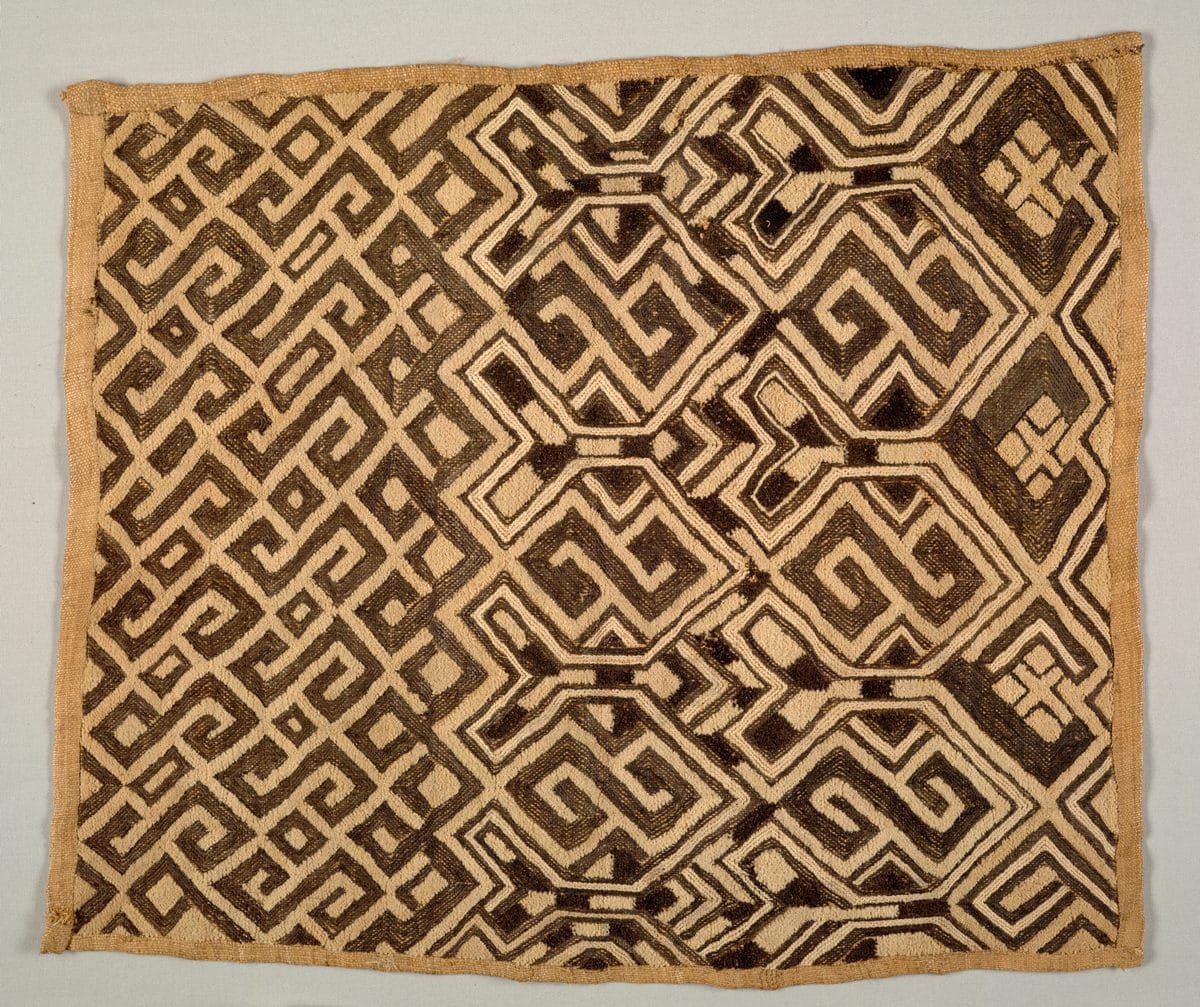
Trace one line with your eye across the Cleveland cloth above. On the left, small turns fit closely together. On the right, the shapes open up enough to enclose crosses. The artist changed the scale of the design within an area barely wider than half a meter. Cleveland identifies the fiber, the dye, and the raised embroidery. It calls the object a cloth and leaves its specific use open.8
For a documented use, compare the Met's Double Prestige Panel. The museum identifies it as a piece for display and exchange. Panels of this kind circulated as currency. Other embroidered and appliquéd cloths could settle debts or form part of marriage payments. At funerals, lengths of raffia might be wrapped around the deceased, while gifts of cloth connected the living with the family in mourning. A piece of pile work could therefore represent labor, wealth, and an obligation between people, even if it never formed part of a costume.2,3,4
Two other African cloth traditions offer a comparison. In the Kongo kingdom, weavers could raise loops as they wove a luxury cloth. In Buganda, a maker could beat the inner bark of a fig tree into a sheet and dispense with the loom altogether. Look for the underlying structure as well as the surface pattern in the early modern survey and the history of barkcloth in Buganda and the Pacific.9,10
Sources
- Woman's ceremonial overskirt — Metropolitan Museum of Art, 1999.522.14. The museum describes the layered ensemble, embroidery, wearers, and dance occasions.
- Woman’s Skirt — Toledo Museum of Art, 1977.73. Shoowa makers, palm preparation, appliqué, and exchanges of cloth.
- Overskirt — Smithsonian National Museum of African Art, 83-2-1. Foundation weave, inclined loom, and funeral gifts.
- Double Prestige Panel — Metropolitan Museum of Art. Wrapping, edge ornaments, cut pile, currency, royal commissions, and pattern names.
- Woman's overskirt (ncaka) — Cleveland Museum of Art, 2003.90. Measurements, overall view, and details of individual panels.Reference 1
- Panels from a woman's ceremonial skirt (ncak nsueha) — Princeton University Art Museum, 1995-412. Bushoong women's collaboration, spiraling the cloth, and uses at ceremonies.
- Mapel (man's ceremonial skirt) — Metropolitan Museum of Art, 1999.522.3. Nineteenth-century man's skirt, dimensions, and materials.Reference 1
- Embroidered Raffia Pile Cloth — Cleveland Museum of Art, 1992.102. Measurements and changes in the scale of the embroidery.Reference 1
- Patterns without End — Susan Brown in conversation with textile conservator Christine Giuntini, Metropolitan Museum of Art. Analysis of early Kongo pile weaving.Reference 1
- Barkcloth making in Uganda — UNESCO Intangible Cultural Heritage. Baganda makers and fig bark.Reference 1