Modern · 1900 - Present
Barkcloth in Buganda, Sāmoa, and Tonga
A fig tree that yields more than one harvest, a skirt with three sawtooth edges, and a royal gift over 22 meters long show what makers could do with inner bark.
By Dan Schnau · Last updated
The cloth on a person's shoulders can start as a continuous layer inside a tree. Beating that layer spreads and softens the fibers into a sheet. In Buganda, a kingdom in present-day Uganda, the tree is a fig and a familiar use for the sheet is a body wrap. In Sāmoa and Tonga, makers commonly work with paper mulberry. They can join pieces to make anything from a length for a skirt to a ceremonial gift larger than a room.1,2,3
Buganda's cloth begins with a living tree
The Baganda cultivate the mutuba fig (Ficus natalensis). Growing a straight trunk matters. Branches interrupt the surface from which a maker can take a broad strip. Families can grow the trees among bananas or coffee, where they also give shade. During the wet season, the maker removes bark and wraps the exposed part of the trunk in banana leaves while it recovers. The same tree can supply bark again. A workshop therefore depends on years of tending trees as well as on the skill of the person wielding the mallet.1,4
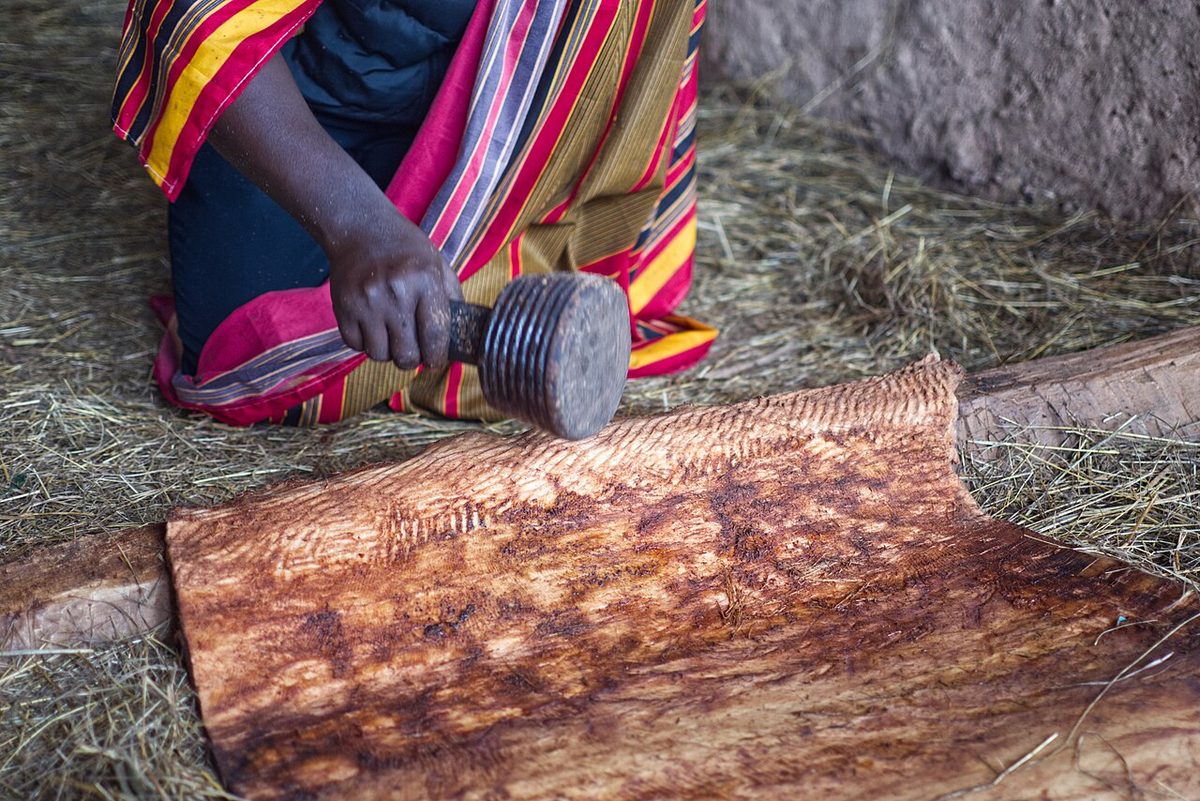

In an open-sided shed, the bark stays workable longer than it would in direct sun. A craftsman uses a succession of wooden mallets to beat it thin and even. The familiar cloth is terracotta in color. Both men and women have worn it draped around the body, with women securing it at the waist with a sash. Kings and chiefs could wear cloth dyed black or white, with a distinctive drape. UNESCO identifies the Ngonge clan's hereditary chief craftsman and the makers who supplied both the royal household and other families.1
One surviving Baganda cloth offers a closer look at what could be done after beating. An early-twentieth-century sheet in Cleveland has concentric circles and four-pointed stars. Its makers stamped and painted the surface with natural dyes. In the court, a large decorated sheet could serve as prestige dress or divide a space. At a burial, several sheets might be wrapped around one person. The Uganda Community Museums Association records that the number itself could express the deceased's standing, and that some people specified it in their wills.4,5
In the nineteenth century, caravan traders brought cotton cloth into Buganda, and fewer village workshops produced barkcloth. Ceremonies preserved reasons to keep making it. The association describes royal orders giving younger people a chance to learn the work, and identifies access to mature trees and an irregular market as difficulties for makers. Both the supply of bark and the occasion for using the finished cloth help explain which skills pass to another generation.1,4
Sāmoan siapo from a painted sheet to a wrap skirt
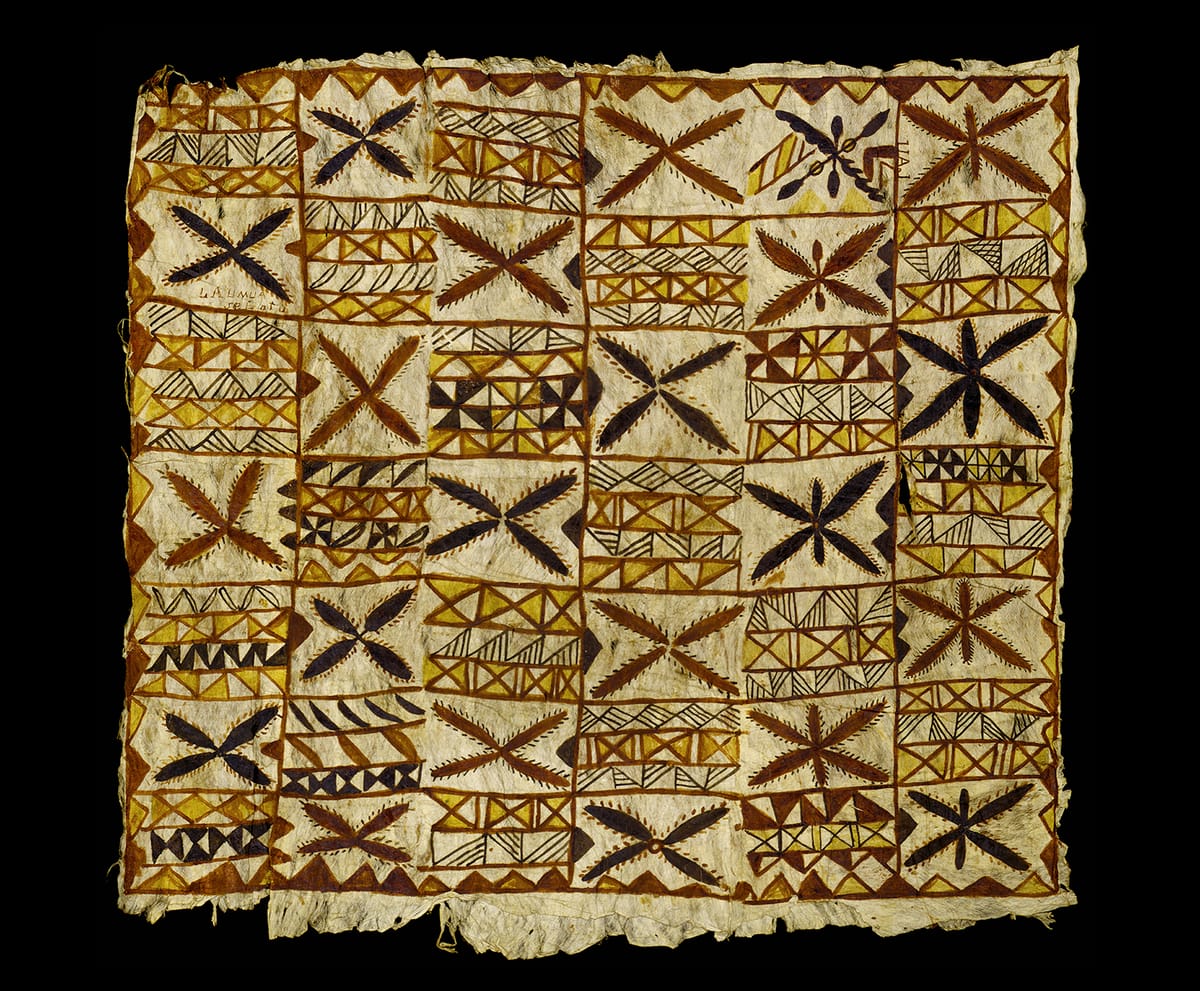
In Sāmoa, siapo is the cloth. The u‘a, or paper mulberry, supplies its inner bark. A maker scrapes the bark clean, beats it over a wooden anvil until it widens, and joins pieces with paste. Look again at the 1890s cloth above. The squares alternate, but the painted divisions, petals, and points vary from one square to the next. This is siapo mamanu, the term for freehand decoration. Its regular arrangement came from the artist's hand.2,6
A maker could also lay cloth over a raised design tablet called an ‘upeti and rub color across it. An impression appeared on the upper surface. The two ways of working could share a single sheet. In 2000, Va‘amuli Moli-Salu of Palauli made a siapo for a hotel using both rubbed and freehand designs. She had learned the craft from her mother and made cloth for local people and relatives overseas as well as for visitors. Her name and account supply something missing from the record of the nineteenth-century piece, whose artist is unidentified.6
How can we tell which part of a wrap went at the waist? On a Sāmoan cloth dated 1900–1945 at the Rhode Island School of Design Museum, three edges have been cut into sawteeth. The fourth is plain. The museum identifies the piece as probably a lavalava, a wrap skirt. The plain edge could sit under a barkcloth belt, leaving the decorative cuts visible below and at the ends. The shape of the border is evidence for how a rectangular sheet was worn.7
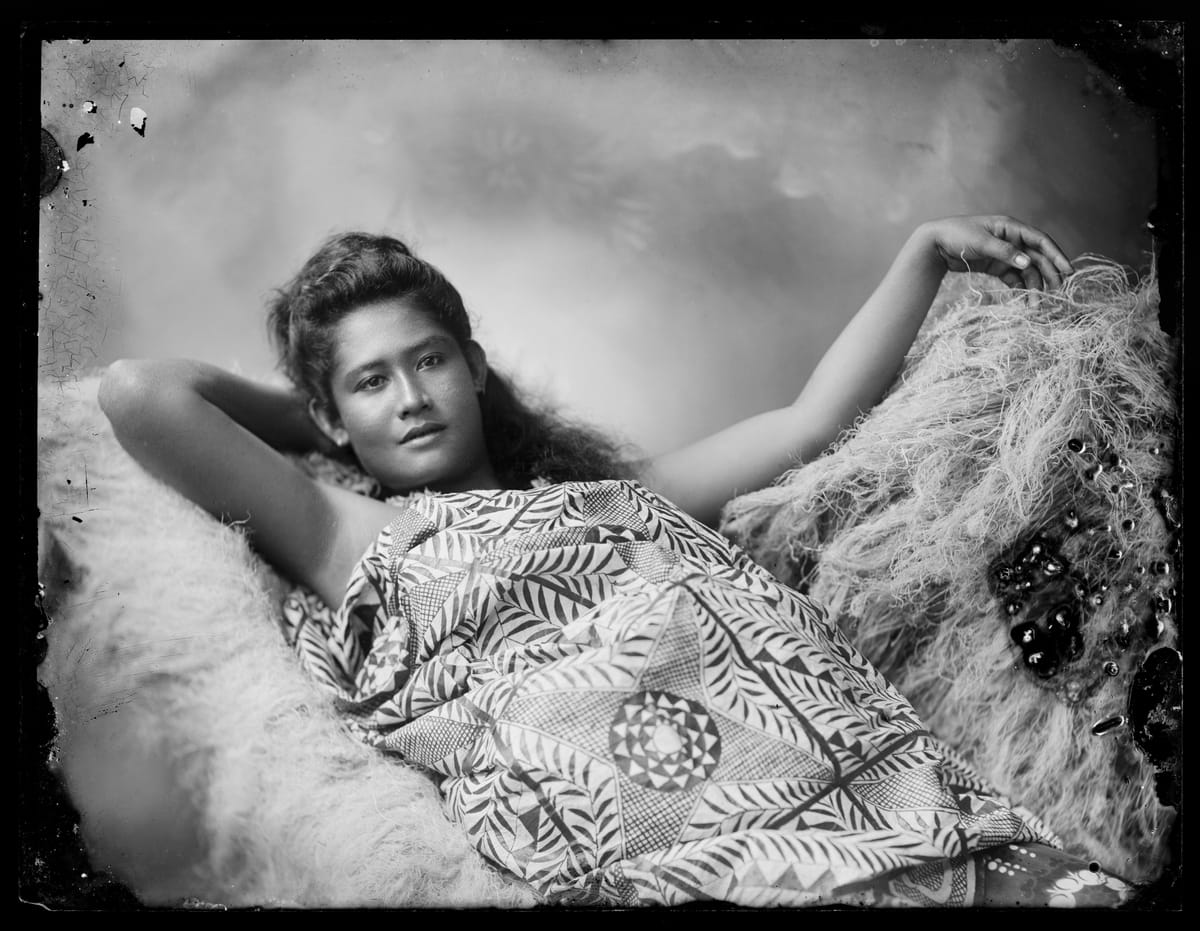
In Thomas Andrew's portrait, the sitter's raised arm leaves the upper edge of the cloth visible. A leafy border folds under her arm, while a star-shaped motif remains fully visible lower down. The photograph preserves those folds and the scale of the decoration against a body. Te Papa records the photographer's name, but the sitter and the maker of her siapo are unidentified.10
Tongan ngatu measured as a gift
Tongan makers call their decorated barkcloth ngatu. After beating strips of paper mulberry, women can join pieces with arrowroot paste, take impressions from pattern boards called kupesi, and add painted details. A piece intended for presentation can be divided into lengths called langanga, marked with numbers on the cloth. Fifty such divisions make a launima. Counting the divisions measures the size of a gift in units that the makers and recipients recognize.3,8
One ngatu launima at Te Papa measures 22.73 by 4.34 meters. Its painted crowns and the initials ERII recall the 1953 visit of Queen Elizabeth II to Tonga. Twelve years later the cloth was placed beneath Queen Sālote Tupou III's coffin on the flight that returned her body from New Zealand to Tonga. It was then given to the pilot, who presented it to the museum in 1968. The painted initials record one event. The history passed on with the cloth preserves its part in a second queen's funeral.3,8
An Auckland wedding dress with a named designer and wearer
In 1994 Jackie Leota-Ete saw a two-piece outfit of tapa and braided cord at a Pasifika fashion show in Auckland. She remembered its designer, Paula Chan-Cheuk, when she came to commission her wedding clothes. Chan-Cheuk, who was born in Sāmoa to a family of dressmakers, made the ensemble in Auckland in 1997 with the bride's input. Leota-Ete wore it on 11 January 1998.9
The full-length dress, long train, and headpiece carried shell and braided sennit decorations. The bouquet incorporated a fue, an orator's fly whisk. The surviving ensemble and the bride's account let us trace a choice from runway to wedding. We know who commissioned the garment, which earlier design she remembered, and how material usually catalogued by the sheet became part of a particular woman's dress.9
For a comparison with palm fiber that passes through a loom, see Kuba raffia cloth and ceremonial skirts. The bark cloth glossary entry also leads to Buganda's place in the site's African clothing surveys.
Sources
- Barkcloth making in Uganda — UNESCO Intangible Cultural Heritage. Mutuba fig, makers, harvesting season, methods, dress, and changes in production.
- Siapo mamanu (tapa cloth) — Museum of New Zealand Te Papa Tongarewa, FE000825. Paper mulberry, preparation, freehand painting, and collection history.
- Ngatu, tapa — Te Papa. Joining, rubbing, painting, gift exchange, and the royal initials.
- Community Museums Safeguarding Uganda’s Intangible Cultural Heritage — Uganda Community Museums Association, section 3(f). Tree care, bark regrowth, funeral cloths, and how young people learn the craft.
- Bark Cloth — Cleveland Museum of Art, 1929.368. Baganda patterned barkcloth and uses at court.Reference 1
- Mapping the Sāmoa Collections: Siapo — Alexander Gordon, Te Papa. Tools, decorating techniques, and the work of Va‘amuli Moli-Salu.
- Cloth Without Weaving — RISD Museum exhibition labels. See the Sāmoan long wrap skirt, 46.486, for its cut borders and probable arrangement.Reference 1
- Ngatu launima (tapa cloth) — Te Papa, FE005172. Dimensions, length divisions, royal occasions, and later presentation to the museum.
- Wedding Dress — Te Papa, FE011130. Paula Chan-Cheuk's ensemble and the commissioning bride's account.
- Portrait of a Sāmoan sitter — Thomas Andrew, about 1890–1910, Te Papa, C.001556. Glass negative showing a lavalava and draped siapo.Reference 1