Early Modern · Sub-Saharan Africa · 1500 - 1800
Kente Cloth History: Asante and Ewe Weaving, Meaning, and Dress
A guide to kente as a woven textile and a worn garment, with examples from Asante and Ewe traditions and evidence for its continuing development.
By Dan Schnau · Last updated
Kente is made by joining narrow strips of woven cloth into a larger textile. It is associated particularly with Asante and Ewe traditions in the area of present-day Ghana and neighboring Togo. Materials, patterns, and uses vary: museum examples include cotton, silk, and combinations of the two.1,2,3
This page examines construction and individual cloths. For the broader setting, see early modern African clothing and nineteenth-century African dress.
How Old Is Kente?
The V&A places the Asante and Ewe traditions it discusses at least as early as the seventeenth century. Its account describes the use of small handlooms and the joining of patterned strips. That chronology should be distinguished from the date of an individual museum garment: an example woven in the twentieth century does not become a seventeenth-century object because it belongs to an older tradition.1
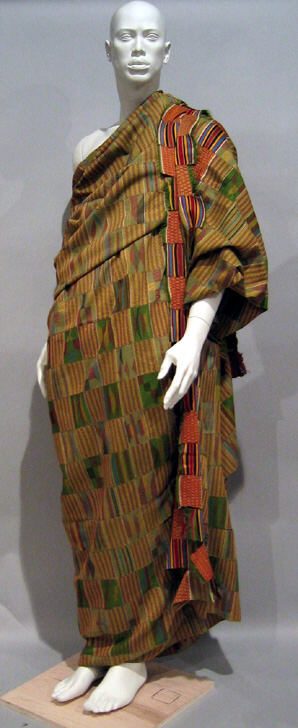
From Narrow Strips to a Wide Cloth
A Cleveland Museum of Art cloth, dated to about 1930–59 and attributed to an Ewe-style weaver in Ghana or Togo, provides a detailed example. Its maker wove one long strip, which was cut into twenty lengths and sewn together. The arrangement alternates passages emphasizing the vertical warp or horizontal weft; extra weft threads create figurative designs.3
The number of strips was not fixed for every cloth. A different Ewe example in the Met, dated to about 1930–50, has twenty-four strips joined along their selvages. This cotton-and-silk textile includes motifs such as fish, elephants, a stool, a camera, and interlocking hands. The two records demonstrate variation within the technique rather than a single recipe.2
Asante and Ewe: Related, Distinct Traditions
The V&A describes Asante preferences for geometric patterning in silk and Ewe uses of figurative motifs, including people, animals, and letters, in combinations of cotton and silk. These are tendencies in the traditions it surveys, not a claim that one motif or fiber can identify every cloth without further evidence.1
Cleveland's cotton example is especially useful here. Its illustrated motifs include hands, birds, combs, and other recognizable forms. It complicates a definition of kente as necessarily a pure-silk textile, while also showing how much a weaver could achieve with supplementary pattern threads.3
What Do the Patterns Mean?
The Met's nineteenth-century Asante cloth record explains that names can refer to warp patterns, rulers, plants, birds, and animals. Naming is part of a cloth's social history, rather than an automatic translation from color to a fixed message.4
UNESCO's description of kente craftsmanship similarly connects finished cloths with proverbs, sayings, and social situations. It notes that age, status, and gender can influence the choice of design and color. These contextual relationships are a better starting point than applying one universal color chart to every Asante or Ewe textile.5
How Was Kente Worn?
The Met describes its Ewe prestige cloth as worn at festivals, religious celebrations, and important life transitions. It was wrapped around the body with a loose end over the left shoulder. Cleveland likewise identifies its cloth as a special-occasion garment for an elite man, with elaborate patterning making wealth visible.2,3
Kente also acquired wider political associations. The Met's Asante record discusses Kwame Nkrumah's role in making it internationally recognizable and quotes scholarship connecting its use with pan-Africanism. That later history adds to the garment's meanings without replacing its particular weaving traditions.4
A Continuing Craft
UNESCO's account describes knowledge passed through families, apprenticeships, and educational institutions, alongside workshops, festivals, and museums. It also includes rayon among the fibers used. The craft's history therefore includes changes in teaching and materials, rather than ending with the older cloths preserved in collections.5
For an earlier West African comparison, continue to Mali Empire clothing. For later developments across the region, see modern African clothing.
Sources
- Africa fashion: cloth of a continent — Victoria and Albert Museum, Kente section (chronology, strip weaving, and Asante/Ewe comparisons).
- Man's kente, 2010.555 — Metropolitan Museum of Art (Ewe artist, about 1930–50).
- Prestige cloth, 2023.9 — Cleveland Museum of Art (Ewe-style weaver, about 1930–59; construction and wear).
- Man's kente, 1972.56.1 — Metropolitan Museum of Art (Asante-Akan artist, nineteenth century; names and later political associations).
- Craftsmanship of traditional woven textile Kente — UNESCO Intangible Cultural Heritage (materials, naming, and transmission of craft knowledge).