Kente is a West African prestige cloth of narrow handwoven strips sewn together. The Metropolitan Museum of Art associates it with the Asante of Ghana and counts it among the body wraps of West Africa.1 The Victoria and Albert Museum records kente weaving among the Asante and the Ewe, and the Horniman Museum states that kente is worn by men and women alike.2,3
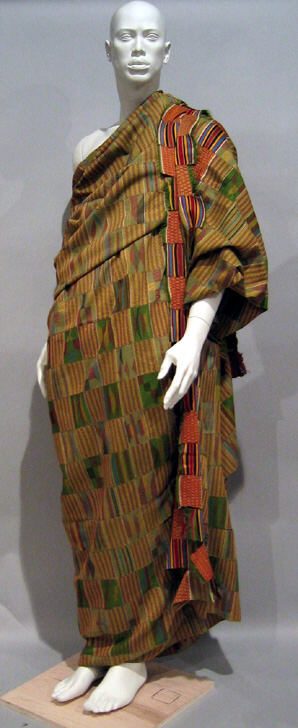

How It Was Worn
The Cleveland Museum of Art describes an Ewe-style cloth from Ghana or Togo, about 1930 to 1959, that an elite man wore at special occasions, wrapped around his waist and tossed over his shoulder. Its weaver made it as a single strip, later cut into twenty strips and sewn together by hand.4 A V&A cloth, possibly from Agotime in southeast Ghana, has nineteen strips about 10 centimeters wide, and the museum judges it a man's wrapper by its size.2
Materials and Decoration
A 19th-century Asante kente in the Met is cotton and silk.1 The Cleveland weaver added extra weft threads to form hands, birds, insects, knives, and combs.4 The V&A cloth has weft-float leaf patterns in its central strips.2
Meaning and Status
The Met states that most kente cloths are named for their warp pattern, while some are named after people, usually rulers, trees, plants, birds, and animals.1 The Horniman records that designs have names and stories, and that in the past some could be worn only by the king.3 The Met adds that Ghana's president Nkrumah made kente famous, quoting Venice Lamb that it became "almost the uniform of pan-Africanism."1
On This Site
- Medieval Sub-Saharan African clothing
- Early modern Sub-Saharan African clothing
- 19th century Sub-Saharan African clothing
- Modern Sub-Saharan African clothing
Sources
- Man's kente (prestige cloth), 1972.56.1 — The Metropolitan Museum of Art, 19th century, Asante-Akan peoples (body wraps, strip construction, pattern naming, Nkrumah, and the Venice Lamb quotation; text retrieved through Jina Reader).
- Kente, CIRC.321-1964 — Victoria and Albert Museum, mid-20th century, possibly Agotime, Ghana (Asante and Ewe weaving, nineteen strips about 10 cm wide, leaf motif, and man's wrapper; record retrieved through the V&A collections API).
- Kenten (kente cloth), HC.1999.280 — Horniman Museum and Gardens (worn by men and women, named designs with stories, and cloths once reserved for the king).
- Prestige cloth (kete or kente), 2023.9 — Cleveland Museum of Art, c. 1930–59, Ewe-style weaver, Ghana or Togo (how it was worn, single strip cut into twenty, and supplementary weft shapes; record retrieved through the Cleveland open access API).