19th Century · Europe · 1800 - 1900
How to Date a Victorian Family Photograph from Clothing
Where does the skirt stand away from the body? What hides the shoulder seam? Use three British portraits to practice dating family photographs and recording uncertainty.
By Dan Schnau · Last updated
Start with the person whose clothes you can see most clearly. On a copy of the photograph, trace the shoulder, waist, and outer edge of the skirt. Compare that outline with dated portraits from the same country and setting. The following clues apply to British women's dress around 1860–1900. They work best on a standing figure seen from the side or at an angle.1,2,3,4
Check the photographic process before using the clothes. A daguerreotype forms directly on a silver-coated copper plate. Unless the camera had a correcting mirror or prism, the image reverses left and right. If an apparent buttoning direction or lapel overlap is central to your identification, look for lettering elsewhere in the picture to check its orientation. The process fell from favor in the late 1850s, so a confirmed daguerreotype is also a reason to look earlier than the dress comparisons below.8
Where to look first
| If you can see this | Start your comparison here | What could change your estimate? |
|---|---|---|
| A fitted bodice above a skirt spreading widely below the waist | 1860s. Look for fullness around the figure early in the decade and increasing emphasis toward the back later on.1 | A turned body or trailing veil can make one side look wider. |
| Fabric gathered behind the hips, with a comparatively flat skirt front | Compare the early 1870s with the revived bustle of the 1880s. A long, close-fitting outline over the hips points toward the intervening fashion.2,3 | A front view conceals the rear projection. Record the back as unknown if it is out of sight. |
| A fitted bodice with conspicuous volume high on the upper arms and a skirt widening toward the hem | Try mid-1890s comparisons, then examine the shoulder seam and lower sleeve.4 | A cape, shawl, or loose outer sleeve can give a similar outline. |
Worked portrait: a broad skirt and a misleading occasion
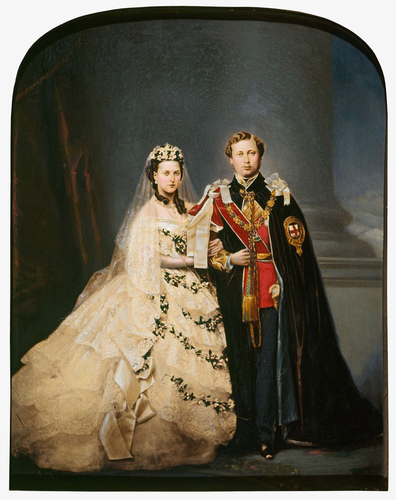

Start at Alexandra's waist. The bodice fits closely there, while the skirt spreads far to her right, on the viewer's left. The garlands follow the curve of the skirt. The veil falls outside that curve, so tracing its edge would exaggerate the width. Her forearms and veil obscure part of the sleeve. An early-to-mid-1860s comparison is reasonable from the skirt and bodice together. Colour adds little here because this version has been coloured.1,5
The couple married on 10 March 1863. The Royal Collection dates its posed two-person wedding-costume portrait to 18 March 1863. In a family album, an inscription naming a wedding can identify the clothes and occasion while leaving the sitting date open.5
Worked portrait: when the clothes give you too little
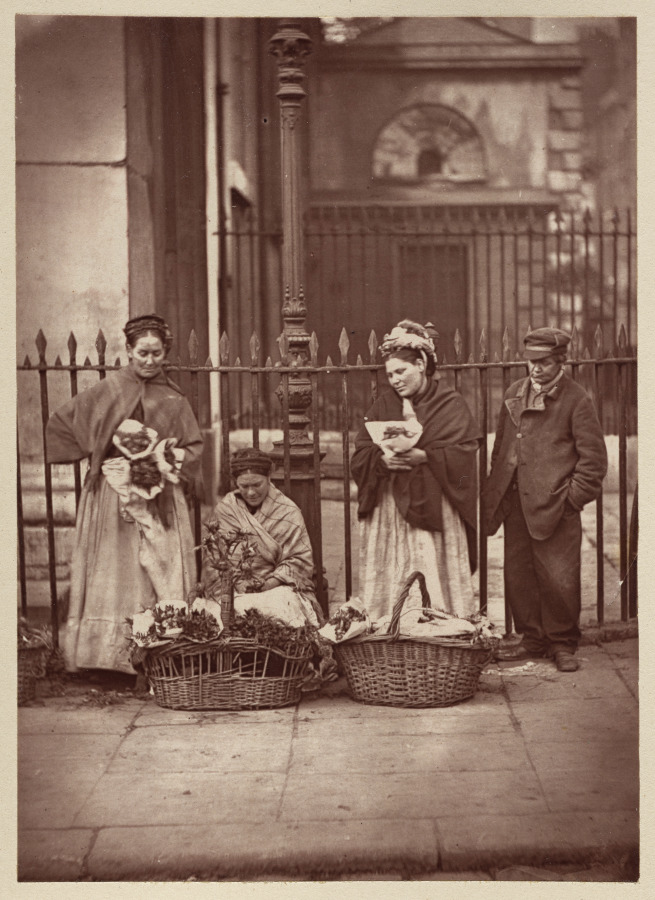
Compare the two standing women. The dark wraps hide their shoulder seams and bodice fronts. We can trace the skirts toward the ankles, but neither woman gives us a clear side view of the back. Even the baskets interrupt the hemline. Keep the estimate broad if this is all a family photograph shows. A confident bustle identification would require a detail we cannot see.
The Cleveland Museum of Art dates this photograph to 1877.6 Its date makes it an especially useful comparison for London working dress. Searching only fashion portraits for a matching skirt would leave out women dressed for a day selling flowers. For the occupations and sources behind such comparisons, see working women's clothing in Victorian London.
Try an undated portrait
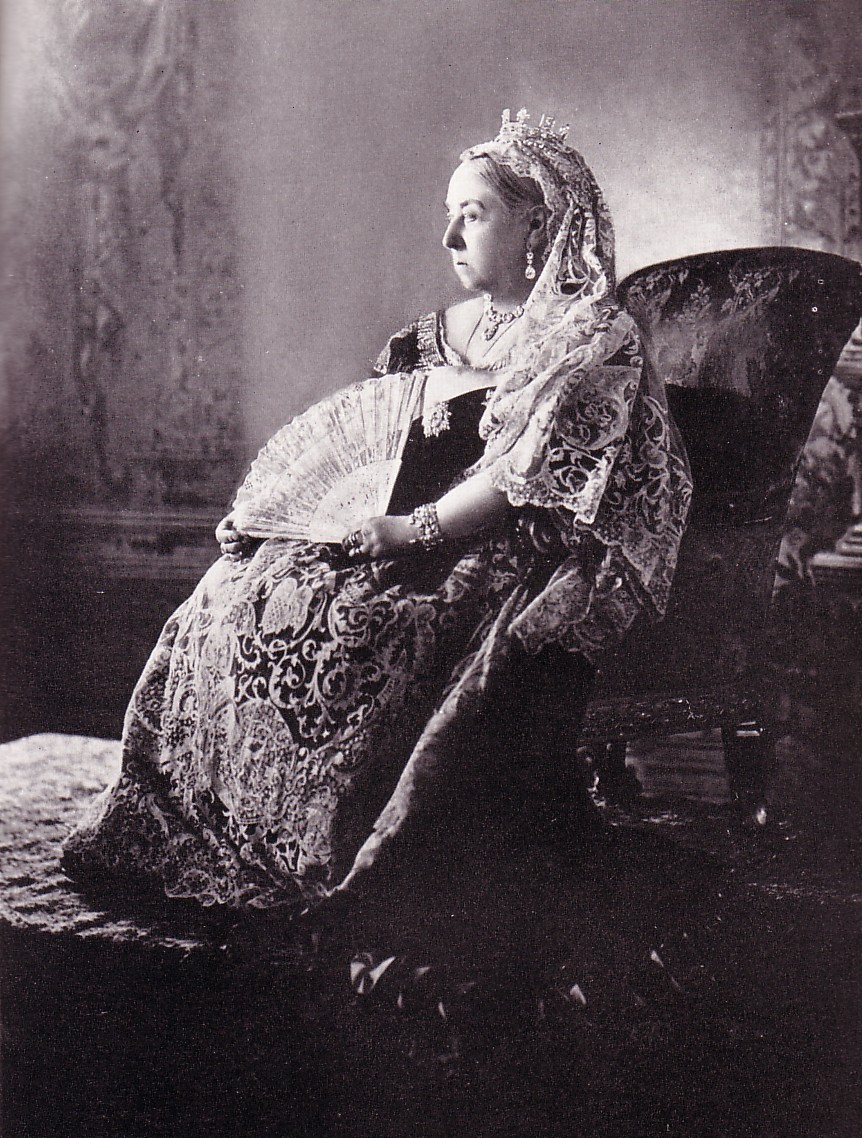

Before opening the answer, name two features you can see and two that the pose hides. Could you distinguish a sitting in 1893 from one in 1897 using this image alone?
Reveal the archive date and compare your reasoning
The fan covers the front waist and the seated pose hides the standing skirt profile. Lace falls across the upper arm, making the sleeve shape difficult to read. The crown and veil help identify the sitter and ceremonial setting. Neither supplies a four-year date range.
The Royal Collection dates Downey's sitting with Queen Victoria to July 1893. The photograph circulated as an official portrait for her Diamond Jubilee in 1897. Both dates belong in the record, attached to different events.
The Royal Collection portrait record explains the sitting and later use.7
Write a date another researcher can check
Record the proposed range, the two visible details behind it, the closest dated comparison, and one detail that remains hidden. Then check the reverse of the mount, the photographer's address, and any family inscription for independent evidence. Keep separate fields for the sitting, the print or copy, and the occasion a later caption commemorates. If the clothing and inscription disagree, preserve both observations for the next researcher.
Sources
- 1860–1869 — Fashion History Timeline, Fashion Institute of Technology.
- 1870–1879 — Fashion History Timeline, Fashion Institute of Technology.
- 1880–1889 — Fashion History Timeline, Fashion Institute of Technology.
- 1890–1899 — Fashion History Timeline, Fashion Institute of Technology.
- Edward and Alexandra in their wedding costumes — Royal Collection Trust, RCIN 2926335.
- Covent Garden Flower Women — Cleveland Museum of Art, 2019.49.
- Queen Victoria, Diamond Jubilee portrait — Royal Collection Trust, RCIN 2912658.Reference 1
- The Daguerreotype Medium — Library of Congress.Reference 1