The unku, also written uncu, was the man's tunic of the Inca Empire.3,4 Sarahh Scher describes the all-tocapu tunic at Dumbarton Oaks as "a single piece of cloth, woven with a slit in the center for the head to pass through, and folded over and sewn together along the sides with spaces left open as arm holes."1
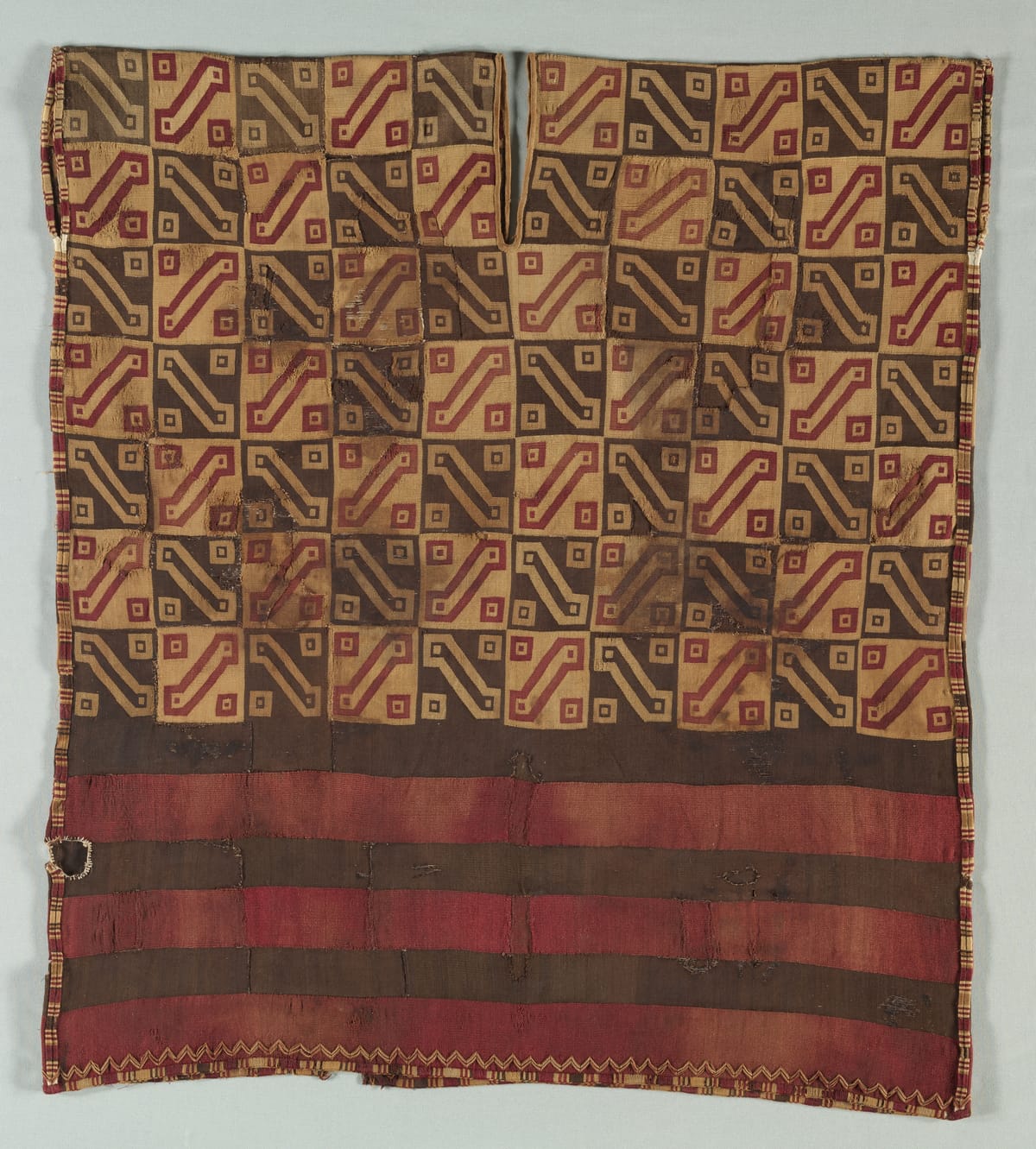
Tunic with the "Inca key" pattern, tapestry of cotton and camelid fiber, Peru, Inca, c. 1400–1540, Cleveland Museum of Art, 1957.136. Cleveland Museum of Art, CC0.
Materials and Decoration
The two main fibers were cotton from the Andean coast and camelid fiber from the highlands.1 Scher writes that it was traditional to weave garments in a single piece if possible, because cutting the cloth once it was off the loom would destroy its spirit existence, or camac.1 The Cleveland tunic shows the Inca key design, which the museum calls one of the most common Inca tunic patterns.2 The Textile Museum dates its own Inca man's tunic to the Late Horizon, 1470–1532 CE.3
Meaning and Status
Finely woven interlocked tapestry garments were a privilege of the nobility within the Inca Empire.2 They were made by women of noble families, by professional weavers, and by the aclla, or Chosen Women, who wove fine cloth for the state, which redistributed it as prized gifts to loyal vassals and allies.2 Shelley Burian of The Textile Museum states that every component of clothing, from materials to colors and motifs, identified a person's cultural affiliation, region, relationship to the state, and social status.3
On This Site
Sources
- All-T'oqapu Tunic — Sarahh Scher, Smarthistory, 9 August 2015 (one-piece construction, fibers, and camac; text retrieved through the Wayback Machine).
- Tunic (1957.136) — Cleveland Museum of Art, collection record via the museum's open access API (the tunic illustrated, nobility, weavers and aclla, redistribution, and the Inca key pattern).
- Inka Influence and Diversity on Display in "Weaving an Empire: Textiles of the Inka World" — The George Washington University Museum and The Textile Museum, 13 August 2026 (the term unku, Late Horizon dating, and Shelley Burian's statement on clothing and identity).
- Fragment from the Topacu Waistband of a Tunic (Uncu) — Art Institute of Chicago, collection record via the museum's API (the spelling uncu for the Inca man's tunic).Reference 1