Aztec clothing was the dress of the Mexica of Tenochtitlan and their neighbors in central Mexico before the Spanish conquest of 1521. Men wore a loincloth and a cape; women wore a blouse called the huipilli and a wrapped skirt. The fiber and decoration of these simple garments showed rank, and the Aztec state collected cloth in huge quantities as tribute.3,13,6,7,8,9,4
These garments were mostly rectangles of woven cloth. The difference between a commoner and a lord was rarely the shape of what he wore. It was the material, the border, the feathers, and the right to wear them at all.9,8,7,5
How We Know What the Aztecs Wore
Our picture of Aztec dress comes mainly from manuscripts painted after the conquest by Indigenous artists, from Nahuatl texts, and from objects in stone, metal, and feathers.
The Codex Mendoza is the most important pictorial source for dress. The Bodleian Library in Oxford, which holds it, dates it to Mexico around 1541 and describes its tribute section as an illustrated catalog of what the towns of the empire paid to the last emperor, Motecuhzoma Xocoyotzin. That section is closely related to, and may be copied from, an earlier tribute record, the Matrícula de Tributos.3 Smarthistory describes the codex as containing information about the lords of Tenochtitlan, the tribute paid to the Aztecs, and an account of life "from year to year," painted by Indigenous artists and annotated in Spanish.2
The second great source is the Florentine Codex. It was completed in 1577 by the Franciscan friar Bernardino de Sahagún with a group of Nahua elders, authors, and artists. It is written in parallel columns of Nahuatl and Spanish and contains nearly 2,500 painted images.1 Many of the Nahuatl clothing terms in this article come from these and other sixteenth-century texts, as collected in the Online Nahuatl Dictionary.6,7
Both sources were made after 1521, for colonial readers. They describe pre-conquest dress, but through a colonial lens. Read them as excellent evidence, not as photographs. For the wider regional picture, see the survey of medieval Americas clothing.
Men's Dress: Maxtlatl and Tilmatli
The basic male garment was the maxtlatl, a loincloth or breechcloth.6 Over it, a man wore the tilmatli, a cape or cloak. A scholar cited in the Online Nahuatl Dictionary calls the tilmatli beyond doubt the most important part of male apparel. The same word could also mean cloth in general.7

Capes came in many named types. Sixteenth-century texts list fur capes, jaguar skin capes, deer skin capes, a turquoise cape with a red border, a cape with an eagle's head design, cotton capes, and maguey fiber capes.7 Loincloths also varied. The Florentine Codex describes "wonderful breech clouts with embroidered ends,"6 and rulers wore loincloths "with long ends."7
A man's cape was therefore a sign that others could read. The pattern and border could mark an honor. The fiber could mark a social class.
Women's Dress: Huipilli and Cueitl
Women wore two main garments. The huipilli was a rectangular blouse or shift, sewn closed and sleeveless, that reached to the top of the thighs. It often had a V-neck with a decorated rectangle at the base of the slit, which probably strengthened the opening.9 Below it, women wore the cueitl, a wide piece of cloth wrapped around the lower body and secured at the waist. Skirts could be made of cotton, maguey, yucca, or palm fiber, and some were leather.8
The pair was so closely tied to womanhood that skirt and huipilli together could stand as a metaphor for "woman."8 For a baby girl, families prepared a little skirt and shift, together with a reed basket, a spinning whorl, and a weaving batten.8 The Codex Mendoza also has an illustrated section on Aztec life cycles, male and female, from birth to death.3
Like men's capes, women's skirts could be richly patterned. One Nahuatl list names a skirt with serpent skins, a skirt with a step meander, a skirt with thin black lines, and an ocelot skin skirt, each with a wide border.8
Elite and Commoner: Cotton, Maguey, and Dress Laws
Fiber was the clearest marker of class. Cotton cloth was valuable. Maguey and yucca fiber were the cloth of ordinary people. A Nahuatl text speaks of a "poor maguey fiber cape or a wretched yucca fiber cape."7 An early seventeenth-century account says that cotton never reached the Mexica because they were very poor, and that some commoners wore loincloths made of marsh plants.10
The Mexica turned these differences into law. Moteuczoma Ilhuicamina, Moctezuma I, was the fifth Aztec emperor.15 During his reign, according to a University of California San Diego history, access to cotton clothing was restricted to the nobility. The same rules covered nose ornaments and ear spools of gold or precious stones, and only the emperor and the figure the source calls the "Woman Snake" could wear fine sandals inside the palace. The policy is credited to the royal adviser Tlacaelel, who seems to have supported more and more such restrictions toward the end of his life.5
These rules did more than keep the poor in plain cloth. They also tied fine dress to war. Some luxury goods were restricted to men who had won the right to them in battle or who belonged to the governing inner circle.5 A man could earn the right to finer dress through success in battle.5
The elite also bought their finery. The Florentine Codex records that merchants of Tenochtitlan and Tlatelolco each took 800 large cotton capes and used them to buy rulers' capes with feather designs, rulers' loincloths with long ends, and embroidered skirts and shifts, all the exclusive property of the ruler Ahuitzotl.7
Warrior Suits and Featherwork
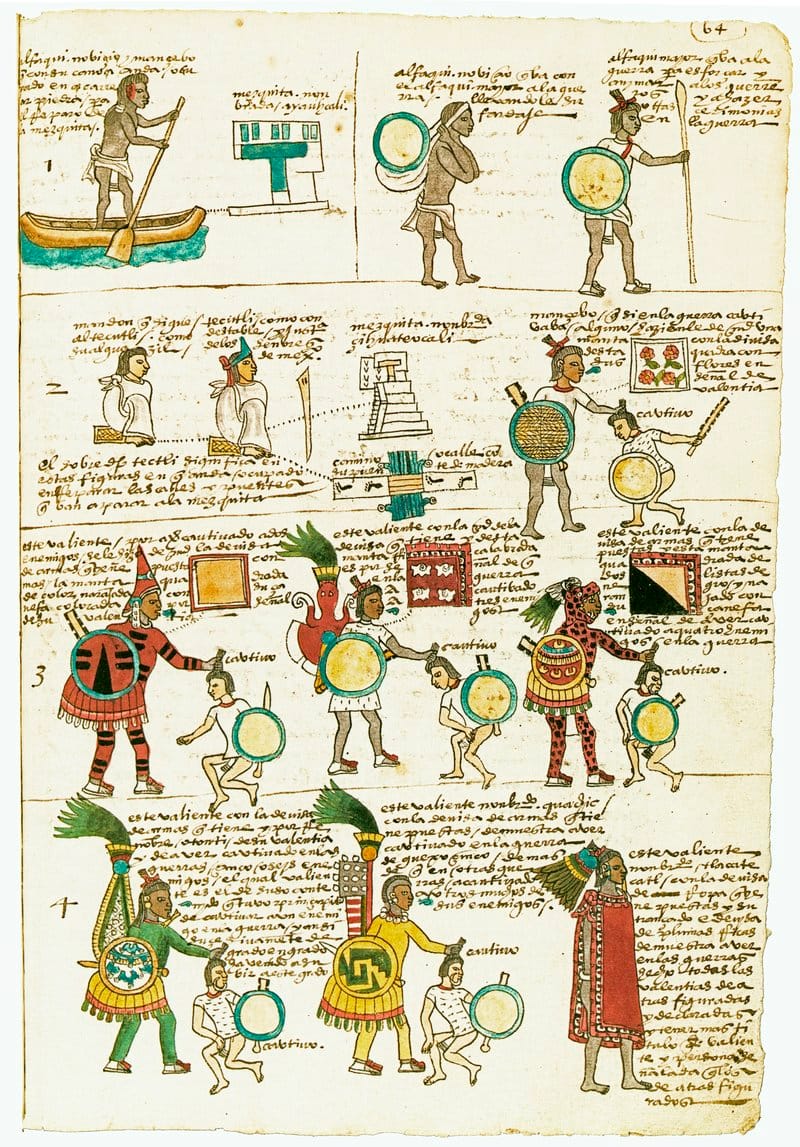
Military dress could be spectacular. Different grades of warriors had the right to different costumes covered with rare feathers or other markings. In the Codex Mendoza, the killer of two enemy warriors wears a red feather uniform, the killer of four wears a jaguar uniform, and higher grades wear other distinctive costumes. A man who had killed no one was marked by his lack of prestige costume.5
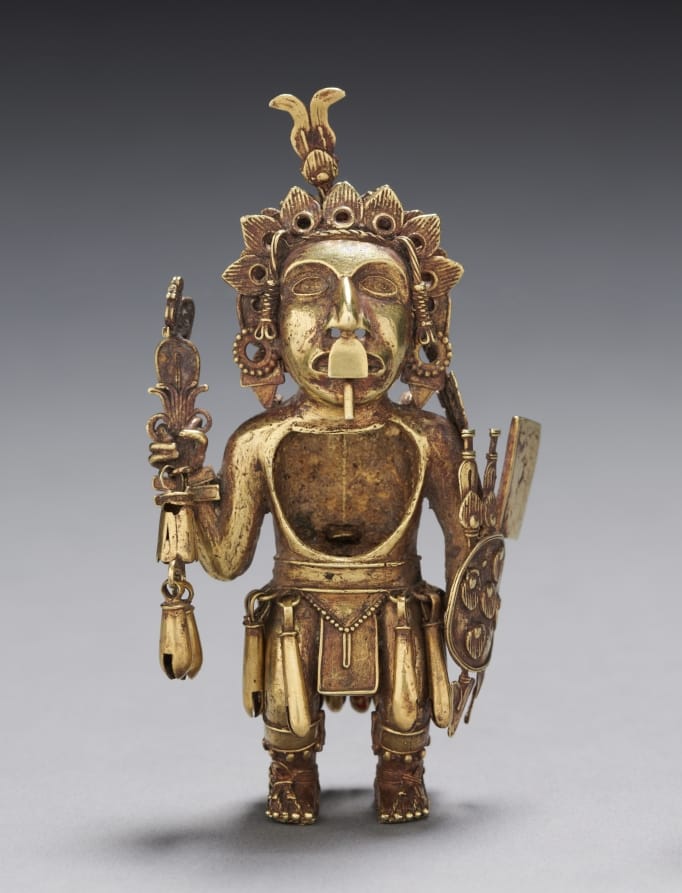
Beneath the feathers, protection could be made of cloth. The Nahuatl word ichcahuipilli means a padded cotton shirt, built from ichcatl, cotton, and huipilli.10 The Cleveland Museum of Art notes that the elite status of its small gold warrior shows in his material as well as in his jewelry and sandals.14
Feathers were also prized for headdresses. The Weltmuseum Wien holds the last surviving quetzal feather headdress of its kind, dated to the early sixteenth century. Its long green quetzal feathers are sewn to three delicate nets. Such headdresses were associated with rulers, gods, and priests.13

Fabrics, Dyes, and Tribute Cloth
Cloth was wealth. The large cotton cape or blanket, the quachtli (also spelled cuachtli), was a length of cotton tribute cloth, and such cloths could serve as a kind of currency before the conquest and in the early colonial period.11 One Nahuatl text gives the value of a small cape as one hundred cacao beans.11
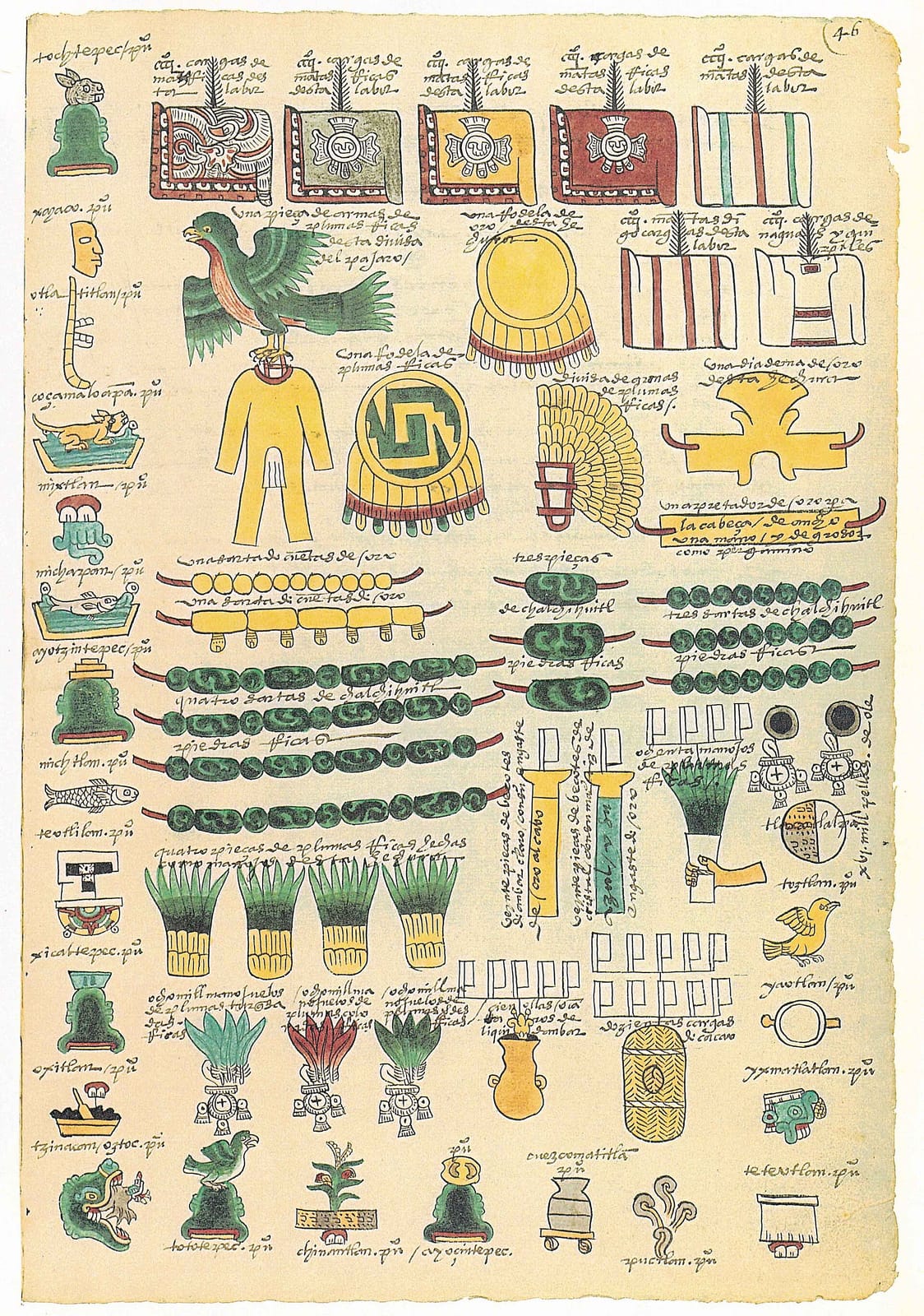

The tribute pages of the Codex Mendoza show the scale. The codex lists the semiannual tribute owed by 39 provinces. The Gulf lowland province of Tochtepec alone gave 1,600 richly decorated capes, 800 striped capes, and 400 women's tunics and skirts every six months. Once a year, it also sent a quetzaltototl warrior costume, a shield, and 80 handfuls of green quetzal feathers.4 Provinces near the capital paid more staple and bulk goods, while distant provinces paid more high-value, low-bulk items.4
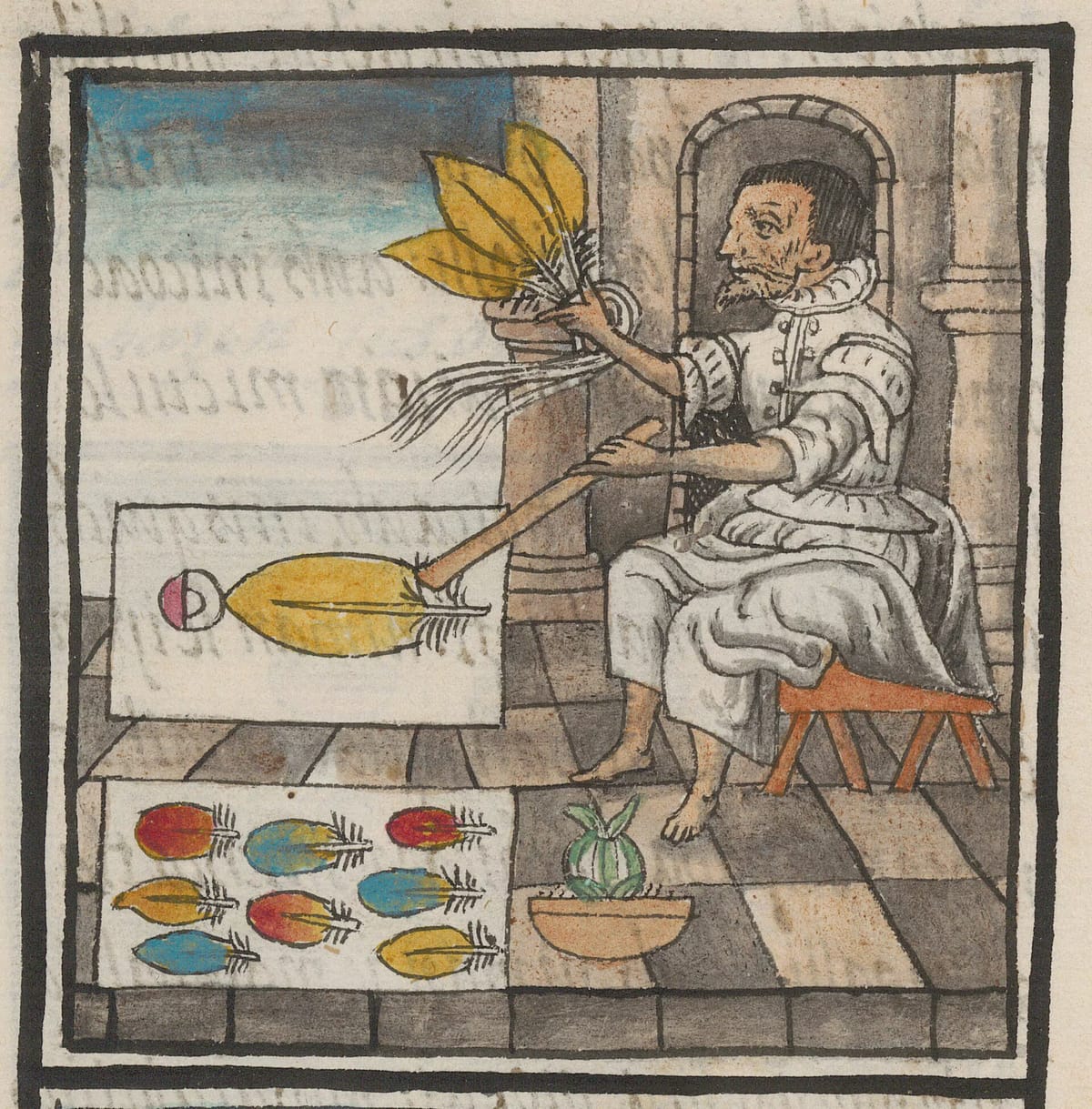
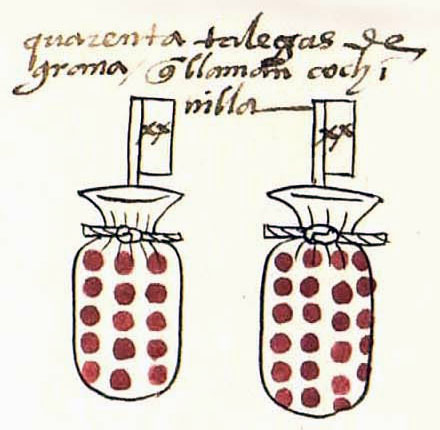
Red came partly from nocheztli, cochineal. The Codex Mendoza shows a bag full of red cochineal grains as a tribute item.12

After the Conquest
Mexica dress did not disappear in 1521. Colonial wills and records in Nahuatl show the huipilli and cueitl still in use nearly two centuries after the conquest. A document from Saltillo in 1627 lists a white huipil and a green Mexica-style skirt. A 1673 Mexico City record gives a grandchild, María Bautista, a huipil and a skirt.9,8
What changed first was the fiber. Europeans brought sheep, and the Nahuatl word ichcatl, cotton, was extended to wool and then to sheep themselves.10 A 1644 Mexico City document lists woolen trousers and woolen cloaks, and a 1707 record from the Toluca Valley mentions a wool huipil and a wool skirt.7,8 The old garments continued in a new material.
The tribute cloth system also faded. One colonial text records that a community gave up paying in long tribute cloaks and substituted money.11 The story of the huipil and the rebozo in colonial Mexico continues in early modern Americas clothing.
Myths About Aztec Clothing
Myth: Aztecs wore elaborate feathers every day. Feathered suits and headdresses were restricted honors for rulers, priests, and proven warriors. Many people wore maguey cloth, and a man who had killed no enemy was marked by the absence of prestige costume.5,7,13
Myth: The Vienna headdress belonged to Moctezuma. The Weltmuseum Wien states that the headdress cannot be identified in the surviving lists of objects sent from Mexico, so the claim that it was Moctezuma's cannot be confirmed. It was first recorded in a 1596 inventory of Ambras Castle in Innsbruck.13
Quick Answers
What did Aztec men and women wear?
Men wore a loincloth, the maxtlatl, and a cape, the tilmatli. Women wore a sleeveless blouse, the huipilli, and a wrapped skirt, the cueitl.6,7,8,9
Could Aztec commoners wear cotton?
Not under the dress laws of Moctezuma I, which restricted cotton clothing to the nobility. Commoners wore maguey or yucca fiber, though warriors could earn the right to finer dress.5,7
What were Aztec textiles made of?
Cotton for the elite, and maguey, yucca, and palm fiber for others, with some skirts made of leather. Feathers and fur appeared on the finest capes, and cochineal supplied red dye.7,8,12
Why is the Codex Mendoza important for Aztec clothing?
It shows clothing in use, from loincloths to warrior suits, and lists the cloth paid as tribute, including thousands of capes and hundreds of women's garments from single provinces.3,4,5
Sources
- The Digital Florentine Codex — Getty Research Institute (Sahagún and Nahua collaborators, completion in 1577, parallel Nahuatl and Spanish text, nearly 2,500 images).
- Frontispiece of the Codex Mendoza — Lauren Kilroy-Ewbank, Smarthistory, 2015, via LibreTexts (contents of the codex, Indigenous artists, Spanish annotations).
- MS. Arch. Selden. A. 1 (Codex Mendoza) — Bodleian Libraries, catalogue of Western manuscripts (date c. 1541, tribute to Motecuhzoma Xocoyotzin, relation to the Matrícula de Tributos).
- Codex Mendoza, Folio 46 recto — Christopher Pool and Barry Kidder, University of Kentucky (39 provinces, Tochtepec tribute quantities).
- The Aztecs: A Tributary Empire (15): Tlacahélel's Sumptuary Laws — David K. Jordan, University of California San Diego, 2008.
- maxtlatl — Online Nahuatl Dictionary, ed. Stephanie Wood, Wired Humanities Projects, University of Oregon.
- tilmatli — Online Nahuatl Dictionary, Wired Humanities Projects, University of Oregon (cape types, maguey and yucca capes, rulers' clothing, colonial wool cloaks).
- cueitl — Online Nahuatl Dictionary, Wired Humanities Projects, University of Oregon (skirt fibers, patterned skirts, colonial wills).
- huipilli — Online Nahuatl Dictionary, Wired Humanities Projects, University of Oregon (form of the huipil, after Anawalt; colonial records).
- ichcatl — Online Nahuatl Dictionary, Wired Humanities Projects, University of Oregon (cotton, extension to wool and sheep, padded cotton shirt).
- cuachtli — Online Nahuatl Dictionary, Wired Humanities Projects, University of Oregon (tribute cloth as currency, cacao values, replacement by money).
- nocheztli (Mdz43r) — Visual Lexicon of Aztec Hieroglyphs, ed. Stephanie Wood, Wired Humanities Projects, University of Oregon.
- The Feather Headdress — Weltmuseum Wien.
- Figure of a Warrior — Cleveland Museum of Art, 1984.37.
- The Aztecs: A Tributary Empire (14) — David K. Jordan, University of California San Diego (Moteuczoma Ilhuicamina as Emperor 5).