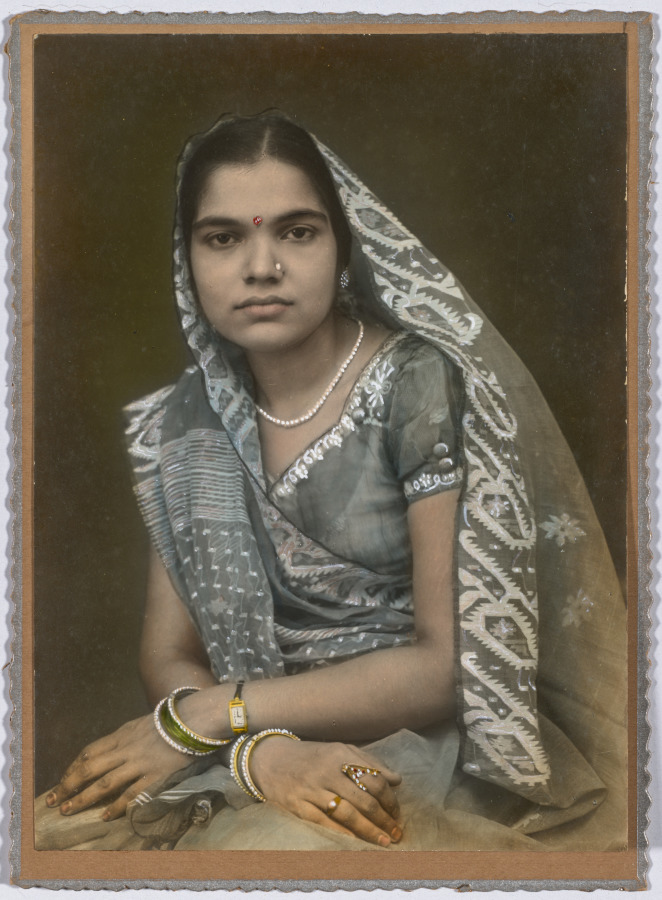
The choli is the blouse or bodice worn by women in South Asia, usually with the sari. The textile historian Jasleen Dhamija writes that the sari, "worn with a choli (blouse), is the most typical form of South Asian women's dress."1
Origins and History
Dhamija finds similar names in the Gupta period. In the murals at Ajanta, she writes, "Women wear a range of blouses, known by names similar to choli, the word for blouse today."1 A set of women's clothing from Lahore of about 1855, now at the Victoria and Albert Museum and described by the Textile Research Centre in Leiden, pairs an embroidered cotton kurta with "a small bodice (choli)" and "a large veil (odhni)."2
Materials and Decoration
Nineteenth-century examples at the Victoria and Albert Museum differ. A choli from Kutch is "of silk embroidered with coloured silks and set with mirrors."3 A bodice from Lucknow of about 1830–40 is described as "red silk muslin embellished with applied gold and silver ornament."4 It belongs to an ensemble that the India Museum acquired as the dress of the "Queen of Oudh," and which the museum now thinks "more likely to have been designed for a young girl's betrothal ceremony or possibly a for wear by a court dancer."4
Meaning and Status
The gallery label for the Lucknow bodice says the costume "would have been worn by a dancer or noblewoman at the flamboyant Lucknow Court."4
On This Site
Sources
- Asia, South: History of Dress — Jasleen Dhamija, Encyclopedia of Clothing and Fashion, via Encyclopedia.com (the sari with choli as the most typical form of women's dress; blouses in the Ajanta murals).
- Kurta from Pakistan — TRC Needles, Textile Research Centre, Leiden (kurta, choli and odhni from Lahore, c. 1855, V&A 6157(IS)).Reference 1
- Choli — Victoria and Albert Museum, IS.26-1957 (Kutch, 19th century; silk embroidered with coloured silks and set with mirrors; record read through the V&A collections API).Reference 1
- Choli — Victoria and Albert Museum, 5833(IS) (Lucknow, c. 1830–40; red silk muslin with gold and silver ornament; summary on the "Queen of Oudh" ensemble; gallery label; record read through the V&A collections API).