Islamic Golden Age clothing is the dress of the Abbasid caliphate and its contemporaries, from the Abbasid seizure of power in 750 to the end of the Baghdad caliphate in 1258,2,4 across a world that ran from Córdoba to Bukhara. Men and women wore layers: tunics, trousers, robes or caftans, and a headdress, usually a turban for men. The caliph and his officials wore black, the Abbasid color, with a tall cap called the qalansuwa.2,3 Court garments carried tiraz, woven or embroidered inscription bands naming the caliph, and robes of honor were handed out to reward loyalty.4,5
The style grew out of Umayyad court dress, which had itself borrowed heavily from Sasanian Persia, and early Abbasid fashion continued those trends with gradual change.3
What Survives, and How We Know
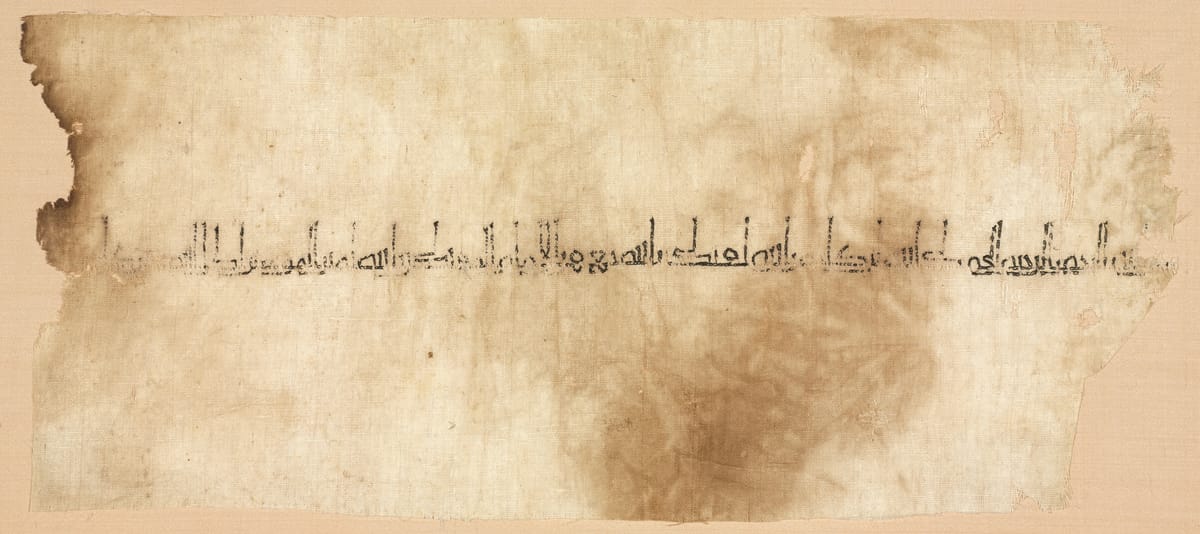
Many surviving textiles are tiraz: strips of linen, cotton, and silk with inscriptions, often naming a ruler, cut from robes, sleeves, and turban cloths.4,7,8 The fragment above names "Ja'far the imam al-Muqtadir bi-Allah, Commander of the Believers."6 The Cleveland Museum of Art describes the surviving corpus as "thousands of medieval textiles with historic or generic inscriptions."8
Wall paintings and painted wine jars from the Jawsaq al-Khaqani palace at Samarra (833–842), ceramics from Nishapur in eastern Iran, and an illustrated copy of al-Sufi's Treatise on the Fixed Stars, copied in 1009, are key pictorial sources for the ninth to eleventh centuries.3 Texts fill in color and etiquette. The writer al-Washsha (d. 936) wrote a guide to elegant dress, and court histories describe what the caliph wore and gave away.1,2,4 For Egypt, about 750 bridal trousseau lists from the Cairo Geniza, mostly from 969 to 1250, record complete wardrobes.16 The evidence is uneven: less is recorded about ordinary people than about the court.1
Tiraz and the Caliphal Workshops
The word tiraz probably comes from a Persian word for embroidery. It means a text embroidered, woven, painted, or applied on cloth, and it can also mean the workshops that made such cloth.5 By the Abbasid period, from the mid-eighth century, the tiraz system was starting to flourish. Coins and tiraz cloth both bore the caliph's name, and control of the tiraz workshops became one of the most important jobs in government, alongside the mints, the post, and taxation.5
Workshops were spread across the Islamic world. The Textile Research Centre in Leiden lists Egypt, India, Iran, Iraq, Sicily, Yemen, and al-Andalus.5 Encyclopaedia Iranica notes tiraz manufactories in particular in Khuzestan, in southwestern Iran, and a tiraz workshop in Bukhara from the eighth century that exported fine cloth to the Abbasid capital and as far as Egypt and Byzantium.4,2 Tiraz began as a court product and was later used by a wider range of people.5
On the body, tiraz often appeared as bands on the upper sleeves. A ninth- or tenth-century wall painting from Nishapur shows a rider whose caftan has embroidered bands of pseudo-Kufic writing on the upper arms, and Elsie Peck of Encyclopaedia Iranica says inscribed armbands seem to be "a purely Islamic innovation in dress."3
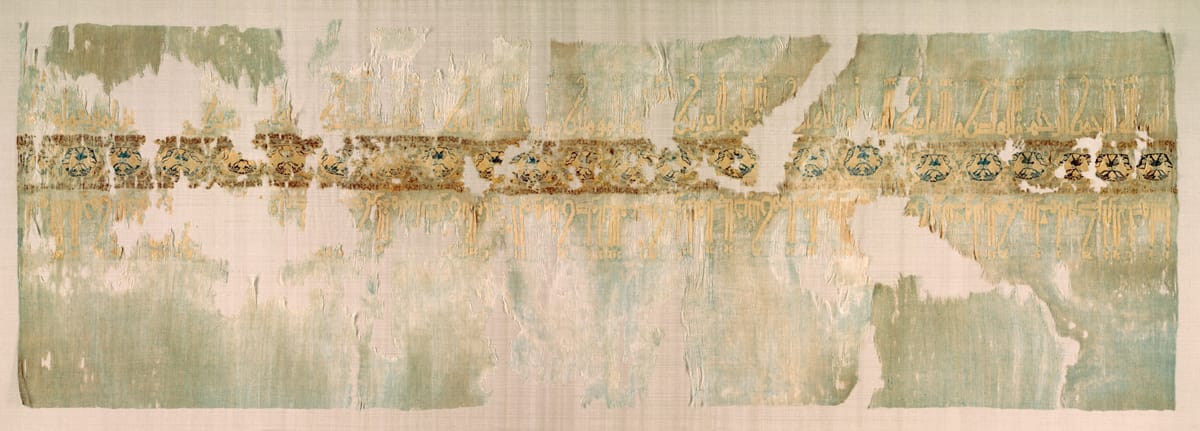
Turbans carried inscriptions too. The pistachio-green linen above was cut from a cloth worn wrapped as a turban, with the silk decoration displayed at the front. Its text asks God to bless the Fatimid caliph al-'Aziz and says the vizier ordered it from the tiraz in Tinnis. The museum suggests it could have been a gift from the caliph to a courtier or visiting dignitary.7
Abbasid Black and the Court Wardrobe
The caliph al-Mansur (r. 754–775) is usually credited with requiring court officials to wear black robes on ceremonial occasions. Black became the official Abbasid color, and in China and Byzantium the Abbasids were known as the "black-robed ones."1 Honorific garments, royal flags, and document cases were all black, usually silk.1
The caliph himself wore black robes and a tall cap, the qalansuwa, and court dignitaries wore black to show support for the dynasty.2 Choosing white, red, or green instead was a political statement. Green was the color of the Alids, and the caliph al-Ma'mun adopted it in place of black when he named the Alid imam Ali al-Rida as his heir.2 The dye was not always fast: a tenth-century chamberlain remembered a sweating official wiping black dye from his turban cloth off his face.1
The qalansuwa is hard to picture because almost no early images of it survive. Historian Richard Ettinghausen identified it from texts as the official headgear of the Umayyad and early Abbasid caliphs.3 By the early eleventh century men without royal status wore it, even non-Muslims. The tall version was probably silk over a framework of reeds, while a shorter version may have looked like a modern fez and was usually wrapped in a turban.3
Robes of honor
An inventory ordered by al-Amin (r. 809–813) counted 10,000 caftans and 5,000 kerchiefs in the caliphal storehouses.1 A robe of honor, or khil'a, rewarded service and secured loyalty, and Encyclopaedia Iranica says the custom, inherited from Sasanian and Byzantine practice, "became more general under the 'Abbasids."4 By the end of the ninth century robes were also given when a governor was appointed.4
Robes were graded by the rank of the person receiving them. The Buyid ruler 'Adud al-Dawla received seven robes of honor, a full set that was much desired, and they were black, the caliph's court color.4 The Seljuqs later had at least seven grades of robes.4 Robes of honor often had borders embroidered with Qur'anic inscriptions, like the ornamental borders of Byzantine and Sasanian court dress.2
Men's and Women's Dress
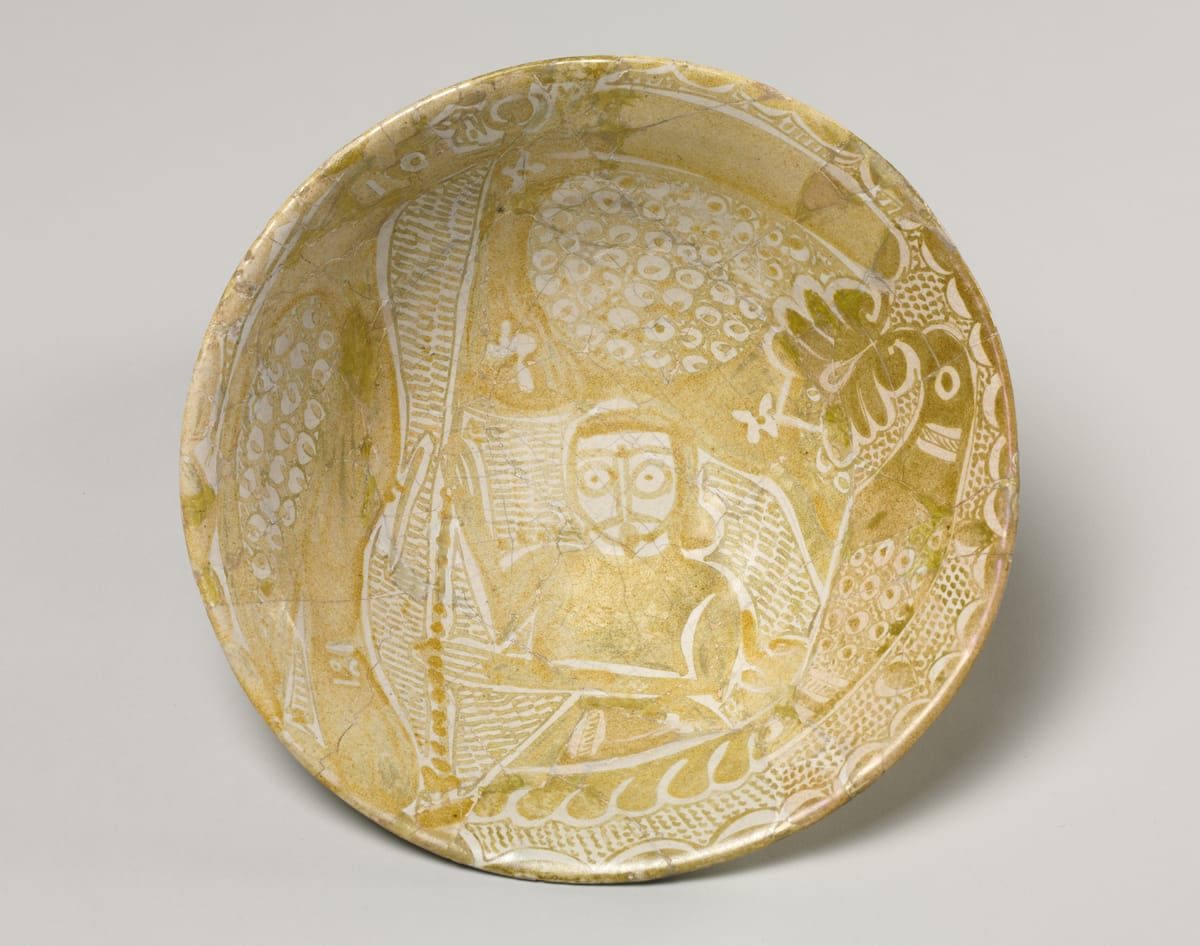
Abbasid lusterware from Iraq, like the bowl above, shows a man holding a banner between two peacocks.10 Persian officials set the tone for men's fashion. The School of Abbasid Studies credits the Persian secretarial class with spreading the caftan, a robe with sleeves that buttoned down the front, across the Arab world.1 The Samarra paintings show men in heavy, ornamented caftans with short, tight sleeves worn over long-sleeved tunics, with decorated trousers gathered at the ankle above small boots. A leather belt with short hanging thongs went with the caftan.3 The colors are bright greens, reds, and pinks, which fits al-Washsha's advice that men of position should wear pure colors.3
Al-Washsha approved of black or red leather boots trimmed with fur.3 For winter, the writer al-Tha'alibi (d. 1021) described silk robes lined with quilted raw silk.3 Al-Mu'tasim (r. 833–842) wore a turban over a soft cap in imitation of Persian kings, and people copied it and called it the mu'tasimi.1 In the copy of al-Sufi's star treatise made in 1009, the most common male headdress is a soft, wound turban, flat in outline.3
A well-known Samarra painting shows two dancing girls in long-sleeved, hip-length tunics and long skirts, with beaded girdles at the hips, scarves over the arms, rounded caps with gold diadems, and pearls in their long braids.3 On a Samanid bowl two women wear heavy belted caftans like their male counterparts.3 Al-Washsha's rules for elegant women forbade black, green, pink, or red unless the fabric was naturally that color, such as red silk.1 Zubayda (d. 831), the wife of Harun al-Rashid, is said to have been the first to wear sandals embroidered with gemstones, and a single length of the multicolored silk called washi made for her was said to cost 50,000 dinars.1
Fabrics, Trade, and the Cost of Clothes
Clothing was costly: in ninth-century Iraq a fine man's outfit cost five to thirty dinars, when a skilled laborer earned between half a dinar and a dinar and a half a month.1 Many fashionable people no longer observed the older pious distaste for silk and satin.1
Cloth was often named for the place that made it. A fabric called 'attabi took its name from the al-'Attabi district of Baghdad, and it later gave English the word "tabby" for plain weave.1 Imports reached Baghdad from far away: oilcloth rain cloaks from China, and from India the futa, a long cloth worn as a loincloth, apron, or head covering.1
Surviving tiraz show the range of fibers. The Baghdad fragment shown above is silk embroidered on cotton.6 The Fatimid tiraz on this page are fine linen with silk, and one adds gold thread.7,8 In Yemen, weavers made cotton ikat, with the pattern dyed into the warp threads before weaving.12
Ordinary people dressed more simply. Laborers wore cheaper wool and fewer layers, and workers' tunics were often knee length. Sailors, fishmongers, and bathhouse attendants worked only in briefs.1 In an early thirteenth-century Persian manuscript, the butcher and the baker wear only loose white trousers, and foot soldiers wear wrapped leggings and short jerkins.3
Beyond Baghdad: Fatimid Cairo, al-Andalus, and Iran
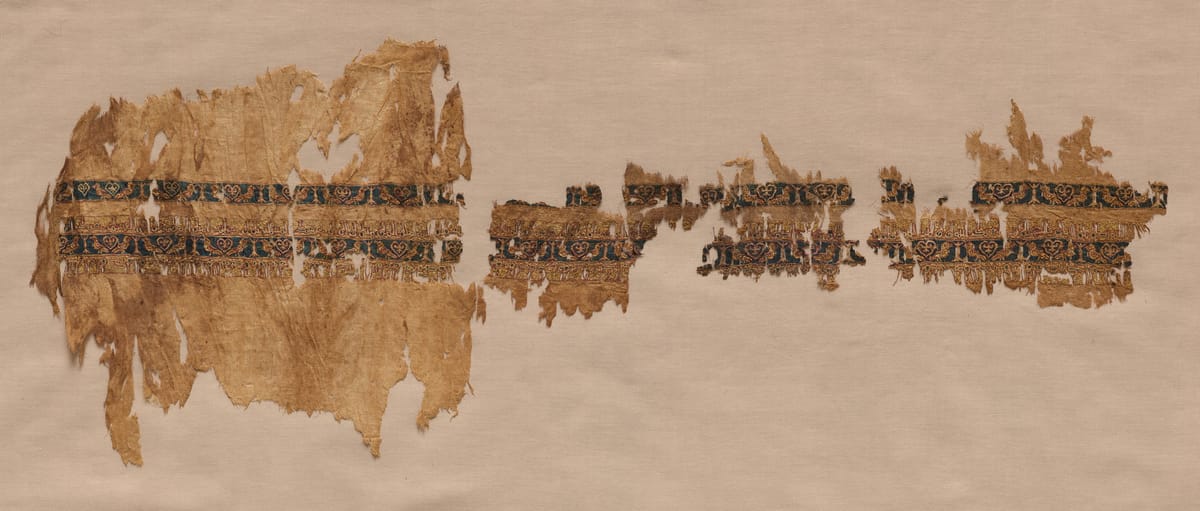
Fatimid Egypt. For the Fatimids, tiraz was not just a court institution but a significant source of revenue.5 Fatimid art shows robes with wider sleeves and polygonal necklines, and women wore loose, wide-sleeved robes banded with tiraz over wide trousers.3 The gold-woven fragment above may come from a wide sleeve that served as a pocket, since clothing had none. The museum describes such tiraz as "emblems of dignity," the prerogative of rulers and those they wished to honor.8

Al-Andalus. The Umayyad rulers of Córdoba ran their own tiraz. This linen strip from the reign of 'Abd al-Rahman III preserves part of an inscription that originally ran well over two meters and says it was made through the agency of Durri, the caliph's servant.9 According to the historian al-Maqqari, when the musician Ziryab arrived in Córdoba from Iraq in 821, people abandoned their old hairstyle and copied his middle parting, and he taught the court to wash linen with salt so it came out white.15
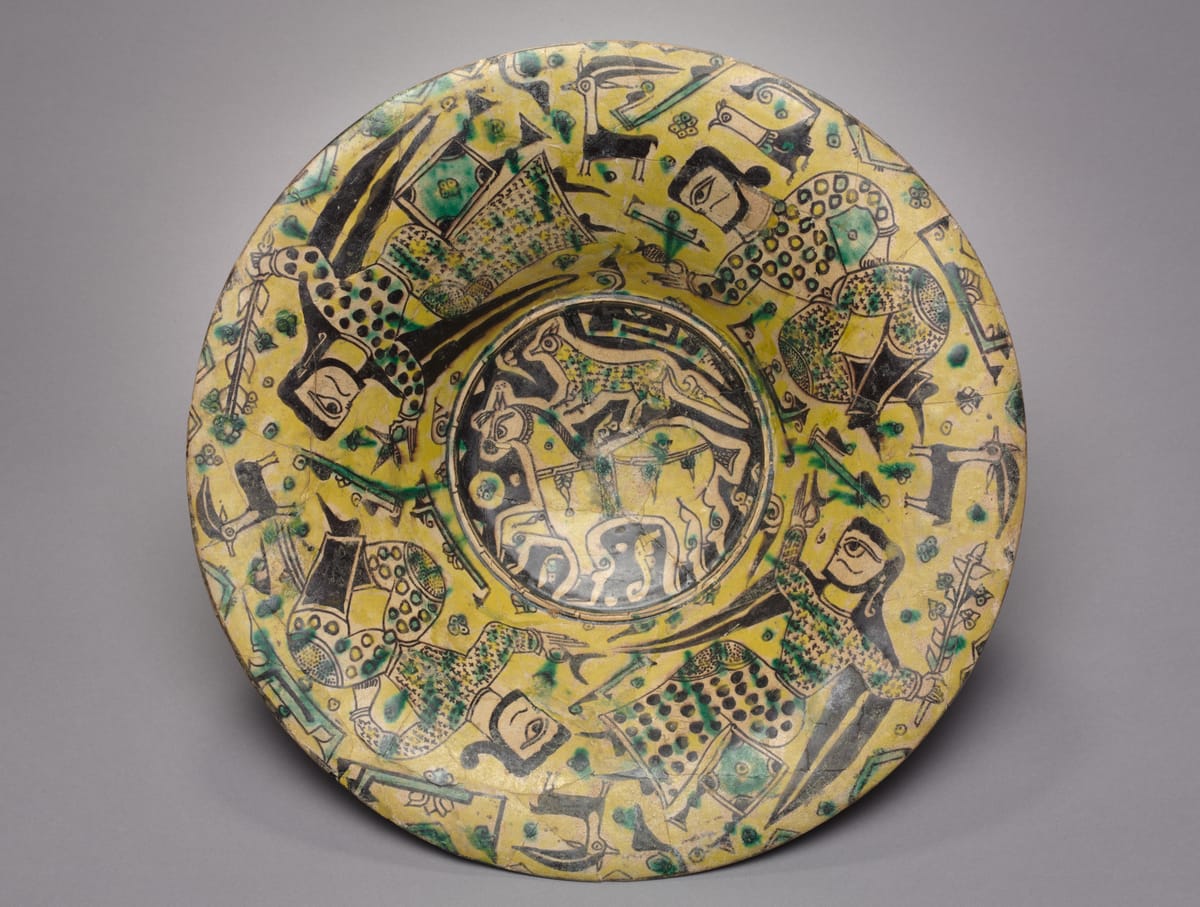
Samanid and Seljuq Iran. Ceramics from Nishapur, such as the bowl above with four bearded figures and an imperial hunt, show eastern Iranian dress in the ninth and tenth centuries.11,3 Peck describes decorated men's caftans with stiff skirts, diagonal closings, and lapels, worn over wide trousers and boots with pointed or upturned toes.3 Under the Seljuqs and their successors, the most typical garment for high-ranking men was a stiff caftan closing diagonally from right to left, now made of patterned textiles and often with gold armbands.3 New Turkish headgear included fur-trimmed caps, worn with tall, close-fitting boots.3
Dress Rules for Non-Muslims
Rules in this period expected Christians, Jews, and other non-Muslim subjects, called dhimmis, to look different from Muslims. The Pact of Umar, a document attributed to the caliph Umar, has Christians promise not to imitate Muslims' "garments, the qalansuwa, the turban, footwear, or the parting of the hair," and to bind the zunnar, a belt, round their waists.13 The Encyclopaedia Judaica says the first ruler to order such distinguishing marks, called ghiyar, seems to have been Umar II (717–720), not Umar I, and that the order was unequally observed.14
The Abbasid caliph al-Mutawakkil reissued and tightened these rules.14 He required Christians, Jews, and Zoroastrians to wear yellow taylasans, shawl-like head cloths, together with the zunnar, and if they wore turbans those had to be yellow as well. Even their slaves had to sew yellow patches onto their clothes.1 It is not known how long these laws were enforced, but al-Muqtadir (r. 908–932) issued similar rules early in his reign.1 Yellow's link with these rules may be one reason that fashionable people avoided the color.1
Myths Corrected
Myth: Ziryab invented fashion seasons. The story that Ziryab introduced spring and autumn wardrobes to al-Andalus comes from al-Maqqari, who was born around 1578, more than seven centuries after Ziryab reached Córdoba.15
Myth: Abbasid Muslims did not wear silk. Silk was common at court. Abbasid honorific garments were usually silk, and the School of Abbasid Studies notes that many people no longer observed pious distaste for silk and satin.1
Myth: everyone in Baghdad wore black. Black was the court color for ceremonies, not a universal rule. The Samarra paintings show men in bright greens, reds, and pinks, and commoners wore cheaper cloth such as wool.1,3
For the wider picture across a thousand years, see medieval Middle Eastern clothing, and for the later Islamic court dress of Istanbul, see Ottoman clothing. For Arabian dress before 750, from the Prophet's era to the Umayyad palaces, see early Islamic Arab clothing.
Quick Answers
What did people wear in the Islamic Golden Age?
Men and women wore layers of tunics, trousers, and robes or caftans, with a turban for men. At the Abbasid court officials wore black, and fine garments carried tiraz bands with the caliph's name.1,2,3,5
What was Abbasid clothing like?
Abbasid court dress centered on black robes and the tall qalansuwa cap. Men of rank wore ornamented caftans over tunics and trousers, a style spread by Persian officials, while laborers wore shorter wool tunics.1,2,3
What is tiraz?
Tiraz is cloth with an embroidered, woven, or painted inscription, often naming the ruler. The word also means the workshops that made it, whose control ranked with the mints among the Abbasid government's key duties.5
Why did the Abbasids wear black?
Black was the dynasty's official color. The caliph al-Mansur is credited with requiring officials to wear black on ceremonial occasions, and wearing another color could signal support for a rival group.1,2
Sources
- Abbasid Clothing and Fashion — School of Abbasid Studies (Persian influence, mu'tasimi, Zubayda and washi, al-Amin's inventory, black, 'attabi, costs, commoners, al-Washsha, ghiyar under al-Mutawakkil and al-Muqtadir).
Return to text (23 references)
Reference 1 Reference 2 Reference 3 Reference 4 Reference 5 Reference 6 Reference 7 Reference 8 Reference 9 Reference 10 Reference 11 Reference 12 Reference 13 Reference 14 Reference 15 Reference 16 Reference 17 Reference 18 Reference 19 Reference 20 Reference 21 Reference 22 Reference 23 - Courts and Courtiers iii. In the Islamic period to the Mongol conquest — C. Edmund Bosworth, Encyclopaedia Iranica, 1993 (caliph's black robes and qalansuwa, green and al-Ma'mun, robes of honor with Qur'anic borders, Bukhara tiraz workshop).
Return to text (10 references)
Reference 1 Reference 2 Reference 3 Reference 4 Reference 5 Reference 6 Reference 7 Reference 8 Reference 9 Reference 10 - Clothing viii. In Persia from the Arab conquest to the Mongol invasion — Elsie H. Peck, Encyclopaedia Iranica, 1992 (Samarra, Nishapur, al-Sufi manuscript, qalansuwa, tiraz armbands, Fatimid and Seljuq dress, al-Washsha and al-Tha'alibi).
Return to text (22 references)
Reference 1 Reference 2 Reference 3 Reference 4 Reference 5 Reference 6 Reference 7 Reference 8 Reference 9 Reference 10 Reference 11 Reference 12 Reference 13 Reference 14 Reference 15 Reference 16 Reference 17 Reference 18 Reference 19 Reference 20 Reference 21 Reference 22 - Ḵelʿat — Willem M. Floor, Encyclopaedia Iranica (robes of honor under the caliphate, Khuzestan tiraz, 'Adud al-Dawla's seven black robes, Seljuq grades).
Return to text (9 references)
Reference 1 Reference 2 Reference 3 Reference 4 Reference 5 Reference 6 Reference 7 Reference 8 Reference 9 - Tiraz — Gillian Vogelsang-Eastwood, TRC Needles, Textile Research Centre Leiden (etymology, Abbasid tiraz system, workshop locations, Fatimid revenue).
Return to text (8 references)
Reference 1 Reference 2 Reference 3 Reference 4 Reference 5 Reference 6 Reference 7 Reference 8 - Fragment of a Tiraz, 1932.21 — Cleveland Museum of Art (al-Muqtadir inscription, silk on cotton).
- Turban end with tiraz, 1950.354 — Cleveland Museum of Art (Tinnis, al-'Aziz, turban use, gift to courtiers).
- Tiraz with gold, probably from a wide sleeve, 1950.549 — Cleveland Museum of Art ("emblems of dignity," gold filé, sleeve as pocket).
- Tiraz of Caliph 'Abd al-Rahman III, 1977.188 — Cleveland Museum of Art (Córdoba, inscription length, Durri).Reference 1
- Luster Bowl with Man Holding a Banner, 1959.331 — Cleveland Museum of Art (Abbasid lusterware, probably Baghdad).Reference 1
- Nishapur Figural Bowl, 1959.249 — Cleveland Museum of Art (Samanid Nishapur, bearded figures, imperial hunt).Reference 1
- Ikat tiraz, 1950.353 — Cleveland Museum of Art (Yemeni cotton ikat, tenth-century inscribed ikats).Reference 1
- Pact of Umar — Medieval Sourcebook, Fordham University.Reference 1
- Jewish Identification: Jewish Badge — Encyclopaedia Judaica, via Jewish Virtual Library (Umar II, al-Mutawakkil).
- Mr. Clean — al-Maqqari, The History of the Muhammadan Dynasties in Spain, excerpted in Lapham's Quarterly (Ziryab's hairstyle and salt-washed linen, fashion seasons, al-Maqqari's dates).
- The Importance of the Cairo Geniza Manuscripts for the History of Medieval Female Attire — Yedida K. Stillman, International Journal of Middle East Studies, 1976 (about 750 trousseau lists, 969–1250).Reference 1