Seventh-century Arab clothing was built mostly from wrapped cloth rather than tailored garments. At the rise of Islam, men and women in Arabia wore layers: an undergarment, a body shirt, a long dress or tunic, and an outer mantle, many of them large rectangles of fabric wrapped around the body. A common pairing was the izar, a cloth wrapped around the lower body, and an upper wrap, most often the rida'.2,1 After the conquests, the Umayyad caliphs (661 to 750) took up the stiff, richly decorated caftans and full trousers of Sasanian Persia and Central Asia for their own court dress.3
This page covers Arabia just before Islam, the lifetime of the Prophet Muhammad (who died in 632), the first caliphs, and the Umayyad dynasty to 750.6
What Survives, and How We Know
The evidence for this period comes from three main places.
The first is text. The Qur'an names several garments, and the hadith, the reports of the Prophet's words and actions, describe what he and his Companions wore.5,4 The hadith were not compiled formally until many years after the Prophet's death, and they survived until then through oral tradition.6
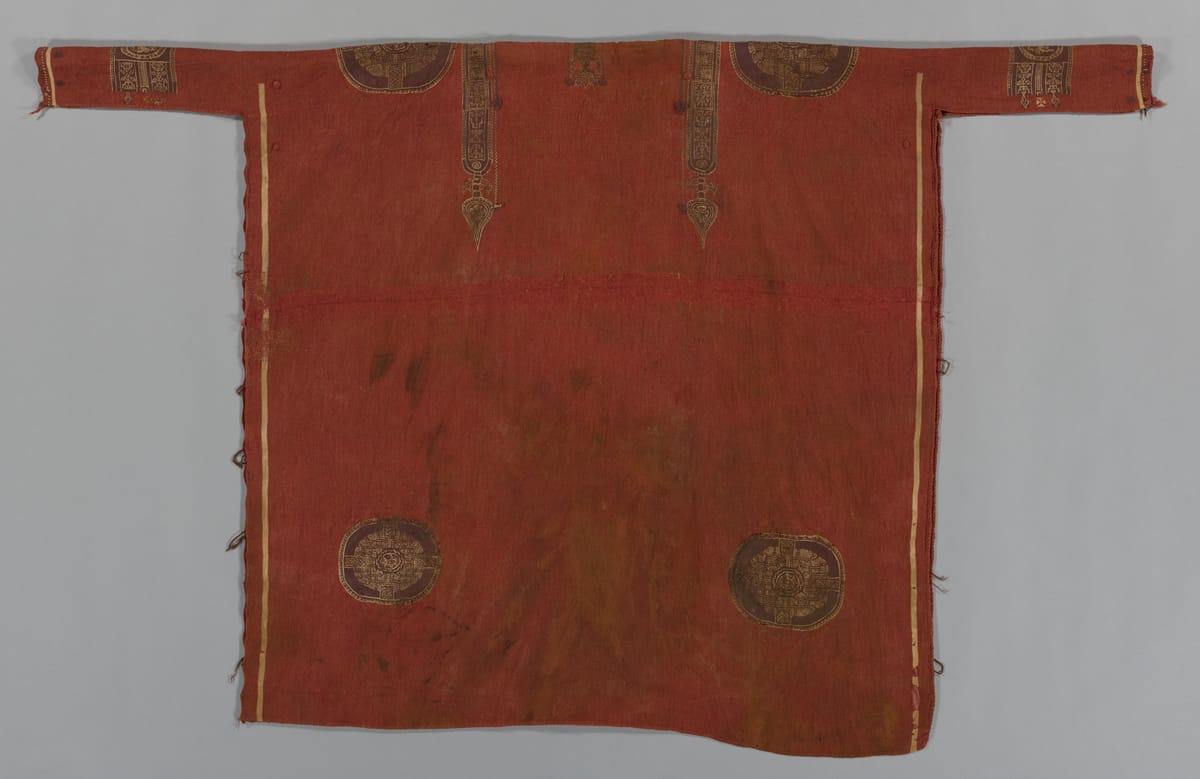
The second is cloth from Egypt, where the dry climate preserved textiles. Linen tiraz fragments have been found in Egyptian tombs, where they were used as shrouds.7 The Cleveland Museum of Art holds a complete wool tunic from Umayyad Egypt, woven in one piece with its front, back, and sleeves already in their final shape.11 Tunics had been the main garment in Egypt since the mid-200s CE.11
The third is art from the Umayyad desert palaces of Syria, Jordan, and Palestine. Elsie Peck, writing in the Encyclopaedia Iranica, warns that surviving images from this period are scarce and that many are "purely symbolic" rather than records of what people actually wore.3
Arabia on the Eve of Islam
The izar goes back to antiquity in Arabia. The Zay Initiative, a collection devoted to Arab dress, describes it as a wrapped lower-body cloth worn by both men and women in pre-Islamic as well as Islamic times.1 Sculpture from the ancient kingdoms of the northern Hijaz often shows bare-chested men wearing only an izar, matching Strabo's description of Nabataean dress.1
The earliest forms seem to have been two identical lengths of cloth woven on the same loom and left unstitched. One was wrapped around the waist. The other was draped across the torso and could be pulled over the head or used as a veil.1 Over time the two pieces were sometimes stitched together.1 Men still wear the izar as part of ihram, the dress of the pilgrimage to Mecca, which the Zay authors read as a ritual echo of these older wrapped clothes.1
Cloth was wealth in this world. Textiles served as gifts, units of exchange, and spoils of war, and the Zay authors suggest that this value may explain why woven cloth was traditionally worn uncut.2 They link the wrapped style to Bedouin dress traditions observed by Ibn Khaldun, and they stress its continuity from pre-Islamic into early Islamic times.2
Head and face coverings were also older than Islam. Karl Prenner of the University of Graz notes that veiling was a common fact of life in pre-Islamic times. Men wore veils too, although the evidence for male veiling is sparse and comes mostly from pre-Islamic poetry.5 Old Arabic poetry also mentions a variety of face coverings.5
Dress in the Prophet's Time
The turban, or 'imama, was of pre-Islamic origin and was already widespread in the ancient Near East. In Islamic times it came to mark first the Arab from the non-Arab, and later the Muslim from the non-Muslim.4 Hamid Algar's Iranica entry cites a frequently quoted hadith in which the Prophet called the turban "the crown of the Arabs."4 According to the traditions, he generally wore white, blue, or red turbans, and a black one on the day of the conquest of Mecca.4 He is recorded as letting the tail of his turban hang between his shoulder blades to a length of about two spans, and as discouraging his Companions from binding the turban under the chin.4
Rules on dress in the hadith aimed at humility. The Zay Initiative notes admonitions against letting the izar fall below the ankles out of arrogance, recorded in the Book of Dress (Kitab al-Libas) of the hadith collection Sahih al-Bukhari.1
Silk raised a dilemma. Robert Klemm, writing in World History Connected, points out that the Qur'an promises silk garments to believers in Paradise but has no verse that forbids silk on earth.6 The prohibition comes from the hadith. In one report, cited by Klemm from Sahih al-Bukhari, Umar, who later succeeded the Prophet as caliph, saw a silk cloak for sale at the gate of the mosque and told the Prophet he wished he would buy it to wear on Fridays and for receiving delegations. The Prophet replied that such a garment would be worn by someone with no share in the Hereafter.6 When silk cloaks were later given to him, he passed one to Umar, who gave it to his pagan brother in Mecca.6 Klemm concludes that the Prophet treated silk as acceptable to give to non-believers but forbidden for his Companions to wear.6
Cloth also carried honor. The Metropolitan Museum of Art traces the custom of the khil'a, the robe of honor, back to the time of the Prophet, and notes that he bequeathed his own mantle to be used as a shroud.7
Women's Dress and Veiling
Prenner, drawing on earlier scholarship, describes old Arabic women's dress as a long, wide, shirt-like garment with a slit running from the neckline down toward the waist.5 Over it went the khimar, an unstitched wrap that could be draped in many ways, including over the face.5 The same word could also mean a man's turban.5
The Qur'an addresses women's covering in two chapters, surahs 24 and 33, which Prenner dates to Medina around 626 to 627.5 Surah 24 tells believing women to draw their khimars over their breasts.5 Surah 33:59 tells the Prophet's wives and daughters and the women of the believers to draw their cloaks, the jilbab (plural jalabib), over themselves, "Thus is it likelier that they will be known and not be disturbed."5 A third term, hijab, appears in surah 33:53, where it means a curtain, not a headdress, and the passage refers only to the wives of the Prophet.5
The jilbab also marked status. Prenner reports that only free women were allowed to wear the jilbab outside the house, and slaves were barred from doing so, a distinction he finds in old Arabic poetry but not in the Qur'an itself.5 He stresses that commentators have held "wildly varying opinions" on how women should cover themselves, and that none of the Qur'anic passages he discusses explicitly mentions covering the head.5
The Rashidun and Umayyad Caliphs

The first four caliphs after the Prophet, the Rashidun, generally shared his preference for simplicity, according to Klemm.6 Klemm, citing the historian Stillman, sees the Umayyad Caliphate (661–750) as the period of the most significant change, from a "Bedouin-esque" wardrobe to one of widespread silk.6
The new style came from the conquered lands. Peck concludes that Umayyad dress for men and women was "derived in large part" from the fashions of Sasanian and post-Sasanian Persia and Central Asia, and that the rulers' images suggest a deliberate adoption of the symbols of power of the vanquished Sasanian empire.3
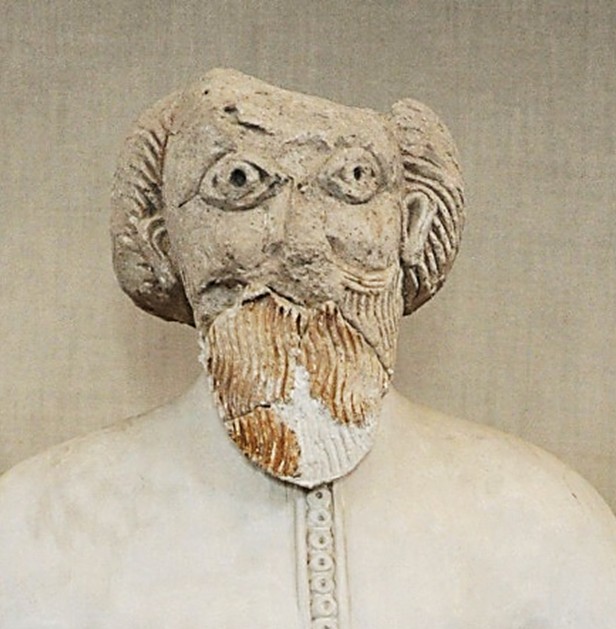
The clearest example is the "standing caliph," a plaster figure from Khirbat al-Mafjar, north of Jericho. Peck says the palace was probably built during the reign of Hisham (r. 724–743).3 The Metropolitan Museum of Art notes that it has traditionally been attributed to Walid II (r. 743–744) instead, and that the date is contested.10 The bearded figure stands with a sword above two back-to-back lions at the entrance of the bathhouse, and the Met describes him as likely the caliph himself.10 Peck describes his dress as a smooth, close-fitting coat with a wide skirt and narrow sleeves, a jeweled belt, full trousers, and soft boots.3 Pearls edge the fastening, the hem, and the side slits of the skirt, which suited a riding coat.3
Byzantium shaped the art as well. UNESCO describes the early eighth-century desert palace of Qusayr Amra, in Jordan, with its reception hall and bath richly decorated with figurative murals that show the influence of classical pagan themes and Byzantine-style portraits.9
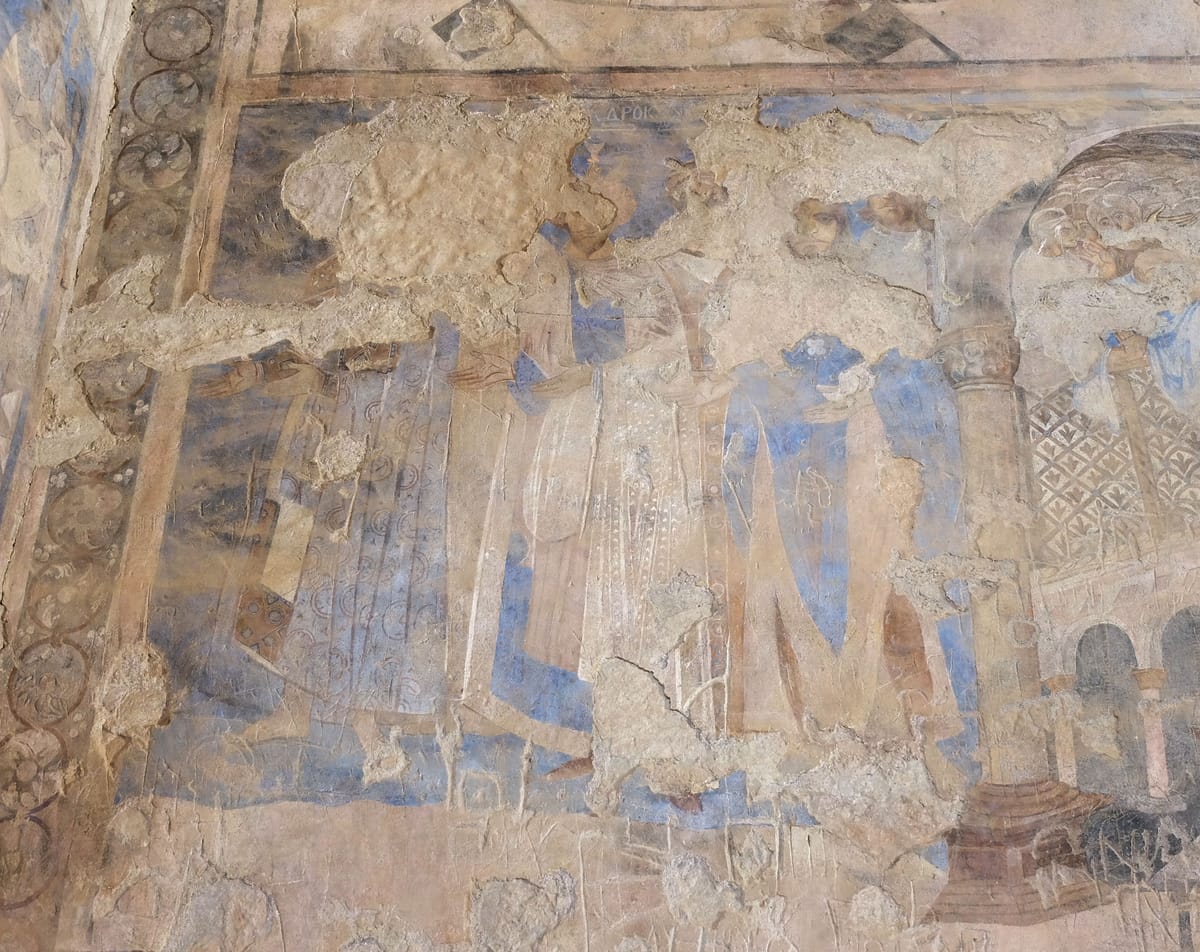

The same paintings also show people below the elite. Peck notes figures of low social status at Qusayr Amra with bare feet and legs, in simple short tunics.3 Two fan bearers beside the enthroned caliph wear soft shoes, long robes with beaded collars, and mantles with patterned linings.3
Women's court dress changed too. Peck notes that trousers are not known for women in the Sasanian period and must have been introduced for women in the early Islamic period, in imitation of men's dress.3 A fresco fragment from Qasr al-Hayr al-Gharbi shows a woman in a low cloth turban wound with a length of fabric around the face, which could serve as a veil.3 Peck adds that the wound turban was already in use early in the Umayyad period and became the characteristic headdress of men across the Islamic world.3
Fabrics: Wool, Linen, Cotton, and Silk
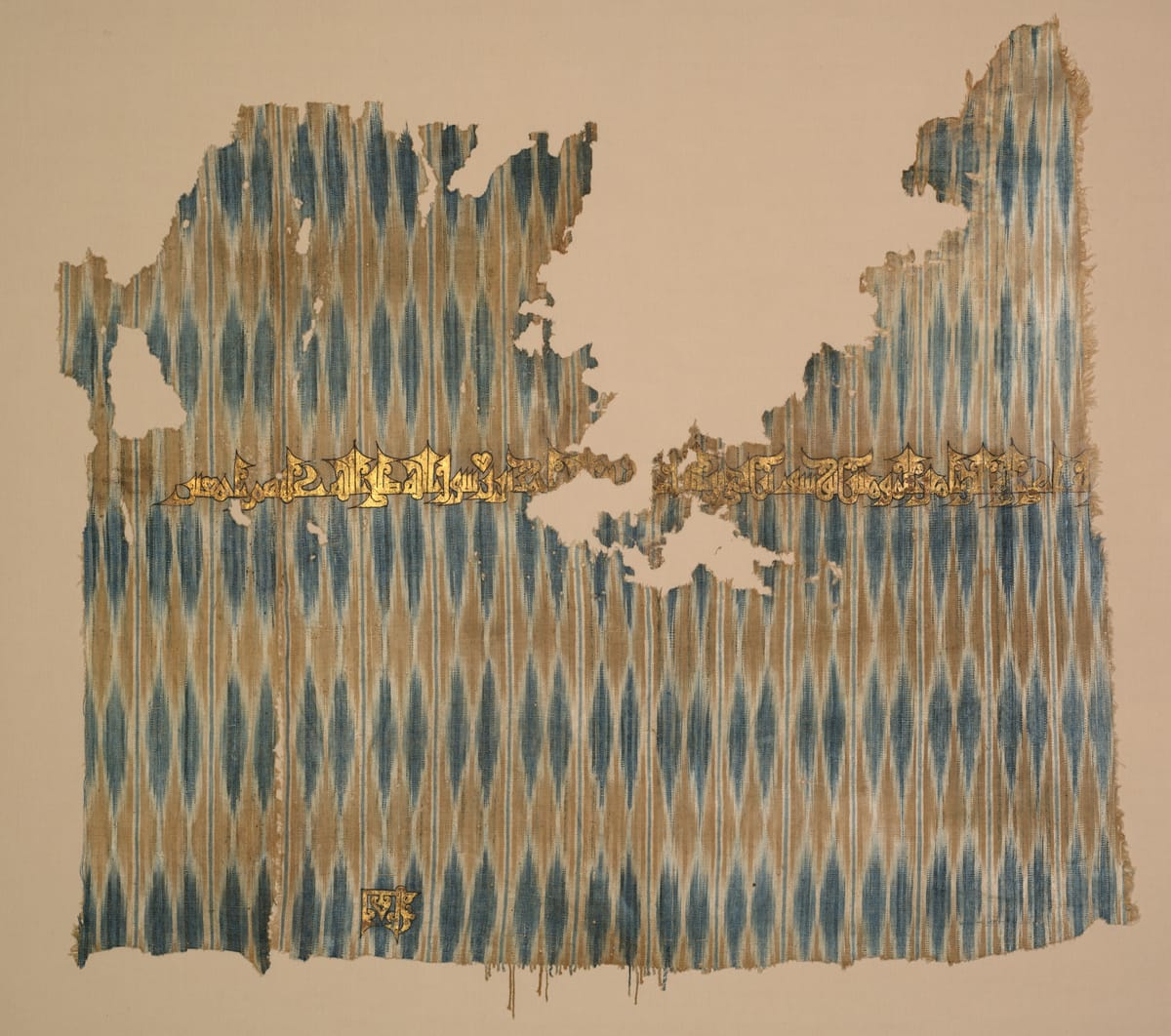
Yemen was a center of textile trade. Carol Bier of the Textile Museum writes that in the early centuries after the Islamic conquests, Yemeni striped textiles were "sought far and wide," and that Yemen's Red Sea and Gulf of Aden ports were emporia for textiles, dyestuffs, and incense in the medieval period.8 The stripes were made by ikat, a resist method in which sections of the warp are dyed before weaving.8 Medieval Islamic sources mention madder, indigo, and a yellow dyestuff called wars.8 The Cleveland Museum of Art notes that Yemeni ikats with tenth-century Arabic inscriptions are among the oldest known, so these inscribed examples are later than the period on this page.13
The Cleveland tunic from Egypt combines undyed linen with dyed wool, and the museum notes that a red background was favored in the early Islamic period.11
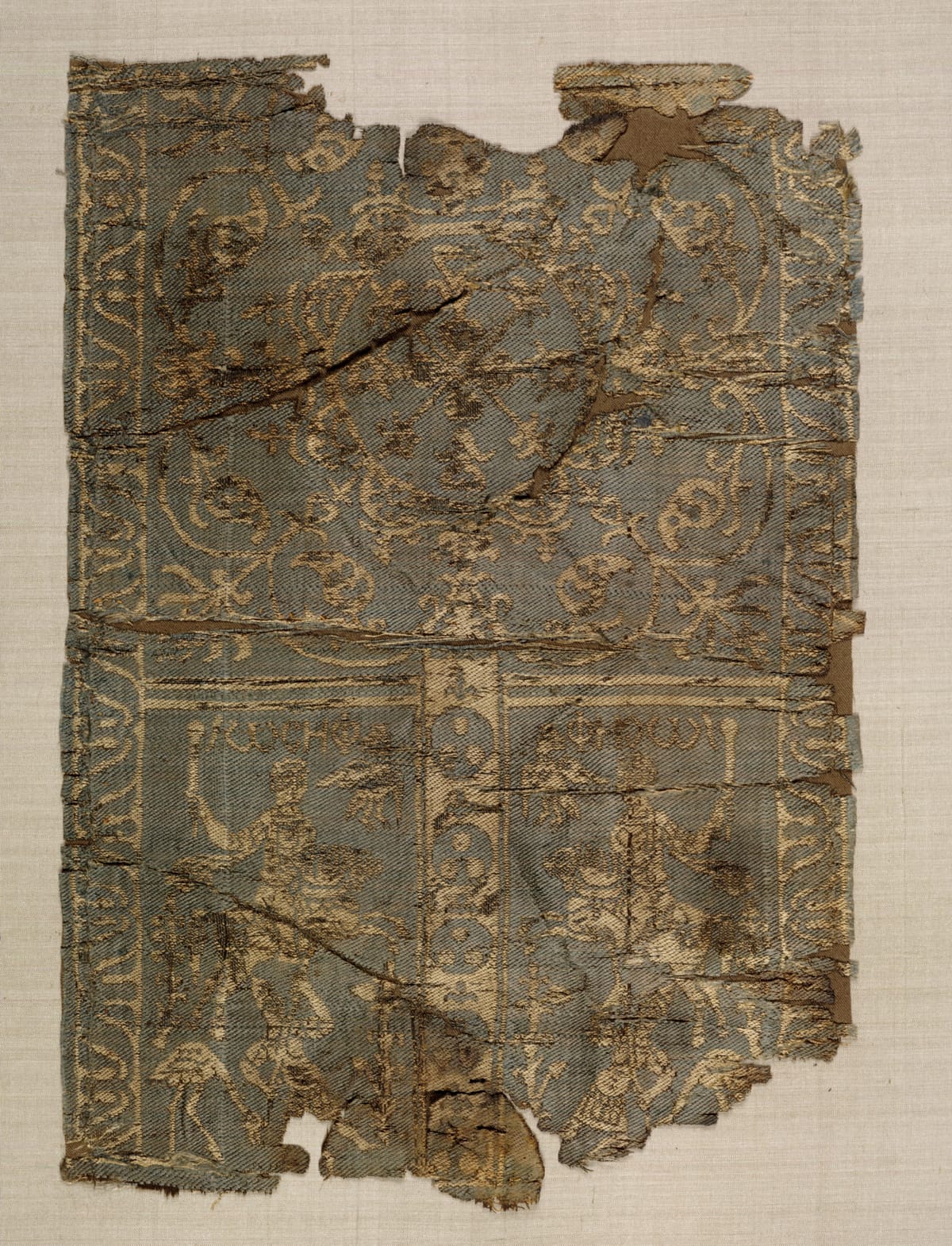
Silk, despite the hadith, became a court fabric. Klemm writes that by the Umayyad period silk was again in high demand and produced in large volume by state-run workshops.6 The Met traces the word tiraz to a Persian word for embroidery, and notes that the earliest tiraz were uninscribed, decorated with medallions and animals in a transition from Sasanian, Coptic, and Byzantine traditions.7 The Cleveland silk sleeve above shows that mixture: a lotus motif from ancient Egypt, a palmette medallion, and a horseman named in Coptic inscriptions as Joseph, probably modeled on Byzantine images of the victorious emperor.12
Myths Corrected
Myth: early Muslims wore a distinct "Islamic" costume from the start. The basic garments were older than Islam. The izar was worn in pre-Islamic Arabia, the turban was of pre-Islamic origin, and veils were in use before the Qur'an addressed them.1,4,5 At court, the Umayyads borrowed heavily from Sasanian Persia and Central Asia.3
Myth: the Qur'an requires a face veil. Prenner notes that the Qur'an makes no specific mention of a face veil, such as the burqu' or the qina', and that the majority of scholars have opined against the face veil as a religious obligation.5 Face veils were already part of Arabian dress before Islam, as old Arabic poetry shows.5
Myth: the palace paintings show what the caliphs wore. Some do not. Peck notes that all the so-called "kings of the world" at Qusayr Amra wear Byzantine robes, an image she treats as symbolic.3 Even the ruler sculptures, in her reading, signal power borrowed from Persia.3
For the wider regional picture, see medieval Middle Eastern clothing. The story continues after 750 in Islamic Golden Age clothing, when the Abbasid court in Baghdad set new fashions.
Quick Answers
What did Arabs wear in the 7th century?
Men and women wore layers of mostly wrapped cloth: an undergarment, a body shirt, a long dress or tunic, and a mantle. The izar wrapped the lower body and was often paired with an upper wrap, the rida'.2,1
What did the Prophet Muhammad wear on his head?
The traditions record that he wore a turban, generally white, blue, or red, with its tail hanging between his shoulder blades, and a black turban on the day of the conquest of Mecca.4
Did early Islam forbid silk for men?
The Qur'an does not forbid silk on earth, but hadith reports have the Prophet rejecting a silk cloak and treating silk as forbidden for his Companions to wear. The Umayyad court nevertheless produced and wore silk on a large scale.6
What did Umayyad caliphs wear?
Palace sculpture shows Sasanian-style dress: a close-fitting coat with a wide skirt and narrow sleeves, a jeweled belt, full trousers, and soft boots.3
Sources
- Unstitched Cloth and Social Meaning: A Transregional History of the Izar, Part I — Reem Tariq El Mutwalli and Rajrupa Das, The Zay Initiative, 1 January 2026 (pre-Islamic izar, Hijazi sculpture and Strabo, two-piece construction, ihram, ankle rule in Sahih al-Bukhari).
Return to text (9 references)
Reference 1 Reference 2 Reference 3 Reference 4 Reference 5 Reference 6 Reference 7 Reference 8 Reference 9 - Unstitched Cloth and Social Meaning: A Transregional History of the Izar, Part II — Reem Tariq El Mutwalli and Rajrupa Das, The Zay Initiative, 1 February 2026 (layers at the advent of Islam, wrapped rectangles, Bedouin traditions, cloth as wealth).
- Clothing viii. In Persia from the Arab conquest to the Mongol invasion — Elsie H. Peck, Encyclopaedia Iranica, 1992, updated 2017 (Umayyad period: standing caliph, Qasr al-Hayr al-Gharbi, Qusayr Amra, women's trousers and turbans).
Return to text (15 references)
Reference 1 Reference 2 Reference 3 Reference 4 Reference 5 Reference 6 Reference 7 Reference 8 Reference 9 Reference 10 Reference 11 Reference 12 Reference 13 Reference 14 Reference 15 - ʿAmāma (the turban) — Hamid Algar, Encyclopaedia Iranica, 1989, updated 2013 (pre-Islamic origin, "crown of the Arabs," the Prophet's turbans).
Return to text (7 references)
Reference 1 Reference 2 Reference 3 Reference 4 Reference 5 Reference 6 Reference 7 - The Practice of Veiling as an Expression of the Moral Behaviour of Women and Their Social Status in the Quran — Karl Prenner, in Headscarf and Veiling: Glimpses from Sumer to Islam, Edizioni Ca' Foscari, 2021, open access (pre-Islamic veiling, khimar, jilbab, hijab, face veils).
Return to text (15 references)
Reference 1 Reference 2 Reference 3 Reference 4 Reference 5 Reference 6 Reference 7 Reference 8 Reference 9 Reference 10 Reference 11 Reference 12 Reference 13 Reference 14 Reference 15 - The Difficult Journey: Overcoming Harām in the Development of Islamic Ṭirāz — Robert S. Klemm, World History Connected 13, no. 3, 2016 (silk in the Qur'an and hadith, the Rashidun, Umayyad silk workshops).
Return to text (10 references)
Reference 1 Reference 2 Reference 3 Reference 4 Reference 5 Reference 6 Reference 7 Reference 8 Reference 9 Reference 10 - Tiraz: Inscribed Textiles from the Early Islamic Period — Maryam Ekhtiar and Julia Cohen, Heilbrunn Timeline of Art History, The Metropolitan Museum of Art, 2015 (tiraz origins, khil'a, the Prophet's mantle, tomb finds).
- A Calligrapher's Art: Inscribed Cotton Ikat from Yemen — Carol Bier, The Textile Museum, exhibition brochure, 2001 (Yemeni striped textiles, ikat, dyestuffs).
- Quseir Amra — UNESCO World Heritage Centre (early eighth-century date, murals, Byzantine and classical influence).Reference 1
- Khirbat al-Mafjar — Byzantium and Islam exhibition blog, The Metropolitan Museum of Art, 2012 (attribution to Walid II or Hisham, standing caliph on lions).
- Luxurious Woolen Tunic with Decorated Bands and Roundels, 1972.46 — Cleveland Museum of Art (Umayyad Egyptian tunic, red ground, repairs, burial use).
- Silk Sleeve Decoration with Hunters, 1947.193 — Cleveland Museum of Art (early Islamic silk with Egyptian, Byzantine, and Coptic elements).Reference 1
- Ikat tiraz, 1950.353 — Cleveland Museum of Art (Yemeni ikat, tenth-century inscribed examples among the oldest known).Reference 1