19th Century · The Americas · 1800 - 1900
The Amauti, an Inuit Parka Made to Carry a Child
The most important part of an amauti is easy to miss in a front view. Inuit makers explain the pouch beneath the hood, the room in the shoulders, and the patterns they learned from family garments.
By Dan Schnau · Last updated
An amauti is an Inuit parka with room for a child against the wearer's back.1 Seen from behind, the broad hood can conceal where the child actually sits. The seat is the amaut, a pouch cut into the body of the coat below the hood. On some parkas a strap around the outside supports the child. The shoulders also do work. In a broad-shouldered style from the Kivalliq region of Nunavut, a mother could reach back and bring her baby round to nurse while both remained inside the garment.1,2,3
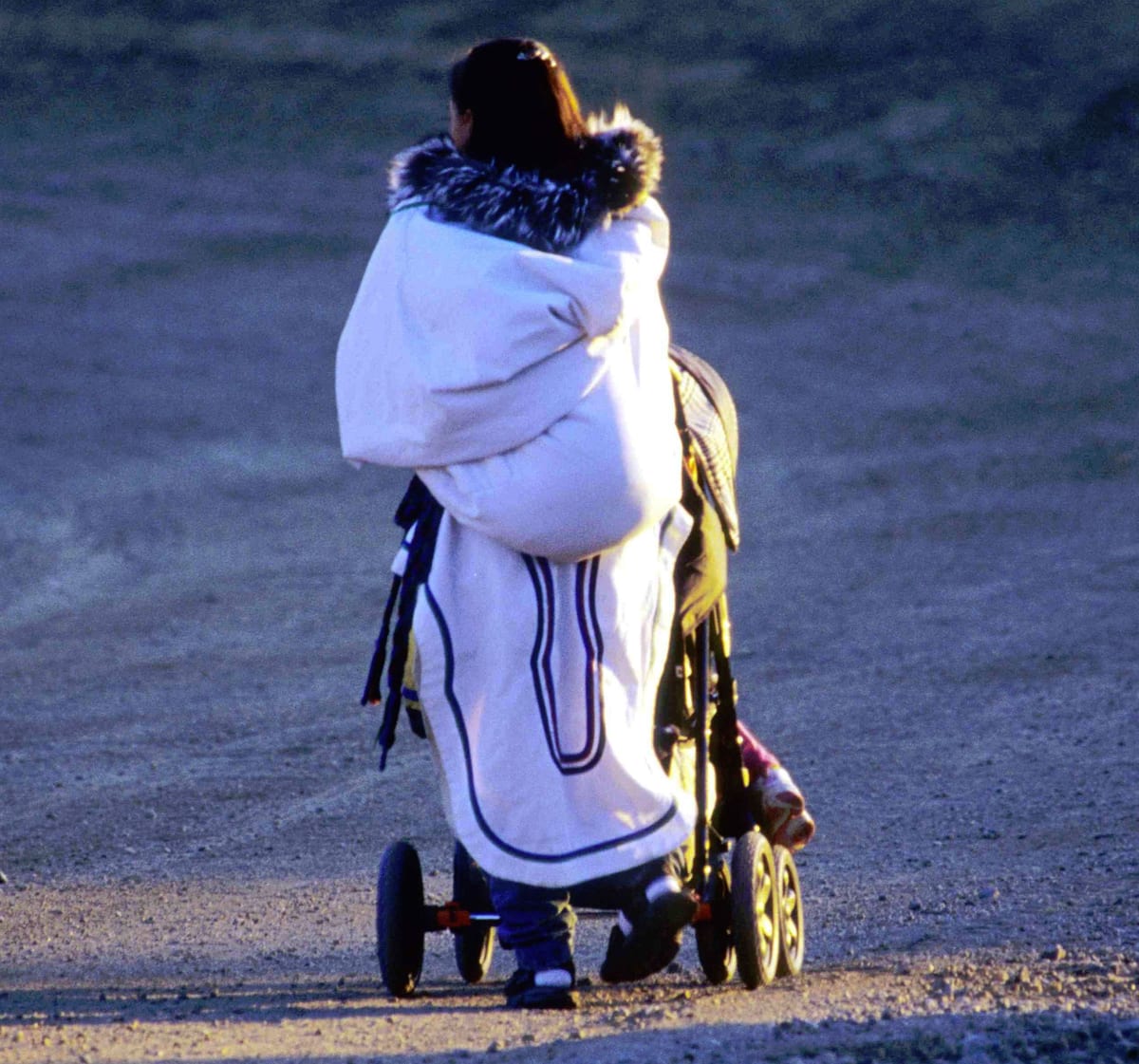

How the shoulders change the fit
The tuili has especially full shoulders and a long hood with a small opening. Bernadette Miqqusaaq Dean, an Aivilingmiut Inuk whose grandmother wore this style, describes the space in the shoulders in terms of a newborn's feet. A mother could turn the baby toward her breast and still have room for its legs. A coat measured only across the back of a woman standing alone would leave out the movement its maker had to allow for.2,3
Fit also varied from one wearer to the next. In 2006 Nancianne Gardiner-Grey helped bring women from across Nunavik to the Mirsuvik sewing centre in Kangirsuk. Working in pairs with instructors, participants measured across the shoulders in hand spans, using their knuckles for shorter distances. The length of the akuq, the tail, depended on the wearer's height. Some women there had never used a sewing machine. One participant brought a cloth pattern that went back to the 1940s.4
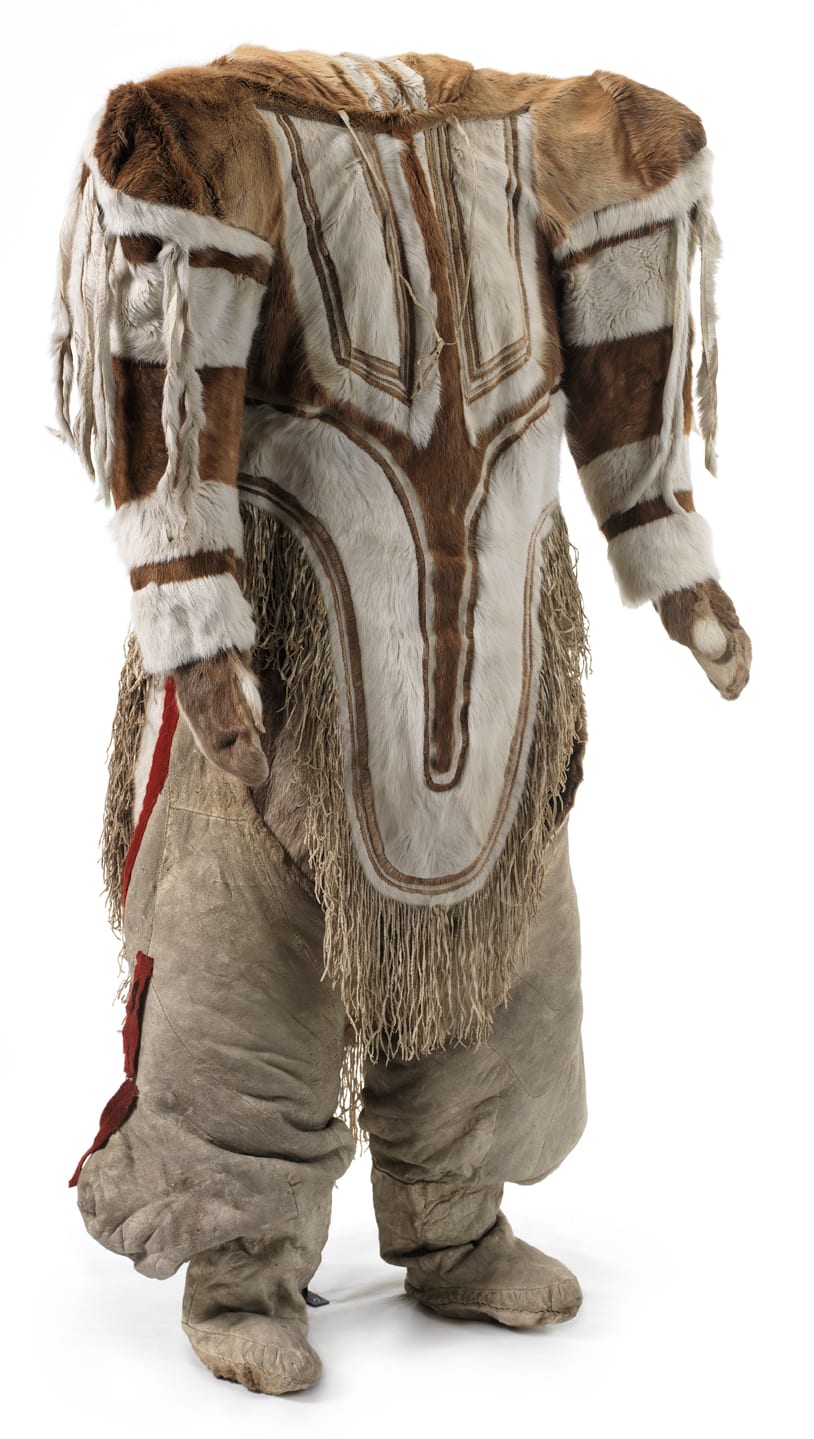
In the ensemble above, pale fur outlines the chest and the long front flap. The two sets of fringe have different jobs. The National Museum of Denmark describes the strips at the shoulders as decoration. Along the bottom, the much denser fringe helps keep the edge from curling up and letting warmth escape. The trousers and boots are also caribou skin. The expedition collected these pieces west of Hudson Bay between 1921 and 1924.5
Beadwork that outlasted its parka
The National Museum of the American Indian holds a parka from Chesterfield Inlet, Nunavut, dated about 1890–1925. The maker arranged nearly 160,000 glass beads into designs across the front, hood, shoulders and cuffs. The wool cloth underneath them matters as much to the garment's history as the beads. Curator Bernadette Driscoll Engelstad identified the beadwork as a transfer from an earlier parka. Dating the caribou skin therefore gives only part of the answer to the question of when this piece was made.3
The region's whaling economy helps explain the scale of the work. At Qatiktalik, or Cape Fullerton, ships hired Inuit crews and women sewed the mittens, boots, parkas and sleeping bags those crews needed. Glass beads circulated there in quantity. Dean reads the heavily beaded Chesterfield Inlet garment as clothing for a celebration such as a drum dance. A hide carrying strap with ivory toggles survives with it. Even a parka decorated for a gathering could do the work of carrying a newborn.3
For one later garment we know how the decoration passed between people. Naullaq Arnaquq recalls that her mother, Baqtita, received nineteenth-century coins from her own grandmother. Baqtita used them to decorate an amauti for Arnaquq and asked Arnaquq's aunt to finish beading its front panel. An inventory could identify metal and glass. Arnaquq can identify the relatives whose gifts and labor put them there.6
What a maker remembers
When Arnaquq needed an amauti after her son's birth, she had two garments to consult. One was the coat she had worn with her daughter, which no longer fitted. She also consulted a neighbor's coat. The difficult join was where a sleeve met the back of the pouch. Arnaquq remembered helping her mother sew small amautiit for a school. She also studied photographs and a doll her mother had dressed. The finished coat became a pattern she could use again.6
The Agguaq Collective has taken a related approach to garments held far from home. In 2023 Brenda Putulik studied an early twentieth-century Kivalliq tuili at the American Museum of Natural History in New York. She drafted its pieces on brown paper and checked their dimensions with a measuring tape. Fellow member Krista Ulujuk Zawadski describes a further collaboration with Putulik on a new garment. Zawadski wanted the high curve over the hips from a tuili, sleeves from another cut and a larger hood. Knowing where older makers placed each join made those changes possible.2
Who gets to use a pattern?
At a 2001 gathering in Rankin Inlet, participants in a Pauktuutit Inuit Women's Association workshop discussed two wishes together. They wanted Inuit to be free to learn, make and earn a living from amautiit. They also wanted a say in how outsiders used designs developed within their communities. They proposed documenting local variations and discussed who should control access to such a record. The published report preserves the proposals and the questions the group left open.7
One maker's business shows what passing on a pattern can make possible. Ujarak Appadoo, originally from Arviat, started Amautiga in 2016 after making carriers and parkas for her first child. Working in Montreal, she obtained materials both locally and from Arviat, and combined inherited patterns with alterations of her own. Her work includes a floral amauti dated 2019. In 2021 Gabai Kaludjuak joined her as a seamstress. A design learned within a family had become paid work making clothes for other families.8
For two sealskin parkas dated 1890–97, compare the pouch shapes in the nineteenth-century Americas survey. The modern Americas survey follows the design into a line of dolls made at Taloyoak.
Sources
- In Mother's Hood: Inuit Packing Dolls of Taloyoak — Anne Bissonnette and Christina Williamson, University of Alberta. Construction of the pouch, hood and belt.
- How the Agguaq Collective Threads New Connections — Krista Ulujuk Zawadski, Inuit Art Quarterly. The tuili's cut, Putulik's pattern work and Zawadski's account of their collaboration.
- Inuit amauti or tuilli, 13/7198 — Bernadette Driscoll Engelstad and Bernadette Miqqusaaq Dean, National Museum of the American Indian. Collection record and commentary on use, beadwork and whaling at Qatiktalik.
- Sharing the art of the amautik — Jane George, Nunatsiaq News, 12 May 2006. Interviews with organizers of the Kangirsuk sewing workshop.Reference 1
- Woman's clothing from Caribou Inuit in Arctic Canada — National Museum of Denmark. Materials, fringe and collection history of the photographed ensemble.Reference 1
- How Learning from Elders Keeps Creative Traditions Alive — Naullaq Arnaquq, Inuit Art Quarterly. First-person accounts of fitting an amauti and receiving beadwork from her mother.
- Inuit Women's Traditional Knowledge Workshop on the Amauti and Intellectual Property Rights — Pauktuutit Inuit Women's Association, final report, March 2002. Proceedings of the May 2001 gathering in Rankin Inlet.Reference 1
- Ujarak Appadoo — Inuit Art Foundation artist profile, including Appadoo's account of founding Amautiga and photographs of her work.Reference 1