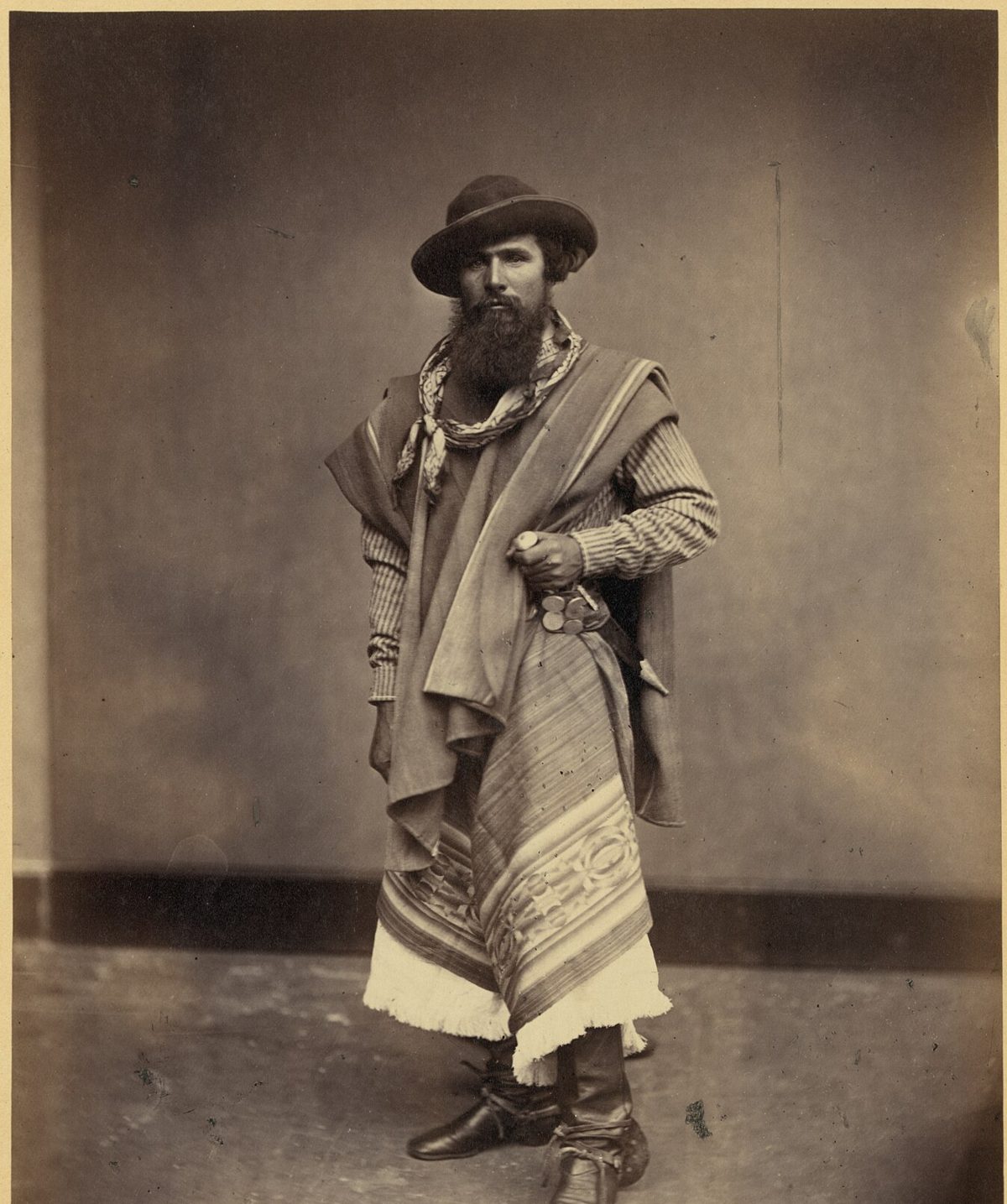
A poncho is an open-sided woven garment associated with Indigenous men of the Andes. The Michael C. Carlos Museum calls the Latin American poncho a hybrid form: the Spanish reintroduced horses, Indigenous men could not ride in their tight-fitting tunics, and "Hence the sides were split open and the poncho was born."1 The Minneapolis Institute of Art states that punchus, or ponchos, became popular in the Andes during Spanish colonial rule, from 1533 to 1825.3

Origins and History
The Carlos Museum states that the poncho is not a pre-Hispanic garment type but evolved from the tunic, a sleeveless shirt sewn up the sides, and that ponchos spread and took on ceremonial roles after the Spanish banned the tunic in the mid-18th century.2 The Minneapolis museum dates the change differently: after a Native uprising in the 1780s, the Spanish viceroy forbade tunics as a source of Indigenous nationalism, and men wore ponchos, "essentially tunics with open sides," a new symbol of Native identity. The Spanish military adopted ponchos too.3
Materials and Decoration
An early 19th-century boy's mourning poncho from Bolivia is spun from alpaca hair and colored entirely with natural dyes; its black stripes mark it for funerals, All Souls' Day, and Good Friday.2 A 20th-century Jalq'a man's kapote from Potolo, Bolivia, is sheep's wool; the Carlos Museum notes that aniline dyes, introduced in the mid-19th century, greatly intensified colors.1
Meaning and Status
The Carlos Museum states that such ponchos took months to make, passed down through generations, and were seen as a link between the living and the dead.2
On This Site
Sources
- Kapote (Man's Poncho), L2014.11.7 — Threads of Time: Tradition and Change in Indigenous American Textiles, Michael C. Carlos Museum, Emory University, 20th century, Jalq'a, Potolo, Bolivia (horses, split tunic sides, hybrid form, sheep's wool, and aniline dyes).
- Boy's Mourning Poncho, L2016.13.1 — Threads of Time, Michael C. Carlos Museum, Emory University, early 19th century, Bolivia (evolution from the tunic, mid-18th-century ban, alpaca, natural dyes, mourning use, and heirloom meaning).
- Ceremonial punchu (poncho), 2009.55.11 — Minneapolis Institute of Art, Quechua, Bolivia, 20th century, alpaca (colonial dates, 1780s uprising, viceroy's ban on tunics, open-sided tunics, Native identity, and Spanish military use; record retrieved through the Mia search API).