The boghtaq (also boqta or bocca) was the tall headdress of married Mongol women of rank in the 13th and 14th centuries. Encyclopaedia Iranica describes it as "a tall construction of felt and willow (wood or bark), the cloth covered with ornaments."1 Eiren Shea calls it "the signature headdress of Mongol married women."2
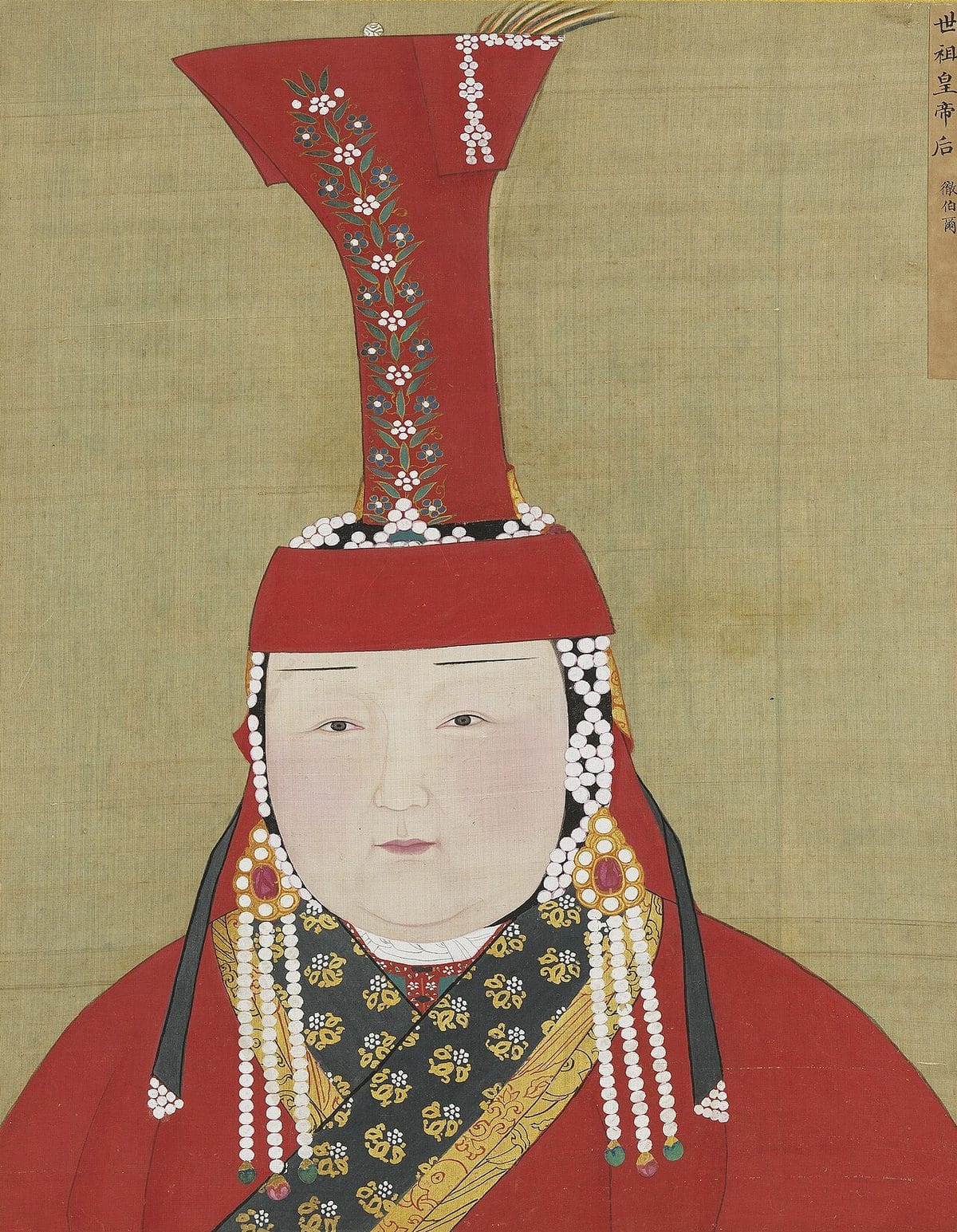
Portrait of Chabi, empress of Khubilai Khan, from an album of portraits of Yuan dynasty empresses, ink and color on silk. National Palace Museum, Taipei. Wikimedia Commons, Public Domain.

Materials and Decoration
Shea writes that the boghtaq "was made of a birch bark interior, covered in cloth, and could be adorned with precious materials such as stones, pearls, beads, and feathers."2 Li Zhichang, who visited the court of Chinggis Khan in 1221, noted that it was usually covered in black felt, while wealthier women used silk.2 In Yuan and Ilkhanid paintings the robe and boghtaq are almost always red, and in the Portrait of Chabi the headdress is decorated with large pearls.2
Origins and History
William of Rubruck, who visited Mongol courts between 1253 and 1255, confirms that the headdress was often ornamented with precious stones and feathers.2 A 2018 report describes a birch-bark frame, with a cylindrical base, frontal plate, and cover, from a female burial of the 13th to 14th centuries at Krokhalevka-5 in the Novosibirsk region, and calls the bocca "an attribute of a married woman."3 Encyclopaedia Iranica adds that Clavijo's description of 1404 shows it was still worn in Timurid Central Asia.1
Meaning and Status
Shea argues that its pearls and stones displayed the reach of the Mongol empire, and that the headdress was a recognizable symbol of Mongol women and the empire as a whole.2
On This Site
Sources
- Clothing ix. In the Mongol and Timurid periods — Eleanor G. Sims, Encyclopaedia Iranica, 1992, updated 2017 (felt and willow construction, ornaments, and Clavijo's 1404 description).
- Portrait of Chabi — Eiren Shea, Smarthistory (birch-bark interior, coverings, Li Zhichang in 1221, Rubruck, red versions, pearls in the portrait, and the headdress as a symbol of the empire).
Return to text (6 references)
Reference 1 Reference 2 Reference 3 Reference 4 Reference 5 Reference 6 - A Mongolian era female headdress from the upper Ob Basin — D. V. Pozdnyakov and others, Archaeology, Ethnology and Anthropology of Eurasia 46:4, 2018, abstract via Novosibirsk State University Research Explorer (Krokhalevka-5 burial, birch-bark frame, and the bocca as an attribute of a married woman).Reference 1