Byzantine clothing is the dress of the eastern Roman Empire, ruled from Constantinople from the 320s until the Ottoman conquest of 1453.1 Its basic unit, for rich and poor, men and women, was a long-sleeved tunic, worn with a mantle in public. At court, rank was shown by the cut, color, and ornament of garments such as the chlamys cloak and the jeweled loros, and by purple silk that the emperors tried to keep for themselves.1,2,4
Most of what we know concerns the court and the upper classes.1 For the wider picture, see the early medieval section of medieval European clothing and the Byzantine inheritance traced in medieval Middle Eastern clothing.
How We Know What Byzantines Wore
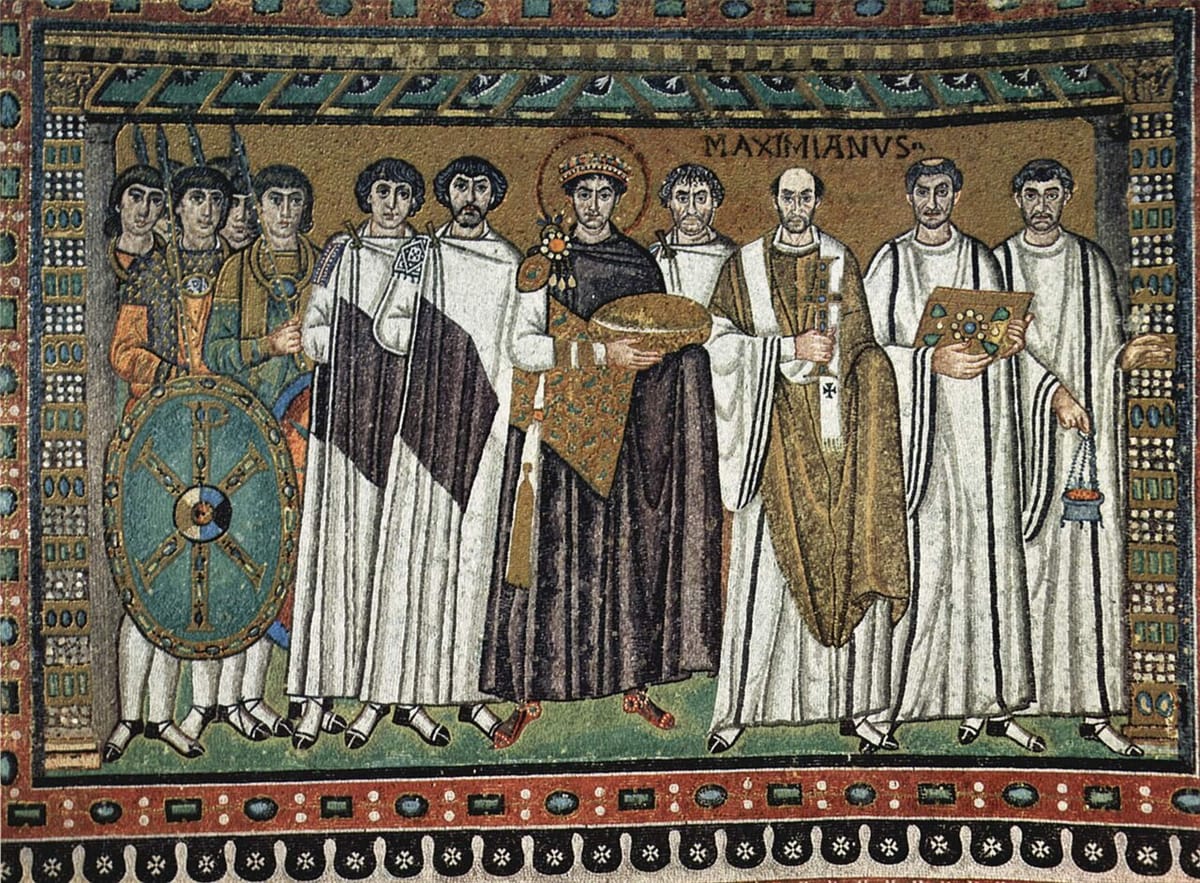

For the early centuries the evidence is mainly mosaics, ivory diptychs, and miniatures, and FIT's Fashion History Timeline calls the imperial panels in Ravenna the richest and most detailed source on Byzantine dress for the early medieval period.1 They line the church of San Vitale, which was dedicated in 547, and show Justinian I (reigned 527 to 565) with his clergy, officials, and bodyguards, beside a matching panel of his wife Theodora.2,1
Written sources are mostly later, from the ninth century onward.1 The best known is the Book of Ceremonies of Constantine VII, a tenth-century handbook of the court's religious and secular ceremonies; a treatise appended to it describes the garments of the court and the emperor. The Kletorologion of Philotheos, compiled in 899 under Leo VI, covers court banquets and what men wore at court, and the fourteenth-century treatise of Pseudo-Kodinos does the same for the court of the Palaiologan emperors (1261 to 1453).1 The tenth-century Book of the Eparch, a set of rules for the guilds of Constantinople, shows how silk was made and sold.5
Thousands of tapestry-woven tunic decorations have survived in the dry Egyptian climate, according to the Cleveland Museum of Art,11 and coins and lead seals record later court dress.7,12 Matching words to garments is hard: Middle Byzantine texts use at least nine words for a tunic, and artists were not always accurate.1
Emperors and the Court: Chlamys, Tablion, and Loros
In the Ravenna mosaic, Justinian wears a short tunic under a chlamys, tight trousers that cover the whole leg and foot, and purple shoes called campagi.1 The chlamys was a mantle fastened at the right shoulder with a brooch. It had begun as Roman military dress and had become court dress for the emperor and for military and civil officials alike.2 On its front was the tablion, a rectangular purple panel usually decorated with gold thread.1 Justinian's brooch is a disc with a red inlay framed by pearls, with three pendants hanging from it.1
Maria Parani notes that earlier Roman men left their arms and legs bare; by the sixth century long sleeves and tight trousers had become proper Roman dress, and the toga had already been reduced to certain ceremonies, a decline traced in our page on the Roman toga.2
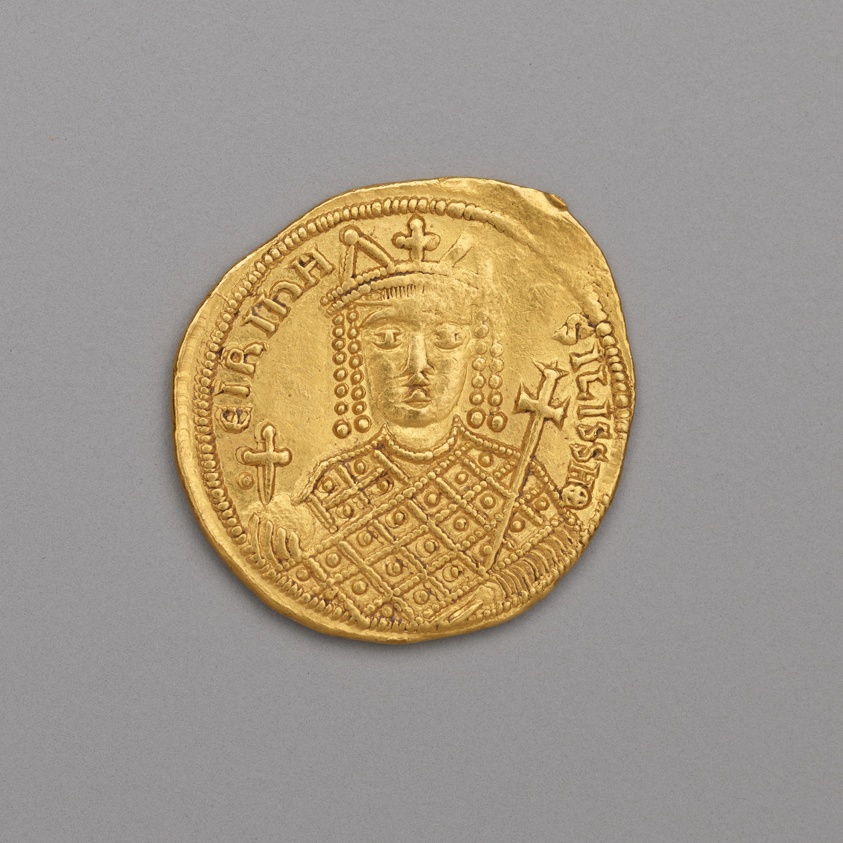
The grandest imperial garment was the loros, a long scarf embroidered with gold and set with pearls and jewels, crossed over the torso. It derived from the gold-embroidered purple toga worn by Roman consuls, and its earliest known images are on the coins of Justinian II.1 On the gold coin above, Empress Irene (reigned 797 to 802) wears a jewel-encrusted loros and holds an orb and a cross-topped staff, signs of male imperial power. The Art Institute of Chicago notes that it is the first Byzantine coin to carry the title basilissa, empress.12 After 856, Michael III appears alone in the loros on his gold coins.8
Garments ranked against each other. A seal of Alexios III (1195 to 1203) in the Dumbarton Oaks collection shows the saintly emperor Constantine in the loros and Alexios himself in a chlamys, which the catalogue calls "a garment denoting inferior rank."7
Under these outer garments the emperor and senior courtiers wore the divetesion (also spelled divitision), a long silk tunic with large sleeves, belted at the waist, which developed from the earlier dalmatic.1 The dalmatic itself was a long tunic with wide sleeves, worn without a belt, which probably originated in Dalmatia.1
Court dress was a system. Parani writes that official dress, "carefully regulated by the central authority," made office-holders of every origin look like one group serving the emperor, while rank showed in the types, combinations, materials, colors, and decoration of their garments and insignia.2
Imperial Purple and the Silk Monopoly
The color of power was purple. FIT, summarizing the historian Antonio Carile, says purple production, sale, and use were regulated since the Theodosian era, and that from the fifth century there were guilds of purple-dye makers and of dyers.1 The dye came from murex sea snails, and Anna Muthesius describes its processing as labor-intensive and costly.4
Silk was the other pillar. According to Procopius, writing around 550, monks who had learned silk-making in a land they called Serinda promised Justinian that the Romans would no longer have to buy silk from the Persians, their enemies. They returned to India and brought silkworm eggs to Byzantium, and so began the art of making silk in the Roman Empire.3
Muthesius explains that imperial decrees aimed to create and then keep an imperial monopoly over silks for the court, above all the murex-dyed purples. From the fourth to the tenth century these appear to have been made only in imperial workshops.4 In the tenth century some were made under strict control by private guilds in Constantinople. The Book of the Eparch (also called the Book of the Prefect) shows seven categories of imperial silk garments or purples in guild production, including whole silk garments of imperial cut and red or blue purples of different strengths.4 A. A. Vasiliev dates the work to Leo VI's reign or later in the tenth century; its guilds include silk weavers, dealers in raw silk, and traders in silk goods and dresses, each with its own monopoly.5
The state enforced this at its borders. In 968 Liudprand, bishop of Cremona and an envoy of Otto the Great, was preparing to leave Constantinople when officials ordered him to show them the costly garments he had bought. In Ernest F. Henderson's translation, they told him that garments "prohibited to all nations except to us Romans" would be taken away and the price returned, and they took five costly purple fabrics from him.6
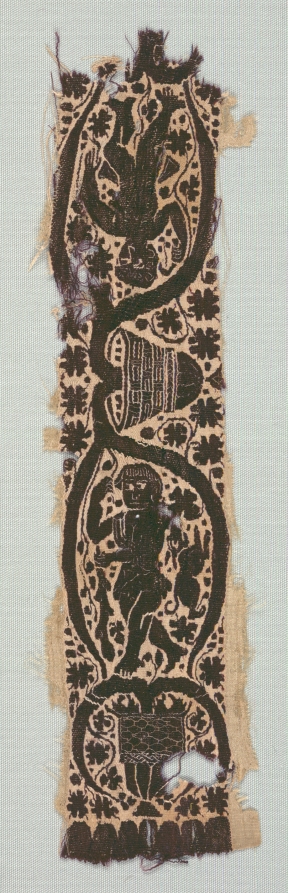
The fragment above is, according to the Cleveland Museum of Art, the only known remnant of a silk tunic among the thousands of tunic decorations that survive from Egypt. Imported silk formed its whole ground.11
Empresses and Women's Dress
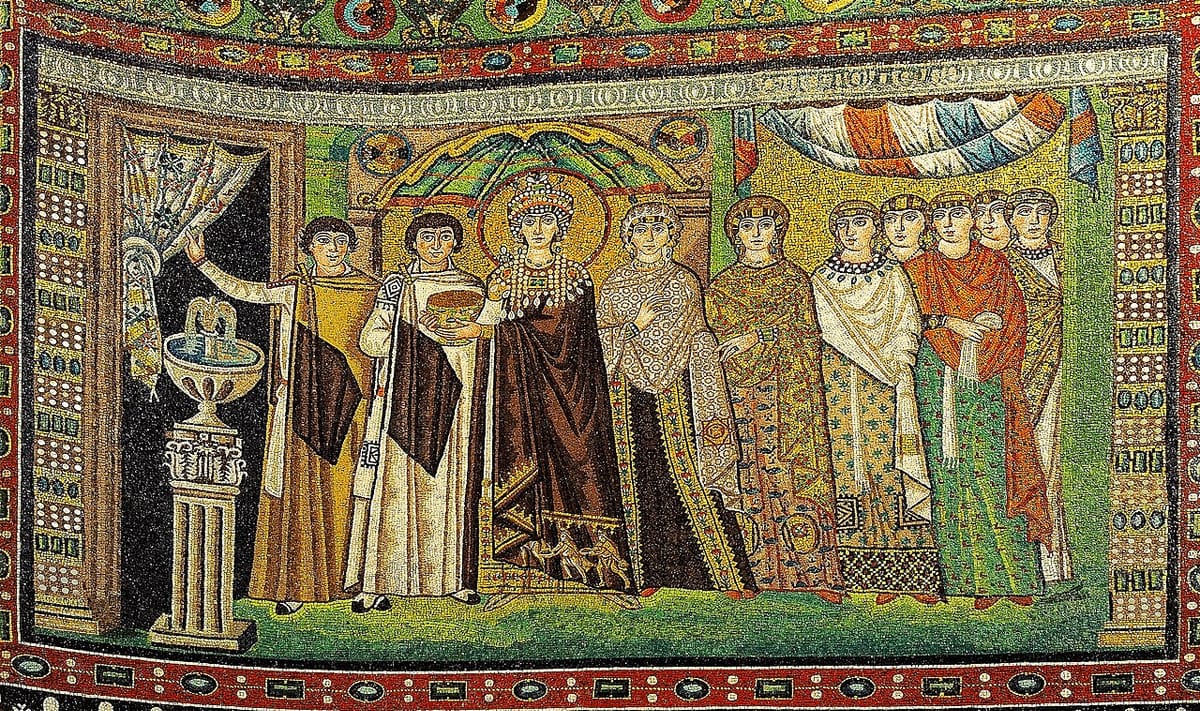

Theodora's panel at Ravenna shows her in a chlamys, a garment normally worn by men; FIT explains the choice by her rank as empress and wife of Justinian. Her brooch is of the crossbow type, and she wears a crown with rows of pearls and a jeweled collar.1 She was not the first: the empress Ariadne (474 to 515) appears on ivory diptychs in Florence and Vienna in a chlamys, holding a scepter and orb.1
Imperial dress for men and women drew closer from the eighth century, according to FIT. In the eleventh-century mosaics of Hagia Sophia, Constantine IX Monomachos and Zoe wear matching loroi over divetesia.1 Empresses of the eleventh and twelfth centuries are often shown with a shield-shaped end to the loros, which scholars call the thorakion; whether it was a separate garment is debated.1
Ordinary women of the upper classes dressed in layers. Parani describes fourth- and fifth-century women in an outer tunic with ample sleeves over an under tunic with long, narrow sleeves, belted under the breasts rather than at the waist.2 In public a woman wrapped herself in the palla, a long rectangular mantle that could also cover her head. Paradoxically, Parani notes, the mantle is what allowed a respectable woman to move in public at all.2 Marriageable and married women wore their hair gathered up, and earrings framed the face.2
Later centuries changed the outline. Middle Byzantine women wore sleeveless mantles to the calves or ankles, fastened at the neck with a brooch, over tailored dresses with tall cylindrical necks. By the eleventh century sleeves had become triangular, and in the twelfth they flared like trumpets, forcing the wearer to hold her hands folded at the elbows.2
Ordinary People, Monks, and Clergy
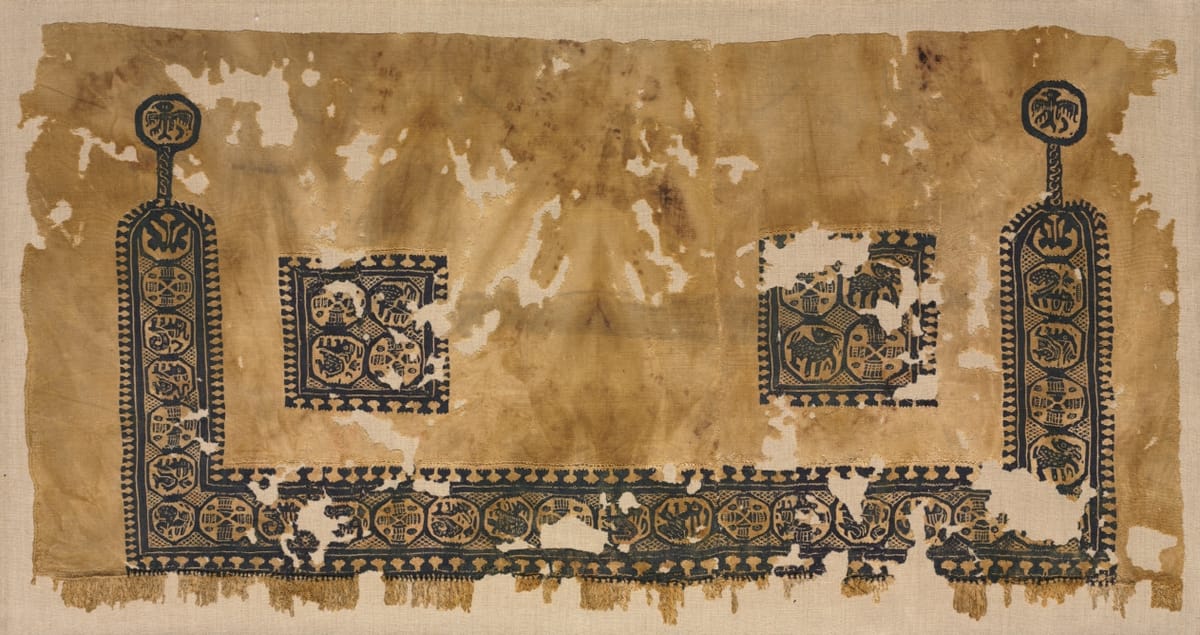
Most people wore a tunic. The Cleveland Museum of Art describes the tunic above as unisex and notes that long, wide tunics were the most common garments of the period. Its deep blue ground was probably a failed purple dye.10 Another Cleveland tunic, a woolen winter garment decorated with bands called clavi, was worn by men and women alike. An ancient repair shows that decorated cloth was expensive and was often mended and reused.13
In late antiquity, lower-class women wore slightly shorter tunics, reaching just above the ankle, and used the belt to hold back wide sleeves while they worked.2 A late thirteenth-century mural at Arta in Greece, a rare image of the poor, shows men in belted tunics with long narrow sleeves that fell below the knee, worn over trousers.2 For the poor, Parani notes, old hand-me-down clothes were a sign of poverty.2
Some institutions had stricter rules. Parani writes that the court, the army, the Church, and the monasteries had dress codes recorded in their own regulatory texts, and that present-day Greek Orthodox clerical and monastic dress shows how well these codes were preserved.2 A priest's vestments were the same types across the empire, though their quality hinted at his wealth.2
Later Byzantine Dress: Komnenian and Palaiologan Changes
Under the Komnenian emperors the imperial crown changed shape. The domed kamelaukion, topped by a cross, first appears in a portrait of John II Komnenos (reigned 1118 to 1143) and then replaced the older open crown.1 Parani tentatively links twelfth-century male portraits that stress the shoulders and arms to the soldier-emperors John II and Manuel I.2
FIT notes that provincial aristocrats in places such as Kastoria, Cappadocia, Georgia, and Armenia wore brocade kaftans, called kabbadion, and turbans. The kaftan opened at the front, which made riding easier, and it traced back to Persian dress. The turban did not appear in Constantinople until at least the twelfth century; the portrait of Theodore Metochites in the Chora monastery, of about 1315 to 1320, is a prominent example.1 Parani describes upper-class men of the late empire moving toward "oriental-looking caftans," some of them tight across the upper body, with a handkerchief tucked into the belt.2 For the kaftans of the empire that took Constantinople in 1453, see our page on Ottoman clothing.
Imperial dress was reorganized too. From the thirteenth century the sakkos, a loosely belted tunic, became the main imperial garment for men, and the loros was simplified, apparently sewn onto the tunic by the fourteenth century.1 Some women of the late period, Parani notes, chose close-fitting dresses in Western styles and were painted in them on the walls of Orthodox churches, while men avoided such styles in their portraits.2
Myths Corrected
Byzantine dress never changed. Introducing its volume on Byzantine court culture from 829 to 1204, Dumbarton Oaks notes that the court's "image of permanence and immutability" was "more apparent than real."9 Parani likewise stresses "dramatic differences in dress styles" across the empire's history.2
Strict laws told everyone what to wear. Imperial laws protected the emperor's privileges over certain garments and precious materials. But Parani writes that apart from these specific restrictions "there were no sumptuary laws in Byzantium" that stopped people from wearing luxurious dress if they could afford it.2 One late antique law did single out female performers: actresses and mimes could not wear the gold-patterned silks, partly purple garments, and gem-set jewelry allowed to other women.2 Even the purple rules had limits. Leo VI's Novel 80, quoted by Muthesius, allowed scraps and clippings of purple cloth to be bought and sold.4
The silkworm story. The account in Procopius, as given in the Medieval Sourcebook, says only that monks brought silkworm eggs to Byzantium after the emperor promised them rewards. It says nothing about how the eggs were hidden or carried.3
Quick Answers
What did Byzantine emperors wear?
A long silk tunic under either a chlamys fastened at the shoulder, with a decorated tablion panel, or a jeweled loros wrapped around the body, with a crown and purple or red shoes.1,7
What did Byzantine empresses wear?
Empresses often wore the same imperial garments as emperors, especially from the eighth to the twelfth century. Theodora wears a chlamys at Ravenna, and Irene and Zoe wear the loros.1,12 Their crowns and jewelry were often richer than the emperor's.1
What did ordinary Byzantines wear?
A belted tunic of linen or wool, worn over trousers by men, with a mantle in public. Women's tunics were longer, and women covered themselves with a mantle outside the home.2,10
Was purple only for the emperor?
Murex-dyed purple silk was an imperial monopoly, and the state confiscated it from foreigners.4,6 Purple bands on tunics were allowed to everyone by the seventh century, and scraps of purple cloth could be legally traded under Leo VI.1,4
Sources
- Byzantine — Giada Lattanzio, Fashion History Timeline, Fashion Institute of Technology, 2022, updated 2025 (sources, purple, Ravenna mosaics, chlamys and tablion, dalmatic and divetesion, loros and thorakion, crowns, kaftans, late dress).
Return to text (26 references)
Reference 1 Reference 2 Reference 3 Reference 4 Reference 5 Reference 6 Reference 7 Reference 8 Reference 9 Reference 10 Reference 11 Reference 12 Reference 13 Reference 14 Reference 15 Reference 16 Reference 17 Reference 18 Reference 19 Reference 20 Reference 21 Reference 22 Reference 23 Reference 24 Reference 25 Reference 26 - Byzantine Identity and Dress — Maria G. Parani, in Jennifer Ball, ed., Byzantine Dress: A Guide (Routledge, 2025), open access (men's and women's dress, court and institutional dress codes, absence of general sumptuary laws, poorer classes, late caftans and Western styles).
- Procopius: The Roman Silk Industry, c. 550 — Internet Medieval Sourcebook, Fordham University, from Cave and Coulson, A Source Book for Medieval Economic History (1936), modernized by Jerome S. Arkenberg.
- Silk, Power and Diplomacy in Byzantium — Anna Maria Muthesius, Textile Society of America Symposium Proceedings, 1992 (imperial silk monopoly, Book of the Prefect categories, Leo VI's Novel 80).
Return to text (7 references)
Reference 1 Reference 2 Reference 3 Reference 4 Reference 5 Reference 6 Reference 7 - A History of the Byzantine Empire: Social and political developments — A. A. Vasiliev, via Elpenor (Book of the Eparch, its date, and the silk guilds).
- Liutprand of Cremona: Report of his Mission to Constantinople — Internet Medieval Sourcebook, Fordham University, trans. Ernest F. Henderson, Select Historical Documents of the Middle Ages (1910) (confiscation of purple fabrics, 968).
- Seal of Alexios III Angelos (1195–1203), BZS.1958.106.608 — Dumbarton Oaks, Byzantine Seals catalogue (loros and chlamys as markers of rank).
- Seal of Michael III (856–67), BZS.1951.31.5.1713 — Dumbarton Oaks, Byzantine Seals catalogue (Michael III in the loros on his coinage).Reference 1
- Byzantine Court Culture from 829 to 1204 — Henry Maguire, ed., Dumbarton Oaks, publisher's description (archived copy).Reference 1
- Lower Section of a Tunic, 1993.177 — Cleveland Museum of Art (unisex tunic, common long tunics, failed purple dye).
- Rare Silk Tunic Fragment with Ornamental Sleeve Band, 1982.77 — Cleveland Museum of Art (only known silk tunic remnant among Egyptian finds, purple wool band).
- Solidus (Coin) of Empress Irene, 2014.9 — Art Institute of Chicago (Irene's loros, crown, and the title basilissa).
- Fragment of a Tunic, 1926.143 — Cleveland Museum of Art (tunics for men and women, clavi, ancient repair, indigo).Reference 1