Ancient · Middle East & North Africa · 3000 BCE - 500 CE
Mesopotamian Clothing: Sumerian Dress, Assyrian Textiles, and Wool
What sculpture, weaving tools, and written records reveal about Sumerian and Assyrian dress, textile work, and the importance of wool.
By Dan Schnau · Last updated
Mesopotamian clothing cannot be reduced to one Sumerian skirt. Surviving images include tufted garments, smooth shoulder wraps, and elaborately decorated Assyrian court dress. Written records add a different perspective: wool textiles were manufactured and traded, with women and children among the workers who produced them.1,2,3,4
This page compares selected Sumerian and Assyrian evidence. The ancient Middle Eastern clothing survey places it alongside Egypt and Persia.
What Did Sumerians Wear?
The Louvre's statue of Ebih-Il, from Mari in present-day Syria, is dated to about 2400 BCE. His lower garment has rows of long tufts that the museum identifies as a kaunakes. The Louvre describes this skirt as worn by both men and women. Ebih-Il's clasped hands and seated posture belong to a devotional statue intended for a temple: he is a represented worshiper, rather than an anonymous sample of everyday dress.1
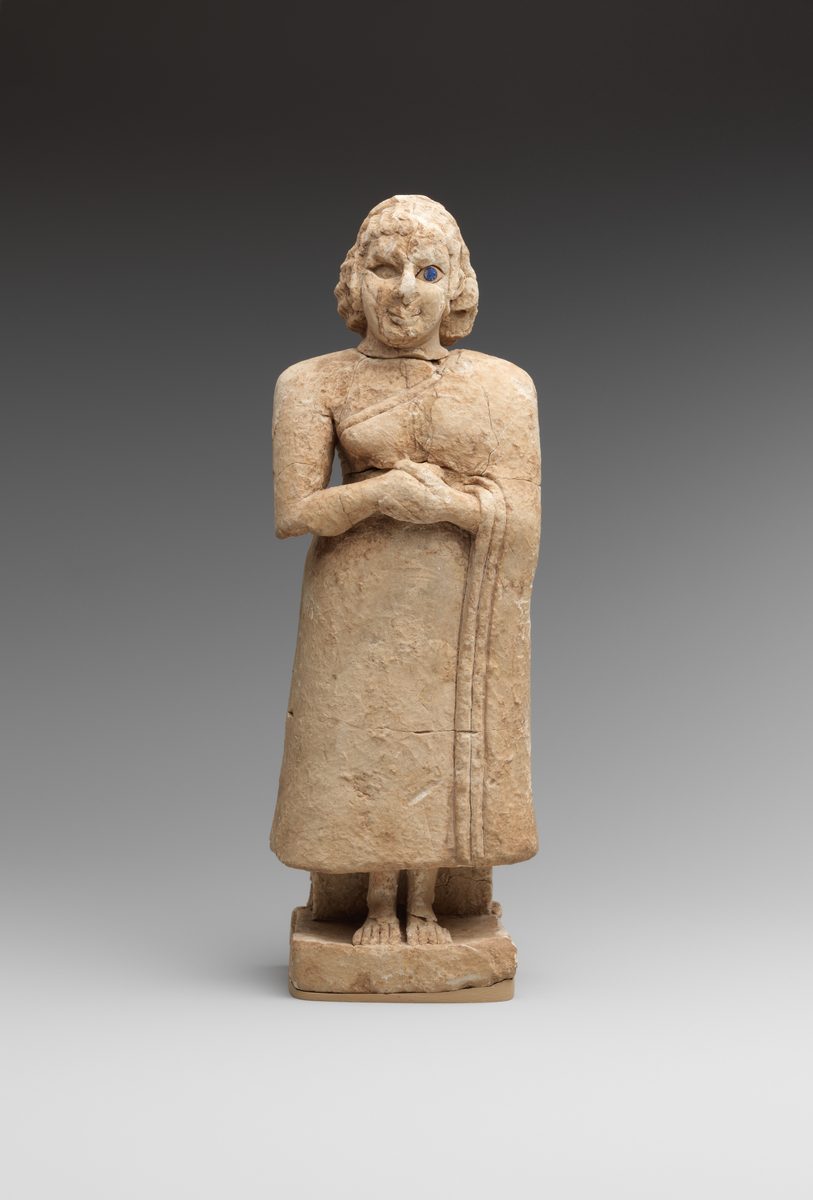
Other figures show a smoother appearance. A standing female worshiper from Nippur, dated by the Metropolitan Museum to about 2600–2500 BCE, wears cloth over her left shoulder. Incised lines mark folds at its border, while the remaining surface is smooth. Her hair is held by two bands. These details show why the tufted skirt should not become the template for every Sumerian garment.2
Why Was Wool So Important?
Penn Museum's account of Mesopotamian city life describes wool from sheep raised outside urban centers being made into cloth and finished garments. Those products supported long-distance exchange for materials such as stone and metal. Spindles and spindle whorls survive as evidence of the work, alongside written records; much less of the perishable cloth itself remains.3
The same account reports tablet evidence for very large weaving workforces around 2000 BCE in the regions of Ur, Lagash, and Girsu. These are estimates for particular places and a period, rather than a population count for all Mesopotamian textile workers. They nevertheless make clear that clothing production extended beyond the making of individual household garments.3
Assyrian Women as Producers and Traders
Letters discussed by the Assyriologist Cécile Michel reveal textile production within merchant households. Taram-Kubi lived in Assur while her husband traded in Kanesh in Anatolia. She managed household responsibilities and produced textiles that could enter his trading network. The letters record commercial relationships as well as family concerns.4
Another woman, Lamassi, explained that making textiles for children and household members had limited what she could send for sale. Michel's discussion shows the competing demands on a producer's time: cloth for a distant market did not remove the need to clothe people at home. Women could also negotiate over the prices their textiles fetched.4
These records concern particular Old Assyrian merchants and their households. They should be read alongside the institutional workforces described for earlier southern cities, rather than combined into a single picture of how all ancient textiles were made.3,4
What Did Assyrian Kings Wear?
A palace relief at Khorsabad presents another kind of evidence. The French Ministry of Culture's account identifies Sargon by his high, truncated-cone tiara and elaborate clothing. A richly dressed dignitary faces him. The carved embroidery, jewelry, and differences in headwear communicate distinctions within the royal court.5
The account draws particular attention to rosette bracelets, associated with the king and the most important court members. Such details help a viewer interpret rank in the image. They do not show that everyone in an Assyrian city wore richly decorated ceremonial garments.5
Common Questions About Mesopotamian Dress
Was every Sumerian garment tufted?
No. Compare the kaunakes represented on Ebih-Il with the smooth shoulder-draped garment on the Nippur worshiper. Both are sculpture, so the comparison establishes variation in represented dress without supplying a complete surviving wardrobe.1,2
Was textile production only work done at home?
No. Merchant-family letters describe household production, while tablet evidence discussed by Penn Museum points to larger weaving workforces. The scale and organization varied with place and period.3,4
Continue with ancient Persian clothing for later court and riding dress, or ancient Egyptian clothing for another textile tradition.
Sources
- Ebih-Il, of Mari — Musée du Louvre (statue, date, kaunakes, and devotional purpose).
- Standing female worshiper, 62.70.2 — Metropolitan Museum of Art (Nippur, about 2600–2500 BCE).
- Mesopotamian City Life — William B. Hafford, Penn Museum, Expedition, 2018 (textile industry, exports, and workforce evidence).
- Housewives, Weavers and Businesswomen: Assyrian Women from Assur and Kanesh — Cécile Michel, The Ancient Near East Today, 2021.
- The Sargon relief — French Ministry of Culture, Khorsabad archaeological resource.