Tocapu, also written t'oqapu, are the square geometric motifs woven into fine Inca garments.2 Andrew James Hamilton describes "complex, multicolored, compositions of lines, triangles, Xs."1 Sarahh Scher writes that these designs "were only allowed to be worn by those of high rank in Inka society," and Hamilton adds that "the Inca state strictly regulated the production and use of tocapus."1,2
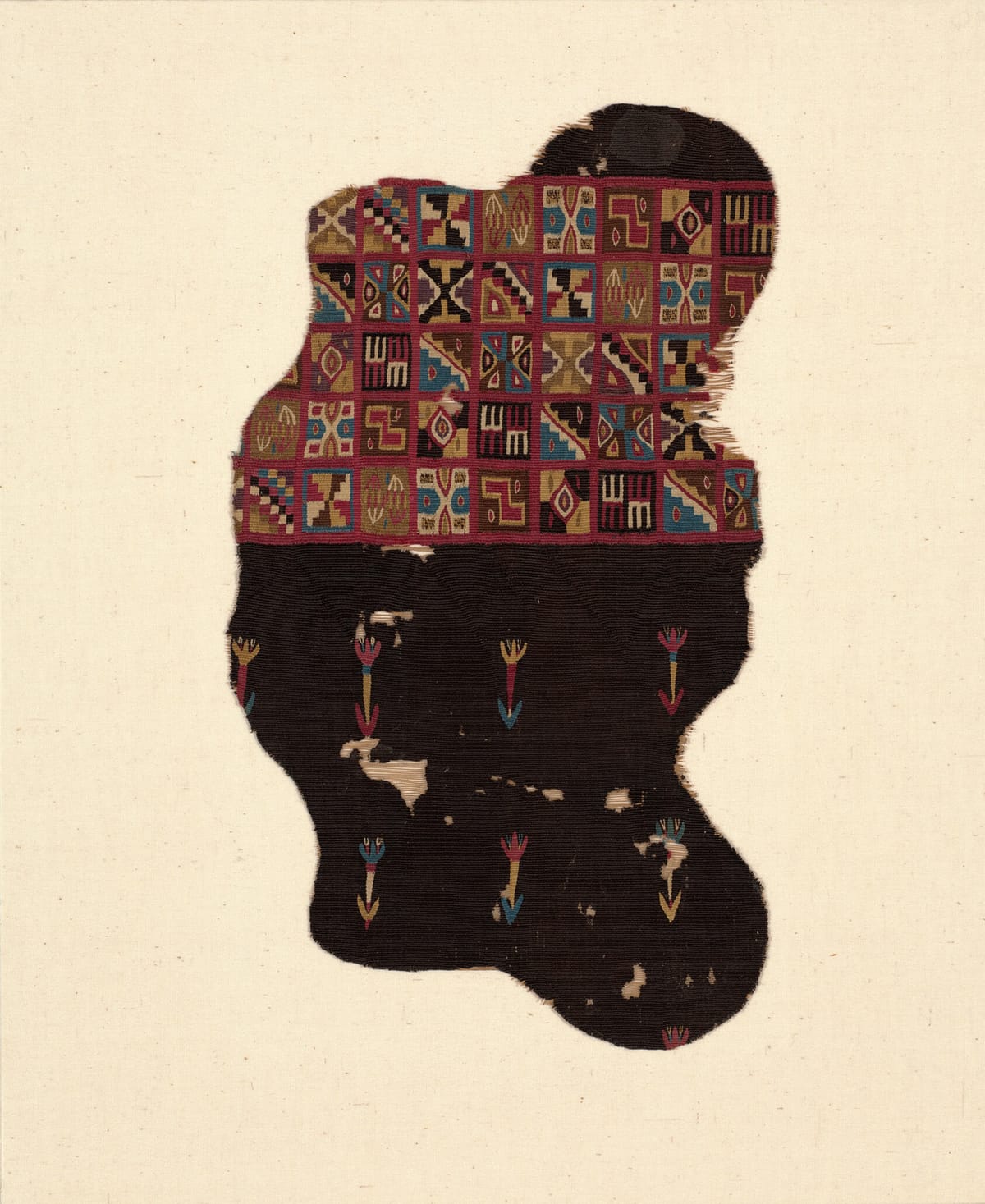
Fragment from the tocapu waistband of a man's tunic (uncu), cotton and camelid wool, interlocking tapestry, Peru, 1550–1625, Art Institute of Chicago, 1924.460. Art Institute of Chicago, CC0.
Meaning and Status
Only weavers working for the Inca government were reportedly permitted to create tocapu, and the state could redistribute tocapu garments to the nobility.1 Most men's tunics had only a few rows of tocapu at the waist, and the more a garment had, the more prestigious it was perceived to be.1 Scher writes that individual designs appear to have been related to peoples, places, and social roles, and that covering a tunic with a large variety of tocapu, as at Dumbarton Oaks, likely marks a royal tunic.2
Origins and History
Hamilton writes that the Inca state appears to have invented these motifs to be deliberately distinct from those of other Andean cultures, and he describes theories that they were a lost Inca writing system as unsupported.1 The Cleveland Museum of Art notes that a tocapu waistband and a deep V-shaped yoke were standard decorations of Inca tunics, and that a half tunic with fantastic animals and floral motifs dates from after the Spanish conquest in 1532.3
On This Site
- Inca clothing and textiles
- Medieval Andean and Mesoamerican clothing
- Early modern clothing in the Americas
Sources
- The Inca Emperor's New Clothes — Andrew James Hamilton, ReVista: Harvard Review of Latin America, David Rockefeller Center for Latin American Studies, Harvard University, 21 November 2024 (motif description, state regulation, government weavers, redistribution, prestige, origin of the motifs, and the writing-system theory).
- All-T'oqapu Tunic — Sarahh Scher, Smarthistory, 9 August 2015 (definition, restriction to high rank, meanings of individual designs, and the Dumbarton Oaks tunic; text retrieved through the Wayback Machine).
- Half Tunic (1951.393) — Cleveland Museum of Art, collection record via the museum's open access API (standard waistband and yoke, and colonial dating).Reference 1