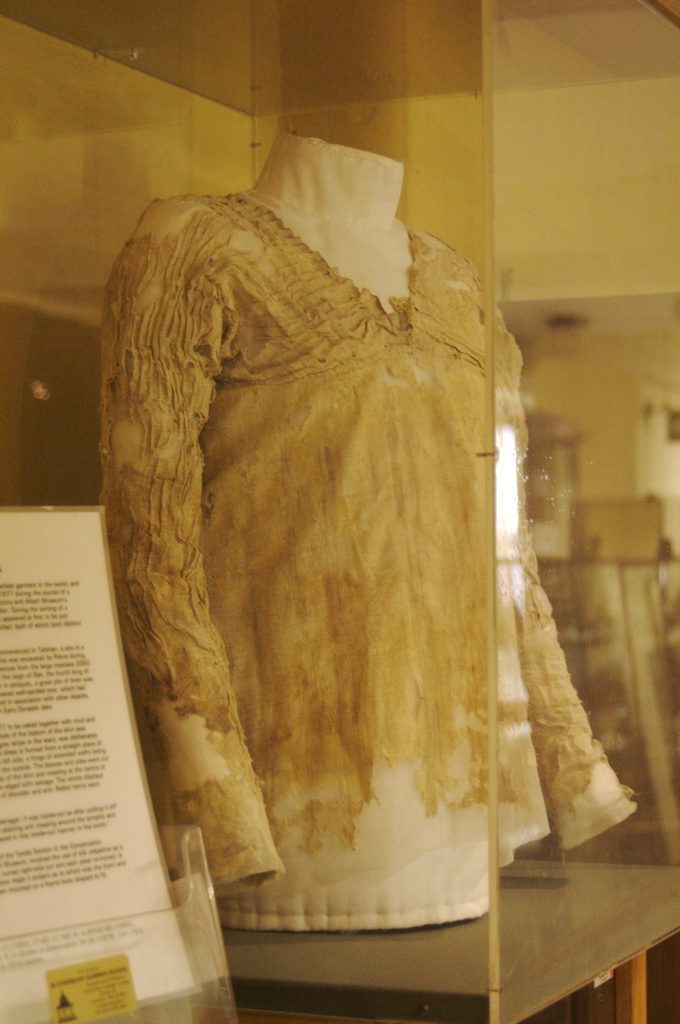
No one invented clothes, and no exact date is known, because the first clothing was made of hides that rotted away long ago. Genetic studies of lice suggest that people were wearing clothes regularly by at least 83,000 and possibly 170,000 years ago.1 Stone tools for scraping hides are far older, and bone tools used to work leather and fur at Contrebandiers Cave in Morocco are about 90,000 to 120,000 years old.3,4 By contrast, the oldest eyed needles are only about 40,000 years old, and the oldest surviving woven garment, the Tarkhan Dress from Egypt, was made between about 3482 and 3102 BCE.3,9
Why the First Clothes Are So Hard to Date
Clothing does not fossilize. Like the soft tissues of the body, hides, furs, and plant fibers decay quickly, so the oldest garments that survive intact are all, by the standards of human evolution, quite young.6 Early clothing made from animal hides would have broken down too fast to leave direct traces in the archaeological record of the Late Pleistocene.1
That leaves researchers working from indirect evidence: the tools used to prepare skins and sew them, the marks those tools left on animal bones, microscopic fibers trapped in cave sediments, beads that were once sewn onto garments, and the genetics of the parasites that live in clothing.3,6 Each line of evidence answers a slightly different question. A hide-scraper shows that people were preparing skins, but not whether they wore them; skins also served as shelters and bags.1,3 A needle shows sewing, but fitted garments could be made without one.3 Putting these clues together gives a range of dates rather than a single moment of invention.
The Louse Clock


Some of the strongest evidence for when clothing began comes from an unlikely source. Humans carry one louse species in two forms: head lice, which live in the hair, and clothing lice (also called body lice), which live in clothes. Clothing lice evolved from head lice only after humans began wearing clothing, so the date the two forms split gives a date by which clothing must have been in regular use.1
A 2003 study led by the geneticist Mark Stoneking at the Max Planck Institute in Leipzig estimated from louse DNA that humans began wearing clothes about 107,000 years ago.2 In 2011 a University of Florida team led by David Reed analyzed more genes with newer methods. Their model placed the split at least 83,000 and possibly as early as 170,000 years ago, and concluded that clothing most likely began with anatomically modern humans in Africa.1,2 The statistical uncertainty is wide (the full range the model allows runs from about 29,000 to 691,000 years ago), so the louse clock gives a window, not a date.1
Two things the lice cannot say are worth noting. Neanderthals and other archaic humans left no living lice to sample, so whether they wore clothes is outside the study's reach.2 And the lice date regular use: people may have draped skins over their bodies from time to time long before.
Hide Scrapers and Skinned Foxes
Stone hide-scrapers, used to clean animal skins, go back far into the Early and Middle Pleistocene in Eurasia, and the 2011 lice study cites hide-scraping tools about 780,000 years old.3,1 These tools show that early humans prepared skins in cold environments, though they cannot show what the skins were used for.1,3
The clearest early link between skins and clothing comes from Contrebandiers Cave on the Atlantic coast of Morocco. In 2021, Emily Hallett and colleagues described bone tools from deposits about 120,000 to 90,000 years old, including tools likely used for leather and fur working.4 Of 62 bone implements, seven were hide scrapers shaped from split antelope or wild cattle ribs, with grooves and polish from scraping hides.5 Cut marks on the bones of sand foxes, golden jackals, and wildcats show the animals were skinned by cutting at the paws and pulling the skin off over the head in one piece, a method that keeps a pelt whole.5 The authors call this highly suggestive evidence for the earliest clothing in the archaeological record.4 The prehistoric Sub-Saharan Africa page covers the evidence from south of the Sahara in more detail.
Did Neanderthals Wear Clothes?
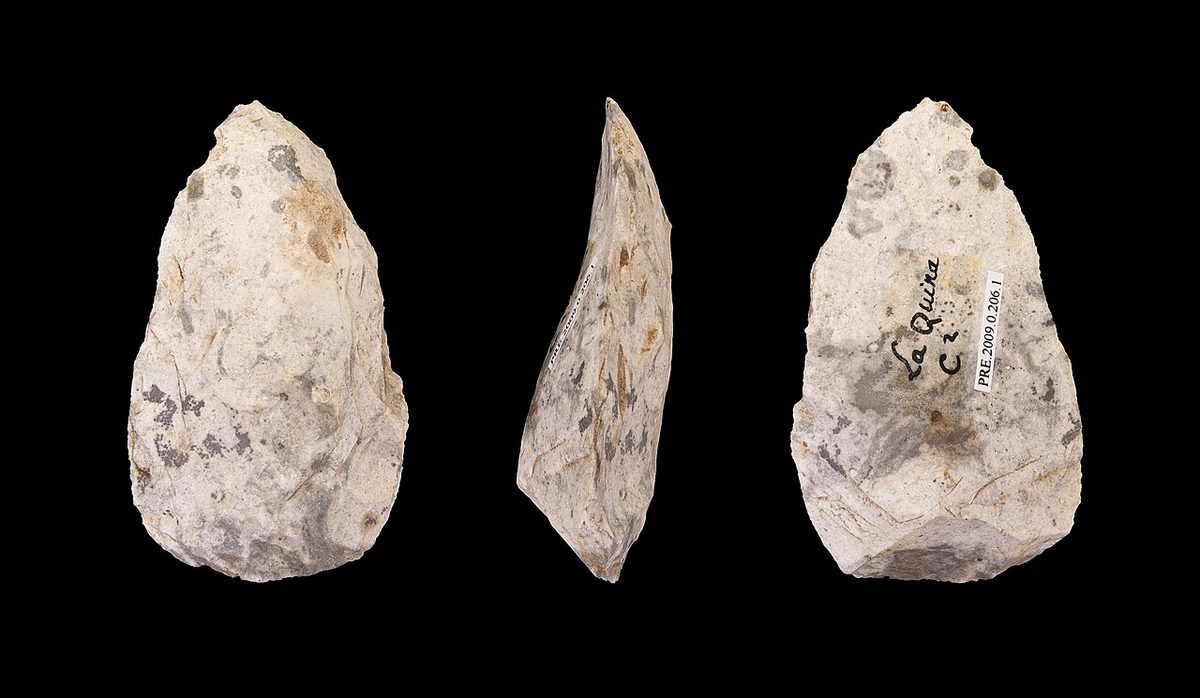

Neanderthals lived through Ice Age winters in Europe and western Asia, and researchers generally think they wore some clothing, but no Neanderthal garment survives.6 Their tools for preparing skins were stone hide-scrapers and a few borers, with bone tools appearing only late.3 The absence of awls and needles at most Neanderthal sites therefore does not mean they had no clothes.3
Evidence from environments, animal bones, and comparisons with recent hunter-gatherers suggests Neanderthals may have worn simple, poncho-style garments; bone awls in late Neanderthal (Châtelperronian) layers in France could mean that some groups adopted fitted clothing late on.3 Bone "smoothers" from the same layers at the Grotte du Renne, dated to 45,000 to 42,000 years ago, carry ochre residue suggesting they were used on skins.3 A 2012 study by Nathan Wales, based on the clothing of 245 recent hunter-gatherer cultures, estimated that Neanderthals in the coldest regions would have covered up to 80 percent of their bodies with non-tailored clothing.6 The archaeologist Rebecca Wragg Sykes has also pointed to organic residue rich in tannin on a stone tool from Neumark-Nord in Germany, a possible sign of leather tanning about 100,000 years ago.6
How much Neanderthal clothing differed from that of early modern humans is contested. Ian Gilligan has argued that Neanderthals' greater physical tolerance of cold gave them less reason to develop elaborate garments, while Wragg Sykes considers the supposed difference overstated because it rests on very little evidence.6
Awls, Eyed Needles, and Fitted Clothing
Archaeologists distinguish two broad kinds of early clothing. Simple clothing is loose, such as a skin draped or tied around the body, and gives limited protection from wind. Complex clothing is fitted to the body and may be worn in layers, which traps warm air far more effectively.3 Fitted garments need holes punched in hides so that pieces can be joined.
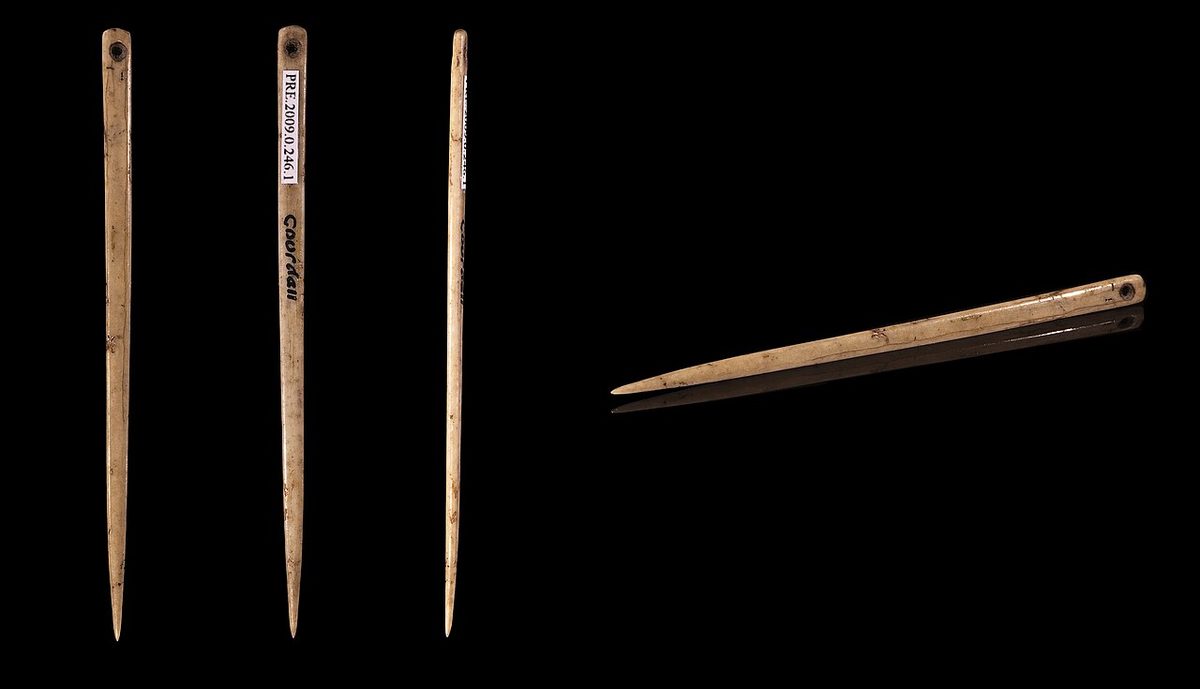

Stone borers could pierce skins, but the main tool for the job before the needle was the bone awl, essentially a needle without an eye. The earliest known bone awls come from southern Africa, at Blombos Cave about 73,000 to 70,000 years ago, where most of the bone tools were used to pierce soft material such as worked hides.3 At Canyars in Spain, rows of punctures on a bone about 39,600 years old appear to have been made while punching holes in leather, long before eyed needles appeared in Europe.3
The eyed needle combined piercing and threading in one tool. The oldest known, about 40,000 years old, come from Denisova Cave in southern Siberia, a site occupied at different times by Denisovans, Neanderthals, and modern humans; which group made the needles is not settled.3 Eyed needles appear at Mezmaiskaya Cave in the Caucasus about 38,000 years ago, in northeastern China by about 30,000 years ago, and in Europe between about 30,000 and 26,000 years ago.3 At Shizitan in China, smaller and flatter needles appear between 26,000 and 23,000 years ago.3 The Arctic site of Yana in Siberia, about 33,000 years old, has produced 192 eyed needles and fragments, four needle cases, and 79 awls.3 Since fitted clothes could be made with awls, a 2024 review argues that the needle's real importance was finer work: sewing underlayers and attaching beads and other decoration to garments.3 More on European needles is on the prehistoric Europe page.
The Oldest String and Fibers
Plant fibers twisted into string are the basis of nets, bags, and woven cloth. The oldest direct evidence of cordage is a fragment of three-ply cord made from inner bark fibers, found stuck to a Neanderthal stone tool at the Abri du Maras in southern France and dated to between 41,000 and 52,000 years ago.7 It shows that Neanderthals could make string, though not what they used it for.7
Among the oldest fibers known to have been used by modern humans are microscopic flax fibers from Dzudzuana Cave in the Republic of Georgia, more than 34,000 years old.8,14 The flax was wild, not farmed. Some fibers were twisted, showing they had been made into cords or string, and some had been dyed.8 Before this find, the oldest known fiber evidence was impressions in clay from Dolní Věstonice in the Czech Republic, about 28,000 years old.8 Cloth made from domesticated flax came much later, in the farming villages of the Neolithic; the prehistoric Middle East page traces that story.
The Oldest Surviving Clothes and Shoes
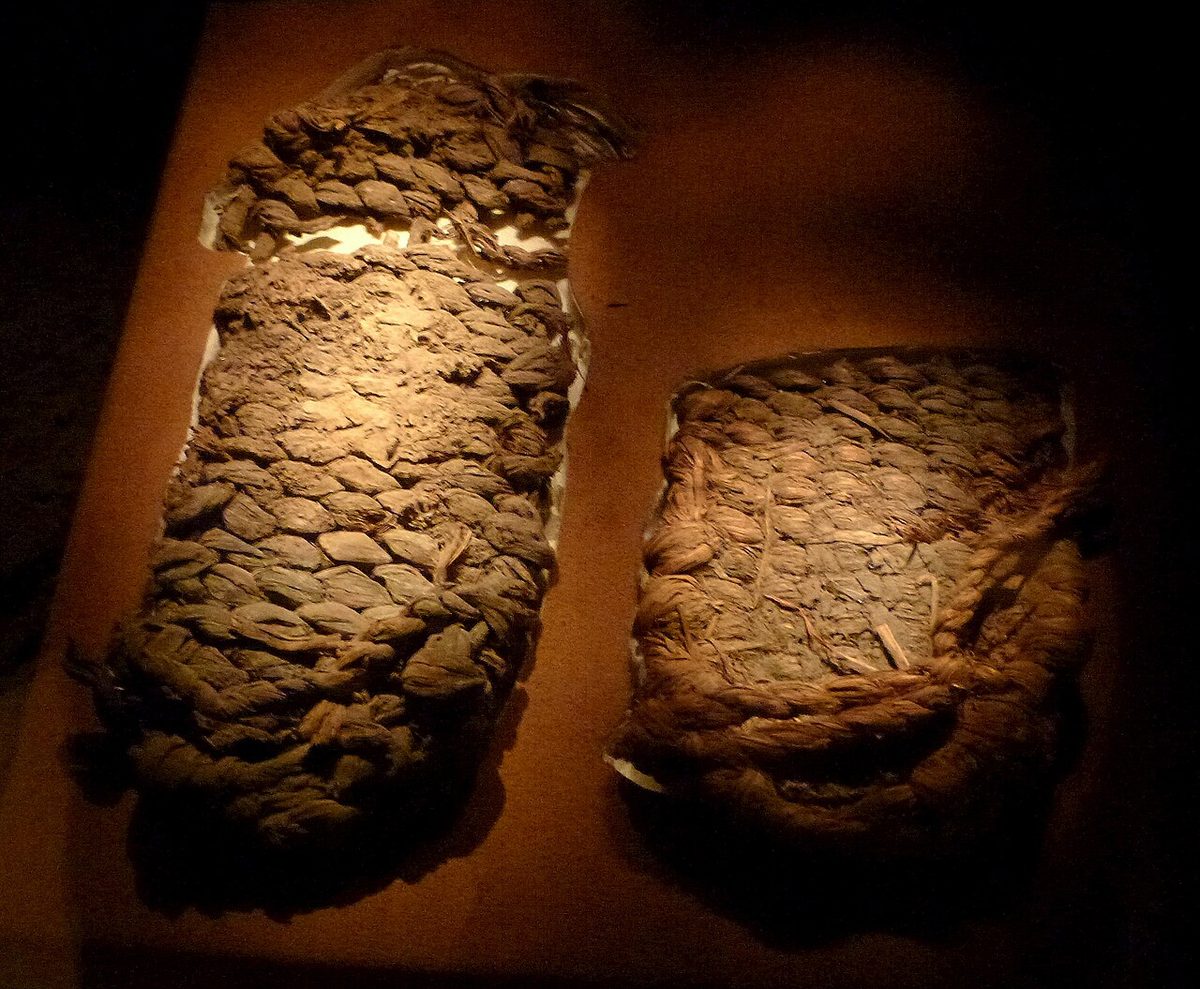

The oldest surviving items of dress are shoes. In 1938 the University of Oregon archaeologist Luther Cressman recovered dozens of sandals from Fort Rock Cave in Oregon, beneath ash from the eruption of Mount Mazama.10 The Fort Rock sandals are made of shredded sagebrush bark, twined into a flat sole with a flap over the toes and tied around the ankle with a rope.10 Radiocarbon dates on more than twenty sandals of this style range from about 10,400 to 9,100 years old, making them the oldest directly dated footwear in the world.10,11
The oldest shoe known from Eurasia when it was published in 2010 was found in 2008 in Areni-1 cave in Armenia. Made from a single piece of leather wrapped around the foot and laced, it was stuffed with grass and dates to 3627–3377 BCE.12 It was shaped by wear to its owner's right foot, and its excavators suggest that footwear itself is much older.12
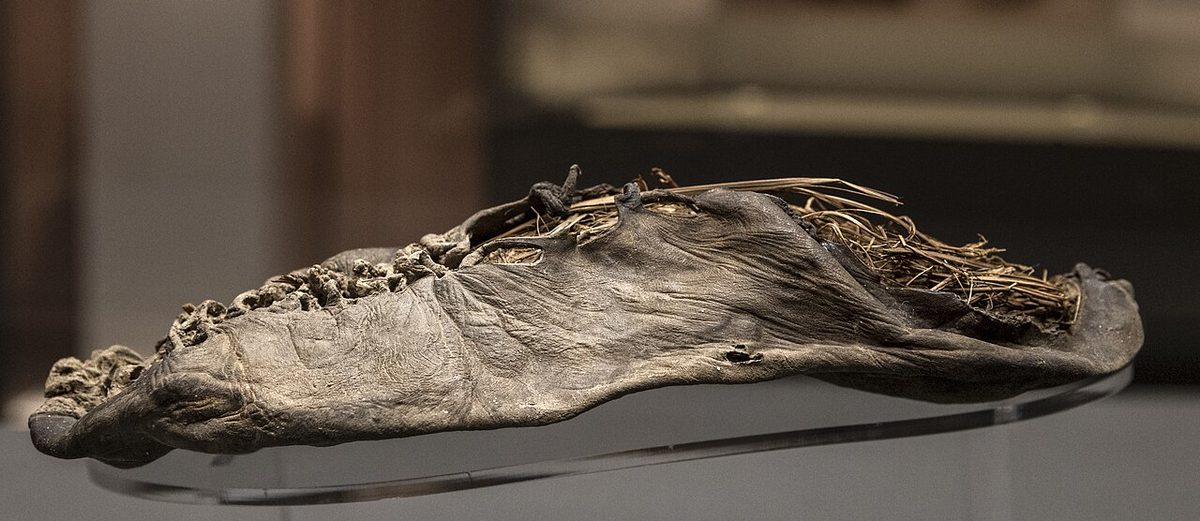

Ötzi the Iceman died in the Alps between about 3365 and 3118 BCE.12 He was found fully clothed: a hide coat of goat and sheep skin, goatskin leggings, a sheepskin loincloth, a bearskin cap, and leather shoes padded with grass, all stitched with sinew, grass fibers, and bast. None of it is woven cloth.13
The Tarkhan Dress is the oldest surviving woven garment. It is a V-necked linen shirt with pleated sleeves and bodice, found in a bundle of linen from a First Dynasty tomb at Tarkhan, south of Cairo, which Flinders Petrie excavated in 1912–13; the shirt itself was only noticed in 1977, during conservation.9 Radiocarbon testing in 2015 dated the linen to 3482–3102 BCE, and signs of wear show that someone wore it in life.9

Why Did Humans Start Wearing Clothes?
The most widely supported explanation is warmth. Gilligan and colleagues argue that evidence from archaeology, physiology, ancient climate records, and lice all points to clothing beginning as protection from the cold, with loose garments used occasionally from the middle of the Pleistocene and fitted ones developing during the last glacial cycle.3 The 170,000-year louse estimate falls within a major ice age that began around 190,000 years ago, when cold stress could have pushed people to start covering up.1 Awls and needles first appear where people faced colder conditions, a pattern that also fits the warmth explanation.3
Loss of body hair is part of the story, but the timing shows it was not an immediate trigger. Genetic studies put the loss of most human body hair at about 1 to 1.2 million years ago, long before the earliest louse date for clothing.1,2 As David Reed put it, humans apparently survived in Africa for hundreds of thousands of years with neither body hair nor clothes.2
Social display offers a different explanation for why clothing stayed. Beads and pendants show that people decorated their bodies long before they had complex clothes; as garments covered more of the body, decoration moved onto clothing itself, and beads sewn onto fitted garments are attested at Sunghir in Russia between 34,000 and 30,000 years ago.3 On this view, clothing turned from a physical necessity into a social one.3 Modesty is the hardest to trace in the archaeological record, and its origins remain obscure.3
Quick Answers
Who invented clothes?
Nobody. Clothing developed gradually, over many thousands of years, from simple wraps to fitted and layered garments.3 The lice evidence points to modern humans in Africa as regular wearers by at least 83,000 years ago, but earlier humans may also have used skins.1
What were the first clothes made of?
Animal hides and furs. Hide-scrapers and skinned carnivore bones are the oldest evidence for clothing materials, and plant fibers, twisted into string, appear much later in the record.4,7,8
What is the oldest piece of clothing in the world?
The Tarkhan Dress from Egypt, dated to 3482–3102 BCE, is the oldest surviving woven garment.9 The oldest directly dated footwear, the Fort Rock sandals from Oregon, are thousands of years older, at about 10,400 to 9,100 years old.10
Did cavemen wear clothes?
Yes, though probably not only the rough furs shown in old illustrations. Wragg Sykes has said that the archaeological record shows people making much more complex clothes by 25,000 years ago, and the needles, awls, and dyed fibers of the Ice Age support her.6,3,8
Sources
- Origin of Clothing Lice Indicates Early Clothing Use by Anatomically Modern Humans in Africa — Melissa A. Toups, Andrew Kitchen, Jessica E. Light & David L. Reed, Molecular Biology and Evolution, 2011.
- UF study of lice DNA shows humans first wore clothes 170,000 years ago — University of Florida News, 2011.
- Paleolithic eyed needles and the evolution of dress — Ian Gilligan, Francesco d'Errico, Luc Doyon, Wei Wang & Yaroslav V. Kuzmin, Science Advances, 2024.
- A worked bone assemblage from 120,000–90,000 year old deposits at Contrebandiers Cave, Atlantic Coast, Morocco — Emily Y. Hallett et al., iScience, 2021.
- Stone Age people used bone scrapers to make leather and pelts — Bruce Bower, Science News, 2021.
- As Fashion Week Ends, Pondering the Origins of Clothes — Riley Black, National Geographic, 2013.
- Direct evidence of Neanderthal fibre technology and its cognitive and behavioral implications — B. L. Hardy, M.-H. Moncel et al., Scientific Reports, 2020.
- Oldest-known fibers to be used by humans discovered — Amy Lavoie, Harvard Gazette, 2009.
- Confirmation of the world's oldest woven garment: the Tarkhan Dress — Alice Stevenson & Michael W. Dee, Antiquity Project Gallery, 2016.
- Fort Rock Sandals — Thomas J. Connolly, Oregon Encyclopedia, Oregon Historical Society.
- Great Basin Sandals — University of Oregon Museum of Natural and Cultural History.
- First Direct Evidence of Chalcolithic Footwear from the Near Eastern Highlands — Ron Pinhasi, Boris Gasparian et al., PLOS ONE, 2010.
- Ötzi's clothing — South Tyrol Museum of Archaeology.
- 30,000-year-old wild flax fibers — Eliso Kvavadze et al., Science 325, 2009.