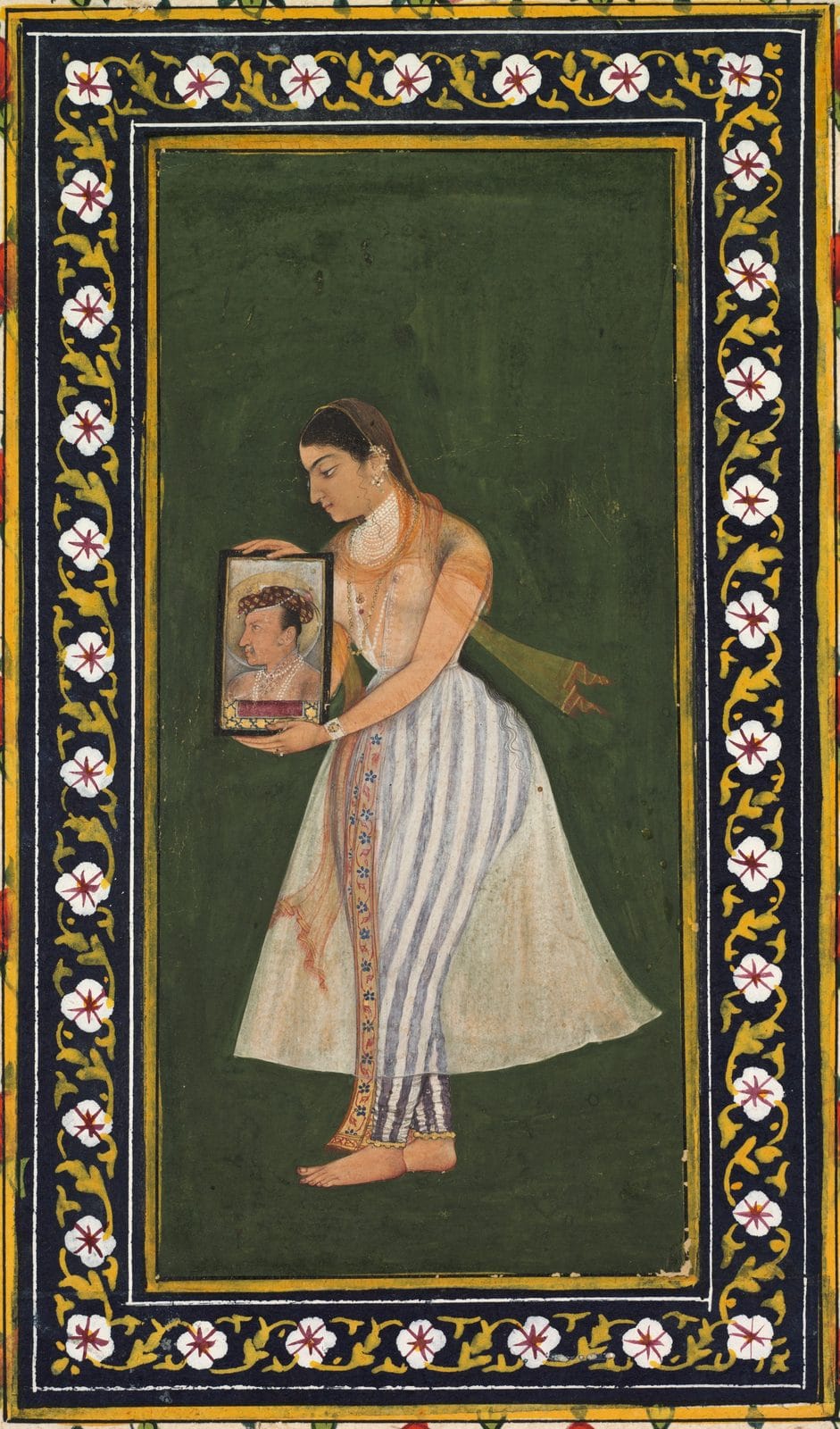
The peshwaz is a long, front-opening robe worn by women of the Mughal court in India. It was often made of fine muslin and worn over trousers and a bodice, with a large head-cover or shawl completing the outfit.1 The Victoria and Albert Museum calls it "the usual dress of Muslim court ladies from the pre-Mughal period onwards," and adds that although it is "usually associated with Muslim women, it was also fashionable in northern Hindu courts."1
Origins and History
The Ain-i Akbari, the account of Akbar's administration by Abu'l Fazl, lists the garment in the imperial wardrobe. It describes the "Peshwaz (a coat open in front)" as "of the same form" as the takauchiyah "but ties in front," and notes that it "is sometimes made without strings."2 A painting of about 1627 at the Cleveland Museum of Art shows Nur Jahan, "identified as the favorite wife of the Mughal emperor Jahangir (reigned 1605–27)," holding a portrait of her husband.3
Materials and Decoration
"Few historic peshwaz survive as, like this rare example, they were often made of fragile sheer fabrics," the Victoria and Albert Museum writes of a robe from the Mughal empire or the Deccan, dated to the late eighteenth or early nineteenth century.1 That example, accession 5842(IS), is muslin "with applied tinsel, spangles and foil," and "was made for a small wearer."1 "Worn over patterned paijama trousers, the skirt opened at the front allowing free movement."1
On This Site
Sources
- Peshwaz — Victoria and Albert Museum, 5842(IS) (Mughal empire or Deccan, late 18th or early 19th century; muslin with applied tinsel, spangles and foil; gallery labels on wearers, survival, trousers, bodice, and head-cover; record read through the V&A collections API).
- The Ain i Akbari, vol. 1, Ain 31: The Wardrobe — Abu'l Fazl 'Allami, trans. H. Blochmann, Calcutta, 1873, via Persian Literature in Translation, Packard Humanities Institute (the peshwaz as "a coat open in front"; retrieved through the Wayback Machine).Reference 1
- Nur Jahan holding a portrait of Emperor Jahangir — Cleveland Museum of Art, 2013.325 (Mughal India, c. 1627; record read through the Cleveland open access API).Reference 1