Patola (singular patolu) are silk cloths woven in Gujarat, western India, by the double-ikat technique: weavers tie and dye both the warp and the weft threads in patterns and then weave them together, so that the pattern appears on both sides of the cloth.2,3 Nineteenth-century examples include saris woven in Gujarat and long ceremonial cloths made there for the Indonesian market.1,2
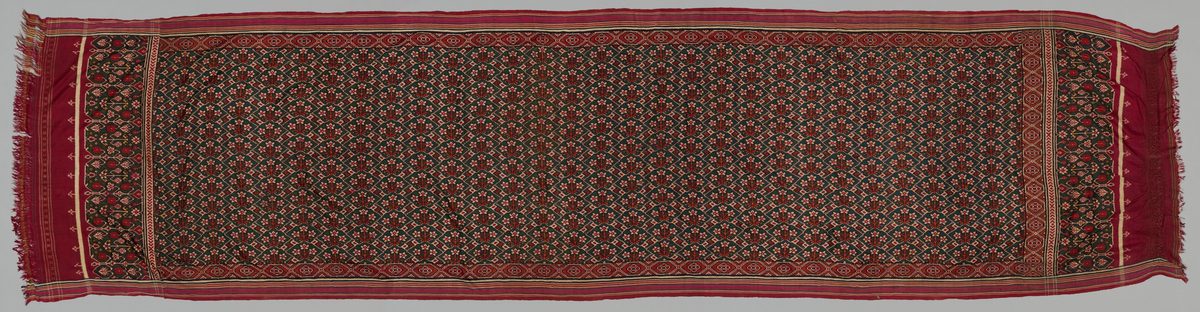
Silk patolu sari, Gujarat, 19th century, double ikat, Cleveland Museum of Art, 1940.607. Cleveland Museum of Art, CC0.
Materials and Decoration
The Cleveland Museum of Art holds a silk patolu sari from Gujarat dated to the 1800s, woven in tabby weave with double ikat and measuring 419.1 by 103.2 centimeters.1 Export cloths carried figurative designs. One patolu in the Victoria and Albert Museum, 480 centimeters long, is filled along its entire length by four large elephants.2 Another, from the late nineteenth century, has rows of tigers and elephants within a grid, with striped cotton borders and an open weave.3
Meaning and Status
The V&A judges that patola of the elephant type were made in Gujarat "exclusively for export to Indonesia," where they "fulfilled a ceremonial role for their aristocratic owners." Over time, people came to treasure them as heirlooms, revere them as sacred objects, and credit them with magical powers.2 In Indonesia the cloths were intended for the elite and worn by the nobility, and at times court sumptuary laws prohibited their use by commoners.3
The Term Today
Museum records use patolu for a single cloth and patola for more than one, and the V&A describes the weaving as "a highly sophisticated technique."3
On This Site
Sources
- Silk Patolu Sari, 1940.607 — Cleveland Museum of Art, open access API (Gujarat, 1800s; tabby weave, double ikat, silk; dimensions; CC0 image).
- Elephant patolu, IS.74-1993 — Victoria and Albert Museum (double-ikat silk, Gujarat, 19th century; four elephants; made for export to Indonesia; heirloom and sacred status; text retrieved through the V&A collections API).
- Ceremonial cloth (patola), IS.5-1989 — Victoria and Albert Museum (double-ikat silk with cotton borders, Gujarat, late 19th century; tigers and elephants; worn by Indonesian nobility; sumptuary laws; text retrieved through the V&A collections API).