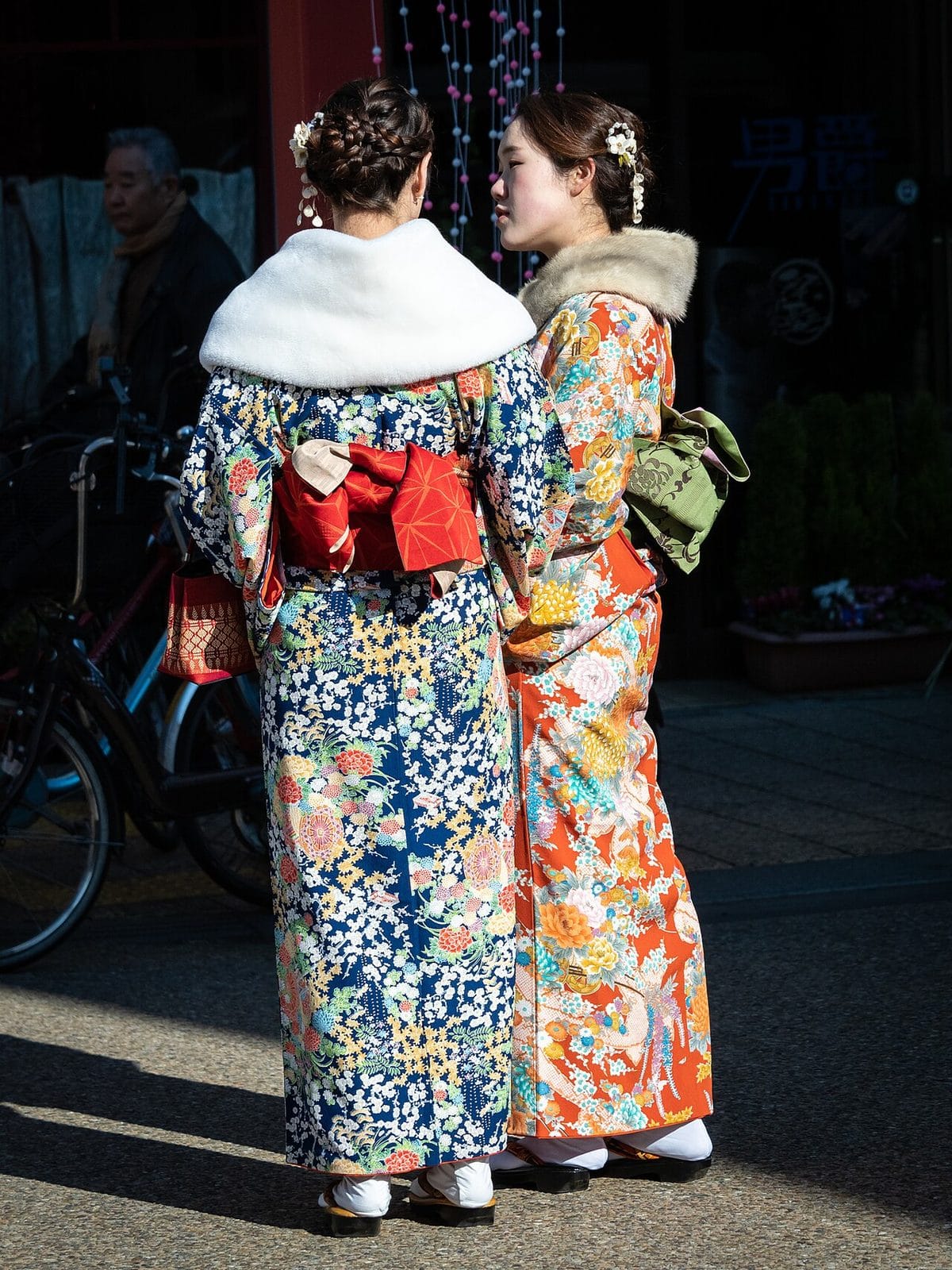
An obi is the long waist sash that secures a Japanese kimono.1 The Victoria and Albert Museum describes kimono as straight-seamed garments wrapped left side over right and secured with an obi.2 In the nineteenth century, according to the museum, women's obi "were very wide and often elaborately woven or embroidered."1

Origins and History
The obi was not always wide. The Costume Museum in Kyoto, describing a reconstructed kosode of the Keicho period at the start of the Edo era, states that the woman wears "a slender obi," and that an uchikake was worn over a kosode without fastening an obi.4
Materials and Decoration
A V&A obi made in 1800-1850 is yellow cut silk velvet embroidered on both sides in silk and gold metallic thread with peonies, paulownia, and wisteria.1 Another, dated 1840-1880, is patterned silk that the museum suggests may have been woven in Nishijin, the weaving district of Kyoto known for nishiki, a term usually translated as brocade.3
Meaning and Status
The V&A identifies its velvet example as a kakeshita-obi, a lavish style worn by a woman of the samurai class to secure the kimono beneath an uchikake, the outer kimono worn without an obi.1 Its article on kimono states that social status and personal identity were expressed through color and decoration, and that the choice of obi and accessories was also important.2
On This Site
- Early modern East Asian clothing
- Nineteenth-century East Asian clothing
- Modern East Asian clothing
- Kimono history: from kosode to modern Japanese dress
Sources
- Obi, FE.23-1973 — Victoria and Albert Museum, 1800-1850 (definition, nineteenth-century width, velvet and embroidery, and the kakeshita-obi worn under an uchikake).
- Kimono — Victoria and Albert Museum, updated 17 April 2024 (wrap and obi, and the importance of obi and accessories).
- Obi, T.85-1927 — Victoria and Albert Museum, 1840-1880 (Nishijin and nishiki).Reference 1
- Woman of the upper class in kosode of Keicho period — The Costume Museum, Kyoto (slender obi and the uchikake worn without an obi).Reference 1