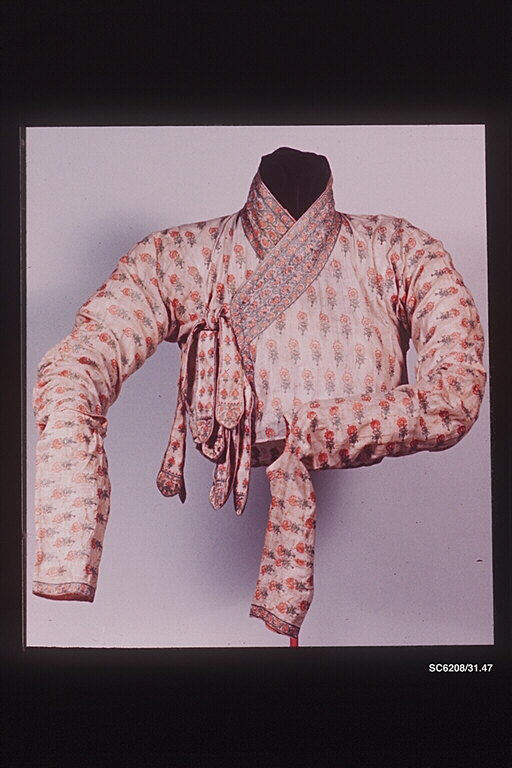
The jama is a long robe with a tight bodice, close-fitting sleeves, and a skirt in crossways panels, which men of the Mughal court in India held together with a patka sash at the waist.1,2 The emperor Akbar adopted a white cotton jama, described as "a translucent garment with a tight bodice, arm-hugging sleeves, and a skirt that fell a little beyond the knees."2
Origins and History
The Public Domain Review writes that Akbar's adoption of the cotton jama "signalled a significant cultural shift."2 The Ain-i Akbari, the account of Akbar's administration by Abu'l Fazl, records that the emperor "changed the names of several garments, and invented new and pleasing terms." Instead of jamah, meaning coat, "he says sarbgati, i. e., covering the whole body."3 The same text describes the takauchiyah, "a coat without lining, of the Indian form," which "formerly" had slits in the skirt "and was tied on the left side." Akbar "ordered it to be made with a round skirt, and to be tied on the right side."3
Materials and Decoration
The scholar Sylvia Houghteling, as quoted in the essay, says cotton "provided a fabric of compromise," and the essay adds that the thin cotton jama "allowed the body of the king to be covered, while its translucence revealed his 'inner state.'"2 A surviving fragment at the Metropolitan Museum of Art, dated about 1628–58, is cotton and silk, plain weave, embroidered, and measures 49.5 by 229.9 centimeters.1
On This Site
Sources
- Fragment of a Robe (Jama), collection record 448583 — The Metropolitan Museum of Art, collection API, 31.47 (India, ca. 1628–58; cotton and silk, plain weave, embroidered; dimensions; public domain).
- The Emperor's New Clothes: Fashion, Politics, and Identity in Mughal South Asia — Simran Agarwal, The Public Domain Review, 26 February 2025, drawing on Sylvia Houghteling (Akbar's cotton jama, its form, cotton as a "fabric of compromise," the patka).
- The Ain i Akbari, vol. 1, Ain 31: The Wardrobe — Abu'l Fazl 'Allami, trans. H. Blochmann, Calcutta, 1873, via Persian Literature in Translation, Packard Humanities Institute (the takauchiyah and Akbar's renaming of the jamah as sarbgati; retrieved through the Wayback Machine).