Ikat is a resist-dyeing technique in which the pattern is dyed into the yarn before weaving rather than applied to the finished cloth. In warp ikat the warp threads are resist-dyed; in double ikat both warp and weft are tied and dyed and then woven together so that the pattern appears on both sides.2,3,5 Surviving examples range from a ninth- or tenth-century shawl from Yemen to nineteenth-century silks from Central Asia and India.1,2,4
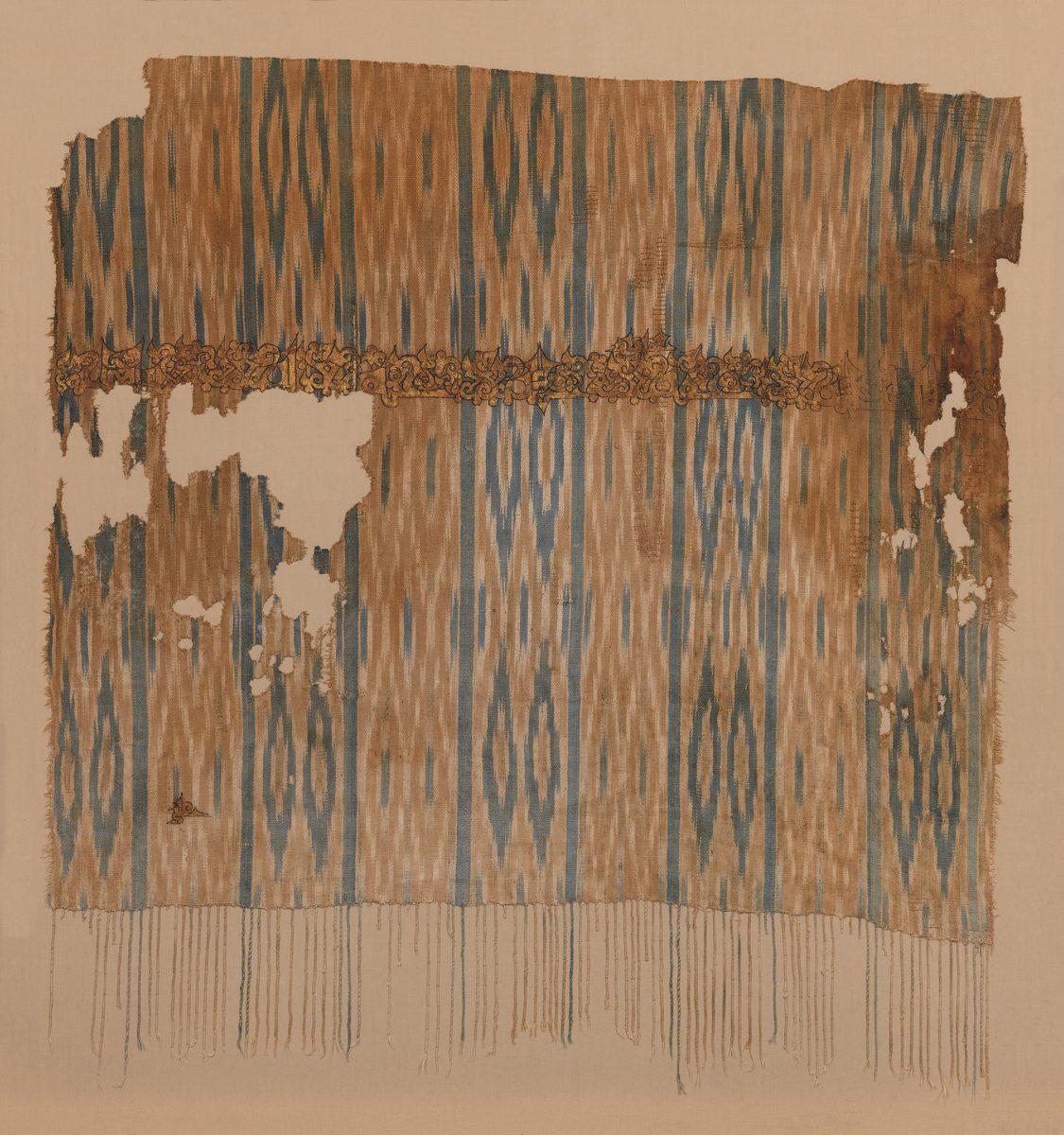
Tiraz fragment from an ikat shawl, Yemen, late 9th–early 10th century. The Metropolitan Museum of Art, CC0.
Origins and History
The Metropolitan Museum of Art holds a fragment of an ikat shawl made in Yemen in the late ninth or early tenth century: cotton in plain weave, resist-dyed by ikat, with an inscription painted in ink and gold.1 In Central Asia, the Victoria and Albert Museum describes the nineteenth century as "the period of ikat's greatest popularity." Warp ikats were woven there in long lengths and then made into clothing or hangings for the home; they were high-status items, often made under court patronage.2
Materials and Decoration
The Deccan region of southern India was renowned for ikat, and it is still made around Hyderabad. An eighteenth-century length of silk with strips of gold, probably from Hyderabad, carries an arrowhead pattern made by resist-dyeing the warp threads and then manipulating them on the loom before weaving.3 The patola silks of Gujarat are double ikat;5 a nineteenth-century patolu sari in the Cleveland Museum of Art is silk in tabby weave with double ikat.4
On This Site
- Medieval Middle Eastern clothing
- Medieval South Asian clothing
- 19th century South Asian clothing
- Early modern East Asian clothing
- Early modern clothing in the Americas
Sources
- Tiraz Fragment from an Ikat Shawl — The Metropolitan Museum of Art (Yemen, late 9th–early 10th century; cotton, ink, gold; plain weave, resist-dyed ikat, painted; text retrieved through the Met collection API).
- Ikat length, 2110(IS) — Victoria and Albert Museum (Central Asia, before 1875; silk and cotton warp ikat; nineteenth-century popularity, clothing and hangings, court patronage; text retrieved through the V&A collections API).
- Textile, IS.4-1999 — Victoria and Albert Museum (silk and gold warp ikat, probably Hyderabad, 18th century; Deccan ikat and the arrowhead pattern; text retrieved through the V&A collections API).
- Silk Patolu Sari, 1940.607 — Cleveland Museum of Art, open access API (Gujarat, 1800s; tabby weave, double ikat, silk).
- Ceremonial cloth (patola), IS.5-1989 — Victoria and Albert Museum (double-ikat silk, Gujarat, late 19th century; warp and weft tied and dyed and woven together to pattern both sides; text retrieved through the V&A collections API).