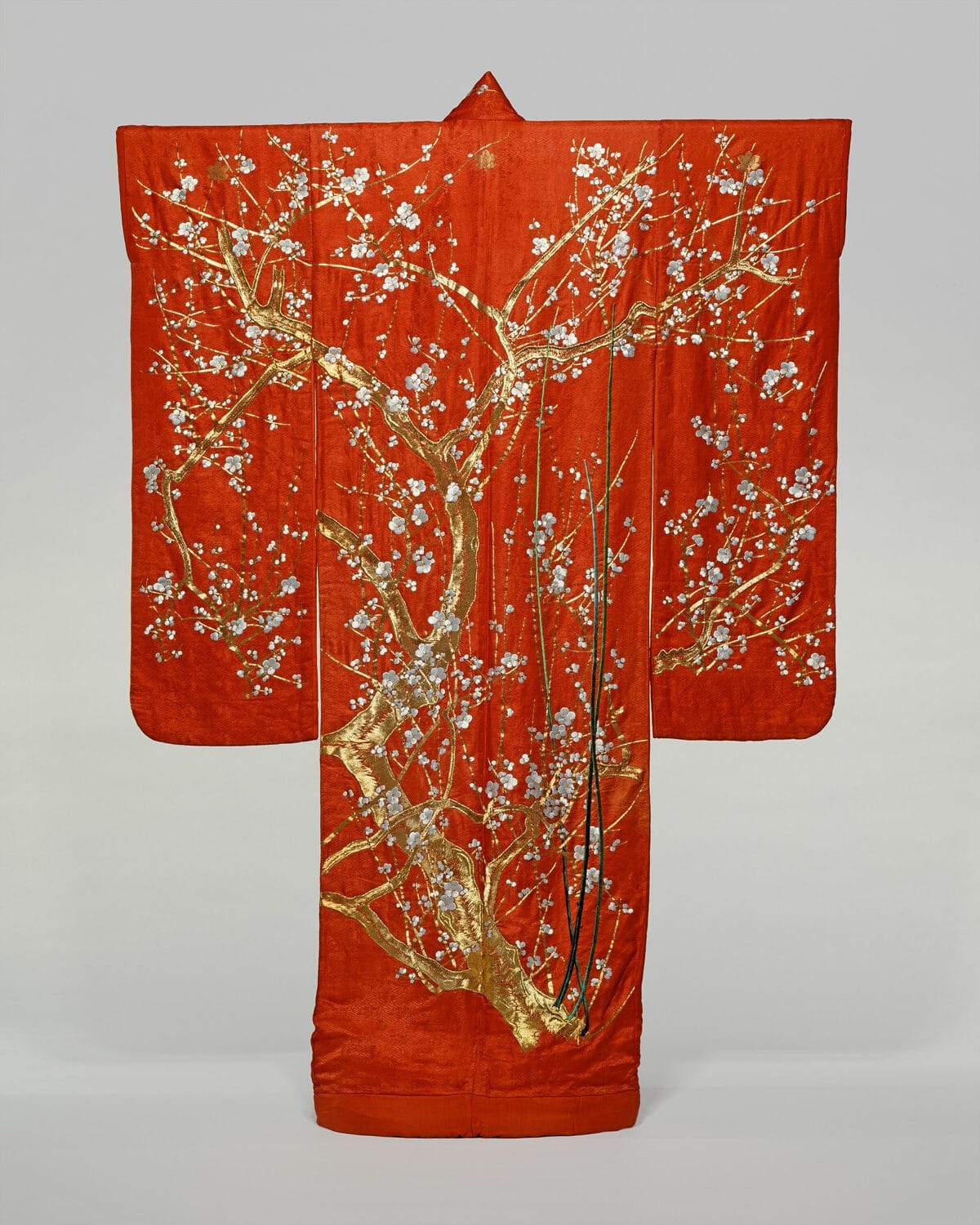
A furisode is a Japanese kimono with long hanging sleeves. The Art Institute of Chicago describes it as "a long-sleeved garment worn by children and unmarried women on special occasions."1 The Victoria and Albert Museum translates the name as "swinging sleeves" and states that the long sleeves of a kimono made in 1800-1840 indicate that it would have been worn by a young woman.2
How It Was Worn
JAANUS lists the furisode among garments usually called subtypes of the kosode.3 The Art Institute's red silk furisode of 1801-1868 belonged to a family whose crest was the tachibana and probably was used as an uchikake, or outer coat.1 The V&A's example was shortened at the waist to serve as an under-kimono.2
Materials and Decoration
The Art Institute's garment is made of rinzu, a soft, lustrous silk, with a blossoming plum tree embroidered in gold and white silk thread from hem to shoulder.1 The V&A states that red symbolized youth and glamour for young women, and that both the beni dye from safflowers and the shibori tie-dyeing on its example were very costly.2
The Term Today
Writing for the Textile Research Centre in Leiden, Naoko Kikuchi describes the furisode as a formal garment with long sleeves worn by unmarried women. She states that the bride at the 1959 wedding of Michiko Shoda and Crown Prince Akihito wore a furisode, which inspired young people to wear kimono on special occasions.4
On This Site
- Nineteenth-century East Asian clothing
- Modern East Asian clothing
- Kimono history: from kosode to modern Japanese dress
Sources
- Furisode — Art Institute of Chicago (long sleeves, wearers, tachibana crest, uchikake use, rinzu silk, and plum embroidery; text retrieved through the Wayback Machine).
- Kimono (furisode), FE.32-1982 — Victoria and Albert Museum, 1800-1840 (swinging sleeves, young women, beni red, shibori, and shortening as an under-kimono).
- Kosode — Japanese Architecture and Art Net Users System (JAANUS), 2001 (furisode as a kosode subtype).Reference 1
- Japanese kimonos from the late 1950s to the 1970s — Naoko Kikuchi, Textile Research Centre, Leiden, 19 August 2021 (formal long-sleeved garment for unmarried women and the 1959 imperial wedding).Reference 1