The antariya was the lower garment of ancient South Asian dress: an unstitched length of cloth wrapped around the hips and legs and held in place by a sash or a girdle of jewelry. Jasleen Dhamija writes that in post-Vedic times draped garments "had evolved into an elaborate costume with distinctive names," the antariya for the lower body and the uttariya for the upper.1 Sculpture from Mathura of the second century CE shows a woman wearing one.2
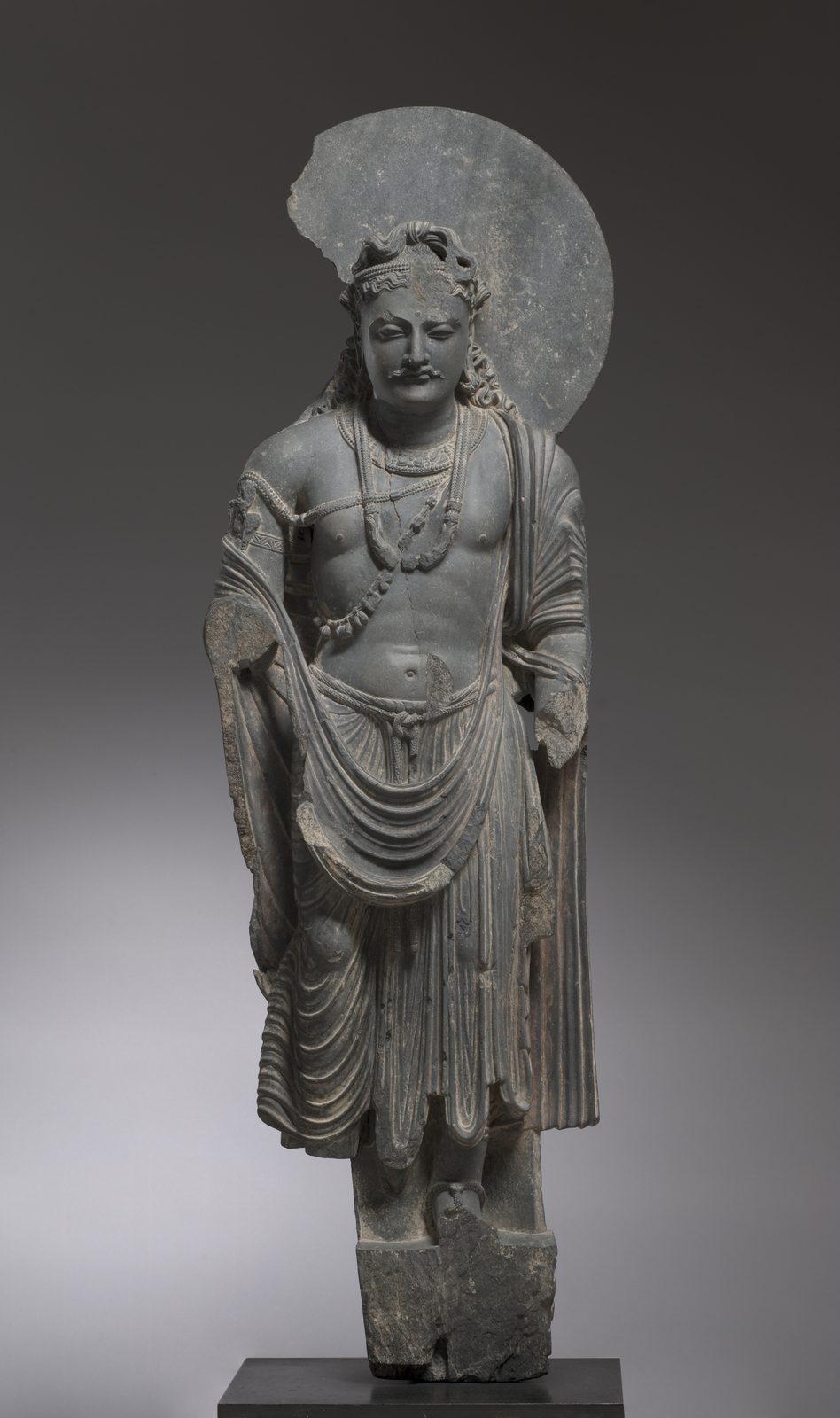
Bodhisattva, Gandhara (Pakistan), Kushan period, late 100s CE, schist, Cleveland Museum of Art, 1965.476. Cleveland Museum of Art, CC0.
Origins and History
The Mahabharata and Ramayana describe elaborate garments whose form is unclear; draped garments continued to dominate in post-Vedic times.1 Later stone sculptures show a pleated lower wrap formed into a pantaloon by passing the pleats through the legs and tucking them in at the back, in variations named "elephant's trunk" and "fish tail."1
How It Was Worn
Dhamija states that "the lower wrapper was held in place by an elaborate sash or a girdle of jewelry."1 A Mathura relief of the second century in the Victoria and Albert Museum shows how fine the cloth could be. The figure, a female nature spirit, appears naked, but a ridge across the stomach and a sash falling down her left side indicate a skirt of transparent fabric, perhaps a fine muslin. The museum identifies this skirt as an antariya, secured by a hip belt of overlapping fish-scale-like segments.2 A bodhisattva from Gandhara of the late 100s CE in the Cleveland Museum of Art wears garments the museum describes as Indian, while its muscular torso derives from Greco-Roman sources.3
On This Site
Sources
- Asia, South: History of Dress — Jasleen Dhamija, Encyclopedia of Clothing and Fashion, via Encyclopedia.com (post-Vedic antariya and uttariya; sash or girdle; pleated wraps passed between the legs).
- Shalabhanjika, IM.73-1927 — Victoria and Albert Museum (Mathura, 2nd century; transparent skirt identified as an antariya; belt and sash; text retrieved through the V&A collections API).
- Bodhisattva, 1965.476 — Cleveland Museum of Art, open access API (Gandhara, Kushan period, late 100s CE; Indian garments and Greco-Roman torso; CC0 image).Reference 1