Ancient Egyptian clothing was made mostly of linen, woven from flax grown in Egyptian fields.1 The basic garment was a rectangle of linen cloth that could be wrapped as a kilt, a cloak, or a dress, and from the New Kingdom (about 1550 to 1070 BCE) men and women also wore a loose tunic sewn from a folded length of cloth.2,3 Men usually wore kilts, women wore long dresses, and the rich showed their status through the quantity and fineness of their linen and the color they added to it with stripes, beads, and jewelry.3,4,5 This page goes deeper into the Egyptian part of our survey of ancient Middle Eastern clothing.
What Survives, and How We Know
Textiles rarely survive from the ancient world, but Egyptian burials preserved real garments.6 The earliest is the Tarkhan Dress, a V-neck linen shirt with pleated sleeves and bodice. Flinders Petrie excavated the First Dynasty tomb it came from at Tarkhan, about 50 kilometers south of Cairo, in 1912 to 1913, but the shirt was only noticed in 1977, in a bundle of 17 other qualities of cloth sent to the Victoria and Albert Museum for conservation.6 Radiocarbon dating published in 2016 placed the linen between 3482 and 3102 BCE, and signs of wear show that someone wore it in life.6 The dress is also discussed on our page about when clothes were invented.
A royal wardrobe survives from the tomb of Tutankhamun. Gillian Vogelsang-Eastwood, who studied the textiles in the Cairo Museum in the early 1990s, reports that his tomb held over four hundred linen textiles and garments, including more than 100 loincloths, along with sashes, shawls, tunics, socks, gloves, and royal headwear.4 Many were decorated with appliqué, embroidery, and beadwork.7 Robbers seem to have taken plain cloth such as bed sheets and left the elaborate garments, which would have been hard to sell.4
Evidence for ordinary clothing also comes from settlements. Excavations at the Workmen's Village at Amarna between 1979 and 1986 recovered several thousand textile fragments, recorded as 4,962 numbered specimens, and the Amarna Project stresses that these were things in everyday use.8 At the village of Deir el-Medina, written records show that servant girls were paid in cloth, and the art historian Rachel Kreiter suggests that much of the weaving there was done by the women of each household on an upright loom.3
Tomb paintings and statues fill in the picture, but they follow conventions. Egyptian art focused on the most important view of a subject, so figures do not add up to realistic human forms, and tomb scenes show Egypt as the elite wished to present it.3 The Antiquity study of the Tarkhan Dress adds a useful check: early reliefs at Helwan show garments like the surviving dress, which suggests that artists drew on real clothing.6
Linen: From Flax Field to Royal Linen
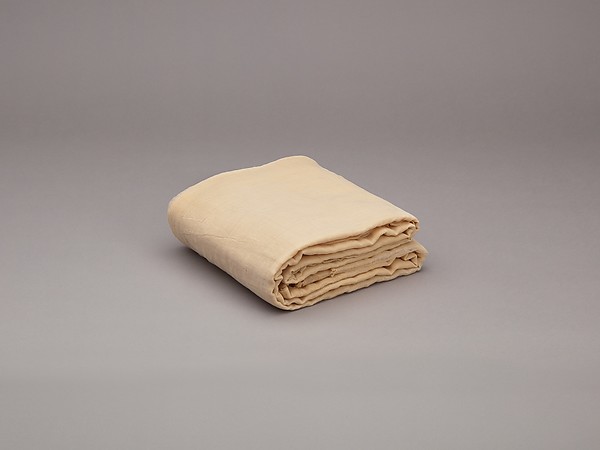
Egypt was unusual in keeping linen as its main fiber long after wool had become the primary textile fiber elsewhere in the region, a shift that began around 2000 BCE.1 Flax was pulled from the ground, often while still green, and the fibers were peeled off in strips and then spliced and twisted into thread rather than spun from a loose mass.1 Thread counts give a sense of the range. A Neolithic fragment from the Fayum, from about 5000 BCE, has about 12 by 9 threads per centimeter; a First Dynasty sheet from Tarkhan has about 24 by 15; and linen from the wrappings of King Thutmose II has about 38 by 35.9
The best cloth was called royal linen. The Metropolitan Museum of Art identifies the folded sheet above, from the tomb of Senenmut's parents Hatnefer and Ramose, as this highest grade: it was woven of superfine thread from very young flax and would have taken months to make.10 Its sheerness, the Met notes, lends credence to New Kingdom images of pleated garments through which the body and even the skin color show.10
Most linen was left undyed, because flax is hard to dye.5 Its natural color is a pale golden brown that whitens with washing and sun, and at different periods very white, light brown, or pale green cloth signaled status because it showed a garment was new.5 New linen was also stiffer, since the natural pectin had not yet washed out, and this is what allowed it to be pleated.5 Color came from ochre on some Old Kingdom textiles, from woad blue in stripes along the sides of New Kingdom tunics, and from madder and safflower reds.5 Vogelsang-Eastwood sums up the rule: status was shown by the amount and quality of cloth and by the presence of color, so even a merchant might have narrow red and blue stripes at his garment's edge.4
Men's Clothing: Loincloths, Kilts, and the Shendyt
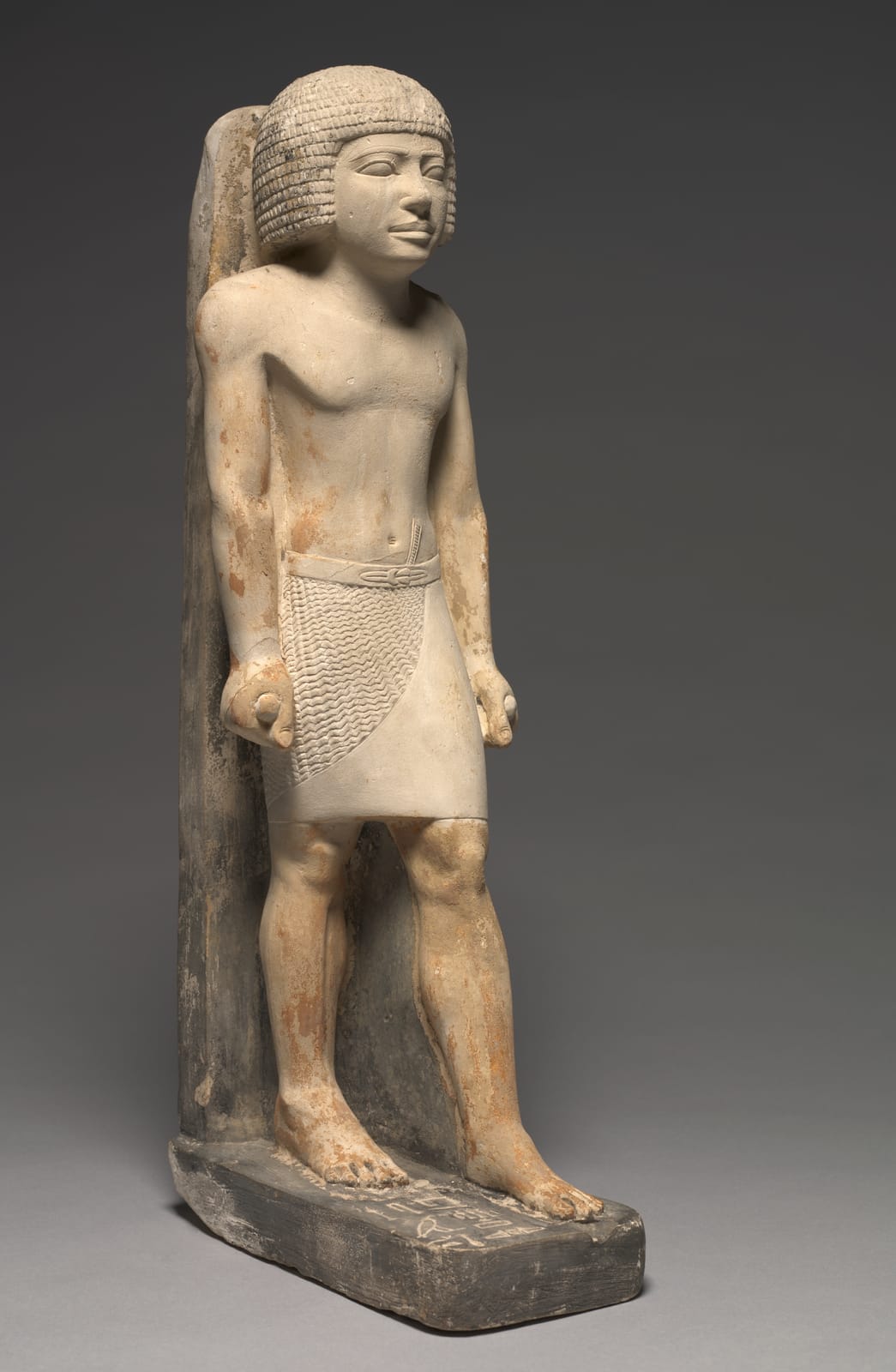
The basic unit of Egyptian dress was a rectangle of cloth, the ifd, often translated "sheet."2 A First Dynasty example from Tarkhan measures about 283 by 105 centimeters. A man could fold it and tie it at the waist as a kilt, perhaps with a belt or sash over it, and much longer versions, up to 20 meters, were folded in layers before draping.2 Men also wore loincloths, sometimes under the kilt; the Amarna village textiles include part of a triangular one.11,8
Kreiter notes that elite men are shown in kilts throughout Egyptian history, shorter in youth and longer on older men.3 The statue of Minnefer, a supervisor of palace attendants, shows the Old Kingdom version: a kilt originally painted white.12 Kings wore a pleated royal kilt, the shendyt, as on a statue of Amenhotep II that also shows him in the khat headdress.13 A length of linen in the Met, found in the coffin of a man buried below the tomb of Senenmut, was probably tied around the waist as a kilt or sash and was found with a shirt; the two may have been worn together, or the kilt over a loincloth.11
In the New Kingdom a new garment joined the wardrobe: the bag tunic (Egyptian mss), a wide rectangle of cloth folded at the shoulders, with a neck hole cut through the fold and the sides seamed below the arms.2 Both men and women wore it. Most surviving examples are sleeveless, but the architect Kha was buried with plain sleeved ones and Tutankhamun with elaborately decorated ones.2 From the reign of Akhenaten, around 1330 BCE, men's torsos were sometimes shown covered in art.3
Women's Clothing: Sheath Dresses and Pleated Robes
Before the New Kingdom, wealthy women in art wear sheath dresses so tight that they reveal the thighs, buttocks, and often one breast.3 The surviving garments tell a different story. Two Fifth Dynasty dresses from Deshasheh, from about 2400 BCE, have sleeves and were cut from a rectangle of cloth, with a V-shaped neck; University College London's Digital Egypt site explains that this long, narrow dress was worn from the early dynasties through the Middle Kingdom, though art more often shows it with one or two broad straps.2 Many early dresses were pleated.2
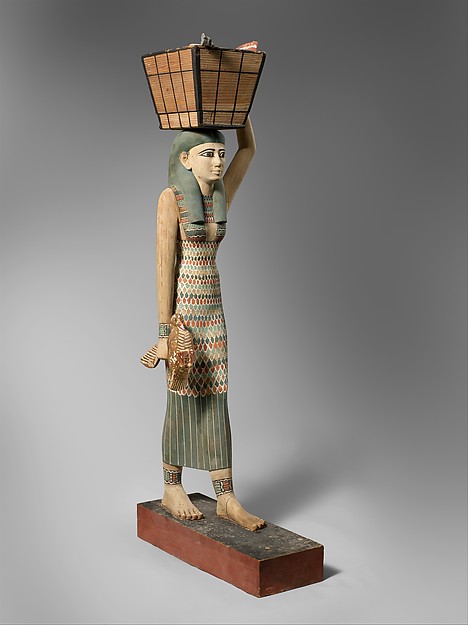
Some figures wear patterns that are not ordinary cloth. The Meketre statue above wears a dress decorated with a feather pattern, the kind of garment the Met associates with goddesses.14 University College London's Digital Egypt site notes that more dramatic decoration survives in the bead-net dresses of Old Kingdom dancing girls.5
In the Eighteenth Dynasty, the tight dresses in art gave way to billowing, sheer, pleated dresses and robes.3 Such fashions showed that the wearer could afford fashionable clothing and did not have to do work it would not allow.3 Eighteenth Dynasty art also shows women wrapped in the old linen rectangle, arranged to cover the upper arms and breasts as well as the lower body.2 Women sometimes wore detachable bodices and sleeves.3
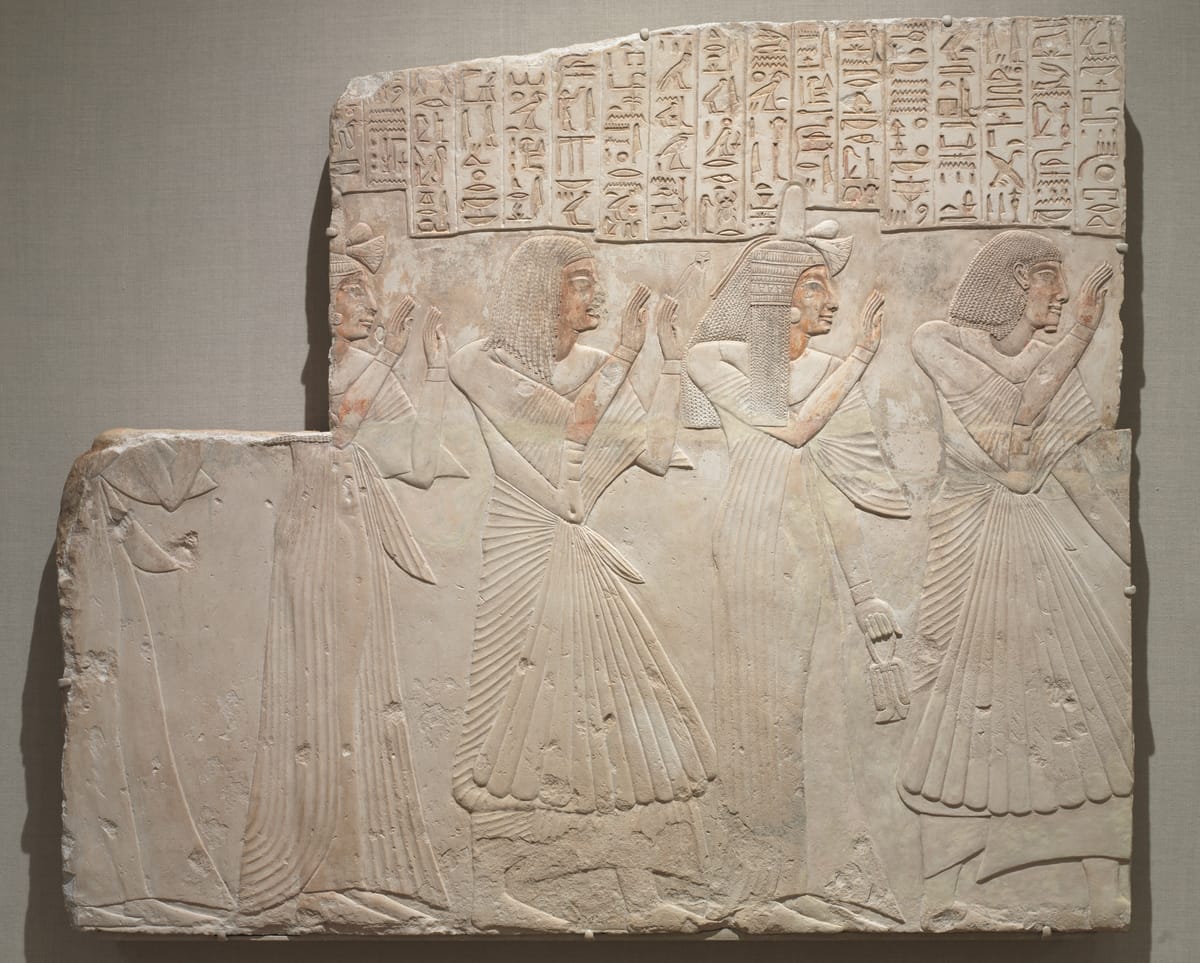
The Amarna period shows the same sheer, layered style. A torso of Nefertiti from the Great Aten Temple shows her in a smooth garment that leaves one shoulder bare, with a pleated shawl over it, tied beneath the right breast.15 The fashion continued under Ramesses II: the Cleveland Museum of Art describes the family of the chief physician Amenhotep in elaborately layered, pleated, billowing linen garments that were the height of fashion in his reign.16
Priests, Workers, and Children
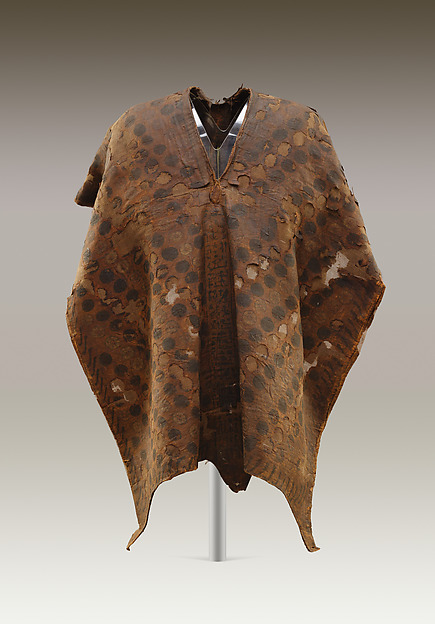
Priests were held to stricter rules. The Greek historian Herodotus says that Egyptian priests wore only linen and sandals of papyrus, and shaved their whole bodies every other day.17 He also notes that, unlike priests elsewhere, Egyptian priests shaved their heads.18 High priests, sem-priests, and Iunmutef-priests wore a leopard skin fastened over a shoulder or hanging down the back, a symbol of regeneration that suited rituals performed for the dead.19 The Met notes that art suggests real pelts, but nearly all surviving examples are painted linen, like the robe above.19 Tutankhamun had three leopard skins, two real and one of embroidered linen, made small enough for a child.4
Workers are harder to see clearly. In Eighteenth Dynasty tomb scenes, male laborers are rarely naked but are often stripped down to loincloths, while their overseers are more fully dressed.3 Kreiter cautions that these images show non-elites as their employers wanted to see them, which does not make them false but does call for care.3 Clothing was also worn hard and mended. A bag tunic from Tarkhan of about 800 BCE is very worn and extensively darned, and such incomplete garments were reused for the lowest layers of mummy wrapping.2
Children of both sexes and all classes are almost always shown naked in art.3 Tutankhamun's tomb held a loincloth, a decorated tunic, and a sash made for him at about eight or nine, around the time he became king.4 A pair of child's sandals of papyrus, palm leaf, and halfa grass was found below the tomb chapel of Senenmut at Thebes.20
Wigs, Sandals, and Jewelry
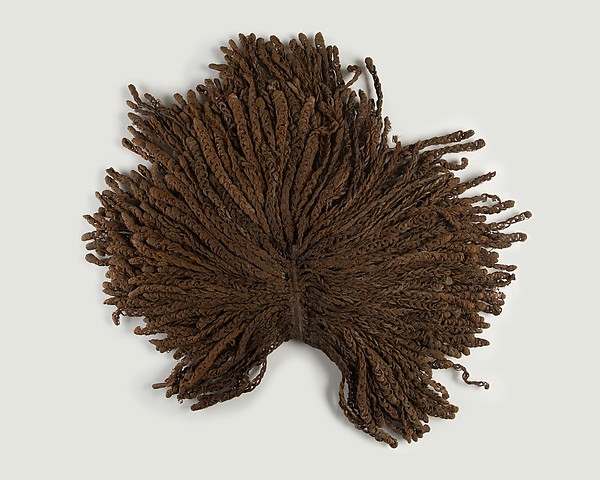
Wigs marked rank: the Cleveland Museum of Art notes that in the Old Kingdom, wigs like Minnefer's showed higher social status.12 The wig above was found behind the head of the mummy of Nauny, in her inner coffin. It is made of braids of human hair tied at the top with a cord and treated with beeswax, with a layer of animal fat over the whole.21
The usual footwear was the sandal, in materials ranging from woven reeds to leather.3 The king's were finer: Tutankhamun owned leather sandals with images of Egypt's enemies on the insoles, so that he trod on them as he walked.3 Gold sandals found on later royal burials in the Delta were probably made for ritual and not worn in life.3
Color was most often added over plain linen with jewelry, such as necklaces and collars, worn by both men and women.5 Royal dress had its own fixed signs. The striped nemes head cloth belonged to the king alone, kings and queens wore the protective cobra, or uraeus, on the brow, and queens wore the vulture headdress.3
Ptolemaic and Roman Egypt
The old rectangle of linen survived, called othonion in Greek, and Roman-period statues of the goddess Isis show how women draped it.2 Weaving changed: a basket weave with paired threads is typical of the Roman period, and from the third century CE plain linen was often decorated with areas of tapestry weave in colored wool or, increasingly, silk.9
Myths About Ancient Egyptian Clothing
"Tomb paintings show how tightly Egyptian dresses really fit." The sheath dress of Old and Middle Kingdom art showed the body as the elite wanted it seen, and Egyptian art did not aim at realism.3 The surviving dresses from Deshasheh have sleeves and were cut from a single rectangle of cloth.2 The Amarna Project, working from excavated textiles, concludes that relying on the art is misleading and that Egyptians probably appeared more heavily dressed, in swathed lengths of plain linen.8 The art is not always wrong, though. Real royal linen was sheer enough to make the see-through garments of New Kingdom paintings believable.10
"Egyptians wore very little." Workers stripped down for labor and children were shown naked, but the excavated evidence points the other way for daily life.3,8 Herodotus even reports that Egyptian men wore two garments each, and women one.18
Quick Answers
What did ancient Egyptians wear?
Mostly linen. Men wore loincloths and wrapped kilts, women wore long dresses, and from the New Kingdom both sexes also wore loose tunics.2,3
What did ancient Egyptian women wear?
Long, narrow dresses, often with sleeves or straps, made from a rectangle of linen. In the New Kingdom, wealthy women wore sheer, pleated robes and shawls.2,3,15
What was royal linen?
The finest grade of Egyptian linen, woven from superfine thread spun from very young flax. A single length could take months to weave.10
Why did Egyptians wear linen and not wool?
Flax was a field crop in Egypt, and Egypt kept linen as its main fiber even after neighboring regions turned to wool. Herodotus says priests were allowed only linen.1,17
Sources
- Linen: the plant — Digital Egypt for Universities, University College London, 2003 (retrieved through the Wayback Machine).
- Items of ancient Egyptian dress — Digital Egypt for Universities, University College London, 2003 (retrieved through the Wayback Machine).
Return to text (13 references)
Reference 1 Reference 2 Reference 3 Reference 4 Reference 5 Reference 6 Reference 7 Reference 8 Reference 9 Reference 10 Reference 11 Reference 12 Reference 13 - Ancient Egyptian Clothing: Real and Ideal — Rachel P. Kreiter, TheTorah.com, 2016.
- Royal Couture — Gillian Vogelsang-Eastwood, RAWI Magazine, 2021.
Return to text (6 references)
Reference 1 Reference 2 Reference 3 Reference 4 Reference 5 Reference 6 - Natural properties of linen and added colour — Digital Egypt for Universities, University College London, 2003 (retrieved through the Wayback Machine).
Return to text (7 references)
Reference 1 Reference 2 Reference 3 Reference 4 Reference 5 Reference 6 Reference 7 - Confirmation of the world's oldest woven garment: the Tarkhan Dress — Alice Stevenson & Michael W. Dee, Antiquity Project Gallery, 2016.
- Tutankhamun and Decorative Needlework (Egypt) — Textile Research Centre, Leiden.Reference 1
- Workmen's Village textiles — The Amarna Project (on Barry Kemp and Gillian Vogelsang-Eastwood, The Ancient Textile Industry at Amarna, Egypt Exploration Society, 2001).
- Woven linen — Digital Egypt for Universities, University College London, 2003 (retrieved through the Wayback Machine).
- Length of Very Sheer Linen Cloth — The Metropolitan Museum of Art, 36.3.111 (label text retrieved through the Wayback Machine).
- Kilt or Sash — The Metropolitan Museum of Art, 36.3.176 (label text retrieved through the Wayback Machine).
- Striding Statue of Minnefer — Cleveland Museum of Art, 1948.420.
- Statue of Amenhotep II (JE 36680) — The Global Egyptian Museum.Reference 1
- Estate Figure — The Metropolitan Museum of Art, 20.3.7 (label text retrieved through the Wayback Machine).Reference 1
- Torso of Nefertiti from a dyad holding a stela in front of the bodies — The Metropolitan Museum of Art, 21.9.4 (label text retrieved through the Wayback Machine).
- Tomb Relief of the Chief Physician Amenhotep and Family — Cleveland Museum of Art, 1963.100.Reference 1
- Herodotus, Histories 2.37 — trans. G. C. Macaulay, via Lexundria.
- Herodotus, Histories 2.36 — trans. G. C. Macaulay, via Lexundria.
- "Leopard-skin" robe of the priest, Harnedjitef — The Metropolitan Museum of Art, 31.9.4 (label text retrieved through the Wayback Machine).
- Pair of sandals — The Metropolitan Museum of Art, 36.3.234a, b (label text retrieved through the Wayback Machine).Reference 1
- Wig — The Metropolitan Museum of Art, 30.3.35 (label text retrieved through the Wayback Machine).Reference 1